This is the Global News Podcast from the BBC World Service.
I'm Valerie Sanderson, and at 16 Hours GMT on Tuesday, the 2nd of December, these are our main stories.
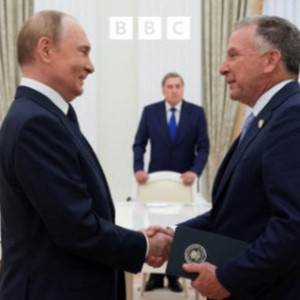
The US envoy Steve Witkoff and President Trump's son-in-law, Jared Kushner, are in Moscow meeting President Trump.
For more information, visit wwwfemagov Plus.
On the final day of his trip to Lebanon, Pope Leo holds a mass in Beirut and makes this appeal to the region.
The Middle East needs new approaches in order to reject the mindset of revenge and violence.
Why conches found in Spain may be some of the world's oldest musical instruments?
We start with the war in Ukraine and ongoing international efforts to try to end the fighting there following the Russian invasion in February 2022.
As we record this podcast, President Trump's special envoy, Steve Witkoff, is in Moscow for talks with President Putin, where he's expected to present an amended peace plan after the original 28-point proposal was rejected both by Ukraine and its European partners.
They'd argued it was overly weighted towards Russian demands.
We asked our Russia editor, Steve Rosenberg, whether Mr Putin is likely to accept this latest peace plan.
From what President Zelensky was saying yesterday in Paris.
There are tough issues that still have to be worked through.
Top of the list, it seems, is the issue of territory.
Remember that up to this point, Russia has been demanding that Ukraine simply hand over territory those parts of the Donbas in eastern Ukraine that Ukraine still controls.
In other words, areas that Russia has not been able to seize militarily in four years of war.
That has been unacceptable to Kiev.
And up to this point...
President Putin has shown little sign of wanting to compromise or make any concessions.
Having said that, over the last few days, we've seen intense diplomacy.
From the moment that the Americans handed over that 28-point plan, draft peace plan, to the Ukrainians just under two weeks ago.
We've seen U.S.-Ukrainian talks in Geneva, then in Florida.
We have Steve Witkoff in Moscow today for talks with President Putin.
Last Friday we saw the Hungarian Prime Minister, Viktor Orban, flying into Moscow for talks with President Putin, offering Budapest as the venue for possible peace summit or peace talks.
So the feeling is that perhaps there has been some movement.
And what is most interesting, I think, is that over the last few days, we've seen very little information coming up from either side.
It was interesting one Russian newspaper today was talking fog of diplomacy and suggesting that that was a sign of some imminent diplomatic breakthrough, or at least movement towards one.
So we'll have to wait and see, of course.
As I say, we don't know what is in this amended peace plan and we don't know what President Putin's attitude to it will be.
Now of course you live there.
Does the invasion of Ukraine still enjoy general support amongst ordinary Russians, do you think, despite the estimated more than a million Russian troops that have been killed or injured?
I wouldn't say support.
I mean, I detect a huge fatigue across the country.
Most of the people we speak to, whether in towns or villages or cities, say they just wish this was over.
Because I think more and more people in Russia feel affected by what's happening in terms of many people have sons or brothers or cousins who are fighting in Ukraine, and also the economic consequences of four years of war are being felt more acutely now by Russians.
Sanctions have had an effect.
Taxes are being put up in Russia from next year.
So more and more Russians are going to be affected by the worsening economic situation, which is a direct result of the decision to launch the full-scale invasion of Ukraine nearly four years ago.
Our Russia editor, Steve Rosenberg.
Finding any common ground between Ukraine and Russia is an ongoing challenge.
President Zelensky has been very clear that ceding territory remains the most difficult issue.
Speaking at a news conference in Dublin in Ireland, he was asked what he hoped would come out of the talks in Moscow.
It's important that this should be all open and fair and just.
There would be no game behind Ukraine's back.
Nothing would be decided without Ukraine, about Ukraine, about our future.
If we're talking about the guarantees for security of Ukraine and there is a signal about the frame document, then we have to clearly understand what it's going to be like and how it's going to work.
At least basic things.
Because, you see, it's not an experiment.
For us, we're talking about our people, our living people.
While Ukraine has always rejected Russian demands to give up the eastern regions of Luhansk and Donetsk, also known as the Donbass, but seizing all that territory remains one of President Putin's main goals.
So, what are the views of those on the ground in Ukraine on the ongoing peace talks?
Our correspondent Jonathan Beale travelled to Ukraine to gauge the mood among soldiers and civilians.
We're heading east, where Russia's still advancing towards Donetsk, the region which may decide whether these US-led peace talks fail or succeed.
This is the last stop. before the Donetsk region, where trains are no longer running.
Ukraine is still defending that territory, but President Putin's made clear he wants it all.
This may be the biggest obstacle in the US-led peace talks.
On the platform, soldiers and civilians mingle, waiting for the equivalent of their last train out of Dodge.
Among them, Andre and his girlfriend, Polina.
The end of the line is also the end of their brief encounter.
A final hug and kiss before their separation.
When will you see each other again?
We don't know.
Polina's returning home to the relative safety of Kiev.
Andrei's going back to the front line, and he doesn't see an end to the war in sight.
He describes the peace talks as chatter, just chatter.
It's very hard, really very hard.
Denis, who's been in the army for two years, tells me everyone's tired, mentally and physically.
But as for President Putin's demand for Ukraine to give up the Donbas...
He insists it's not going to happen.
No one's giving it up.
Nobody will give Putin Donbass.
No way.
It's our land.
But there's been a dramatic rise of desertions.
Serhii, not his real name, is now in hiding.
He's just one of hundreds of thousands of cases of reported desertion, with the largest increase this year.
So he says he was sent to fight near Pokrovsk with a unit that was badly led.
We had no morale or fighting spirit.
Even if we had enough weapons, there weren't enough people to operate them.
There was simply no one to fight.
I joined to serve, not to run.
We witnessed dozens, old and young, arriving at a reception centre just over the border in Mosovar.
There's a steady stream of people coming in who've used the fog as cover to travel out of the Donetsk region.
They say at this reception centre where they're being processed, they get around 200 people a day.
For 69-year-old Vera, life had become unbearable.
They bombed almost every day.
Every single day.
Civilian areas, schools.
Houses were destroyed so badly that they can't be rebuilt.
I don't know.
I wish.
Alexander says it's too dangerous to stay.
He thinks it's time to make a deal.
Russia's demands are probably unacceptable for us, but I don't know.
Maybe personally, I would already agree to those terms.
Ina says all she wants is peace.
She fled with her five children, aged between nine months and 12 years old.
She tried to tell them the explosions they heard from their cellar were just fireworks.
She doesn't expect they'll ever go back.
They're already looking to rebuild their lives elsewhere.
Jonathan Beale in Ukraine.
The number of dead in the floods which struck Indonesia last week has now reached more than 700, with rescue workers still battling to reach affected areas.
The government's disaster agency says several hundred people remain missing and a million have had to evacuate their homes.
Floods have also hit Sri Lanka and Thailand, and the combined death toll across the region is now more than 1200 people.
Our BBC Indonesian service got through to one person in the worst affected region on the island of Sumatra in western Indonesia.
Lodewijk Marpang is a resident in central Tapanuli area, also known as Tapteng, which remains cut off.
Kapteng is completely paralysed today.
It's very frightening.
The electricity is out, there's no internet access, food supplies are running low and there's no clean water.
The number of missing has reached hundreds and the bodies found are already in the dozens.
And this number will keep rising.
Road access to Tapteng is cut off.
We should be in a state of emergency.
It must immediately be declared a national disaster.
People have started looting everywhere.
It's extremely tense in Tapteng.
From the bottom of our hearts, we are asking for help from anyone.
We got an update on the latest situation from our correspondent in Jakarta, Astridestra Ajinkrastri.
A lot of these areas are still isolated.
Aid hasn't come through to their villages.
In some part of the North Sumatra area people have to loot stores and warehouses not because they want to incite violence, but because they are in desperate need of food.
So tell us more about what the authorities are actually doing.
This is a week after the disaster and they are still trying to go to the most isolated areas.
Heavy machineries can be seen. all across the northern part of Sumatra.
They're trying to remove the muds that are sometimes even as high as the waist.
The broken bridges have been now rebuilt.
They're building emergency bridges because in places where they're most isolated, the only means to go there is by those bridges.
And you have to bring the AIDS manually, by foot or, at best, by motorcycle, because cars cannot go through.
But of course, as you can hear from a lot of testimonies that we have gathered, many people claim they haven't received any food.
While the food stock in their villages has run out pretty fast, they have to feed many people who also lack of clean water, medical supplies.
They don't have clothes.
The Navy is trying to provide food from the ocean because a lot of these affected areas are coastal cities.
They also have deployed helicopters and military planes to airdrop those aid.
But Many of these people have to walk several hours just to go to the points where the AIDS are dropped.
And in those places, they even have to fight it over with other villages.
So we're seeing people are still in dire needs of basic necessities and the government is racing to try to fulfill it.
Is there much criticism of the government that they weren't ready for this?
Not enough preparations were in place.
Before the floods, we've seen that northern Sumatra has received a heavy amount of rainfall, which is unusual for Indonesia.
The heavy downpour was double the normal amounts, in some places even four times higher than the normal amount of rainfall.
But then there's no preparation.
People also claim that they are not warned enough.
Many of them are still staying at their homes. which is in the slope of mountainous area.
So when the landslide happened, everything just crumbled down from the forest that is in the upper part of those areas.
Astridestra Ajankarastri in the Indonesian capital, Jakarta.
And for more on one of today's big stories.
You can go on YouTube search for BUC News.
Click on the logo, then choose Podcasts and Global News Podcast.
There's a new story available every weekday.
The wife of the disgraced former president of Honduras, Juan Orlando Hernandez, has said he has been released from a prison in the United States following a pardon from President Trump on drug smuggling and weapons charges.
Mr. Hernandez was charged with being at the center of a conspiracy to smuggle drugs.
400 tons of cocaine into the United States during more than a decade of involvement with organized crime.
President Trump said he would pardon him last week.
From the capital of Honduras, Tegucigalpa, we'll grant his more.
Juan Orlando Hernandez's wife, the former first lady of Honduras, Ana Garcia Carias, has kept up a relentless campaign claiming his innocence from the moment he was arrested and extradited to the United States in 2022.
Now she has said via social media that her husband is a free man.
She posted a screenshot from the website of the Federal Bureau of Prisons which appeared to confirm the former president was released from a prison in West Virginia on Monday.
Hours earlier, at least one local media outlet in Honduras had reported the same information from the family's lawyer.
The release is yet to be confirmed by the White House and there has been no sighting of Mr Hernandez himself.
Ms Garcia-Carias thanked President Trump in her posts for giving her family back their hope and recognising a truth we have always known.
As she put it.
Mr Hernandez was sentenced to 45 years in a US prison last year on drug smuggling and weapons charges after a long case by the Drug Enforcement Administration and US prosecutors.
Will Grant.
Hong Kong's leader, John Lee, says there are serious problems in the territory's construction industry, as he announced an independent inquiry into last week's apartment complex fire, in which 156 people are now known to have died.
Accusations the fire was spread by a flammable construction materials have sparked widespread anger.
Mr Lee said it was vital to uncover the truth.
I call for thorough investigation and serious reform.
We will overcome the obstacles of vested interests.
Pursue accountability, regardless of who he or she is.
We must uncover the truth, ensure that justice is served.
Let the deceased rest in peace and provide comfort to the living.
Hundreds of people attended a memorial service on Tuesday to mark one week since the blaze.
Residents were reportedly told they faced relatively low risks when they fled concerns about fire hazards more than a year ago.
Martin Yip is in Taipo, where the fire began.
For those who have lost their lives in this huge fire...
Today is the seventh day since death ritual for them and is particularly important in southern China culture.
Earlier in the afternoon, just outside of Wangfu Court, two separate religious rituals were performed.
Hundreds of family members attended the ritual, which was hosted by Buddhist monks, followed by Taoist priests, and they laid flowers, they burned paper money and they left in obvious sadness.
Police are still continuing with their search effort inside of the charred buildings and, at the same time, they're now asking for members of the public to provide whatever potential evidence they could have.
Martin Yip.
Still to come.
What's triggered concern is the new order, making it mandatory on every device, old and new.
We look at a row in India over an order that all smartphones should have a pre-installed government cybersecurity app.
Now to Lebanon.
Sounds from Beirut, where around 150000 people have attended a mass held by Pope Leo on the waterfront where a blast killed more than 250 people five years ago.
The Pope offered prayers for the dead and called for the region to move away from the horror of war.
The Middle East needs new approaches in order to reject the mindset of revenge and violence, to overcome political, social and religious divisions and to open new chapters in the name of reconciliation and peace.
Pope Leo also called on Lebanon's leaders to tackle years of political and economic crisis.
I got more from our correspondent in Beirut, Hugo Bochega.
This was a visit in which...
The theme was very much a message of peace, unity and coexistence, and this was at the heart of what the Pope had to say this morning.
He again urged Lebanon's leaders to come together, to unite, to try to solve the country's problems.
He said the beauty of Lebanon had been darkened by poverty, violence, conflict and economic crisis.
And obviously this is a country that has been engulfed by multiple crises in recent years, and this visit comes at a very difficult, delicate moment for Lebanon, amid fears of another possible escalation in the conflict between Israel and Hezbollah.
And obviously these concerns have exacerbated internal divisions as well.
And Hugo, that massive explosion five years ago on Beirut's waterfront still very much in people's minds, isn't it?
Yeah, and the Pope led a silent prayers today at the site of the explosion.
And for many Lebanese.
You know the port and you know the grain silos that remain are destroyed are a symbol of the country's problems.
We're talking about a huge economic crisis, political paralysis corruption, mismanagement and obviously, conflict.
So this was at the centre of this visit by the Pope.
And it was very significant for the Christian population of this country.
Obviously, a third of Lebanon's population is Christian.
But I think this visit was framed by many here as a moment of national importance, national unit.
We've seen those Lebanese leaders from different communities, sex, united.
And this was very much the message that the Pope had to share with the Lebanese, a message that this is the moment of a new chapter in terms of reconciliation and peace.
Zambia experienced its worst environmental disaster earlier this year, when a dam collapsed at a Chinese copper mine, leading to toxic waste, including heavy metals, pouring into the surrounding waterways and farmland.
China is one of the biggest foreign investors in the region and it's often framed its relationship with Africa as a win-win an opportunity for China to access critical minerals while African countries industrialise and boost their economies.
Our Africa correspondent, Mahini Jones, travelled to Zambia's Copper Belt in the north of the country to discover what this incident tells us about Chinese influence there.
I'm walking to meet Frederick, a local farmer. whose crops have been affected by the spill.
I mean, I'm surrounded by fields.
I can see him hoeing in the distance.
Some of the fields are green and lush, but a lot of the nearby ones are completely burnt out.
There's dried leaves on the foot.
Nothing seems to be growing here.
Have you been to see a doctor about your leg?
The doctor says maybe if we are using this contaminated water, maybe it can cause this.
And by a stream at the bottom of Frederick's farm, is connected to the Kafue River, which was polluted in February.
And the water looks clear, serene, you'd never know.
A massive chemical spill had happened here earlier this year.
But the tell is that you can't see any living life here.
And the villagers say this stream used to be teeming with fish and now there's nothing.
Frederick says he was given just 700 compensation by Sinometals, the company responsible for the spill and a subsidiary of a state-owned Chinese firm.
Some commentators have suggested the spill illustrates some of the downsides of Chinese investment in Africa.
We've just driven down a dirt road off of the main road, somewhere private, so we can interview a worker from Sino Metals who's agreed to speak to us on the condition of anonymity.
How safe do you feel working at Sino Metals?
There's not much safety given by the company.
But he's speaking for himself and not, in general, for other people.
Maybe for other people they have enough and they feel safe enough, but for him he doesn't feel as safe.
Can you just give me an idea generally of what doesn't make you feel safe there?
So he says the PPE is not 100%.
They would use it and sometimes get spoiled.
So they would just take a risk and use it again.
To hear that this area, where your family lives, can be contaminated for decades.
How does that make you feel?
He says he doesn't feel okay.
He feels bad because that's where his family is.
In some ways, this man's plight illustrates that of his government.
He benefits financially from Chinese investment, but it comes at a high personal cost.
We reached out to Sinometals for comment.
They didn't respond.
But the Chinese embassy in Zambia told the BBC that Sinometals has worked hard to improve water pollution levels.
It added that they've paid all fines, compensated for 154 households and kept paying their employees despite their mining operations being suspended for more than six months.
Critics say the Zambian government acted too slowly after the spill, blaming its estimated 5 billion debt to China.
Of course we had challenges.
Dr Duti Chibamba is from the Ministry of Green Economy and the Environment.
So whether we are in debt with China, the Chinese have to follow our rules and laws.
There is no treating them with kid gloves here.
We don't care whether we...
We are owing them more.
That's not about this.
That's not the issue.
The issue is that there's some pollution that has happened.
It must be cleaned up.
Back in the Copper Belt... schoolchildren swim in a tributary of the Kafue, Zambia's longest river.
Over 100 local farmers have launched one of the biggest environmental lawsuits in Zambia's history against cyanometals.
The spill here has raised questions around how much leverage African countries have against Chinese companies accused of wrongdoing.
How this case goes could provide answers to these questions.
Our Africa correspondent, Mayani Jones.
Rights groups in India have expressed anger over an official order that all smartphones should have a pre-installed cyber security app, which is run by the government and can't be removed.
One organisation, the Internet Freedom Foundation, said it was a deeply worrying expansion of existence.
Executive Control.
Reporting from Mumbai, Archana Shukla.
Thank you.
It currently states it doesn't store user data, but experts warn that once it's mandatory and it's on the device that access could be misused later.
It's significant as India is the world's largest phone market with over 1.2 billion mobile users.
Political parties here have called it a step towards state surveillance, and they're demanding a rollback.
Researchers in Spain have found what could be some of the world's oldest musical instruments, all made from large shells.
Terry Egan reports.
One researcher says the closest instrument to the sound produced by the shells is that of the French horn.
Putting your hand into the opening while playing, he says, you can change the tone and timbre.
The team from the University of Barcelona discovered 12 conch shells found in what's now Catalonia, dating back to 6000 years.
The researchers say the tips of the shells were removed, which could indicate they were used as trumpets for communicating across long distances or even as rudimentary musical instruments.
They believe the shells were collected long after their snails had died, meaning they weren't just a by-product of cooking.
And to prove the theory, they've been conducting acoustic experiments.
Improvising, the researchers were able to modify notes and tones.
If these were communication devices or instruments, they might have been used to pass messages between people in the region or between settlements and individuals working out in the field.
Six of the shells were found in mines and may have been used by the workers there either way.
As ancient ancestors of trumpets and trombones, they would be among the first instruments known from human history.
Terry Egan.
MTV has announced that it will wind down its international music broadcasting by the end of the year, as it struggles to compete with online streaming and social media.
So, is the era of the music video over?
Daniel Rosny has been investigating.
Gone are the days when you'd sit in front of a TV, switching between channels playing music videos.
Even MTV, the world's most recognizable network for music videos, is starting to switch off some of its dedicated stations globally.
If you're going to watch a music video at this point, you're likely watching it on your phone.
Amanda Klein is Associate Professor of Film Studies at East Carolina University and author of the book.
Millennials killed the video star.
There were a lot of factors that led to the significance of MTV.
One of the big ones was you could finally watch your favorite artists perform.
Acts that became very popular were very visually dynamic.
But with the advent of social media, consumers now can have access to their favourite acts on TikTok or Instagram and no longer need to be told what music is cool.
Instead they can type in on platforms like YouTube the music they want to watch and listen to.
Earlier this year, singer-songwriter Lewis Capaldi made his comeback after a two-year hiatus.
A video for his song Survive has been viewed around three million times on YouTube and was directed by Charlie Sarsfield.
I think TikTok has skewed the sort of gauge of what's successful on YouTube now.
So unless you're on 100 million plus, is that a successful video?
Record labels now suggest artists posting on social media themselves can have as much of an impact on sales as music videos.
Will Page is the former chief economist of Spotify.
This business is going to get bigger and bigger and bigger, because streaming can enter markets that the previous formats couldn't.
But elsewhere in the world, it's a different story.
The South Korean genre K-pop is estimated to be worth more than 10 billion US dollars.
Zany Bros is one of the biggest production companies in Seoul.
Yoon Hong Kim is the founder and CEO and spoke with me through a translator.
Music videos really are the center of the K-pop industry.
The K-pop industry has grown, sales numbers have increased accordingly and the budget for music videos have also increased.
The future of music videos may not lie in the traditional blockbuster format, but in how artists, creatives and labels adapt to a world where attention itself has become the most valuable currency.
Daniel Rossney reporting.
And that's it from us for now.
Global News Pot.
This edition was mixed by Mark Pickett.
The editor is Paul Day.
I'm Valerie Sanderson.
Until next time, bye-bye.