Discussion keeps the world turning.
This is Roundtable.
Hello, welcome to Roundtable where we serve up piping hot debates on the issues that sizzle in China and beyond.
I'm Niu Henglin.
The Global South is often described in terms of challenges.
But if you listen to its young leaders, you hear something very different.
Possibility.
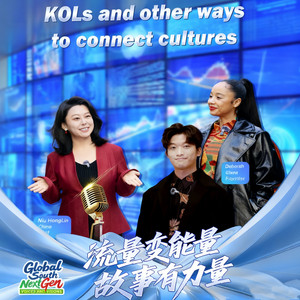
In today's special series, Global South Next Generation Voices and Visions, we moved our studio to a beautiful classic Si He Yuan or Beijing-style courtyard to have a talk about cross-cultural communication.
Let's have a listen.
Hello welcome to global south next generation voices and visions.
Today we're exploring what communication across different cultures really means in an age where a single video can reach millions of viewers.
Today, i have two amazing guests from two corners of the world ghana and indonesia.
Yet their stories meet somewhere in between, in connection, in creativity and in the shared desire that we want people to understand each other just a little bit better.
Allow me to introduce Deborah, also known as the African Mermaid, a pop artist, brand influencer and a human rights advocate from Ghana.
Welcome to the show.
Hello.
Thank you.
Thank you so much.
Great to have you in today's show.
And also we have Zender William, content creator from Indonesia, currently in Huaqi University.
Yes, hello, hello everyone.
Hi, thank you both of you for coming here in Beijing to do the show.
And it's not your first day in Beijing.
You've known the country, know the city a little bit.
But I bet, do you know where we are currently?
Do you know the surrounding?
Do you know about the surrounding?
I don't think so.
How about you, Deborah?
I have no idea.
This is a very typical, traditional Beijing Si He Yuan. yes that's the official name of it it's just a courtyard house and the reason we pick it is also because it represents a little bit of Chinese culture traditional culture and philosophy because the courtyard sits towards south, which represents good luck in ancient Chinese culture, and also it's relatively an enclosed area, but you also get to see that there is a main house right behind us, that is the main house, and two houses on the two sides, the west and east sides, and this represents respecting the elders, the elders as well as those very distinguished guests would always be greeted in this main area in the main house and also in these kind of areas you also get to see a little bit of nature like a fish pond or a little garden so that is also representing the harmonious coexistence between man and nature and yes I think for today's episode since we are doing something culture related this would be a perfect location to do that it is really beautiful it is perfect I'm glad you enjoy it but you've been here in Beijing for several days besides this beautiful Sihe Yuan anything that caught your attention that you feel like ah a very interesting thing that I haven't never seen in my own culture that caught your eyes anything? the first day we went to Beijing it was the second day actually we went to Jingshan Park so it's actually behind the Forbidden City and after we get to the top I can see the whole area of forbidden city and it's really beautiful because it's right down in the middle the left and right they are separated beautifully and it's really really amazing was that where we went like in the center center most point of beijing the one with the central point of beijing it's really beautiful over there i mean for me i didn't know we were going to see the great wall so that came as a lovely surprise for me because since i was a child i heard about the great wall even though i you know i was born and raised in ghana So the fact that I've been able to see the Great Wall without knowing I was going to see the Great Wall, I'm like, I'm actually at the Great Wall, can you pinch me?
So yeah, that was very exciting for me.
Here in China there truly are too many elements, too many attractions that I get to.
I wish I could introduce to everyone who have never been here before.
For example, Deborah.
You are known as the African mermaid.
You are a pop artist.
You are a brand influencer.
Also, you advocate for human rights.
I would assume not all of the human rights, certain human rights that you are more passionate about think essentially, my questions are have two parts.
One is how would you introduce yourself mainly to those who yet to know you, and what are the main content that you focus on?
Okay so, as a pop artist, I use my music to talk about things that I'm passionate about, like the environment, human rights, and also, when talk about the environment, i don't only talk about advocating against plastic pollution, i also talk about advocating against fast fashion and basically sustainability and um yeah, i do love fashion as a whole, so you would see that in like my music videos and stuff, and i love animals.
So i love nature, i love animal life, and i talk about this.
You know my social media And, as I said, through my music, my music videos.
How about you, Alexander?
I know you were in China for more than five years.
And you mentioned earlier that your content creating is focused on the life special exchange students are enjoying here in China.
So exactly what are some stories that you make?
For example, are you the only main character in your videos?
No, no, no.
I'm not.
Go ahead am.
I'm an Indonesian student, but I'm also I came from a Chinese background, so I think it was my Wai Gong, so it's my mother's father yes, came from Fuzhou, so I do have, like this, Chinese descendant background.
So I don't really look like an Indonesian.
But I never learned Chinese since I was small, so I learned Chinese in 2019 the first time I came to China, and I the first thing that I learned is there's so much similarities between Chinese culture and Indonesian culture, but also very, very different, and that's the thing that's still tickling me right until now.
So I want to make videos that I want to let the world know that, even though we are different, but we are also very similar, we can live in peace is what I'm trying to reach here.
Like, which video represents you the most?
I think I'll pick the more recent videos.
I just went to Xi'an.
I took a video about the Terakota Army, the Pimayong.
It's very amazing, really grand.
And the thing that I highlight in my videos is the way that the local peoples and even the museum they used high technology, such as AI, AR and even 3D.
That's to make us understand more about the Terakota Army.
And the main thing that I talked about in the video is whether culture, and also whether history, is important for human development, for human civilization.
And it is really important.
There's a lot of people from Indonesia that made comments on the video and stuff.
Oh, nice.
What is the most asked question?
There's two things is the Terokota army really really big?
And also whether AI is really important for this kind of stuff because, as we know, there are a lot of things that they can replicate in AI and many of them are afraid whether their AI can take over humanity or some sort.
You have some really sophisticated followers asking these deep questions, right?
Yes, i thought it would be something to do with.
Ah, the costume's different.
Which dynasty is from?
We're asking are artificial intelligence going to take over a take over human beings in the future?
That's very sophisticated, but i get it.
It's a huge topic and it's even influencing our line of work.
Yes, we'll get to that a bit later but deborah, you've been here in china just several days and i know it's your first time here.
Yes, did you already notice anything that you find really different between your culture and chinese culture?
Or, in general, you know chinese people's way of living lifestyle, society?
Yes, so you know, because we're trying to bridge the gap between china and other countries and we're trying to, you know, let people know the truth that china is actually very welcoming, Welcoming for business, welcoming for tourism.
And trust me, I haven't been paid to say this.
Welcoming for collaborations.
I like to focus more on the similarities, but I also like to say what I've observed.
I don't know if it's just the places I've been to, but so far, from Beijing to driving here and for spending a couple of days in Beijing, I'm like wow, everything is orderly.
Everything is so clean.
The streets are so clean.
Nobody's fighting.
Nobody's throwing out insults out of the cars.
No one is honking unnecessarily.
You live here, so it might be normal to you.
But for me, I'm like, wow, the system is working.
Everything is so organized.
People are very respectful.
And to talk about similarities in Ghana, people are also very respectful, very welcoming to foreigners, like we love meeting new people, we are very warm and um, we speak with very similar intonations and gestures and what else.
We love rice as well, lots of rice yes, and what.
We also respect our elders very much, because you mentioned that earlier on.
So those are the similar things i've seen.
Unfortunately, both ghana and china love to use a lot of single-use plastics.
That's something you do not like personally.
Yes yes, yes.
Well, we are on a track of um creating a greener life and push forward a greener future, for sure, and a lot of people on the internet, for example, are telling about or sharing about different ways that they are adopting in their lives so that they can give back to the society a bit and protect the environment a little bit.
So there's that.
Young people are on that track right with you over there.
But I get what you're saying.
When you see a brand new culture, you definitely would notice things that are similar to the ones that you are very familiar with, and also you would notice the difference.
But when it comes to content creating, because both of you are creators, you would like more people to be able to relate to the content that you create and also be able to understand deeply what it really is about.
Anything that you find worth sharing, or what are a moment that you had in this content creating, or the sharing of your view of your stories that you find most impressionable, something that made you feel like wow, i'm doing something so meaningful, or something that you makes you wonder hmm, maybe i should do this a bit differently any memorable stories you want to share.
So before i come to china, there's a lot of people that they weren't me.
Before i come here, don't talk too much.
They will.
They will judge you very differently.
Chinese people will judge me and all of these things about chinese people are.
They're cold.
They won't.
They won't welcome you as as we welcome you here, indonesia and i, and that was at the back of my mind when i come here when i first.
It's my first day in xiamen, so i didn't speak anything when I arrived in the airport.
You didn't talk too much, you didn't talk to anybody.
Nope, I was afraid.
And then the second day, when I went to the cafeteria to eat some lunch, the ayi the one that's bringing the foods she was really really, really welcoming.
And friendly.
And just really friendly.
And I was thinking like, hmm... That's surprising.
Is this a trap?
Is this a test?
I was thinking the same thing.
Is it because I'm in the school? is it because i am a foreign student in the school so i went outside so i went to like some kind of a local market besides the school investigate whether local people are also like that okay and it's really different it's it's very different from what people told me in indonesia chinese people they are all very welcoming whether it's the the young people the old people whether it's male female all of them they are very very bright and they are very welcoming since i don't look like an indonesian at all but when i talk when i speak they know you're not from china yeah so they were always asking me oh where you came from why you speak like this and it's it's healing at some sort so when i when i was when i was learning about this kind of history and culture differences i was thinking about making some videos about street interview talking with some locals who want to know more about their history and culture and that video actually made some friends of mine change their perspective about china oh that's beautiful and at the same time i'm not really sure if before this trip to china previously you've had a particular interest to china but definitely in ghana there well in china as well there are so many different type of cultures and from different ethnic groups from different places we say they all definitely belong to the chinese culture but we do also need to learn about each other and learn more about each other i think it's similar in your culture as well there are more cultures from different places from the different ethnic groups yes so how do you find a way to help people understand each other a bit more yes so for example i have a song called ghana jollof um jollof is a type of food yes made from rice and used mixed with a lot of tomato tomato sauce so it has this reddish color but jollof actually originates from senegal from their food called chip from the wall of people and it's something that we have you know taken on to also you know prepare so ghanians make jollof nigerians make jollof so the senegalese who are the originators of jollof make jollof and i think cameroonians as well so one time on ex but that time it was twitter we had something called the jollof wars where west africans and others were like arguing they were in serious debates some were even fighting about whose jollof is better we do that all the time here in china as well when it comes to food yes so there was a lot of back and forth and a lot of you know as i said insults flying up and down and it inspired me to do a song called ghana jollof and i believe that that song brought like comic relief to the what we called the jollof wars because there was a hashtag jollof wars at the time and then my song like most of my music is very satirical it has a lot of playful humor and fun to it so i brought like comic relief to the jollof wars wow through that song.
Peacekeeper.
I'm curious, was that word really serious?
Because here in China, we have similar kind of conflicts between people from different places.
Some people believe that mooncake or rice dumplings, sticky rice dumplings are meant to be sweet.
Some believe it's meant to be salty.
That's very important, important one.
And also the tofu.
The tofu more like a tofu soup kind a dish.
Some believe it's supposed to be sweet, some salty, but that was never a serious word.
Yeah, it's not supposed to be serious, but some people don't play with their food, oh yeah, So they take it very personal.
Indonesians as well.
Some people took it personal.
That's very interesting.
That's what I was thinking about.
Because previously, for our parents' generation, for example, I'm pretty sure they are serious about the choice of flavor about their food as well.
It's just they lack the platform to share their views that vastly.
They cannot argue with someone living thousands of miles away about the choice of the flavor but now we get to do that so do you think it's a bliss or do you think it's kind of a curse that people can share their views willy-nilly when whatever they want whenever they want on the internet well for some people they would say it's like a curse some people say all social media is bad blah blah blah but I feel like you should use social media how you want to use it and in a positive way I always advise if you see something that you don't like or you feel is negative, just scroll past.
Don't dwell on it.
How about you, Alexander?
Pro or con?
Well, yes or no for the Internet.
I think it's more of a pro for me myself.
It's easier for me to spread.
Oh, we also had this conversation before about spreading misinformation on the internet.
Yes, it's very easy for us to learn stuff on the internet, but it's also very easy for us to be misinformed.
Yes, thank you.
So that's why i think it's better for us, before we jump on, jump up on the internet, that we had our fair share about the the things that we need to share on the internet.
We need to learn stuff, We need to make sure we are putting out correct information.
We need to make sure we are very knowledgeable about the subject that we are talking about.
So it is a blessing at some point.
Yes.
Exactly.
Responsibility is very important.
Yes.
So if it weren't for the Internet, we would not be able to meet each other, to start the conversation here today, to know about each other's culture a little more.
So definitely for me, it's a big four.
And for those of you who are against the creation of Internet?
I doubt there will be many.
Leave a comment.
Let us know what you think and give us solid reasons.
We are reasonable people.
We'll definitely respond to your reasons.
But on top of that, I also think real life connection is the most important.
We thank the internet when we cannot meet each other, meet each other in person, when we cannot communicate face to face, but somehow in real life, the impact can definitely be much deeper.
Have you ever done something that transformed your online content or a, for example, online campaign, something on the internet, to real life, to make real life changes?
Yes, I think I have.
I released a song in 2018 called Kakalika Love, which translates to cockroach love.
That means like a hidden, forbidden love.
And so the challenge was like people dancing and sort of pretending to hide or hiding.
And it went viral in my country.
So a very generous friend, an older gentleman, decided to sponsor the whole campaign.
It became a campaign eventually.
And he donated or sponsored 1000 Ghana CDs every week for several weeks.
Let's say he planned to do it for like three weeks, but it was going more and more viral.
So we ended up sponsoring for seven weeks.
Exactly.
So at the end of each week I will select the best entries for the week and I would actually meet the fans.
So they will meet me in person over lunch.
It was mostly over lunch.
We take pictures, we do videos together and I will hand them the cash and send the footage to the sponsor.
So we did that for seven weeks and the fans would thank me.
They're like, oh my God, I needed this money so badly.
Sometimes they were a group of friends and they had like, some bills to pay or some debts to cover.
So it was in a small way it was impactful.
And for the official music video, for some of the fans who wanted, you know, a bit of exposure or fame, i opened the video casting to anybody who wanted to join.
So if you watch that video, kakalika love by sister deborah all the young people you see in, they are all fans, fans of the song, fans of the virality of the video or the campaign and fans of the brand.
Through these kind of campaigns, I can definitely see you helping people.
But at the same time, when people have a shared hobby, a shared passion for something, they form a community.
They started to help each other, they started to communicate with each other.
We say cross culture communication is important.
Sometimes every single person holds a little bit of who they are, their knowledge, their identity, and the communication between two persons can sometimes make the biggest change you can ever think of.
And that is, in my opinion, also quite important.
And that is why in a lot of different countries, especially here in China, we have a lot of different types of cultural activities and people to people exchanges, kind of activities and events sponsored by the government.
And this year 2025, is a big year.
It's the 65th anniversary of the funding of the diplomatic relationship of China and Ghana and it is the 75th anniversary of the founding of the diplomatic relationship, or the formal establishment of the diplomatic relationship between China and Indonesia, which is why there are many different events.
I know that a Fujian dancing and singing group, a performance group, went to Ghana to perform and gathered more than six thousand viewers and they enjoy the Chinese style singing and dancing.
They get to know this, at least this side of the Chinese culture.
And as for Indonesia, if I remembered it right it was a calligraphy and painting tour and all these kind of activities are quite unique to the viewers.
We do not know how effective or how important it is to put the two countries' relationship into a brand new stage.
We do not know about that, but we know it matters to those who attend these activities to enjoy the beautiful performance and arts.
So somehow I find the support from government is also important.
Do you see it that way, or have you even entered or participated in person some of these kind of people to people exchanges?
Yes, I did because, as I told before, I went to a lot of cities and most of them are government supported activities.
So, as of last year, as of 2024, I've already went to 60 cities wow, 60.
So I started from Fujian.
I'm currently living in Xiamen.
I went to Changzhou Quanzhou, Fuzhou and, more to the south, maybe to Guangzhou Guangxi, and then I went to Yunnan impressive and even the most remote places, for example, in Inner Mongolia, or even in Xinjiang.
I already went there.
I've seen the culture, I made videos.
So yes, all the things about community supporting each other.
I've even made some friends that also have the same goal as me to make videos about the culture here in china and sharing these stories to people all around the world.
So it's really fun and i think it is really important for the government to also support this kind of events, campaigns.
Look at this some events changing you and through your videos, it also changes yes, millions of other peoples on the internet.
So you are doing a lot of content, also cross-culture content.
How do you make sure that your content in somehow your language and sometimes with your cultural background, how do you make sure it's relatable to people from other cultures as well?
Yes, so i, first of all, i make sure um, it's the right information, like it's not an untruth.
I, you know, most of my music is in english, which i think is a universal language, Or it is right.
And I project Ghana through my style, my fashion sense, the way I sing my accent in my music, the way I've even dressed right now.
This is traditional from Ghana.
And this is actually from my ethnic group, which is called Akan.
And under Akan, we have the fancy speaking and the tree.
I speak, I'm from the tree side.
And...
So I'm an Asante.
And we have this fabric.
It's called kente.
It's woven.
It's beautiful.
Hand-woven.
Yes, thank you so much.
And, you know, that's, you know, special and unique to Ghana.
And so, like in my music videos, I, you know, project the culture.
As I said, the language.
I also mix English with Ghana pidgin, which is broken English, which I taught Alex a few phrases yesterday or two days ago.
And...
I also mix it a bit with my Ghanaian language, which is tree.
I put a bit of tree in it as well.
And yes, I just try to make sure that it's positive.
It's fun, it's motivational, it's inspiring, and it's positive.
You know what can get you some Chinese followers, some more Chinese followers?
Tell me, learn some Chinese and you can do it very, very easily, even in Ghana.
I think there are three Confucian institutes in Ghana and three universities.
I've been to one right.
Yes, you can learn the language, and that's what I'm talking about.
I think we do not lack the resources, no matter if it's the national government, the local government, universities and different NGOs, people are trying really hard to make sure that we get to.
We would have the opportunity to know each other a bit more, as long as we have the willingness.
So the resources, the access, they're there.
And that is something I am happy about this day and age.
At the same time, We are from three different countries, but we all belong to the Global South area.
And the world, or at least the media, has long been relatively more dominated by the Western voices.
And how do you think or do you think it's important for us to find our place, to talk about or tell our stories and use our languages?
It is.
I think it is important because I am from Indonesia.
We have a very rich culture and history.
So I think it is really important for us Indonesians to have our own voices, to speak in our own language and also to be recognized from all parts of the world.
So it is very important to have this kind of cultural communication.
What are some good ways to do that then?
Do you think we have enough conditions or enough um, let's say, support to do that already?
To as long as we have the willingness, we have enough content.
We have the technology and platform already.
Yes, i mean the technology is there, sort of.
I mean the internet is there.
So i feel like um, for each content creator from you know, from each country, it's good to boost the confidence of even other people by speaking in your own language, being proud of your culture.
It will make people from other countries, other content creators, be confident you know in their own skin, speak their own language, not be shy to show their local foods um, their way of life and things like that.
I think it boosts confidence in people and it's prevents people from always trying to copy the West.
We kind of touched upon it and we promised we'll talk about it.
That is the role of technology, to be more precise, the role of generative AI in our line of work, because we use it.
I have to admit, I use it all the time, at least every day nowadays, and we use it to help us polish the content put in subtitles and even sometimes generate some pictures, so that we can show our viewers what we really meant, without being able to be a great painter.
I'm not a good painter.
So I asked AI to help me to show people what I really thought.
But here in China, we also are very cautious about it.
Back in 2023, we already have a guideline telling people how to use generative AI smartly.
And, for example, you have to label your content and you make sure in certain areas if you're using it.
For example, if you are making an avatar of yourself, it's fine.
But if you're doing it to others, you have to have their consent.
And also we know it is so easy to misuse AI as well.
That is why at least China is being very strict when it comes to labeling your content, when it comes to making sure that you're using it at the right place.
So, personally for you and, of course, from your culture, from your country, what do you think is the most important thing when it comes to the using of AI in at least our work?
Well, for me, I'll start with what I do not like about AI.
I don't know, it's not AI, it's the people, how people use it, as we said.
So I don't like it being used to create false situations.
Don't like that at all.
Like when i see it, i just i have to scroll past, like it.
It irritates me.
However, i do appreciate ai in like subtitle generation because it makes my work faster and easier, but because of you know the way i sing, in my music, as i said, i incorporate a lot of different languages, like broken english english, maybe tree, sometimes even romanian, because i speak romanian as well.
I still have to do a lot of work, but I don't mind.
I still edit the subtitles, and I don't mind.
I have a background in publishing so I love to do copy editing and proofreading, so I don't really mind.
But also with technology, it helps me.
For instance, I want to shoot content.
I don't have the time to maybe do makeup.
Mostly that's the reason.
I just use the filters.
I love to use Snapchat filters, and I feel like that's technology as well, and it helps me. not lose an opportunity or a chance to create the content and put it out there so those would be like that would be like a benefit of you know technology or you know ai for me in my opinion ai is it's only a tool so for example ai is a stone in the hand of an architect i think ai can be something the stone can be something beautiful but a stone a rock in the hand of a baseball player they will just throw it far far away so it's It depends.
On the hand of a madman, that would be dangerous.
It will be very dangerous.
So AI is only a tool and it's really important on how we use it, on how we apply it on our daily life, on our art, on our work.
So it really depends on the human.
Just like the internet, it's another tool that we're using.
And, at the end of the day, we want to use it to better foster the communication between different cultures.
And we already mentioned that.
We believe it's important for people from all around the world, especially the global south, to make their voice heard.
So any suggestions to especially the young content creators or those who have just thinking about hmm, I have a good story i want to share, but i don't know if there are people out there who would want to listen to the story, who are interested in my culture, my community.
Any advice to them?
How'd you get start?
Be brief, just do it.
Yes, just do it.
As he says.
There's definitely someone out there like you.
That's why we even have the word niche.
There's always a niche.
There's definitely someone out there like you who can relate.
You, actually you you could probably be saving a life.
Someone might be depressed thinking of doing something very bad, but then they realize that Oh, there's someone like them out there who likes a certain thing or doing something in a certain way.
And you can really inspire or make a change or make a change.
Um this, I don't know if this is a bit far from it, but um, I have a song called um refuse reuse, recycle.
And after releasing the song, I did a song together with my brother.
We had like professors from universities ask us for the music and the music video to show in universities.
And I had fans coming up to me in the streets saying that now they use cloth bags, reusable bags, and they use like yeah, like tote bags and baskets when going shopping.
They avoid going empty-handed because when you go empty-handed you end up taking like a plastic bag.
So just put stuff out there.
You can relate.
Some people will be like, oh my god, I don't like using plastics and I haven't thought of this.
But thanks to this song or to this, now I know I can hold a basket and not be shy.
I won't feel like I'm the only one doing it or I can take my own bag to purchase something and I wouldn't feel odd.
And even if there's only one person who appreciates your content, you didn't do it in vain.
You find your friend from afar.
So final question you're here in Beijing, you're on a special tour.
You're learning about another culture.
Hopefully you're finding that fascinating.
As I imagined, If you're taking one thing back to your account, back to your viewers, you're doing a content, a video related to your trip here in China.
What would that point be?
What would you like to give to your audience?
Take from here and share it with all of your friends online.
I think for me it would be what I said at the beginning about how Chinese people very, very respectful of others, very clean and very welcoming.
So, unlike the propaganda that has been out there about China, China is actually the opposite and very welcoming to collaborations, as I mentioned earlier, and to tourism and, of course, business.
I will make videos, maybe about also about the things that is that haven't been seen around in the internet, maybe because i'm i'm making videos about us going through jingshan, kongyuan and then the heavenly temple and also the great wall, and while i was taking the video in vlog style, i also have this video.
I'm also i'm also wearing a body cam, a sport camera on my around my neck, so first person yeah, it's my pov about when i'm going through, and i think i had some videos about me communicating with the locals and i'm thinking that's nice, this should be fun.
It's authentic.
Yes, usually when we do shows like this, we talk about the topics we care about.
We talked about green development, we talked about the importance of having young people having their voice heard on international stages.
But today, we're not only talking about cultural communications.
We are doing cultural communications.
We're doing it right now.
Yes, we're doing it right now.
We're practicing it.
We're sharing each other's views and making sure that we understand each other a little bit better.
And I think that is the essence of it.
It's fascinating to think about the fact that Somewhere out there, someone is singing in a language that we do not understand, sharing a piece of life from where we've never visited.
And that is the beauty of cross-culture communication.
It reminds us that the world is vast, yet reachable.
You're listening to Roundtable.
That was a conversation between myself, Niu Honglin and Sister Deborah, also known as the African Mermaid, a pop artist, brand influencer and human rights advocate from Ghana, and Alexander William, content creator from Indonesia, currently studying in Huachao University.
Hope you enjoyed the conversation.