Want to learn to integrate your work? Want to connect and train with AI experts?
Do both and more at GTC. The premier AI conference comes to the East Coast November 4th and 6th.
Join over 3,000 developers, researchers, policymakers, and CIOs at the GPU Technology Conference in Washington, DC.
Choose from over 100 sessions on the latest in deep learning, cybersecurity, autonomous machines, HPC, intelligent video analytics, healthcare, 5G, VR, and more.
Join Capital One, Kerasoft, HP, MIT, NetApp, NIST, NIH, NVIDIA, SAS and many others at GTCDC.
Government registers free. Learn more at gputechconf.com.
That's gputechconf.com. Hello and welcome to the NVIDIA AI podcast.
I'm your host, Noah Kravitz. If you're familiar at all with supply chain logistics or transportation, you know the term last mile.
The final leg of a journey, whether you're moving people or goods, is critical to the business health of any company working in these spaces.
And guess what? Our friends the robots can help.
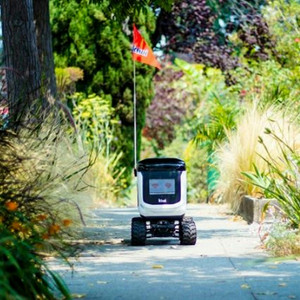
Felipe Chavez-Cortez is co-founder and CEO of Kiwi, a robotic ecosystem for last mile delivery.
Headquartered in Berkeley, California, Kiwi is in close proximity to an ideal testing ground for the automated delivery of lots of small goods to lots of people. bringing food to hungry college students at UC Berkeley.
Felipe, thanks for taking time out of GTC 2019 to join the AI podcast.
Thank you very much for inviting me. So let's start with the basics.
Tell us about Kiwi and KiwiBot. Your website has a wild video of a courier riding a tricycle packed full of robots up and down Telegraph Avenue.
I live near there. If anybody listening lives near there, you know Telegraph is right off the Cal Berkeley campus.
There's a lot of restaurants and shops. Tell us about that.
I'm sure that's only the tip of the iceberg of your story.
What is Kiwi and KiwiBot up to? We build robots for food delivery.
As you mentioned, we have delivered already more than 30,000 orders in the last 10 months.
And so this is something that it's actually live, that it's working.
You can go to, if you live around the campus or if you go to Cal, you can order whenever you want.
And we work seven days a week. 24 hours a day?
Not 24 hours. We work from... 10 a.m. to 8 p.m.
Basically, what we are doing is... It's optimizing and building how the delivery is going to work in the future.
So we're trying to get that future reality for now.
So deep learning, computer vision are at the core of lots of autonomous vehicle navigation systems.
How are you guys using DL and computer vision?
And what, if anything, is unique about your approach to solving the problem of autonomous navigation?
I'm very convinced about the incredible progress that the society is going to have with AI and all the things that are happening right now in the ecosystem.
But we have a different approach or like a unique approach.
I think that what Differentiate us from other companies working with AI is that we are investing heavily in parallel autonomy.
And so for the ones that are not familiar with the concept, it means that you use AI, but you also have human sensor as an input.
So we have a fleet of 100 robots in Berkeley delivering goods every day.
We also have a group of people 3,200 miles away. in Colombia and Medellin.
We have one human being, one person in Medellin that is capable to control three robots in three different locations with apps with up to five seconds of latency without any... mapping without any, we don't need to install RTK sensors or RTK antennas.
No, we can start Anywhere where we can have an internet connection of about 500 kilobytes per second, we can put our robots to work.
So we, of course, have a Jetson TX2 NVIDIA.
We have six cameras on board. radar on the robot.
We do SLAM techniques. We do a lot of things.
But we have recognized that there is tons of edge cases.
And just to give you an example, we are crossing 2,000 streets per day.
We cross 2,000 streets per day. So even if we have 99% of autonomy, then will be like 20 times per day that we will be crossing streets with high risk.
Which is a lot. Yes. So our approach is that we're building an infrastructure that involves humans that are remote that give inputs about what they see and in the final sensor fusion system, the human input, it's very important.
So are the humans kind of course correcting when they see obstacles or something going wrong?
Or what's the human role in this sort of...
I don't know, semi-autonomous situation.
Yeah, basically making sure that they are in the correct direction Also, sometimes we have a behavioral neural network that allows us to have the robot centered in the sidewalk, but Sometimes it's not centered in the sidewalk, so making sure that it's centered in the sidewalk.
And also... just giving extra inputs about the position, so where exactly is the robot, the direction, like navigation, like if it's heading to the correct place, and for high-risk phases of delivery, like crossing a street.
So every time that we cross the street, we have physical and visual radar on board. six cameras, 300 degrees of view, but we also have a human that confirms that the input that we receive from the traffic lights, the input that we receive from the readers are correct and it's actually safe to cross.
So the interesting part is that we can control multiple robots with just one human mind and we can actually enhance the navigation having the human.
Is this your model from the beginning or did you set out thinking you would build fully autonomous robots and then kind of pivot to... this sort of semi-autonomous human oversight model.
Because we've talked to a lot of companies and there are... We've talked to some and there are a lot of companies out there building... or at least trying to achieve this fully autonomous model of delivery robots.
And you guys have this unique approach. I'm just wondering how that came about.
I think when we started, we started with a 100% remote robot. but it was very difficult to control it because basically The latency was a big issue, also the control, the robotics control was very difficult.
So we recognized that we needed AI. And at the beginning, I thought like, okay, let's invest...
Let's try to invest all of our resources in order to get to a fully AI system.
But what moved the needle was actually understanding the logistics.
So I believe, and the philosophy of the company is that in order to build the robotic system of the future, We need to be out there doing thousands of orders, understanding how it's going to be the interaction with the restaurant, how it's going to be in interaction with the customers, how the community is going to accept the robot.
And it's very difficult to build it in a lab.
So when we started to analyze the costs, operational costs that are like amortization of the robot, um, internet costs, deployment costs, battery logistics, recovery, Everything related with having a robot outside doing deliveries, actually having a human brain in managing in Colombia was very small part of the cost.
I think I mentioned before I live near Berkeley.
I'm familiar with Telegraph where you're doing the testing.
And I've seen your video and you've got somebody riding a tricycle and the tricycle is loaded up with robots and they...
From what I can tell from the video, they go by the restaurants and they'll stop. and load the robots up with the orders and then ride back and deploy them.
How did this model come about? Is it something that you see being sort of the optimal model of a human sort of managing the robots on the fly?
Is it something that came up out of necessity?
How did this model of the human riding the trike full of robots come to be?
So remember that I told you that we believe that in order to build the robotic system of the future, you need to be out of the lab?
Yes. We actually consider Berkeley our lab.
Yes, many people do. Yes, so the trike was one of our experiments.
It was based on a hub spoke logistic model that basically Our hypothesis was that we can deliver in a more efficient way if we had that model.
Right now, it works like that project doesn't halt.
They try it. And we are betting more in the integration with the restaurant.
So we... At the end, when you are doing...
Deliveries that are less than 0.7 miles, the robot is enough.
The other part is that we saw that like the biggest roadblocks were in the first part of the journey, like the transition between the kitchen and the robot.
So right now we are working on some under the radar projects that will integrate that part.
And urban-wise, like in the urban scenario, we are focused totally on the robots and the KiwiBots.
That's all. And without asking you to divulge secret sauce and under the radar projects, how have the restaurants responded, the ones you're working with?
When you talk with restaurant owners, one of their biggest problems is actually staff. how many people they have in their kitchen.
And in peak hours, it's very difficult. Actually, a restaurant, 60% of the companies that are created every year in the US are restaurants.
It's a very difficult business. It could be even more difficult than a startup.
It's very difficult. And at peak hours, they don't have the bandwidth to load the robot.
Like they will say at the beginning, Like, yes, this is cool and everything, but as soon as they have like 20 orders in one hour and they also have customers over there, they will load the robots late.
So... Then when we experienced that, so those kind of insights, you got them as soon as you started to do hundreds of orders per day.
So when you start to do hundreds of orders per day, you realize, okay, they can do it for one per hour, but when you have 30 orders in one hour, they are not going to do it.
Those kind of insights like pushed us to create and develop technology to make that transition faster. and you will see in a couple of months the output of those experiments.
We're speaking with Felipe Chavez-Cortez.
He's the co-founder and CEO of Kiwi, a robotic ecosystem for last mile delivery, aka...
Bringing food. Is it just food you bring other goods or is it only food at this point?
At this point, 99.8% of our deliveries are just food.
Okay. So bringing mostly food to the very hungry students of UC Berkeley and their neighbors.
Let's switch gears a little bit and talk about you, your background.
You're a little bit of a serial entrepreneur. if my research holds up.
What were you doing before this and what led you to co-found Kiwi?
So I was skiing in Chile before. What an entrepreneur does, you know.
Yeah, yeah, normal. Actually, this is my third company.
My last company was in logistics, in delivery.
I'm originally from Colombia. Like in Colombia, I created, when I was in college, a food delivery service, like Instacart-like groceries. and we operated in Colombia and Mexico.
Then I sold that company. I went to Chile for an incubation program that its name is Startup Chile.
And I started to play with robots. I actually studied business, but I know how to... and I like to play with robots.
And so I started to build a robot just for fun.
And one of my best friends, he was working here at NASA.
And I started to show him the videos of the things that I was building.
So he was very excited, and I invited him to Chile.
I also invited my ex-co-founder in my last company, And we started to work on a robot.
And the crucial point was when we finished the first version, we needed to buy new parts.
And the delivery time to Chile was six weeks.
And the delivery time to California was four days.
And we took a plane and we landed on a parachute here.
So it's... Most direct route, yeah. Yeah, like, Berkeley have received us with open arms.
Like, this is actually my first time in the US since I arrived.
And you landed in Berkeley. Yes, and people are amazing.
The community of Berkeley have been very patient with our product.
They have been very supportive. Are you working directly with the university or what channels do you have to go through to deliver food?
Yeah, so the university, through Skydeck, is one of our investors.
Oh, okay. our seed investors. We have been working not just with Berkeley, but also with other campuses.
We're about to expand to other campuses in the next months.
It's a very interesting step to actually build a bigger infrastructure in the US.
So what do you think is next, both for Kiwi and also more broadly, the last mile delivery industry?
Are bots the future robots or is a hybrid system that's kind of akin to – and again, I'm focusing on that video just because it was –
It spoke to me. I've been to Fat Slice. Is it kind of more of a hybrid model of humans kind of... helping to smooth that transition you mentioned with the restaurants interfacing with the robots?
Like, where do you see this all going? Another important fact, Bogota, that is the capital of Colombia, is one of the cities in the world, I think that is the fifth one, with more deliveries per capita.
So actually we have a strong delivery culture.
And I also used to live in London. That is one of the cities in the world with also very strong delivery culture.
I also used to live in Shanghai, where it's another city with a strong delivery culture.
And one other thing that was very shocking for me when I arrived to California is that there is not as much.
It's not as much. It's not as much. And when I started to make the research about what was happening, it was very interesting that the penetration of online food ordering was very low.
When I arrived, it was like 6%. When was this?
Two years ago. Okay. And now it's 9%. It's gone up, yeah.
Yeah. If you compare that with China, with Meituan, that's like already more than 30%.
Or with Rappi in Latin America, in their biggest cities, it's more than 20%.
So being in the richest country in the world with the biggest trust in commerce and with an incredible culture of productivity, it's insane that we are not ordering everything.
Like several times per day. And one of the biggest roadblocks, it's of course that the logistics are very inefficient.
So what we believe is that we can create a system that is going to also use humans on field.
It's going to have humans behind the scenes, but it's going to allow everyone to order several times per day.
And like a price point and speed is fundamental.
But I think that finding a way that people can order several times per day without worrying a minimum quantity or like a minimum price.
It's going to be fundamental and we want to build that.
What, if anything, has surprised you since you got into playing with robots, let alone working with Kiwi?
I'm working with AI-related, you know, DL and ML and all that good stuff. jumped out at you as kind of surprising, or if not surprising, even kind of a pivotal moment in the progression of the industry?
It's incredible. Of course, there are several challenges.
I think that sometimes when you're you're building AI, you feel that it's a black box and that are not totally sure how exactly it works.
But also there is a very interesting part that, for example, when you're building a And AI infrastructure, sometimes the AI part is just a small block.
You also need to have very strong software engineering and like pipelines and a lot of things, like a very strong infrastructure.
So that's very interesting because I thought that it was like a different field, but it's very, It's very close to software.
On the other hand, the bad thing about hardware is that the iteration, it's so much more difficult when you make mistakes.
So when you make a mistake or when you want to update something, it's going to take instead of like one weekend without sleeping and trying to fix the books, it's going to take two months until you get everything from China and upgrade and do the assembly and everything.
So I think that those are like two characteristics, but in general, it's actually one of, like, I really like biology.
And when you see, for example, we have a robot that could do obstacle avoidance and being centered in a sidewalk and we have a Jetson TX2 on board and six cameras and big batteries and like, a lot of a big team working on that.
And sometimes you just see a fly and that fly, it's, it's incredible how that, uh, animal could actually fly and could do obstacle avoidance and reviews.
It's kind of understanding or like it's a way to appreciate the world that we have out there and just trying to do a small thing.
I think that it's magic and that's the best kind of engineering that you can do.
The folks listening can't see this, but as I'm looking at you, I'm facing the the windows of our hotel room here at GTC and the sun setting.
The light is sort of magical. And as you're speaking about this, and I'm thinking about the fly and the amazing... things that nature does in our pursuit to sort of replicate and innovate around those.
It's... It is. It's magical. It's magical.
We are blessed and very fortunate to be able to work on a field like this.
It's amazing, yeah. So where do you see this headed, Kiwi?
You've got a couple or one other or more than one other campus kind of in the works that you're... We're going to be... in more than 10 campuses next month.
Oh, that's fantastic. Yeah, so very excited about it.
Well, if people want to find out more about the work that you're doing, where can they go online?
Yeah, they can go to kiwibot.com. Also, I'm starting to tweet more.
So it's FelipeKiwi90. Yeah, we are going to launch very interesting things if you are interested in robotics, in parallel autonomy.
And last, my delivery definitely shoot me a message and I will be very interested in talking more about it.
Very cool. Well, I think I live just outside of your delivery radius, but I will take a trip to Berkeley.
I will hang out. Maybe not on Telegraph, but I'll hang out on Bancroft by the campus.
Get the app, place an order, experience it for myself.
Yeah, definitely. Yeah, yeah, yeah. It's incredible.
It's a very good experience. Have you received an order from a robot?
I have not. That's on the bucket list. Yes, exactly.
If I'm doing this podcast, you know, for goodness sake, I should get myself a real-life delivery.
It's very important. I'll come down to campus.
I'll place an order. And then, you know, maybe we'll do a follow-up.
Who knows? Cool. Perfect. Felipe Chavez Cortez, thank you so much for making the time.
Thanks a lot. Wish you, this is... When people listen to this, it'll be after the fact, but wish you a great GTC 19 and all the best with Kiwi and KiwiBot.
Awesome. Thank you very much for inviting me.
Thank you.