This message comes from NPR sponsor, Capella University.
Interested in a quality online education?
Capella is accredited by the Higher Learning Commission.
A different future is closer than you think with Capella University.
Learn more at capella.edu.
Okay, before we get to the show, these days a lot of listeners are asking how they can support the show.
And there's a super easy, totally free thing you can do.
It takes literally two minutes.
Go into the podcast app, where you're listening right now, and rate and review this show.
That's it.
Doing that helps other people find Pop Culture Happy Hour, and that helps keep us going.
Thanks so much.
You know the musical's cabaret in Chicago with songs by Kander and Ebb.
You probably don't know their musical Kiss of the Spider Woman, though.
Now's your chance to check it out.
There's a new adaptation in theaters starring Jennifer Lopez and Diego Luna.
In an Argentinian prison, one man tells his cellmate the story of his favorite old Hollywood musical starring the silver screen.
Goddess he worships.
That's J-Lo.
I'm Ayesha Harris.
And I'm Glenn Weldon.
And today we're talking about Kiss of the Spider Woman on Pop Culture Happy Hour from NPR.
This message comes from NPR sponsor, Adobe.
Introducing the all-new Adobe Acrobat Studio, now with AI-powered PDF spaces.
Need to turn 100 pages of market research into five insights with a click?
Templates for a sales proposal that'll close that deal?
Or an AI specialist to tailor the tone of your market report?
You can do all that with the all-new Adobe Acrobat Studio.
Learn more at adobe.com slash do that with Acrobat.
Here at Life Kit, we take advice seriously.
We bring you evidence-based recommendations.
And to do that, we talk with researchers and experts on all sorts of topics.
Because we have the same questions you do.
Like what's really in my shampoo?
Or should I let my kid quit soccer?
Or what should I do with my savings in uncertain economic times?
You can listen to NPR's Life Kit in the NPR app or wherever you get your podcasts.
In the U.S., national security news can feel far away from daily life.
Distant wars, murky conflicts, diplomacy behind closed doors.
On our new show Sources and Methods.
NPR reporters on the ground bring you stories of real people, helping you understand why distant events matter here at home.
Listen to Sources and Methods on the NPR app or wherever you get your podcasts.
Before Gwendolyn Christie was cast as Brienne of Tarth on Game of Thrones.
She had a hard time finding a good role.
The feedback she'd always get was the same, and it wasn't particularly helpful.
Because you're too tall and you're too unconventional looking.
And I just thought, gosh, how limited.
Gwendolyn Christie from Game of Thrones, Severance and more on Bullseye from MaximumFun.org and NPR.
Joining us today is entertainment journalist Christina Escobar.
She's the co-founder and editor-in-chief of Latinamedio.co.
Hey, Christina.
Hello, hello.
Welcome, welcome.
Also with us is NPR producer Corey Antonio Rose.
Welcome back, Corey Antonio.
Oh, glad to be where you are, Glenn.
Mm-hmm.
Glad to have you here.
Kiss of the Spider Woman takes place in Argentina, 1983.
Diego Luna plays Valentin, a revolutionary imprisoned and tortured by the military dictatorship.
A new inmate arrives to share his cell, a queer window dresser named Melina.
He's played by Tonatiuh.
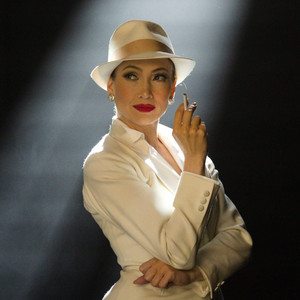
Molina idolizes Ingrid Luna, a classic Hollywood movie star played by J-Lo.
His favorite movie of hers is a musical called Kiss of the Spider Woman, in which she plays both the leading lady Aurora, and the villain, a jungle spirit known as the Spider Woman.
Night after night, Molina regales Valentin with the story of the movie and we see that movie come to life in glorious melodramatic technicolor with J-Lo Luna and Tonatiuh playing the key roles.
Kiss of the Spider Woman is an adaptation of the 1993 Broadway musical written by Terrence McNally with songs by John Kender and Fred Ebb.
It represents the first time this story, which has been a book, a stage play, a movie and a Broadway musical, has been presented with an all-Latin cast.
It was directed by Bill Condon, who directed Dreamgirls.
Yay!
And the live-action Beauty and the Beast.
Boo.
It's in theaters now.
Christina, did you get caught in her web?
Yes, I did get caught.
I absolutely did.
You know, going into this film with these huge Latino stars, knowing we don't get that many shots at this type of film, I was nervous.
And about halfway through the movie I was really nervous because there's all these changes in tones.
It switches between this dark gray, dreary prison cell and this beautiful bright, technicolor experience.
And switching is difficult as an audience.
It's difficult to care about both places.
It's difficult to toggle and hold the emotional threads together.
But I want to say, by the third act, they had gotten me.
They had gotten me emotionally.
I felt like the performances really came together.
There are some tropes about how LGBTQ folks are portrayed and the sort of access to happiness that can be problematic.
But I also want to say that the love story in this is portrayed beautifully in a way that still feels.
Radical.
Something we don't see on screen very often.
And by the end, they just totally had me and I walked away buzzing, thrilled.
Okay.
Corey and Tony, what do you make of Christina's thoughts about the shifts in tone?
They are dramatic.
You know, the musical, the stage musical, is very much not structured the same way as the film where you're kind of unsure.
Is this reality?
Is this fantasy?
What are we looking at?
And I thought that it worked really well to not only separate the two landscapes, the Argentinian prison and this technicolor fantasy land, but I thought that also just like taking out the singing prisoners and a lot of the campier elements of the original musical in favor of sort of these darker, bleaker moments where we really see the harsh realities of being in a prison in the 80s in Argentina.
I thought that it really elevated the storytelling and it took me out of the space.
Usually, Kiss of the Spider Woman, I'm like, what is going on?
Who is this lady?
Are we watching the film?
Are we watching the film of the film?
Are we watching the musical of the film of the musical?
But there were no questions with this viewing, which I really appreciated.
It felt like they were taking all of the haze off of the story.
Yeah, I think that conscious decision actually works in its favor.
I agree.
Glenn, I'm pretty sure that there's going to be at least one or two people listening to this who are already spinning their web and want to entrap you for saying that this show is not memorable, does not have memorable music.
I, for one, agree with you.
But I think the fact that this show does not have its mind hair, it doesn't have its all that jazz, it doesn't have that one standout song.
There is one song that is sung in a prison.
That one is Dear One, Querido, which that is sung by a couple of prisoners.
We don't ever see those prisoners again.
And it comes at a really emotional moment.
It's also very brief.
Querido, vivo ahora y siempre.
Este triste presente pasa.
But other than that, I think, because we have that separation, why it works is that once we go to these escapist places and it's J-Lo and it's beautiful costumes and you're giving us singing in the rain and get happy from summer stock and like all these, like little you know, nods to old classic Hollywood movies, that makes me more forgiving of the songs being not memorable, because I'm just like it appeals to me in the same way that I think it's supposed to appeal to the character of Melina, which is it is pure escapism.
Like, I don't have to actually remember these songs.
I do remember the visuals.
And they serve as an escape within this world.
That, I think, helps to balance those tones and works really well.
And I think Tony Tiu and Diego Luna, they are the emotional core.
And I think that to me, even though the music is not great And it's challenging all of my beliefs that like, in order for a musical to succeed, the musical numbers need to be good.
I think that the fact that their relationship grows and changes and shifts and is so complex is what makes this movie succeed for me.
And I really, really enjoyed it.
Okay, so I have thoughts about the songs, as you might imagine, but first we've got to talk about the people who are singing them.
I want to say, from the gate, Tona Tiu is the real thing.
They are a star.
They clean up really well, especially when they have to play the role in the musical.
Their mannerisms and diction switch into old Hollywood.
They fit right in, and they move like a musical theater star, which is important.
If they, at any point in a dance number, have to extend a hand to J-Lo...
They do it with the flourish and precision of a trained dancer in a way that Diego Luna.
I love Diego Luna.
He's a naturalistic film actor.
That's his training.
He has trouble kind of locking in and he lives in the close ups.
But if there is a long shot, if there's a dense number and he extends a hand to J-Lo, he's basically thrust in a ham hock in her face.
You know, he's not trained for this.
You can't get a lifetime of theater dance training in the time it takes to prep for one movie.
J-Lo locks into the dancing, of course.
And, of course, the Internet being the Internet has already had their say.
There was an interview on CBS Sunday Morning where she said she thinks she has a voice more suited to the theater.
And that being the Internet said, girl, you've got a voice more suited to dancing in the theater.
But let's be real.
I would disagree with Aisha.
Musicals live or die by the songs.
They are the engine.
They are the structure.
They are the story.
And I think they're lacking here.
Talk to me about them.
To be clear, I agree with that, but this movie has challenged me.
That's what I'm saying, Glenn.
But yes, continue, continue.
I went and listened to the soundtrack of this film twice in preparation for this.
And it is not something that I recommend.
It was rough.
It was rough.
The songs are not... standalone numbers.
I think J-Lo does fine.
I think Diego Luna can't really sing.
God bless his heart for putting himself out there.
He does great in that acting portion of this.
Absolutely.
The close-ups.
But.
But I feel like the film does still work because, as Aisha said, the music is in many ways separate.
It's not as integral.
It's an escape, a dip out of reality.
And maybe it would work a little better if even one of the songs was something you could hum afterwards.
But they're not.
They're kind of like old musical timey horny, like little silly things, and you know it is what it is.
They feel like kind of background nothing, oh wow, oh wow, i mean you like them.
I think that the problem with this film is that the way the songs are packaged, the delivery is not memorable, and when i listened to the vanessa williams cast recording, It sticks with me.
It's cute.
It lives up to a musical theater standard.
I think the problem is that there are no phenomenal voices in this production, in this film, except for Tona Tiu.
And that makes these songs not memorable because there are no long notes held.
There is no real vibrato.
Everything does have that studio clean finish and you don't get that moment that you get in some of Bill Condon's other musicals I'm thinking of Dreamgirls, Jennifer Hudson.
This time Effie White is going to win.
Like.
There are no moments where you're like oh, I am watching musical theater on film from the vocal perspective.
You get that from the dancing.
You get that from the beautiful gowns and i think i think one of the things i left the theater thinking was wow j-lo, beautiful gowns, transcendent dancing.
Yeah, the vocal was never going to be there.
Yeah sorry, noted.
I need to listen to the vanessa williams cast album because i also listened to the cheetah rivera original and i love cheetah.
She was a legend.
Let's not get this.
This is not doing it.
And we're not in the same way, but in a different way, like Chita Rivera, she was a triple threat.
Now, was she a singer along the lines of like, I don't know, Barbra Streisand or what?
Like, no, but like she has a very powerful voice and she could use it.
When you think about some of the biggest Hollywood musical stars of the golden era Fred Astaire, Gene Kelly like they couldn't really sing.
Their voices were limited, but they knew how to sell a song.
They could use their voice in the limited capacity to sell the song.
And JLo.
I love her dancing beautiful, looks great, but she's not up to selling these songs in the way they need to be sold.
And she has quite a few songs.
She has a lot of songs.
It's not like she just has one or two.
So I think it's notable that she shows up here And she is only in the fantasy world.
She does not appear, at least not like in a real way, in the real world.
And so I think it's really interesting, because she is the marquee name here, but she is not the star.
And that's a choice.
And I think the choice it both suits her.
But also I wish we had someone who could sell these songs a little bit better.
Jaina Jackson could have did this.
But that would have been a whole different thing.
That's a whole different thing.
That's a whole different thing.
I don't know if these songs are easy to sell.
I'm here to tell you that I approach this like Christina.
And sometimes it just takes, you know, some songs, more listens to worm their way into your brain.
I gave them plenty of opportunities.
Nothing did.
I just, all I kept hearing was the simplicity, which surprised.
Surprises me from the folks who did Cabaret in Chicago and even The Rink.
I mean, I notice it in the lyrics because I don't know anything about music.
But again and again, these songs land so hard on the terminal rhyme of each line, which is what you have to do, I guess.
But you know exactly what the next line is going to be.
If you hear Tide's low ebb, you know that caught in her web is coming around the corner.
And the magic of a musical number is that those rhymes are there to provide the structure and the form, but also to reassure you that there's craft involved here.
Right?
That we got your back.
But if they never surprise you, if they never bring you up short, if they never go beyond the first draft, like first entry in the rhyming dictionary, you're left with.
Meet street, miss kiss, gloom room, hiss kiss.
You're always one step ahead of the lyrics, which isn't satisfying, because every musical phrase gets resolved as precisely as you expect it to.
So tension gets introduced and immediately reduced, and nobody comes to art, musicals included to have our expectations precisely met.
God, I needed some out of left field something here.
The songs are not where this movie is going to deliver that for you.
Like, they're just not.
And like, you know, I hear you all comparing it to Bill Condon's past works, which I think is fair.
But when I was watching it I was comparing it to Amelia Perez, which is the other big, like quote unquote.
Latino movie, musical awards juggernaut.
I forgot about that movie.
Yeah, I wish I had too.
And watching it compared to that, like none of those songs were hummable.
And this movie had an emotional core.
It had something to say about what it was to be in a certain place and time in Latin America.
It had representation that felt meaningful, in a way that just resonated off screen in And also Diego Luna's continuing playing of this revolutionary like there were notes that sang out from this film maybe sang isn't the right verb that reverberated out from this film into the real world.
That made it more powerful and more strong in a way that, like that other film that we can forget about, just didn't right.
And that's where the meat of the film is.
You got to kind of just let the songs go.
But that's hard for a musical.
This is the thing.
It's a musical.
Especially because this has already been a book, a stage play, a film.
Maybe this is just an exception.
But I guess I'm able to overlook the songs because of that central story.
And for me, what I liked about this adaptation is that even though it is set in 1983 and it's set in the past and it feels as though it's in touch with sort of our current sensibilities, especially when it comes to Christina you kind of hinted at earlier.
But there's this idea around like queer stereotypes and you know Molina is very proudly apolitical.
So he says, and is like obsessed with divas and is like basically a walking stereotype.
And then you have, of course, the Valentin character and they're clashing and it's, What I found interesting was how it feels very much in conversation with something we're talking about now, which is like whether you're queer, whether you're black or a person of color, like how much do we put into this idea of like resisting, quote unquote, everything that's happening through pop culture and art and like putting all of our energy into that.
Like I'm going out dancing.
I'm resisting.
And it's like a fraught conversation.
And I feel like this movie in many ways and this is like a common thread throughout every iteration of this but it feels especially like it wants to be in conversation with that idea now.
And I kind of like the way that played out in this film and I'm curious how that kind of struck you all in terms of its discussion around art as resistance or art as just a way of expressing yourself and attaching yourself to that.
Yeah, I think there's definitely something to be said in the film about the power of art to really heal you.
And I can't experience Kiss of the Spider Woman without making comparisons to the Drowsy Chaperone, because I feel like thematically, there is something there where it's like those songs that you are supposed to leave a musical going back to with your head, those stick with you and those are there for your times of duress, for your times of peril, where you can have something to lean on.
And I think that I didn't catch... as many stereotypes in my viewing of the film.
I thought that Melina Tona Tiu's performance as Melina was actually incredibly nuanced for the stage of queerness that they were embodying, as far as When I walked into the theater, maybe two minutes in, I was like oh, that's not a boy.
They don't carry themselves like a boy.
They don't move through the world as a boy.
That's not a boy.
And without spoiling too much, that is made evident within the first 15 minutes of the film.
They're like, oh, I want to be a woman.
But to be able to portray that part of your where you know that if you had the resources to get what you needed to get done done, you know how it would look, you know how it would feel, you know how it would move on you.
And I found that to be incredibly enthralling in the film, because they found a way to tie that concept to this idea of diva worship.
And it gave it something past just like, oh, gay men love divas.
And she became a possibility model in this place where you know, Molina is literally experiencing psychosexual torture.
At the hands of these guards, at the hands of the warden, what have you.
And I don't know.
I just found it delicious.
I loved it.
He doesn't just stand with Jennifer Lopez and Diego Luna.
He owns this production.
Oh, this is his movie.
It is.
Absolutely.
His through and through.
And he can.
You are with him every step of the way.
I don't think that he is a stereotype.
He is able to really embody something that feels fresh and beautiful.
And his love story with Diego Luna and how that is portrayed and how it grows feels really subversive in this moment that we're in to have it portrayed in that way where a traditionally masculine type guy falls for him feels subversive.
It feels wonderful and affirming and just really lovely.
And I think that's where the power of this film is.
Yeah, definitely the power is in that relationship in Tonatio himself.
And also one of the other reasons I'm going to be recommending this film, even though I think the songs just lay.
There is the orchestration, the choreography.
All the stuff that's supposed to evoke these old Hollywood musicals.
They're firmly in place because on one level that's kind of a bit right.
We're not parodying these old musicals per se, but we are leaning into the excess of it all.
There's so many harp arpeggios.
You mentioned the big brassy horns.
It's melodramatic.
It's over the top because it has to be because it's doing work, right?
We need to understand harmony. why Melina is obsessed with this movie and this woman.
We are seeing it through his eyes.
So all of that lushness can be simultaneously kind of silly and funny, but it's serving the story.
It's serving the characters.
And the look of this thing.
In those musical moments.
There's a scene near the end where the main characters confront the spider woman and it's in the jungle with mist, and it's clearly a set.
It's clearly a soundstage because, of course, it needs to be.
Because...
Everything about that setup, that blocking, the framing of it is absolutely pitch perfect.
Could have been lifted out of a 1940s Lupe Velez movie.
And not for nothing.
That also ties into the fact that there's not an infinite budget for this movie, right?
This film was made outside the studio system.
That means the sets don't disappear into the distance.
There is a definite budget, analog quality.
That is necessary because that's what this movie is about, because they're paying homage to a B movie, right?
The movie that if you went to the movies in the 30s or 40s, it's the second half of the double feature.
Right, the movies of Dolores Del Rio and Lupe Velez, Latin stars that didn't get the huge budgets and the huge promotions from the studios but were always kind of in the wings to be employed like this and to make movies like this.
And I think that's working so well that, even though I couldn't hum a tune if you paid me, I still recommend this movie a lot, Yeah.
Tell us what you think about Kiss of the Spider Woman if you're feeling at the tide's low ebb.
You can find us on the World Wide Web and Facebook and Letterboxd.
And that brings us to the end of our show.
Christina Escobar, Corey Antonio Rose, Aisha Harris, thanks so much for being here.
Gracias.
Thank you.
Thank you for having us.
And just a reminder that signing up for Pop Culture Happy Hour Plus is a great way to support our show and public radio.
You get to listen to all of our episodes sponsor free.
So please go find out more at plus.npr.org slash happy hour or visit the link in our show notes.
This episode was produced by Carly Rubin, Janae Morris and Mike Katzeff and edited by our showrunner, Jessica Reedy.
And Hello Come In provides our theme music.
Thank you for listening to Pop Culture Happy Hour from NPR.
I'm Glenn Weldon and we'll see you all next time.
Keeping up with the news can feel like a 24-hour job.
Luckily, it is our job.
Every hour on the NPR News Now podcast.
We take the latest, most important stories happening and we package them into five-minute episodes so you can easily squeeze them in between meetings and on your way to that thing.
Listen to the NPR News Now podcast now.
Across the country, states and counties are rushing to to change their voting rules.
Stacey Abrams says these attacks on voting rights are part of the authoritarian playbook.
You may not be into politics, but politics is into you and it is a stalker.
Listen to Code Switch in the NPR app or wherever you get your podcasts.
Making time for the news is important, but when you need a break, we've got you covered on All Songs Considered NPR's music podcast.
Think of it like a music discovery show, a well-deserved escape with friends and yeah, some serious music insight.
I'm going to keep it real.
I have no idea what this story is about.
Hear new episodes of All Songs Considered every Tuesday, wherever you get podcasts.