If you're a smoker or vapor ready to make a change, you really only need one good reason.
But with Zinn Nicotine Pouches, you'll discover many good reasons.
Zinn is America's number one nicotine pouch brand.
Plus, Zinn offers a robust rewards program.
There are lots of options when it comes to nicotine satisfaction, but there's only one Zinn.
Check out zinn.com slash find to find Zinn at a store near you.
Warning, this product contains nicotine.
Nicotine is an addictive chemical.
To get 50% off your new system, go to simplisafe.com slash podcast.
That's simplisafe.com slash podcast for 50% off.
There's no safe like SimpliSafe.
For more information, visit teacherlukecouk.
Hello, welcome back to the podcast.
Alright, how are you doing?
I hope you're doing fine in podcast land, in LEP land.
I hope you're having a nice morning afternoon evening night, whatever time of day it is, wherever you are.
Hello, welcome.
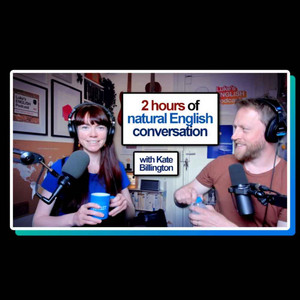
Kate Billington is back on the podcast again in this episode.
Kate is a popular guest.
This is her fourth appearance on the show.
Just in case you don't know, or in case you've forgotten, Kate is an English teacher like me.
We work together in the same school.
She also does stand-up comedy in the evenings sometimes, like me.
Kate also makes cakes.
She's a professionally qualified cake maker.
She makes cakes and pastries.
And Kate loves cycling.
And in fact, this episode is called Kate Billington Cycled to Berlin.
So here is about two hours of Kate and me in conversation, natural conversation, conversation that flows this way and that way as it moves forward.
So yeah, two hours.
It's another long episode.
And so with this, I just invite you to join us.
Try to follow the conversation.
See what bits of English you can pick up along the way.
You don't have to listen to the whole thing in one go.
Obviously, you can if you want to just join us for the whole two hours.
But you don't have to listen to it all in one go.
You can listen to some and then stop.
And then later you can listen to some more.
You know, the more you listen, the more you learn.
But it's up to you.
If you feel like after half an hour, that's enough for you.
If you feel like you wanted a half an hour episode, listen to half an hour of this.
But otherwise, if you're enjoying it and you are captivated, keep going.
Because the more you listen, the more you learn.
Hopefully we will keep this fairly entertaining and enjoyable for you all the way through, with some jokes, some little stories and some little explanations of vocabulary or expressions or little cultural details.
Consider listening to the audio version on your phone.
You know what a phone is, right?
Consider listening to the audio version, which you can just get in a podcast app on your phone.
I use Pocket Casts, but you could use Apple Podcasts, Google Podcasts, Spotify.
You could listen to the audio version.
Just subscribe to Luke's English Podcast in your podcast app of choice.
And the advantage of that is that you can do other things while you listen.
Just put your headphones on and you can just do other things while you're listening, which allows you to multitask.
Like you could do some housework, you could drive, you could walk around somewhere.
Just walk around in a circle.
Yeah, or alternatively, walk to a specific place if you've got some shopping to do or something, while you're spending time on public transport on the way to work and on the way back or whatever it is you're doing.
This is how most people listen to podcasts.
They just listen to the audio version, which allows you to do other things at the same time.
That's another way to do it.
Alternatively, you could just close your eyes and just focus on the words, phrases and sentences that you can hear.
But don't do that while driving a car or operating heavy machinery or any of those other dangerous things.
But there you go.
Anytime you want to stop, you can just pause the episode and all podcast apps will remember where you paused so that when you come back to the episode, you'll be able to continue from that moment and then carry on.
And ultimately, I think it's probably best not to think about the length of the episode, okay?
Don't see this as a mountain that you have to climb.
The length, it doesn't really matter.
Just join us, get involved in our conversation, keep listening, enjoy it and get carried away by the sounds of the English language in motion.
One last thing before we start properly.
This episode is called Kate Billington Cycled to Berlin.
And that was the original plan for this episode to talk about her long cycling adventure to Berlin, cycling all the way to that city.
But in the typical way here on Luke's English Podcast, there were plenty of tangents, distractions and other talking points along the way to that main topic.
And you'll see me trying to get there.
But for some reason, we end up talking about this, that and the other, which is fine.
That's the whole spirit of this show.
So we do eventually talk about Kate's cycling trip.
And there's also a story about a nice, a nice?
No, that's not the word.
Definitely not the right word.
Not nice.
Nasty.
There's a story of a very nasty cycling accident that Kate had recently which will definitely hold your attention.
So we do talk about those things, about the cycling, but it takes us a while to get there.
When exactly do we start talking about the cycling trip and the cycling accident?
Well, you'll have to wait and see.
But keep listening because we do get there eventually.
So now, without any further ado, let's now join my conversation with Kate, and we jump straight in with me, attempting to start the recording of the video and audio tracks while also making tea and talking to Kate, all at the same time.
It's exactly the same way that the last episode with Kate started.
So more of the same kind of stuff, more conversation with Kate.
All right, good.
So now I've said that, let's get started right now.
And here we go, click record here, so i have started, and so my my decision there to start was based on oh god, it's difficult to explain why.
Well because okay, maybe i shouldn't have started now, i should have just finished the t and then started.
But uh, i just kind of think i'll just press record and then i don't have to worry, that's done, and then we can just carry on and that's you know.
Living with regret now.
I know, yeah.
Now we can say shoulda, woulda, coulda.
Yeah, shoulda.
Should we teach your students that expression?
Go ahead.
Shoulda, woulda, coulda is a song, isn't it?
Is it Macy Gray?
Could be, I don't know.
Don't know that.
You don't know that song?
No, I don't think so.
I'm not going to sing it because that would be embarrassing for everybody.
Have you used this in an English lesson by any chance?
I have.
I've used it for pronunciation because it means should have and would have and could have.
So it's like it's about somebody regretting their like.
I think it's about her regretting losing a partner or something like that breaking up with somebody.
And...
The song says all the things that she should have done and could have done and would have done if she could go back and change it.
But the song isn't called should have, would have.
Thank you.
Could have.
It's called shoulda, woulda, coulda.
Yeah.
Because that's how we actually say it.
Yeah.
Should have done this.
I should have.
I should have put the milk in before I pressed record.
I should have done that.
I should have done this.
I should have given Kate the tea earlier when I invited her onto the podcast last time.
I calculated it.
It was over 30 minutes that you had to wait.
I think that's the first time in my life I've ever been 30 minutes without tea.
Really?
It's always like at least maximum 30 minutes.
I'm a chain tea drinker.
Yeah.
Yeah.
So you have to, there's no more than 30 minutes between each cup.
Yeah.
Okay.
And I would have refused to come back, except that you said lots of people listened to the episode.
Yeah, yeah, yeah.
So see, that was, I was just trying to find an excuse to use woulda.
That's why I said that sentence.
I would have come back.
I would have refused.
I would have refused.
You know what, I think it's would have, I think it's a v in there.
Macy Gray's American, isn't she?
Yeah, she is, yeah.
So, was American?
I would have refused, but was American?
What, she changed her nationality or she died?
I think she might have died.
Really?
I don't know.
She might have died.
Did you just say that sentence?
I said might have, didn't I?
I didn't say mighta.
And the point we're trying to make for people who are actually here to listen to their English and not find out whether or not Macy Gray is still alive, is that Americans would often say shoulda and Brits would often say should've.
Unless they're emphasising it for a certain reason.
But I don't know what that reason would be.
Why would you emphasise it because it's an auxiliary?
Maybe if you say, I should have gone to the doctor, and they say, you can't go to the doctor now.
And you go, no, no, no, I should have gone to the doctor.
Ah, yes.
Then you would probably also emphasise the gone.
I should have gone.
You'd probably still, but you'd say the have, you're right, you'd say the have.
I should have gone to the doctor, but you can still, there's still time.
No, I should have gone.
Yeah, I suppose so.
Yeah, you'd emphasize both.
She's still alive?
Yeah, she's still alive, yeah.
All right, that's embarrassing.
Macy Gray.
How old is she?
She's not even that old, is she?
Natalie Renee McIntyre, known by her stage name Macy Gray, is an American RB soul and soul singer and actress.
She's known for her distinctive raspy voice and a singing style heavily influenced by Billie Holiday.
Gray has released 10 studio albums and received five Grammy Award nominations, winning one.
And she's still very much alive.
I don't know why you thought that she'd passed away.
I don't know.
Just now that Tina Turner's gone, I assume they've all gone.
All singers.
All R&B soul singers.
All great R&B soul singers have gone.
You heard it here first.
Yeah.
Tina Turner, that's, yeah, pity.
Lost another legend.
I heard about that in class.
One of my students said it.
Really?
And I had to, like, lean on the table.
And I was like, I'm sorry, guys, I'm going to need to take a minute.
Yeah.
Because I was very shocked.
Same thing happened.
And they all knew.
They all knew that you were shocked?
No, they all knew that she had died and I was the last one.
Really?
So they got to enjoy you receiving the news?
Yeah, they found it quite funny.
Did they?
To be fair, it was quite funny.
What, that you received the news and you were shocked?
Yes.
Not that she died?
No, that's just sad.
It's quite sad, but it's not a tragedy, is it?
She was 83.
Yeah, she led a good life.
She had good innings.
I taught them that expression.
Yeah, it's a good one.
I only use that in Britain.
They don't say that in the States then, or Australia or Oh okay, so in cricket-playing countries maybe.
Yeah, yeah, I guess.
But, so yes, maybe they would say it in Australia, India, South Africa, I don't know.
Shall we explain She Had a Good Innings?
I mean, since this is a Learning English podcast.
Yeah, it is, yeah.
Also, I'm not supposed to be vain, but I've just noticed my hair's a bit weird, so I'm just going to fix that.
Go ahead.
So we're on video, obviously, audio listeners.
There's a video camera filming us, which is, you know, an interesting experience.
We talked about that last time.
This is what happens when you come onto my podcast.
We just talk about the same thing we talked about in the previous episode.
We do.
Which is probably the thing we talked about in the previous episode.
We did that last time.
Somehow just go over the same ground every single time.
But yeah, so she had a good innings, Tina Turner.
So innings.
So I think if...
You wanted to use a more international expression.
You'd say she lived to a good age.
You'd say 83 is a good age.
Yeah.
And I think that would be quite universal as an expression.
But a good innings is... It refers to cricket.
And it refers to your cricket score.
So when you're batting, the goal is to get as many runs as possible.
Yeah.
There are no goals involved, though.
Sorry.
The goal... The objective... The objective is to get as many runs as possible.
And that's...
And your innings is the amount of time that you're batting.
Yeah, you can stay in for ages.
You can bat until someone bowls you out or catches you out.
You could be in all day or you could be in for several days.
You could be in for several days, which would include multiple tea breaks.
Yeah.
Because that's not even a joke because this is a British sport.
It's great, isn't it?
I love cricket so much.
I miss cricket.
I actually have a cricket ball here.
You do?
Which is just like a... It's just a really good sort of stress reliever.
All right, OK.
It's... just cricket balls are wonderful things they're covered in leather and they've got these stitching the seam down the middle which is actually an important part of the game because you can if you're bowling the ball you have to bounce the ball and you can throw it so that it bounces on the seam and that makes it unpredictable is it going to go this way that way and other things but so yes in cricket if you are batting if you are hitting the ball you can stay there all day if no one gets you out And if you do have a long innings and you stay there for a long time and you get a good score, then, yeah, you would say, oh, he had a good innings.
Or she.
Or she, yes.
Were she to be a female cricketer.
Yeah.
Or they, were we to not know.
Yeah, exactly.
If they're at a distance or it just wasn't clear or for any other reason.
But so Tina Turner, yeah, we do say that about someone who's lived a good long life.
Yeah.
And it's a sort of a positive thing to say when someone has died.
Yes.
If they've had a good long life.
You can say, well, you know, he had a good innings, she had a good innings.
Yeah.
Yeah, I think we say I say it quite a lot if somebody's Yeah, if somebody's died at an age that suggests they lived a good life.
Yeah.
Or lived a plentiful life.
Mm-hmm.
Absolutely, yeah.
She had a good innings.
I was still a bit upset when she died.
Mm-hmm.
And I still had to lean on the table.
Similar thing happened to me when David Bowie died.
Oh.
That one hurt, didn't it?
Yeah, it did.
Because it was unexpected.
And he just released an album and he was kind of like you know, backing our thoughts and stuff like that.
Like a week before, I saw the video for his latest single and it was strange.
And it was weird and it disturbed me.
The video?
The video did, yeah.
For, is it Lazarus?
Lazarus, I think it was.
Oh, that was prophetic.
Or Dark Star or something like that.
It was very odd.
Lots of sort of what looked like occult imagery and references to his career and weird things.
I didn't know what to make of it.
I watched it early in the morning.
The next week.
I was just about to go into an English lesson and one of our colleagues Rob, do you remember?
Yeah.
Do I remember Rob?
Not the Rob that is there now, but there was another.
I saw him on Monday.
Dylan, do you remember Dylan?
Also still there now.
No, he's not there.
No, there's another Dylan.
Yeah, there's another Dylan.
Yeah, Dylan Walker.
I think if there'd been two Dylans, I would have been more aware of it.
Maybe he left before you kind of got a chance to meet him.
He does a podcast as well now called English with Rob, even though his name is Dylan.
But yeah, Dylan is his middle name or I don't know.
It's confusing.
But yeah, anyway, so he came into the teacher's room.
It was like maybe 10 minutes before I was due to go into class and start teaching.
He came into the teacher's room.
He's like, David Bowie just died.
And I was like, what?
What?
You know.
And then I had to go in and teach.
And I was like, OK.
So today's lesson is about David Bowie died.
And one of my other students was a huge David Bowie fan.
And she was like, yeah, I know.
Oh, no.
Yeah.
So the whole lesson, we were both like this.
Yeah, he was ill, yeah.
So was that why his last album was about what his career had been?
Yeah, yeah, lots of sort of deep hidden meanings and a lot of stuff like that, yeah.
The video's gone off.
The computer's gone into... The computer went to sleep, but we are still being filmed.
The video is still rolling.
All right.
OK.
All right, so, OK, wow, we've already covered quite a lot of ground there.
Yes, yeah, we have.
Yeah.
Yeah.
Do you have a plan for the podcast?
Yeah, I do.
I have a plan.
Yeah.
Oh, yeah?
I did write some notes.
Are we going to talk about last...
Like the last appearance?
Yeah.
That's not part of the plan.
No, I thought that we would start by... Well, let's see.
So I saw you recently or you texted me and you said, can I come back on the podcast?
Yeah.
I said, of course you can.
And you said, because I want to talk about cycling to Berlin.
Yeah, I did want to talk about that.
And then after I'd said it, I was like, I've not really got many stories about it.
Really?
Because when you cycle somewhere...
A lot of the time you're just on your own on a bicycle.
Yeah.
It's not really anecdote rich.
Unless it's a tandem.
Then you'd be on your own on a tandem.
If you were me.
You're not necessarily going to have another person on it, are you?
No.
I like to cycle alone because other people are quite annoying.
And I'm also quite annoying.
Especially on long holidays.
Really?
Yeah.
Why?
What happens?
I just so.
Cycling's quite stressful sometimes because obviously you've got to get to the place you want to get to by the end of the day.
And if you have things like punctures, or if you get lost or anything like that, then it's quite.
You can get quite stressed.
And then I get very angry and I shout at my bicycle or I shout at my phone or my GPS if I go wrong.
Yeah.
And it's just not nice.
What kind of things do you shout, can you say?
I don't think I should say.
You could swear or you could... I don't want to swear.
No, okay.
I don't think it's very polite.
Fair enough, fair enough, yeah.
There are times when swearing is appropriate, and one of those times is when you're cycling and you're trying to get to a certain place and you're climbing up a hill or something like that, and things are difficult and you have frustration and you vent it at an inanimate object.
Which I think is fine, because the inanimate object can take it.
And I do always say sorry as well afterwards.
I always feel bad and then I always think, if it's, maybe it's not as inanimate as I think it is and maybe it's going to be angry with me and stop working.
Yeah, you never know, especially with your phone, because they're that close to being sentient now, aren't they?
Yeah yeah, you've got to be careful what you say to your phone.
I mean, I've got a very old phone, so I think it's quite far from being sentient.
Yeah really yeah uh-huh, but i i um, i don't really apologize to my phone.
I don't, i don't like my phone.
So yeah, where is it?
It's in it's in my bike helmet, it's just there just yeah, your phone's just feeling sad.
I don't like phones in general, you know no, because they're just.
I don't like the fact that you kind of you don't have to have one, but i feel like i have to have one.
Yeah No, I know completely.
Yeah, I mean, they're obviously very useful, but also we have to have them now, don't we?
Yeah, there's no choice anymore.
We've been forced to kind of do that now.
But yeah, often I am much happier when I take steps to put the phone away.
I keep it in my bag and I'm like right, I will not check it, because you know we're being psychologically manipulated and we just have to.
We just pick it up without even realizing it, like the decision's been made for us, but you will now pick up your phone.
You haven't picked up your phone for for however many minutes um yeah, so yeah um, and i check my.
You know it hasn't gone off because no one texts me or calls me ever, but i'll check it just in case.
Yeah, why there's, you know, sandy toxfig.
Yes, the comedian.
The comedian, who's brilliant in my opinion.
But she had a joke about how that's like just opening your front door just in case somebody's there.
That's so true.
That's basically what I'm doing.
Is there someone here?
No, there's not.
Okay, I'll close it again.
That's basically what you do when you're just checking your phone for no good reason.
When you do check your phone for no good reason.
Yeah, it's like opening your front door just to check if someone's there.
But it's also like finding yourself standing at the door, with the door open, and you're like Oh, I was going to the kitchen to make a cup of tea and I'm standing at the door.
For some reason, you're standing at the door.
Yeah, exactly.
I do that with Twitter.
I'll go on my phone because I need to find an email that someone sent me from last week, because I've got to do a specific thing.
And then I'm scrolling through Twitter.
I'm like, whoa, wait a minute.
I thought I was writing an email.
How did this happen?
Because you open your phone and there it is.
And then it gets you like that.
But you can get apps.
Sorry, I cut you off.
That's all right.
Okay.
Well, I was going to say, I'm going to say it now.
You can get apps that stop you from accessing certain other apps at times that you fix, can't you?
Yeah, yeah, yeah, yeah.
So you can't open Facebook except between this time and this time or Twitter in your case or...
But in order to do that, you need to go into your phone, open up that app and decide the hours that you want.
And what would happen to me is I'd go in.
I'd be like, right, I'm going to set my my my allowances or my time windows.
And then, oh, I'm on Twitter.
So you'd never actually never actually get there, because there's always some other app that's like hey.
Yeah.
Jumping in the way they do.
Yeah.
Literally.
Yeah.
That is what.
Yeah.
So I think that's why I don't like my phone.
I tend to find I have happier, more fulfilling moments when I when I keep my phone at a distance.
You know, you kind of live in the moment a lot more.
And that's that's good.
Yeah.
So, all right, so cycling to Berlin then.
Yes.
So you're going to tell us about this.
Yes.
Let's see where this takes us, probably to Berlin.
Probably.
In terms of the conversation.
Yes.
So, okay, when, where, how, why, what, which, whom?
Which what?
I don't know, which route did you take?
Ah, good, good question.
What's the difference between what and which?
That's a question that students ask me sometimes.
Oh, I would say.
Well, the reason I asked then, when Luke said which, I said which what?
Because which suggests a choice between multiple options.
So we can use it either when the options are clear, like here, which route did you take?
So you're talking about the various possible routes from Paris to Berlin.
Or if it's just implicitly clear, like if you said, which colour is your favourite?
There's obviously a limited number of colours.
Yes, yeah.
Although, of course, some people would argue that that is not a limited number of colours.
What, really?
Well, I suppose it is limited, but all of the possible shades...
Yeah, you get that kind of spectrum.
Have we defined every colour?
I don't know if we have.
I see what you mean.
But anyway, it still works.
When you go on the internet and you want to choose a colour for a particular thing, if you're making some artwork or something, then yeah, then there are many many many, many little codes and subcodes.
And yeah, if you break it down, that's true.
But you could still say which colour is your favourite.
But probably what is your favourite colour would be the most common question.
So the point is that which is normally when there's a sort of limited number of options available.
For example, if you've got like three cakes on the table, which cake would you like?
We have got cake.
I know, yeah.
On that note.
I should say Kate brought cake, of course.
Is that why you thought of the example of cakes?
There's not a choice of cakes.
Cake is always a good example for most situations.
All of my examples are about cake.
Yeah.
Kate did bring cake, I should say.
Kate brought the cake, not the cake brought Kate.
That wouldn't be possible.
It would be interesting if a cake brought you here.
I don't know how that would be possible.
Who knows?
One day, when the cakes become sentient as well as the phones, then maybe we'll be riding around on cakes.
That's the future we have to look forward to.
I think cakes have got further to go than phones.
I'm going to put that out there in terms of sentience.
But phones are always developing, always sort of changing, apparently getting better.
But cakes, you know, maybe they they've finished, you know, they're already great.
They don't need to be improved as a concept, I think.
So you did bring cake, which you have in a... Would you like some cake?
Well, you know what?
Often I will share comments from the comment section...
One said it's rude to eat on a podcast.
Is that what you were going to say?
I read that.
And I have to say to that person, I'm sorry, you're just going to have to deal with it.
Yeah, really?
Yeah.
Really?
Really?
Why?
Do you think it's rude to eat on a podcast?
First of all, the vast majority of comments were extremely positive.
Oh, OK.
You're going to tell me about the negative ones?
No, no, no.
I'm not.
I love this.
Go on.
No, I'm just saying this just for posterity, you know.
Just so everyone knows like the vast number of comments are positive.
And whenever I talk about comments, if I ever bring up negative comments, I always feel like I should balance it by saying most people's comments were positive.
So I don't first of all give the impression like you know, that one comment out of 100 comments was negative that by just talking about the negative one, that that somehow makes it more significant than the others.
You don't want to give it more weight.
Yeah, exactly.
And it should have.
Yeah, yeah, yeah.
And also, I can't remember the other points I was going to make in my list.
I think I said several reasons, but never mind.
The first one we'll do.
But yeah, so vast majority of comments were positive.
But there was one comment that simply said, I think eating on a podcast is rude.
That was the contribution that that person made to the conversation.
Don't you think so, though?
Because I think that person, you know, although, you know, that was the only thing they said.
Yes.
I think that person might have a point that there's this, that as you know, that there's one...
You know, when people are listening, they don't necessarily want to hear... Could you hear that?
No, I don't think we could.
I don't think that eating was audible.
Well, because I think, I think when I ate, Because it was only me who was eating as well, wasn't it?
Because you'd already eaten.
That's right.
I gave you some of the cake that I'd bought.
I think that when I ate, I ate while you were talking. and was away from the microphone.
So I think it's rude to eat in somebody's ear, yes.
I would agree with that.
And if you eat into a microphone that you know people are going to listen to, that's like eating into someone's ear.
Yeah, so if the listener can hear the sounds of eating, that's rude.
I think that's rude.
But if the listener is aware that a human is eating in the room, that's not rude per se, is it?
I wouldn't say that's rude.
But I'm not 100% sure that you couldn't ever hear me eating.
But I think...
Yeah, maybe there was just one single like sound in the background.
Maybe it was just like the wind blowing the door against the doorframe.
And it sounded like me eating.
I do have a large mouth, but not quite that large.
Yeah, that's not really anything like the sound of anyone eating.
No.
When there's a little background noise.
Sometimes these sounds can become indistinguishable from each other.
So I would disagree with that person.
Yeah.
So what you're saying is that there's a difference between eating on the podcast and then eating professionally professional podcast eating, which is eating away from the microphone only when another person is talking.
So you're not going.
Yeah, good point.
You know not that, but instead you've now done which i've now done, but there was no food in my mouth, so that was a simul, that wasn't so.
Would that person find it more polite for you to make eating noises while not eating, or to eat but stay away from the microphone?
Eat but make no noises, or make noises but not eat.
Which one is worse?
Yeah, that's the question.
That's the question.
To pretend to be eating into everybody's ears.
So if I'm going, lovely cake, delicious.
Yeah, I like that.
Thanks, Liam.
You can put headphones on, by the way, Kate.
Why, so I can hear that more clearly?
So you can hear that even more clearly.
I was going to ask about the headphones, actually.
Should I put them on?
Yeah, I forgot to mention that.
You can put them on if you... Why should I put them on?
Just in case you want to get a sense of your proximity to the microphone.
Oh, yes, I get it now.
That can help.
Can you hear that?
Louder, quieter?
I don't know.
I think it's about the same volume as you.
People do sometimes ask me that in comments.
Why are you wearing headphones?
They don't ask it in that voice, but that's the voice that enters my head when I read that comment.
And it's just because it helps you monitor the sound.
It helps you know if you're close or far from the microphone.
And because of the proximity effect.
You see, the closer you are to the microphone, the more you sound like you're on the radio.
And the further away you get, you know, you can use the proximity for different purposes.
If you want to shout, for example, you shout off the microphone.
If you want to whisper, you have to whisper close to the microphone.
So hearing your own voice through the microphone helps you to deal with all of those things.
Professional podcasting advice.
All I was thinking while you were talking was this would be a great time for me to have a bit of cake.
Yeah, because I was like, now he's going off on one.
Because Luke is talking for a while.
Yeah, yeah, well, all right.
But I don't know, what's the jury's answer?
Conclusion, what's the conclusion?
Well, you've given it, you've made it an audience participation question.
I have.
But this isn't a live podcast.
Yeah, I know.
So how will we know?
Ultimately, I'm the boss.
I decide.
I think we can eat, but we eat responsibly.
And if you're listening... It's like drinking alcohol.
You should do that responsibly as well.
I think you should do most things responsibly.
Yeah, that's true.
But certainly some of them should be done with more of a sense of responsibility than others.
Because drinking alcohol can go badly wrong.
Whereas drinking tea...
How wrong can it get?
I mean, you might need to rush to the loo after a certain amount of time.
That's true.
But that's probably as bad as it's going to get, isn't it?
Yeah.
Well, you could slosh it all down yourself.
Tea is hot, so you could spill it on someone and actually quite hurt them.
Yeah.
So these are examples of how you should drink tea responsibly.
Yeah.
There we go.
Make sure it goes into your mouth and down your throat and not all over someone.
And not all over someone or yourself because you could burn yourself and that would be inconvenient.
Yeah.
Yeah.
OK, well, I just heard you drinking the tea.
I know.
I'm sorry to that person.
Genuinely.
Right.
That person who commented and said that thought that was rude.
You know, we don't mean to be rude or anything.
I'm sorry if your experience was diminished by this.
Even the thought of a person eating.
Yeah, I get it.
But I don't I don't think you could hear us eating.
You could hear me eating.
But perhaps I'm wrong.
Yeah.
Yeah.
We'll see.
We'll see when that person comes back with a similarly curt reply.
Maybe their name is Kurt.
Yeah.
I don't think it was.
It's not a very common name.
Look at this, everyone, video viewers, listeners will describe.
Can we see if the video is working?
Yeah, the video is working.
So my computer just kind of went to sleep.
But then how do you know?
The computer's locked.
It is.
It continues to record even in the background.
No, I was going to say, how do you know what can be seen on camera?
I need to describe this to the audio listeners.
I'm holding a tin in my hands.
It's a circular, a round tin with Marmite on the front, a picture, a nice design, of a jar of Marmite.
There's a whole other conversation that could be done.
Marmite is a sort of a yeast extract spread, which is a great way of selling it.
Also describing it, because nobody listening to that knows what that tastes like.
No well, that's yeast extract.
Let's put marmite, but that is what it is.
Let's put marmite on the side for a moment.
Alright, and we may come back to marmite.
I think we should, because it's very easy for us to get distracted by one thing or another, especially marmite, and I'm holding this thing and I've got to.
You know, I've got to continue.
So alright, metal tin.
It's round.
There's a nice picture of marmite on the front, but that's not what's inside.
We take off the lid.
What do we have inside?
Cupcakes, beautiful cupcakes.
Oh, i can smell them as well.
I can smell vanilla yeah, good.
So can you describe the cupcakes?
Yes so um, the cupcakes.
I brought cupcakes because last time, i think, i talked about cake but i hadn't brought it, and it was the first video episode we've done, and i felt um, quite self-conscious about the fact that i hadn't actually brought cake, even though it's suddenly a visual medium.
You know, most people don't bring cake to things.
You know that It's not like the standard that you have to try to.
That's how I make all my friends.
Yeah.
I bring cake.
You bribe them with cake.
Yes.
And then people are like, oh, we should invite her to stuff because she'll bring cake.
This is how I make my friends.
During lockdown, I was studying patisserie at home and became friends with all of my neighbours because I live alone.
So I was making loads and loads of patisserie.
So I would make like 16 croissants and then be like...
Wow.
I should probably deliver these to people instead of eating them alone.
It's very nice.
You're really contributing to the community.
Yeah.
And then I became friends with those people.
And incidentally, they invited me to Berlin.
That's why I went to Berlin.
Ah.
But anyway.
It does all connect.
It does all make sense.
So the cakes are.
So you said you can spell vanilla.
Yeah, I think so.
What kind of cake would they be in British cake terms, victoria sponge correct, i've got it right.
Listeners victoria, testing if you're really british or not, victoria sponge cake is uh, it's.
Yeah, it's kind of kind of cake that's got vanilla flavoring in it.
Yes it's um, it's a very sort of simple cake.
Um, they have the same cake in french and they call it the four quarters.
They're wrong.
It's Victoria's Sponge.
It is Victoria's Sponge.
But they call it that because there are four parts, essentially the same quantity of each butter sugar, flour and eggs.
And then you also for the flavouring you put in vanilla essence and baking powder, which was invented quite near in time to the coronation of Queen Victoria.
So when Queen Victoria was crowned, they invented a new national dish, as they do for coronations, as you've probably mentioned on your podcast.
And baking powder was a British invention that was taking off because it makes cakes rise and it makes them light and fluffy.
So it was quite a revolution in cake making.
And therefore they made this cake. this sponge where previously all the kind of cakes that were made in the uk and i think in many cultures were much heavier and they would be you know like fruit cakes with dried fruit raisins that sort of thing so it would be a heavier cake whereas now they had learned how to make lighter cakes and that's why um the victoria sponge ended up being the coronation dish when queen victoria was crowned that's that's from my memory i might have got a few facts a little bit wrong um yeah no it sounds i'm not sure i can't fact check that in my own head but it sounds right yeah this makes sense victoria sponge cake named after queen victoria because of all the things you said i'm not just going to repeat them no you can i could but why That might be why our last episode was two hours.
Yeah.
Just repeat everything you say.
I do that a lot.
But when Queen Elizabeth was crowned, there was a coronation dish as well.
Coronation chicken.
Coronation chicken.
Yeah.
Which is, what is coronation chicken again?
Do you know?
It's chicken in a sauce and it's a yellow sauce.
It's got almonds and raisins in.
Right.
There must be some sort of like turmeric or something like that in it.
Probably something, some kind of spice from India or something like that, right?
Uh yes, kind of like a very watered down, milded version, like english version, of an indian dish.
It's very mild yeah, it's not spicy.
It's not spicy at all.
Yeah no, it's very creamy, so it's kind of like a chicken in a creamy sauce uh, with raisins and almonds and probably some spices and stuff, but it's not, it's not actually hot spicy.
No, it's quite nice.
Yeah yeah, yeah.
And then when king uh, king charles was crowned, what was it?
Coronation quiche.
But the French apparently were not happy with this, because apparently I didn't even look at the recipe I heard it wasn't actually a quiche.
Because it doesn't have cream?
Or egg?
I don't know.
I'm not sure what, according to the French, makes a quiche a quiche.
And is it like creme fraiche or egg or something that has to be in there?
I think it needs to have egg and cream to be a quiche.
And otherwise it's a tart.
I see.
Because you can have a sweet tart, like an apple tart.
Or you could have a savoury tart, like a vegetable tart.
And so if it doesn't have egg and cream, I think it's a tart and not a quiche.
Mm-hmm.
I think.
So the coronation quiche, as it was called, what was it?
It was vegetarian.
I have no idea what it was.
It was vegetarian, which made some people angry.
Why?
Because they're idiots.
Sorry, you're not supposed to call people idiots.
It has to be the sacrificial killing of a creature.
Yeah.
Yeah.
They wanted to put a remainer in it.
I don't know.
Probably.
That was a very old Brexity joke.
Yeah.
Let's not explain it.
It's not funny.
No.
Okay.
But I think there was courgette.
There was courgette in it, right?
It was a kind of vegetable tart of some kind.
I think it was vegetarian because I think I remember people being angry about that.
Probably shouldn't talk about it anymore because neither of us know what was actually in it.
Yeah, we're inventing.
We're making it up.
But I'm pretty sure there was courgette or some other, maybe broccoli or something.
And the overall impression I got of the Coronation quiche was that could be very soggy.
That was my first thought.
Good that it's vegetarian.
Nice one, Charles.
But soggy, probably quite soggy, but...
Who knows?
He probably didn't cook it himself.
I doubt it.
Maybe he likes cooking.
I don't know.
No idea.
How would you know?
Well, I don't know.
He'd probably have mentioned it.
Yeah, I expect so.
So, lovely cupcakes.
Yeah.
Victoria sponge.
Yeah.
With, what do you call the buttercream?
Buttercream.
Whipped buttercream on the top.
Yeah.
And a raspberry.
Yeah.
Which is the proverbial cherry on top of the cake.
Indeed.
Oh, my goodness.
We're going to do the cherry on the cake again.
Here we go again.
The cherry on top of the cake.
It's actually a raspberry this time.
Yeah, it is.
The raspberry on top of the cupcake.
When you eat it, you have to cut it in half.
Oh, yeah?
Why?
Down the middle, because there's a surprise in the middle.
What?
What have you put in these?
I've ruined it now because it would have been better if you hadn't known.
But then I think that might have ruined the eating quietly.
I'm curious to know what's inside these now.
It's nothing revolutionary.
No?
No, I don't think so.
Yeah.
OK.
Am I going to be able to drive after I've eaten?
Yes.
Do you drive?
No.
Well, you operate heavy machinery.
Do you do that?
No, not really.
But you know what I'm saying?
Yeah.
Yeah.
Yeah.
And it's not like in the middle I've put like minced beef or something.
It's a good surprise.
It's a good surprise.
I reckon there's chocolate in the middle.
Do you now?
Yeah, that's what I reckon.
Maybe something like a hazelnut chocolate or something like that.
Are you going for Nutella but not naming the brand?
Nutella but not Nutella, yeah.
A better version without all that palm oil and grief inside.
You know, orangutan grief.
It's the second time we've talked about orangutans today.
I think we started talking about orangutans before we pressed record.
So they're like, what, orangutans?
I don't remember this reference.
It's very rude to talk about orangutans without context.
Oh, so I read some other comments.
One said that I laugh too much.
Oh, yeah.
There was one person who just took exception to.
And I think I replied saying I think you'll find that Paul Taylor, who's a regular guest on this podcast, is famous for laughing on the show.
Yeah.
Famous for it.
Yeah, he is.
Yeah, he's famous for laughing on the show.
In fact, they've got a jingle.
Yeah.
I don't really do jingles that much.
They've got a jingle.
Yeah, amber and paul, i've got a jingle and in the jingle it's basically a condensed version of all the comments that people had made about the two of them.
The first one is that amber's got a lovely voice and the second one is she has, she does yeah yeah, yeah.
And the second one is that paul um laughs and everyone enjoys his laughter.
Oh well, so it's like okay, so he can laugh, that's fine, but uh, not kate.
No laughing from kate, no laughing, no eating.
I mean, I feel like my right to drink tea is hanging by a thread right now.
We're just asking for it now.
I'm going to do it anyway.
Someone's going to say, no liquid, no imbibing of liquids allowed.
Kate was breathing too much.
Yeah.
Can I switch the?
Yeah, yeah.
Don't worry.
It's still recording.
But I don't like to not be able to see it.
Really?
You just need to know that the video is recording.
Every now and then, listeners, my laptop goes to sleep and the screen goes all dark.
And Kate's like, ah, no, what's happened?
I don't know why, because it's not like it's nice to watch yourself.
I think it's because I'm checking if I'm still very red.
And the answer is yes.
I'm just thinking, is this microphone, is this positioned correctly?
I don't know.
It's your job.
I don't want it to, like, get in the way so that people can't actually see you.
But at the same time, I want it to be able to capture your voice.
Should I move?
Is that good?
This is good.
Yes, that is good, yeah.
Ah.
German.
Because you cycled to Berlin.
I think this episode might be called Kate Billington Cycled to Berlin.
And we cycled around the topic.
It took us 90 minutes to actually talk about it.
No, but I just wanted to say one other thing about your comments.
Some people said that I laugh too much.
No, just one person.
But some people said that they didn't understand me because I talk too quickly.
And I think somebody said because I talk too quickly and because I was laughing.
That was just, the laughing is just one person.
Are you sure?
Yeah, if it's just one person, then forget about it.
Okay, so, but I have had that comment before.
What, that you're difficult to understand?
No, that I laugh too much.
Like on the mini English lessons.
You know those, quite a few of those have comments underneath that just say things like why is she always laughing?
And I think that is valid because I'm laughing at nothing.
Some of them say she's laughing at nothing.
And that's true.
But you know what?
I don't think it's just you.
I think this is a sort of maybe an English thing.
And I've noticed this, too, in various places that us English people, we do.
And I don't think it's just English people or whatever, but.
We do sort of laugh sometimes when there isn't necessarily an obvious thing to laugh about.
No one has made a joke.
You just say something, whatever, and then there's laughter.
What does that laughter mean?
Why do we do this?
Is it because we're awkward as a nation?
Yeah, I think we're awkward.
Yeah.
Which just means that we're a bit socially uncomfortable.
So we laugh as a way of saying what?
What does that laughter actually mean?
It's like guess.
It's kind of like uh, i'm finding this a little bit funny because i don't know, i don't know, i don't know if i was laughing awkwardly, though i am british, but i'm not a very awkward british person.
It's hard to explain, isn't it?
But again, we probably shouldn't dwell too much on what some individuals find a bit annoying.
For that, I'm just going to continue to be someone who laughs too much.
There's going to be something you don't like about everyone, and if that's the thing you don't like about me, I think it's okay.
Maybe there are other things.
Maybe now all the comments will be a list.
Things we don't like about Kate.
Number one, she laughs too much.
Number two, she doesn't care that she laughs too much.
But number three is valid.
She talks too quickly.
So I'm going to make an effort on this one to talk more slowly.
Yeah, but you say that, right?
But again, I mean having done this for quite a long time and having read a lot of comments over the years and received emails and all the rest of it Okay, so on one hand yes, we should try to maybe control the speed of speaking and stuff like that.
But if we speak too slowly and if people get the impression that we are adapting our speech, other people will come in the comments and say Speak, naturally.
Please speak normally.
We want you to speak at the natural speed.
We can understand you, but we can't understand native speakers.
We need to get practice of listening to people speaking at natural speed.
Okay.
So there's going to be someone else.
If we make that change, someone else is like, why did you move it?
It was better when it was here.
Yes.
You know.
You can't please everyone.
You can't please everyone.
It's true.
It's true.
And if you try, you'll please no one.
Yeah.
That's right.
Yeah.
All right.
But I do think I was speaking too quickly.
Well, I understood you.
Yes.
So how do you judge speaking too quickly?
Hmm.
Maybe one of the reasons you understood me though, is because we have a lot of cultural commonalities.
Commonalities?
You're speaking American English again.
What did you say last time?
You said it in an American accent.
I can't remember.
It was like something else you said.
And I said, I'm sure that should be spoken.
It's how we speak in Great Britain, in His Majesty's land.
Where's my phone?
There it is.
I don't know.
I can tell you what the word was.
Oh, did you write it down?
No, because someone commented on that just today, I think.
Oh, curious.
Yeah, it was like, Luke was right.
I checked the dictionary and it wasn't really a thing to disagree about.
Don't worry.
That's okay.
I believe that you were right.
Okay, this is fun.
Luke looks up something on his phone during the episode.
So you were talking about how we understand each other, because we have a lot of commonalities, a lot of things in common.
A lot of cultural things in common.
We have quite similar accents and similar patterns of speech.
I think I do speak more slowly if I'm speaking to somebody whose first language is English but who isn't British.
Oh, yeah?
Yes.
So if you're speaking to Dylan not the Dylan I mentioned, but the other Dylan who's from the States, he's from New York, right?
If you're speaking to Dylan, it's like you have to speak very slowly to Dylan because he's American.
He doesn't understand.
He's from the... Yes.
No, what I mean is there's some vocabulary I probably wouldn't use.
Yeah, like if you saw Dylan, who's from America, North America, the United States of America, I mean, because there are some people who like get annoyed when you say America, when you mean the United States of America understandably.
Yeah.
So what would it be?
He is from America, but we can be more precise.
True.
Yes.
Yeah.
So it would be like some English sentence like all right mate ooh, apples and pears, ooh yeah.
Not that you would use.
That's not what I meant.
Once I can't find this comment.
No, I don't.
That's OK.
Let me know another time.
Once I had like a text conversation with an American friend who was going to meet me somewhere.
And he said, I'm just getting some food on my way.
Do you want me to get you anything?
And I replied, no, I've already eaten tar.
And he arrived to visit me or to, I don't know what we were doing, to hang out.
And he said, what's tar?
You ate some tar?
Yeah, but it's tar spelled T-A.
And it just means thank you.
But it's very British.
And I think it's also used in New Zealand and maybe in Australia, potentially.
I wouldn't be surprised.
Yeah.
New Zealand, I'm pretty sure about.
But I don't know about Australia.
So it is used in other places, but it's not used in America, in the USA.
It means thanks, by the way.
It means thanks.
I did say that.
Did you?
You did.
Okay.
Just clarify.
Well, you know, I have to repeat everything you say.
You have to repeat everything I say?
I have to repeat everything you say.
Good.
So I said, yes, exactly.
When I said to him, I've already had some tar, he thought that was a food item that I had eaten.
Yeah.
So then he arrived and wanted to know what tar was.
Yeah.
And you were like, it's like Marmite.
Yeah.
It's very British.
You wouldn't understand.
This is still here in the background, by the way, meaning we have to talk about this.
Are you putting it on a shelf so we can see it?
The listeners will see it and we will forget about it.
Love it.
Can we have more tea?
The listeners will see it.
Did you get that?
Oh.
That was a mistake.
I meant the viewers will see it.
The listeners will be able to hear the... The Marmite calling to us.
The tin lid.
You'll be able to hear it on the shelf at the back of the room.
I think I'm going to sneeze now.
Oh, my God.
Another one.
Another taboo in podcasting.
Am I allowed to sneeze?
You have to say excuse me now.
Excuse me.
Yeah.
You didn't say bless you.
Bless you.
I was too busy like wicket keeping for your sneeze.
So many cricket references today.
Yeah, yeah, yeah.
The sneezing.
Yeah, yeah.
I've sneezed on the podcast in the past and have not said excuse me, because normally we don't say excuse me.
I normally do say excuse me, but I was distracted by the fact that there was a lot going on.
Yeah, you see what I mean?
A lot going on.
There's not that much going on.
That's why I just press record and then that's done.
Yes.
But yeah, I've sneezed on the podcast before and I had comments saying I think it was very rude that you didn't say excuse me after you sneezed.
Yeah, it's true.
You should say excuse me.
You should do, especially if you sneeze directly into someone's ear.
I didn't do that.
I caught the sneeze.
Yeah, you did.
You caught the sneeze, meaning you didn't let the sneeze, pow, come out explosively.
No, no.
I didn't even open my mouth.
It's the healthier way to sneeze, I have to say.
Not for other people.
Not for other people.
True.
Only for the person who's sneezing.
Good point.
But I've been told that if you hold a sneeze in, that you lose a few brain cells when you sneeze.
I don't know if that's true.
That's one of those nonsense facts.
I don't believe that for a second.
Firstly, we're all losing brain cells all the time anyway.
You lose a brain cell by laughing or nodding.
They lose a brain cell when you laugh as well, apparently.
Apparently they do.
Yeah.
Really?
But then we're also developing new ones.
No, I think that stops after a certain age.
Oh, right.
Yeah.
We're only going downhill now.
I'm not sure what age it is.
Well, this is my very vague understanding of brain cells that there are so many of them that we are just constantly losing them.
Every like every minor impact means you lose brain cells.
We don't make new ones?
I don't know about the new ones.
I think I don't.
I think that stops after a certain age.
No, I don't think you do.
Yeah, yeah.
Well, my listeners can tell.
If any long-term listeners, if you've been listening to this show for, let's say, over 10 years, you can give me an assessment of whether you think I've developed any new brain cells in that time or if it's just been a downward uh trend since the first time, maybe you first listen, you thought luke's reasonably intelligent and these days he's like who am i listening to?
Like a chimpanzee.
We found a microphone.
What's, what is this?
Yeah, maybe they are thinking that can i?
Can i segue into a little language point, sure?
Don't you think it's interesting that the expression to go downhill could be positive or negative, because if or not exactly to go downhill, but like, for example, it's all downhill from there, it could mean everything's got easier.
Yeah, It's like riding a bike, right?
You're riding uphill.
That's hard work.
And then you get to the top of the hill or the top of the mountain or whatever.
And then it's all downhill from there.
It's so easy.
Yeah.
You just freewheel.
So if you're talking about literally, so there's the literal expression and then there's the idiomatic version.
No, because if you said...
If you were working on a long-term project, you could say right, I need to get all of these aspects of the project done and lined up, and then it's all downhill from there.
But don't you think though, that the potential So the expression can mean you're essentially freewheeling on a bicycle the best part of riding a bike when you go down a hill.
Yeah, easy.
You just freewheel all the way down.
But also we use it to mean...
You know, when you get to 50 years old and then you know you've lost so many brain cells.
It's basically all downhill from there.
It's not getting any better.
Everything's getting worse.
Things are going down.
Getting worse, which is something that I think people say, right?
After 50, that seems young.
I heard someone say that on a podcast recently.
Was it yours?
No.
No, it wasn't just me hearing myself say it just now.
Just now?
I heard that.
That's so funny.
I heard it 30 seconds ago.
Yeah, that was me.
That was me.
But I heard it on a podcast, I think yesterday, talking about you get to 50 and then it's all downhill from there.
They meant everything gets easier.
It's like riding a bike.
Yeah, maybe.
In the last episode.
You disagree with this because your belief is that as you get older, you get better.
Yes, we talked about ageing.
And you talked about being a grumpy old man.
No, you told... I'm doing it.
Look, I'm pointing.
Grumpy old man.
You talked about me being a grumpy old man. old man because you pointed at me probably i talked about me becoming wise like a wizard and you were like what because i think in your head when i said that the older i get the more like a wizard i become i think in your head like what like harry potter they're children wizards no anyway i don't think that's what happened okay did i mention harry potter no but that's why i'm that i'm just i i'm i think i'm reading that i'm i i thought that oh god so i said as i get older i feel kind of good because i'm gonna get more like a wizard and you're like what what are you talking about no i just think the older you get the better you get i think i said that last time yeah so yeah i would apply that to you and if you think that means becoming wizard d wizard like Yeah.
I almost said wizardry.
And then I was like, that's the noun.
That's not an adjective.
Wizened, isn't it?
Wizened.
But that's negative.
That's negative.
Yeah.
That means all like dried up.
I think a plant could be wizened if you didn't water it.
Yeah, I suppose so.
Shriveled.
Shriveled.
Yes.
Please, can we have more tea?
Yeah, of course.
Thank you.
I think we didn't finish the point about going downhill, did we?
Or is that done now?
But go on, carry on.
I think the point I was trying to make was that in many contexts it would mean things have got worse.
Like you might say oh, that used to be a really nice restaurant, but then they got a new chef and it's gone downhill.
Yeah.
For example, that's clearly in the context and from the tone of voice and everything.
That clearly means it's not as good as it used to be.
Yes.
But then... If... Yeah, I think if you're working on something difficult and then you say...
So don't worry, guys, we've done most of the hard work now.
It's, you know, we've got over the hump of this project.
It's just all downhill from now.
Plane sailing.
Plane sailing.
Smooth sailing, you could say as well.
Yeah.
But I was going to say that you know it might be.
Wouldn't you avoid using it's going down, it's all downhill now because of the potential misunderstanding in the back of people's minds.
They'd be like, oh, what negative?
That it's got too many negative connotation so you'd be using more positive language.
It's plain sailing with freewheeling.
It's freewheeling that suggests yeah, that would be more.
Because that's still the same image of going downhill, because when you're freewheeling you don't have to pedal, Especially in the corporate environment.
You've got to be very sort of.
Everything's got to be positivised all the time.
I wouldn't know.
That's why I don't have one of those jobs.
Yeah.
Well, me too.
But this is what I've perceived to be the case.
Everything has to be made all positive for understandable reasons.
I think you're right.
Yeah.
Yeah.
One point for me there.
Do I not normally say that you're right?
No, I think you do.
Do I?
Yeah, it's fine.
These cupcakes look so tantalising.
I keep showing them to the camera as if I'm selling them.
Once upon a time I was going to sell cupcakes.
You were, yeah.
As people who've listened to other episodes will know.
You were talking about becoming a chef.
That's right.
Anyway, we've got to talk about you cycling to Berlin, because I think that might be the title of this episode.
And some people are going to be like, never mind the laughing and the eating.
Just talk about the thing that was on the label.
You can change the title, though.
It's not like the title's...
Yeah.
Yeah.
Determined.
Yeah.
Yeah.
Well, when you're titling an episode, you've got to be, it's got to be quite punchy and it's got to kind of make people listen.
What was the title of the last one?
Kate Billington in the podcastle.
Just, you know, just descriptive.
Yeah.
Oh, good.
So while we're talking about things that are catchy.
Yeah.
Can I ask your listeners for some advice?
Sure.
I want a new Instagram handle.
So my Instagram handle used to be cake underscore by underscore.
Cake underscore, underscore Paris Paris yeah uh which, as you can tell, I was impressed that you knew any of that um, but it's not very catchy, especially those underscores yeah, all of the underscores.
And also I created it when I wanted to open a cake shop in Paris, so it made sense um, but now I don't want to do that and I mostly use Instagram for comedy, So I want an Instagram handle that is catchy, that is not already taken.
A lot of them are taken.
That preferably would refer to cake and comedy.
So at the moment, I've changed it to cakey comedy, which is rubbish, isn't it?
Let's be honest, could be better.
Yeah, it's bad.
Um, so i need to find something else.
Like um anna, who we were talking about earlier, who's a friend of a friend of mine who you also know yeah, would that be accurate?
Um yes, she's a good friend of mine.
She runs comedy shows in paris and her instagram handle is anacomically correct, which is really good, very good, because anatomically correct would mean anatomic, would mean like for a biological drawing yes, of an of a plant or an animal.
Oh, probably an animal, because i don't know anatomy.
Yeah yeah um, it means that the, the drawing, the diagram, is correct.
Um biologically, all the body parts are there, so we'd call it anatomically correct Like, for example, the Simpsons.
It's not anatomically correct.
A picture of Homer Simpson, that is not anatomically correct.
They have four fingers on each hand.
Right.
Not anatomically correct.
Correct.
But Anna came up with this Instagram handle and also she's a scientist, so it's got that science side to it and it's such a good Instagram handle.
It's very clever, yes.
Anacomically correct.
It's really good.
And I need something that good.
So my cousin came up with Top of the Billington.
Hey, yeah.
Didn't we talk about this before?
Did we?
Didn't I mention that before?
Have we talked?
Because the first i think i said top of the billington is the is is the best, suggested that or at least verified that.
I remember my cousin coming up with it for sure, but maybe you could also come up, i think.
I think maybe you said this to me before and i was like top of the billington yeah, it is a good one, it is a good one, but i want something that has cake in it.
This tin has got cake in it.
Oh yeah, and it's mine.
Perfect, Top of the Billington.
I don't know.
What can you do with that?
How can you add cake to that?
I don't know.
Maybe it's got to be something different and not Top of the Billington um, you know?
You see that we're going to explain top of the bill.
If you're top of the bill yeah, it means there's a bill is the list of performers that are on a show, like a playbill that's, that's a um.
In the states they still use the term.
They use the term playbill, but we would call it a program.
Right, when you arrive, if you go to the theater, you get um a list, a piece of paper with the actors names on it, and that's yeah, we would call it a program, they would call it a playbill, Yeah.
And you also see like posters for Glastonbury Music Festival.
And, you know, there's like a list of performers on different stages.
And then the one that's at the top of the bill is in the big letters, like Elton John, and then other performers afterwards.
So top of the bill is a reference to a show.
Yes.
And you can say you could say somebody is top billing as well.
A top billing artist.
Yes.
Or a top billing comedian.
Yes.
Would mean that if they're on like a variety show or a festival or whatever, they'll always be at the top of the list.
Yeah.
I think.
Yeah.
It's an adjective phrase, right?
Yeah.
Yeah.
I agree.
So top of the Billington is good.
I mean... Yeah.
It's a reference to comedy and being on a show.
Yes.
And it's also sort of selling yourself as well.
Yeah.
Like...
Maybe overselling.
You wouldn't want to say... I mean, you have to sell yourself.
Fairly rubbish comedian.
Yeah, like, you know, sort of mid to lower mid-tier comedian.
You know, you wouldn't do that.
In comedy you have to try and sell yourself as much as you can, including taking any single positive thing that anyone has ever said about you and putting it into the poster, you know, and things like that.
So you sell yourself.
I think Top of the Billington is very good.
Why do you need cake in there?
There always has to be cake.
Why are you still holding on to the cake?
Because you're right.
There always has to be cake.
But does there, though?
This is my question.
Does there really, Kate?
Maybe you need to let the cake go.
Maybe I do.
I haven't even taken a picture of these cakes.
They're not going to be on Instagram.
It's just going to be Kate.
Kate without cake?
Yeah.
You can do it.
This is...
Maybe they don't need the cake.
But how will I get invited to parties, Luke?
Because they're inviting you for you, Kate, not for the cake.
That's the dream.
The cake helps.
It really does.
I'm not going to lie.
People like the cake as well.
Yeah, they really do.
That's really a good thing.
I'm not saying you should burn all the cakes.
I have burnt cakes.
I'm sure you have.
It's all part of the learning process.
But I think top of the Billington, it's going to be difficult to beat that.
For an Instagram handle.
But then I don't know how.
How about this?
Top of the Billington, brackets, cake, close brackets.
That's so catchy.
There's cake there, at least.
You need your cake in there.
There it is.
But then I don't know.
Do I need to pass you tea bags?
Oh, yeah.
Make us a brew.
I remember this tin from last time.
Yep.
I just held it up for the camera.
Thank you.
So.
I'm all right.
I'm still going with my cup.
Oh, are you?
Lukewarm.
My least favourite phrase in the English language.
Lukewarm.
Yeah.
Where's it from?
Lukewarm.
I've no idea why we say, OK, well, let's hold that.
I'm going to put Lukewarm over there with the Marmite.
OK, because let's finish the thing we were talking about, which is your Instagram handle.
Top of the Billington.
What do you think, listeners?
Is there any way of getting cake in there?
Does she need to put cake in there?
Or is topofthebillington at Instagram.com?
It is not an email address.
That's not how Instagram works.
It's not.
I have a really limited understanding of how Instagram works.
You're telling me.
Even I know that it's not topofthebullingtonatinstagram.com.
I don't work for Instagram, surprisingly.
I don't know why they haven't employed me.
Despite the fact we've mentioned them a number of times now.
This is basically product placement.
Yeah.
No, I don't understand Instagram either.
People keep asking me, like, why aren't you on Instagram?
You are now.
I am.
I have been for ages, but I don't use it.
No.
It's just one.
I've just got one image on it which is a poster of me performing comedy alongside other comedians from like 2017 or something like that.
So I don't really use Instagram.
And that's because I just don't have the time to work out how to use it and then to actually use it.
So you won't know the answer to my next question, which is if somebody had my old Instagram handle from like I had business cards when I was going to open a cake shop, for example.
Okay.
So if they found that. and then they searched for it on Instagram, would it send them to my new one?
Can you redirect?
Yeah.
I mean, I don't want to have to do anything.
I just want, if somebody searches for it on Instagram, will it redirect to my current name?
You're asking the wrong person.
I know.
I don't know.
Sometimes your listeners might know.
But also I think perhaps this is a problem I don't need to worry about because I don't think that's going to happen very much.
Is it?
Let's be honest.
Are there not like other tags that are included in an Instagram profile?
Like Kate Billington cake.
Can you not add all those tags in?
So that when someone searches for these things, if they search for cake, underscore by underscore cake underscore Paris at Instagramcom.
At Instagram.com.
That they will find you because you'll include all those tags in your profile.
Is that possible?
Again, we're asking people who know.
You do write like a bio, they call it, I think.
You write a little description of yourself.
Mine's just, it just says, I think it says stand up.
Stand up cakes and cycling.
I think that's what it says.
Okay.
Can you not include formally cake underscore by underscore cake underscore Paris at Instagram.com?
I bet if I Google this, I'll find the answer.
I don't know why I've brought it up in conversation with you of all people.
Hive mind.
That's why.
Because of the other people.
Using the hive mind of the listeners of Luke's English podcast to find out the answer.
Hmm um, i'm still.
I've got three things now in my mind four, four things.
Thing number one should we eat cupcakes?
Obviously i want to, but there's just the managing that while also talking to you and that one person who's like fuming right now, there might be more than one.
Oh, there will be more than one.
I've heard this before.
I've heard, i've heard this uh, from audience and from other people on other podcasts the phenomenon of of eating on a microphone and and some people feel so strongly about it that i I generally would advise against it as a professional podcaster.
Right.
But you know I don't want to lay down the law too much, because you've gone to the effort of making cupcakes and that's fantastic.
And I actually want to eat one.
And I think the last time...
Not the last time, but when I was on the podcast a few years ago and we did two quite close together and then there was a very like a two year break.
Yeah.
I think during both of those ones, both times I brought food.
Yeah.
And I think we ate it during the podcast.
I think so too.
Hmm.
Maybe because there was a video version of the last one.
This person was aware that they cake was being eaten was the comment on the YouTube.
It was on the website, which suggests that they listen to the audio version.
Although the YouTube version is also available, it's embedded on the website page.
There's no way of knowing and, to cut a long story short, we should probably not give that comment a lot more airtime credence.
Yeah, but it is in my mind and i'm aware of the the the, the issue of podcast, of eating on a podcast um, so that's one thing.
Another thing is um, i think my rule is yeah, if they can't hear it, it's fine, that's my rule okay okay um, says the person who doesn't have a podcast.
Well, you know, you can't please all the people all the time and it would be a shame not to eat some cupcake and let's see if we can do cupcake, professional cupcake eating.
I bet I could be a professional cupcake eater.
I think you could, definitely.
I'm not sure about me.
I don't know if I could manage that professionally.
That's my dream job, professional cupcake eater.
Professional cupcake eater.
Yeah.
If you're a smoker or vapor ready to make a change, you really only need one good reason.
But with Zinn Nicotine Pouches, you'll discover many good reasons.
Zinn is America's number one nicotine pouch brand.
Plus, Zinn offers a robust rewards program.
There are lots of options when it comes to nicotine satisfaction.
But there's only one Zinn.
Check out Zinn.com slash find to find Zinn at a store near you.
Warning, this product contains nicotine.
Nicotine is an addictive chemical.
Every idea starts with a problem.
Warby Parker's was simple.
Glasses are too expensive.
So they set out to change that.
By designing glasses in-house and selling directly to customers, they're able to offer prescription eyewear that's expertly crafted and unexpectedly affordable.
Warby Parker glasses are made from premium materials like impact resistant polycarbonate and custom acetate.
And they start at just $95, including prescription lenses.
Get glasses made from the good stuff.
Stop by a Warby Parker store near you.
Do you have a knife?
You should have brought one, shouldn't you?
I thought I had some... I've got a spoon!
What could we use to cut the cake in half?
Should we use the edge of the fork?
Yes.
Okay.
Maybe we should use the tin lid as a plate, unless you have plates.
Okay.
So, should we eat the cupcakes?
That was one thing.
Another thing in my mind... I'm voting yes on eating the cupcakes.
...was Marmite.
Yes.
Another thing was Lukewarm, and then another thing was the potential title of the episode, which is Kate Billington cycled to Berlin but doesn't talk about it very much.
Yeah.
You want to use the cake lid as a plate.
I think that's a good idea.
I think that's a good idea, too.
Choose your weapon.
That's an English expression meaning, which cake would you like?
I'd like this one, please.
Look, they've been individually wrapped.
It would be rude to Kate not to eat this.
Do you understand?
Do you understand?
You've lost that listener forever, Luke.
And it's my fault.
Look, I love all my listeners, okay?
And people absolutely have the right to find it rude if someone is eating in their ear.
I understand.
I understand.
But understand also there's a process going on here.
It's not as simple as you might think.
And there are many different competing factors that might cause a person to even knowingly eat a cake on a podcast.
You see, it's not just as simple as you might think.
From the point of view of the listeners or viewers, it's almost two-dimensional, right?
There's just like I can't even explain the complex inner workings of a person's brain and all the different things that are swirling around while recording.
Whereas when you actually watch it it looks like yeah, one thing just leads to another thing and you don't get the sense of all the complex social and psychological forces that are at work.
I'm rambling so much because I can't multitask.
I don't know what you're talking about.
I don't know either what I'm talking about, but I'm never mind.
What shall I do here?
What's the appropriate thing?
Just cut it in half.
Sorry, I sounded really impatient.
Just cut it in half.
Just cut it in half, Luke.
Okay, the raspberry gets cut in half.
This is the bit that Kate's been waiting for, where the contents of the cupcake are revealed.
And I thought it would be something chocolatey, maybe a kind of Nutella, but better.
Better Nutella.
Other hazelnut chocolate spreads are available.
Is it?
What is it jam?
Yeah, it's jam.
Ladies and gentlemen, what kind of jam?
What do you think?
Well, it should.
I was just.
I would say raspberry jam, because it would be the raspberry might feel a bit put out if it was strawberry jam, or never upset a raspberry.
That's one of my top life rules.
Yeah, This is great.
Okay.
And I was surprised that you guessed chocolate because Victoria's Sponges traditionally contain jam.
Of course they do.
So I thought you would immediately say, well, if it's a Victoria's Sponge, it'll have jam in.
Yeah.
You know?
Yeah.
Well, how does Bob Marley like his Victoria's Sponges?
With jam in.
With jam in.
Okay.
Now you've got the challenge.
Now, I'm going to eat professionally, which means I'm going to set you a little speaking task.
Oh, I love a speaking task.
So I'd like you to explain the expression lukewarm.
And I want you to also speculate on why it's my least favourite expression in the English language.
Go.
So lukewarm is used when something is tepid, which means it is not hot.
Normally it means not hot enough.
So if, for example, your soup is tepid, you probably want your soup to be hotter.
Soup should be either hot or cold.
Not so hot you can't drink it, but like hot.
But lukewarm is also used metaphorically to mean that you don't have very strong interest in something.
If you're kind of lukewarm on it, it's like you don't have a strong feeling in its favor.
You probably don't mind it, but you definitely don't love it.
You feel lukewarm.
I would assume it's Luke's least favorite expression because Luke often feels too cold.
And therefore, when people use the word lukewarm, he's like, I wish I was warm, but he's not.
So he says, oh, what a horrible word, taunting me with the thing I wish I had, but I don't.
Oh, I'm wrong.
It's because Luke doesn't like it because it means something you don't like very much.
And it's rubbish to have your name in a word that means you don't like it very much.
I think that was obvious.
But I thought it would be funny to come up with an alternative.
It may have been obvious, but it needed to be put into words.
That's kind of what this podcast is about.
Right.
Saying obvious things.
But what's not obvious is where it comes from.
Do you know where it comes from?
I was going to think of a witty response to that, but then I thought, no.
Yeah.
No, I don't know.
What's the origin of the phrase lukewarm?
What's the etymology of that?
I can't believe you haven't looked that up as a luke.
Well, I don't like the phrase, so I'm just like, eh, no thanks.
I'm lukewarm when it comes to the phrase lukewarm.
I don't think you are.
I'm not even lukewarm.
I think you actively dislike it.
Yeah, it's clear.
Yeah, imagine having another thing, like something negative, if it was a cake.
Right, if there was a word to describe when you eat a cake and it's not very satisfying, it's not moist enough, it's too dry or something.
It's like it's a bit Kate dry, isn't it?
You'd feel a bit put out by that, wouldn't you?
Listeners, Kate has moved off the microphone a significant distance.
In fact, you know what I could do?
I can mute her microphone.
Kate's microphone has been muted.
And now you don't even need to worry about whether she's eating cake or not.
OK, it's all good.
Yeah, no skin off your nose, she said, which is another expression.
We might let that one slip.
OK, so there we go.
The cupcake has been tasted and it's very good.
It's very tasty.
Do you think it's a bit dry?
Sorry, do I think it's a bit dry?
You mean Kate dry?
No.
That's not a nice phrase, is it?
It's not.
See?
You see what I'm living with when it comes to lukewarm?
You know, a lukewarm reception.
There's another collocation with it.
You know, the launch of the product.
We were very disappointed with the launch of the new product.
Why?
Because it received a lukewarm reception from the customers.
Please can you switch off my microphone again so I can have the other quarter of cake?
Kate's microphone is being muted in three, two, one.
Muted.
So, do I think it's a bit dry?
No, I think it's fine.
I think it's really good.
It's a fine line, isn't it, to get the balance right between dry and then, on the other hand, soggy right, which is the other extreme undercooked, which I guess could lead to sogginess.
And then in the middle, that sweet spot, which is moist, right?
But not too much.
So I think it's good.
I think it's great.
Yeah, very good.
Tasty, delicious.
Thank you very much.
And not so moist that it makes a sound when you eat it.
You can eat it quite discreetly.
Very well designed.
Well engineered.
Excellent.
Good job.
What were the other things in my brain?
There was also the word marmite, the whole marmite thing.
So Kate's tin has got a picture of Marmite on the top, although there is no Marmite in the middle.
Basically.
To put it in a nutshell, Marmite is a spread that you might put on toast or toasted cheese sandwiches or other things.
Are you ready to be unmuted?
Yeah.
Okay, you're back.
What else would you put Marmite on?
Crumpets.
The crumpets, okay.
Which are also toasted normally.
Savory.
It's not sweet.
It's very savoury.
Right, salty then.
Salty.
Yeah, and the thing is about Marmite, so it's made of yeast.
It's yeast extract, which is not a great way of selling it.
But it's healthy.
I mean, it's full of vitamin B12, I understand, which is good.
I think so.
But you're supposed to put just a little bit on.
You don't spread it on like butter or something, just a little bit.
Contains B vitamins, it says.
Yeah.
Does it say which ones?
Yeah, probably.
Yeah, contains B vitamins.
B vitamins.
Probably B12, I suppose.
Isn't that the best one?
I don't know.
They kept working on the B vitamins and they got to 12 and were like, we're done.
And so also Marmite is a reference point for things that either you love or hate.
Yes.
Yes.
Like Marmite and Margaret Thatcher.
It's those two things.
Yeah, I mentioned Margaret Thatcher.
Kate's eyes narrowed.
Clearly, there's... Just the suggestion that anybody would hate Margaret Thatcher, obviously.
Right.
It's divisive.
It's a divisive thing.
People either love it or hate it.
That was their slogan.
You love it or you hate it.
Yeah.
Which I think is very clever marketing because it turned it into a thing.
Yes to love it.
You were sort of declaring your side yeah, but for a very long time I was sort of lukewarm on Marmite no honestly, by which I mean I didn't have a strong, I didn't mind it, But I didn't love it.
So you're a third category of person.
Yes, I ruined that advertising slogan.
I thought humans are only in two categories.
People who love it or hate it.
But there's a third category.
Vegemite, mate.
Yeah, exactly.
You would have strong opinions about Marmite, not because you hate Marmite, but because Australia and a few other countries have this other Marmite that's called Vegemite.
It's very similar, but it does have a different taste.
But I think therefore, for example, an Australian might love Vegemite and not hate Marmite for the taste, but hate it on principle.
But still hate it.
Because there's rivalry.
Yeah.
Yeah.
OK.
Or they might just be like, it's just not as good.
Yeah, I think so, probably.
You see?
Yeah, I expect so.
But I think British people, people who've grown up in Britain, are supposed to have a strong opinion on Marmite.
That's what you're supposed to think.
You're supposed to think either love it or hate it.
Yes.
That's what the advertising slogans tell you.
The other thing about Marmite as well, just to finish off, before we start talking about cycling to Berlin at some point in the next 10 years, is that.
It's one of those foods that you get videos on YouTube, and it's like Americans react to English food.
And it's always like a piece of toast with loads of Marmite on it and they eat it and they're like, oh my God, this is disgusting.
What is this?
And they're eating it wrong because you're not supposed to put a huge dollop of it on.
You're just supposed to put a little liberal amount on top of your toasted cheese sandwich and it definitely improves it.
It gives you a lovely little edge.
So there you go.
I would say not a liberal amount.
To me, a liberal amount is a lot.
Oh, really?
Yeah.
I always thought a liberal amount was like a small amount.
Oh, God.
I'll be wrong, Kate.
I'll be wrong.
You said that like you were volunteering for it.
We'll just Google it.
We don't get to choose, Luke.
That's not how it works.
No, it was a prediction.
And maybe a... What did I say?
Maybe I was volunteering to be wrong.
Yeah, it did sound like you were volunteering.
But I think I am wrong.
A liberal amount meaning... Let's see.
Yeah, a large and generous...
Right.
Oh, my God.
My whole podcast castle is crumbling to the ground now, as every single listener questions all of the things I've ever said before.
Maybe he said everything wrong in the past.
He doesn't even speak English.
No, this isn't English what you're hearing.
This is another language that only one person speaks.
It's very, very similar to English.
In fact, it's exactly the same.
Yeah, it's an idiolect.
It's exactly the same as English, except that in Luke-ish, a liberal amount means a small amount.
That's the one difference.
Other than that, they are the same.
And the word lukewarm doesn't exist.
Yeah, that's right.
But cake dry does.
Yeah, those are the differences.
And that's it.
So don't worry.
It's 99.9 recurring percent the same as English.
So we're fine.
I think everyone's got an idiolect, haven't they?
Yes, that's why it's called an idiolect.
Yeah.
That's why it's called an idiolect.
No.
That's why the word exists for it.
Yeah, yeah, yeah, yeah.
Okay.
So tell us about cycling to Berlin then.
Yes.
So wait a minute.
Why did you decide to do that?
Okay.
First of all, let's get the parameters in place.
So you cycled from Paris to Berlin?
No, because I decided I didn't quite have enough time.
So instead I took a train.
You thought, I need to get to Luke's pod room to talk about nothing for 45 minutes.
And then, yeah, go on.
Yeah, I took a train to the border between France and Belgium to a little town called Jumont.
J-E-U-M-O-N-T, it's called.
And that's right, it's just on the French side of the border.
But that way I cut off about, probably about 200 kilometres.
And all the trouble that you'd have getting out of Paris.
Yes.
Because that's often the hardest part.
Although, to be fair, I think I would have followed the canal, which makes it much easier.
Unless you fall into it.
Unless you fall in, yeah.
Yeah, but you would have done that.
I would have done that.
You could have, should have.
I know, and I've just realised I said would have.
Oh my God.
I know.
I said it because I didn't know what verb was coming next or I was hesitating.
That's why.
Yeah, it's all right.
I just thought people will comment, but there was a bit where she said would have.
Well, they will learn from context that that's the way it goes.
Sometimes we don't necessarily need to instruct the listeners in the language.
Just show them how it's done by just doing it.
Okay.
Okay.
So you chose to go, you cut out some of that journey.
Yes.
Because, well...
Because so some friends invited me to Berlin because they were planning a trip there.
So a friend of mine has a brother who lives in Berlin.
And so this group of friends planned a trip and they were going to stay with the brother.
And there were originally seven people going.
And then when I was talking to them at a party, the friend who's kind of a new friend for me um, she said oh, we're going to berlin and you should come, but they, she thought we're going to berlin, we're going to need cake.
Yeah exactly, exactly.
Um, i had just made a cake for that party and um, it was for a friend of mine who had a lot to drink at that party.
She had a lot of wine yeah, and we brought out the cake.
Had 36 candles on it because she was 36 yeah, she blew them all out and then she got up on a chair to make a speech and fell onto the cake.
It was amazing.
Fortunately, the candles had all been blown out.
Yeah.
And removed?
Or she fell onto the candles?
No, no, no.
She shoved the candle into the cake with her body weight.
Wonderful.
She only fell onto the side of it.
So I was able to repair the cake.
Yes.
By picking out the candles and using the icing to stick the cake back together.
And then I wrote on it, happy birthday.
Please don't fall on this again.
That was good.
So this is the friend who was going to Berlin?
She's part of the group.
The one who fell on the cake is part of the group.
Yes.
I've not named her in case she listens to this.
My only regret about the cake falling is that there's no video of it because it was spectacular.
Could have been online, right?
It could have been online.
It would have been a big hit.
Epic fails 2023.
It's such a good video.
Sorry, it was such a good moment.
It would have been such a good video.
But anyway, it doesn't exist.
But at that party this other friend invited me to Berlin and it turned out they were going at the first weekend in May, which is the end of our school holiday.
So I looked at the calendar and I thought oh, I have almost two weeks before a holiday, before the weekend that they arrive in Berlin.
Therefore, maybe I could cycle there.
And that was where the idea came from.
OK, so your route was from what was the name of that town again?
Jumon.
Jumon.
Which is I'm I can't pronounce it.
No, I think I can pronounce it correctly.
But it sounds exactly like if you said in French, I'm lying.
Really?
Yeah.
Because the French verb to lie is mentir, right?
So I lie is je mens.
I thought it was like je m'en fous, which is another thing.
That's a different thing.
That's something else completely.
Not the same verb.
No.
Je mens is like, okay.
It's like I am lying.
Really?
Yeah.
So there's a whole, that's not the etymology of that French town.
I don't know.
Maybe it is.
Maybe the town doesn't really exist.
And people were like, I'm going to go to... I'm lying.
I've come all the way from the Belgian-French border.
Oh, whereabouts?
Germont.
No, no, really.
Oh, so you didn't go.
Okay.
So you started there.
Why there in particular?
Because the train went there and it was... So there's different types of trains.
And, you know, in France, they have a good high-speed train network, for example.
But you can't take a bike on a high-speed train very easily.
Because they're very fast.
You've got to catch up with them.
You've got to catch it.
It's really difficult.
No, because you've got to put it in a special bag.
So it's almost like carrying a suitcase onto the train instead of carrying a bike on.
Put the bike in a bag, not the train in a bag.
Not the train.
I tried that.
It doesn't work either.
Big bag.
Yeah, big bag.
So I found trains which are not the fast trains of the T.E.R., which is regional trains.
And you can take a bike on those easily.
So that was why I picked that.
So it was a French train, because when you're taking a train that crosses borders, it's just a bit more complicated to find a train that you can put a bike on.
So I didn't want to bother.
And also I wanted to do as much of it as I could, as much of the journey as I could.
Just if I'd gone from Paris, I think it would probably have been 11 or 12 days.
So literally the whole of my holiday.
Oh my gosh.
And I just needed a bit of time to, you know, pack and plan my route in Paris before I left.
Yeah, because going from Paris to Berlin is what, about a thousand kilometres?
If I'd done the whole thing.
He said, having checked earlier.
Yeah.
If I'd done the whole thing, I think it would have been 1,100.
Right.
Actually.
That's quite a lot.
It is quite far.
So I cut off a few hundred.
All right.
So you did something like 750 or 800 or something like that, did you?
No.
Less?
No.
1,100 minus 200.
Oh, yeah, yeah, yeah.
I did 930 to get there.
Okay.
That's significant.
Yeah.
It was great.
Significant, was it?
Yeah.
Very flat.
Thank goodness for that.
I know.
All right.
So what was the route that you took exactly?
So I went across the bottom of Belgium into a tiny bit of the Netherlands, the bit that comes down in between Belgium and Germany, where Maastricht is.
Okay.
Obviously, a lot more of the Netherlands is further north.
And then into Germany.
I arrived in Germany quite near Dusseldorf.
And the way that I planned it was essentially I planned the train to Germont and then I opened Google Maps and I took a pen and I put the pen on the map between Germont and Berlin and then that was my route.
So I planned the most direct route I possibly could.
Put a pen on the map.
So it would make a straight line, like putting a ruler on the map, right?
Between Germont and Berlin.
And then I just looked along the map and every hundred kilometres or so I was like right, that's where I'll spend the night.
And that was what I did.
Okay.
So that I would make it as direct as possible.
Yeah, yeah, yeah.
Because...
Obviously, I'm not going to take motorways or anything like that.
And you can use things like Google Maps as a kind of guide to plan things.
And there are also established cycle routes all across Europe, which are good.
But the problem with them is they often won't take you on the most direct route.
So you end up adding a lot of kilometers because it wants you to go along a scenic route and to visit these lovely villages and things, which is great if you've got the time.
But if your goal is to get somewhere, it doesn't always work out.
Mm-hmm.
So how many days did it take?
Nine.
Nine.
Yes.
Eight nights, nine days?
Eight nights.
Yes.
And then after Berlin, I also had another night on the road, because I took two trains from Berlin back to Paris.
Yeah.
I took one train from Berlin to Baden-Baden, which is near Strasbourg but on the German side of the border.
Yeah.
And then I cycled from Baden-Baden to Strasbourg, but I stayed in between them.
I stayed the night in between them.
Why do you call Baden-Baden?
Why twice?
Why not just Baden?
I'm not sure.
Barth means bath in German.
So lots of spa towns have Barth in the name.
So this is like, it's like spa, spa.
Spa, spa.
Yeah.
Okay.
It's like maybe I wonder if the city of Bath in England was established first and they were like well, it's like the German Bath, but it's better than English Bath.
So let's call it Bath, Bath.
Right.
Twice as good as Bath.
So good they named it twice.
Yeah.
New York, New York, New York.
That was three times.
That was three times.
Unintentionally.
So, all right.
So you, where did you stay each time?
Oh, so.
Were you camping or what?
No, I camp.
So I've done this lots of times.
I've done big cycling trips lots of times.
And normally I do them in the summer.
And in the summer I camp because I've done them in France, Italy and Corsica.
And you can be sure in all of those places that in the summer the weather will be hot and the days will be long.
But in the spring that seemed like a bigger risk.
So I didn't camp, which is obviously good because it means you have to carry a tent.
So instead, what I did was it's like couch surfing, you know, couch surfing.
But there's a couch surfing website that is especially for cyclists and it's called Warm Showers, which is an odd name.
Hmm.
But it's not an odd website.
It's a good website.
Video is still recording.
Yeah.
Yeah.
Have we been talking for one hour and 26 minutes?
One hour and 26 minutes.
We're very bad at being succinct, aren't we?
That's not what this podcast is about.
Evidently.
TikTok is.
That's what TikTok is for.
Oh, no.
Don't get me started.
Yeah, let's not.
I'm really bad at TikTok.
So you stayed, warm showers it's called.
I know, I know.
Okay, and it's basically an app that allows you to meet up with other people and sleep on their couch and stuff like that.
Yeah, it's couch surfing, but for cyclists.
Okay.
And so I found from eight nights on the road, well nine.
If you include the way back, I found six people to host me.
And the other three nights I stayed in hotels.
Mm-hmm.
So it was great.
So I stayed.
One time I stayed on a pig farm in the middle of nowhere in Germany.
That was great.
Another time I stayed in a tiny little wooden house on the edge of a forest um, which was beautiful.
Sounds like i could be scary also.
Scary also because i had just watched stranger things.
Have you seen stranger things?
There's a lot of monsters chasing people through a forest right.
So it was scary uh, but also beautiful, and you're in germany as well, so you're like fairy tales.
Yeah, is this where hansel and gretel nearly got eaten?
Yeah, and then i did follow a trail of breadcrumbs, did you really?
Yeah, because i thought it might lead to some cake.
She didn't really.
I didn't.
That was a really bad joke as well.
It's all right.
Yes.
So I stayed in some great places and with lovely people.
And because they're also cyclists.
All of the people who host are cyclists.
They just know what you want, which is a comfortable bed and a lot of food.
Yeah.
And a warm shower, hence the name.
Right.
Yes.
Okay.
So how many kilometres did you manage to do each day roughly?
Depends on the day.
The most I did was 130.
Okay.
And the least I think was about 85.
All right then.
And you said very flat.
I mean, you're going through the Netherlands.
Which is famously flat.
And yet the hilliest part was probably in the Netherlands.
Really?
I went through the only hilly part of the Netherlands.
OK.
But I don't know about in other languages, but in French it's literally called the flat country.
Yeah.
So, yeah.
And never in English means low, doesn't it?
Yeah, it does.
Yeah.
So the low country.
The low country, the lowlands.
Yeah.
So very flat.
But in fact, I went through a slightly hilly part.
I mean, it's very slight.
Last summer, I cycled around Corsica, around the edge of the island.
Yeah.
That is not flat.
No.
One side of it's flat.
And the other side is very much not flat.
Yeah.
So how do you how you didn't have to deal with many hills this time.
So tell me about cycling up hills as a cyclist.
What I mean?
Because, like most people have probably had experience of cycling and those times when you haven't get up a hill, it's horrible and you think why am i doing this?
I just want this to stop.
Yeah uh, why do you why?
Why, why do you do this?
What's the tell us about going up hills?
Yeah, going up hills is i don't think it's that difficult.
What's really difficult on a bike is when you have a headwind, So that's a wind coming towards you that's slowing you down.
Because the good thing about a hill is you know when it's going to end.
And when you're cycling into the wind, it could just be like that for the entire day.
And so you feel like you're making a lot of effort when you're cycling into the wind.
But you're not getting anywhere very fast because the wind is against you.
And that's obviously, that can be very powerful, right?
So you can be working really hard and not really getting anywhere.
And that's what is very demoralising and difficult.
But if you're cycling up a hill, it feels like an achievement first of all, whereas cycling against the wind, there's no sort of tangible sense of achievement there.
And also you can see where it's going to end and you get the downhill afterwards.
Yes.
Which is glorious.
It's all downhill from here.
Exactly.
Once I cycled uphill, I did a 14 kilometre uphill.
Wow.
And it wasn't steep, but it was uphill.
It was at the edge of the Alps.
How long does that take?
Oh, I don't remember, but it was a long time.
Okay, so like a couple of hours?
I can't remember.
An hour, maybe?
I really can't remember.
Yeah, no, more than an hour, I think.
And on that hill I think I did stop to have something to eat, like to have an energy bar or something.
But then the downhill was also 14 kilometers long.
Wow.
And that's just amazing.
And how fast do you go in a situation like that?
It depends.
Last summer, I did Mount Ventoux, which is the...
It's like after you did Mount Vaughan 1.
Mount Vaughan 1.
I did Mount Vaughan 2.
Mount Vaughan 3 next.
I see your French is really coming along.
It's actually Vaughan 1.
Oh, yeah, of course.
Why is it Vaughan 1 and then Vaughan 2?
Anyway, never mind.
Mount Vaughan 2, which is a famous mountain.
In the Alps?
No, it's in Provence.
OK.
Oh, it's at the top of Provence in the Vaucluse.
And it's very famous because it's often on the Tour de France.
And it's famously difficult, even though it's not that high.
But it's called Ventoux because so vent in French means wind.
Good work.
So you have been working on it.
And it's very windy.
It's windy.
It's Mount Windy.
Yeah, and the fastest wind speeds ever recorded on Earth were recorded on the top of Mount Ventoux.
Seriously?
I know.
What?
Which I didn't believe.
I'm not sure that's still the case, but definitely for a long time it was the case.
I don't think it's been beaten.
Is that only because they're the only ones who had the recording equipment?
Yeah, there is always that, isn't there?
The wind recording equipment was invented on that mountain.
It was in France.
Yeah.
But that was hard work yeah okay, but then the speeds though that you and then going.
Yeah, that's why i started talking about it, because i can't remember when i did that 14 kilometer up and 14 down.
I can't remember what speed i got to, but i remember on mount von two last year, going downhill, getting to like I think it was 73 kilometres an hour.
Is that not a little dangerous?
Terrifying.
Terrifying.
Yeah.
And then we found out afterwards, a few months later, we found out that the bike I was on, which was my mum's I'd borrowed, actually had a cracked frame.
So really shouldn't have been cycling it.
So I know that was quite scary.
Okay, side question.
I'm going to ask you about the trip and stuff in a moment and continue with that.
But side question, have you ever had a crash on your bike?
Yes, I had one.
The biggest one I've ever had was this year on the 11th of March in Paris.
The infamous crash date.
I know that date so well because I've put it on so many medical forms now.
Because I was cycling along.
It was like...
About quarter to eight in the morning on a Saturday, I was going to work.
It was not a busy time on the roads.
And I was cycling down the Boulevard Sébastopol in the centre of Paris.
Normally very busy.
Yes, but not at that time in the morning.
And they've got a dedicated cycle lane.
Yeah.
So it's not too bad.
It's dedicated.
It's really keen.
It's so keen on its job.
It loves it.
So it was a dedicated cycle lane and I was going down it.
And then you get to the Rue de Rivoli at the bottom, which is again quite a busy road, but not at this time in the morning.
And somebody on a bicycle, on a hire bike, came zooming around the corner of the Rue de Rivoli into my side of the bike lane on the boulevard de Spastopol and smashed right into me and knocked me off.
Whoa.
And there was a cake on the back of my bike.
This is the worst part.
Yeah.
And the first thing I said was, which means my cake.
As the cake flew into the air.
This is the brilliant thing.
I'd attached it with bungees and it was in a plastic Tupperware that seals really, really well.
Yeah.
And it was the perfect size for the cake.
The cake was fine.
Completely fine.
The Kate, on the other hand.
The Kate was not fine.
I luckily was wearing a helmet, which saved my life.
Really?
You whacked your head on the floor?
I smacked my head on the pavement.
Oh my God.
Really hard.
Wow.
And got a concussion.
Yeah.
And then I phoned work and nobody picked up because nobody was.
Also nobody was staffing the phones before 8am.
Yeah yeah true yeah, um.
And then, and then the guy who hit me was all like oh, i'm sorry, i'm sorry, that was my fault.
And i was like correct, it was your fault, don't cycle like that um.
And then he got on his bike and cycled off oh okay, leaving me on the floor with a concussion.
Is that a crime?
It is a crime, but i'm never going to catch him, am i?
So that's that.
I've just let it go.
But then I got signed off work for eight days and I had to go for a brain scan.
And yeah, it was quite a big deal.
Was that an MRI scan?
Yes.
How was that?
MRI scan, that's when you have to lie down and they put you inside this horrible tube.
It was all right.
And you get all these weird noises around you.
The worst part was they said I needed an injection for the brain scan.
Yeah.
So I got there and the guy looked, the radiographer looked at my file to check why I was there.
And he said to me, OK, you might not, we might not need to give you the injection.
If you can stay really still and the images are clear enough, we won't give you the injection.
And I hate injections.
So I was like, I'm going to be so good.
I'm not going to move at all.
So I was like frozen in this machine.
And then they did the scan and he came out again and said it's OK, we don't need to give you the injection.
Thank goodness, because I would have hated that.
But yes, so that happened on a Saturday.
I continued on to work because I didn't know what else to do.
Yeah.
But I was cycling along, you know, crying.
Yeah.
Oh, my God.
Really stressed out and I didn't know what to do.
I think I was okay until he cycled off and then it really upset me.
Yeah, because... Because it's not a good thing to do.
That's a shitty thing to do.
It is really bad.
So yeah, I was very upset.
And then got to work and everyone was like um, i don't think you can teach.
And i was like i'll be fine, i'm just gonna go and teach now.
And they were like no, sit down, we're going to take your lesson for you.
Yeah, um.
And then um, i got a taxi.
I got sent home in a taxi.
Did you have like symptoms?
It wasn't anything terrible.
I had a very bad headache that didn't go away for a long time.
And I was struggling to kind of make full sentences and do anything.
Quite important as an English teacher.
Quite useful.
Quite useful, yeah.
But that was a Saturday.
So I did see my doctor immediately.
And she obviously gave me a medical note for that day.
Because in France you have to get all your absences accounted for if you've got a medical problem, which is fine.
So she gave me a note for that day and she said I'll put it down for tomorrow as well, even though the next day was Sunday.
And then I was due to go to work again on the Monday because it was an intensive week at work, which is when we teach intensive courses.
All day, every day.
All day, every day when students come for a 30 hour course in one week.
So those are my busy weeks, obviously.
So I went into work on the Monday and it was like an out-of-body experience.
It was awful.
Why?
Because I felt like I was floating above my body and looking down on the classroom.
This is after... Two days.
Two days.
Yeah.
You came back after two days.
I thought I could come back.
And as I was.
The thing is.
The thing about something like concussion is when you're just having a quiet time at home, you don't notice the symptoms.
Because all I was doing was sitting, reading.
I went to the supermarket.
I had some food.
Sitting, reading, falling over.
Exactly.
I didn't have to do anything mentally demanding.
I slept quite a lot.
And then I went to work.
I cycled to work, actually, which was stupid of me.
And as I was cycling to work, everything was very heightened emotionally.
Yeah.
Meaning like all of the colours were brighter than usual.
Was it the cake that you'd eaten?
It was not just the cake that I'd eaten.
That was the concussion.
Right.
Concussion cake.
Concussion cake.
And then I got to work and I said to the head of the adult department Andrea, I was like I'm going to go and teach, but I don't think I can do it for very long.
And she said, OK, well, keep me posted.
And I, yeah, I went in and tried to teach.
And I don't think the students would have noticed anything, anything terrible, because the first day of the course is quite.
It's pretty much always the same.
You basically give them a task where they're getting to know each other.
They're doing a lot of talking.
I don't have to do very much talking because the point is I'm listening to them, taking notes, giving corrections, that sort of thing, and helping them to get to know each other, because that's how the course is going to be a good course.
Yeah, if they bond and want to talk to each other, yeah.
So I did it without too many issues, except for when they asked me questions, sort of grammar questions or vocabulary questions, and I couldn't find my words.
And then I came out of the class and I said I've got a brain scan book this afternoon because I already had it booked and I don't think I'm going to be back.
So I had the brain scan and then I saw my doctor again.
It was a different doctor, but at the same hospital, a doctor's surgery who looked at my notes and said oh yeah, you shouldn't have gone back to work and then signed me off for another week.
Imagine if if Tina Turner had died that day as well.
I can't make full sentences and I have to hold on to the table for support.
They would have been like, maybe we shouldn't have signed up for this course.
I'm joking, of course, but no, but no, that sounds that sounds horrible.
Yes.
I mean, I was very, very lucky.
Thank goodness I was wearing a helmet.
It literally saved my life, that helmet.
And now I have to buy a new helmet because you're supposed to.
After a big impact, you're supposed to buy a new one.
And it was quite new and very expensive.
That rotter who crashed into you.
I know.
I have to buy another one, which I haven't got around to doing yet, which is a bit naughty of me.
I will do it.
Well, thank goodness you're wearing a helmet.
Wear a helmet, kids.
Really do wear a helmet.
Really, really do.
And I used to almost always wear a helmet.
But if I was doing a short trip, you know, to a friend's house or the supermarket or something like that, or a trip where I was just cycling next to the canal, for example, and there are no cars, I often wouldn't put my helmet on because it's a five minute cycle or whatever.
Now I always do every single time.
Yeah.
Because all it takes is some nutter on a rental bike who doesn't give a crap.
They're very big, those rental bikes.
They're very big and heavy.
Electric ones.
Was it the white and green ones?
Yes, yeah.
They're really heavy.
They are very heavy.
I mean, he fell off as well.
But he got back on it.
So there's some justice.
Yeah.
He got back on it.
And as he got back on, I said, you can't just cycle off and leave me.
And he was like oh yeah yeah yes, I can.
Well, then I turned around to look at my bike.
I'd broken a few spokes on the front wheel.
I had to replace them.
But I turned around to look at my bike and to pick it up again, to try and start picking it up and then when I turned back it had gone When your back was turned.
When my back was turned.
The cowardly scumbag.
That's exactly what happened.
You turned your back and he just disappeared.
What an absolute shit.
Yeah, it wasn't a great day.
No.
But then it was okay.
You know, I wasn't too bad.
I just...
I think we're very lucky to live in a country where we have very good health care and we get signed off.
We need to be signed off and that's that.
Then you're paid properly and, you know, your need for rest is recognised.
And there you go.
Absolutely wow, wow.
I didn't expect the full, the full.
Uh sorry, like a concussion story, but no no, i didn't know.
Another two hour episode, isn't it?
Yeah well, you know what, kate?
Um, the episode i did before this one, which is just me on my own, guess how long that one, oh no, ended up being three hours, three hours of you talking to yourself, Me talking to myself.
I thought only I could talk to myself for that long.
Can we put the video back?
I can't see it anymore.
Yeah, yeah, yeah.
Can we just do this?
Yeah.
I'm going to have to unlock my computer.
You look so young in that picture.
Because I have a beard.
So when my computer falls asleep and it has to be woken up again, you see a picture of me and I have to enter my password.
And the picture of me is me without a beard.
And I do look younger without a beard.
Yeah.
So do I. Yeah.
Yeah.
So, all right, what about your... Can we pause?
Can I just say, can we have another cupcake?
Yeah, yeah, yeah, of course.
If we half it, will you have half?
Yeah, definitely.
Solid.
I was going to ask you about the rest of the trip to Berlin.
Were there any.
I mean it's Okay.
So you got back on your bike after that which happened in.
That happened in March, did it?
That happened in March.
And then you did your trip in April, May?
End of April, beginning of May.
Yeah.
Okay.
So, all right, you weren't deterred by your traumatic experience.
No, no.
And in fact, you decided to double down on the cycling and do really long distance.
What were the roads like?
I know it was flat, but you were riding through Germany.
I imagine Germany going long distances.
I think Autobahn.
People driving BMWs incredibly fast.
I didn't go on the Autobahn.
No, no, no.
Obviously, because it wasn't an auto.
It was a Fahrrad.
It's really hard to pronounce.
Can I tell you about my first proper conversation in German?
Yes.
So I started studying German in...
February, maybe after some.
After I got invited on this trip, I was like I better learn some German.
Yeah, so I started studying and um, thank you, hold on, Kate.
How are we going to manage the uh the, the consumption of the cake?
You go first and I'll tell you.
Carry on with your anecdote.
I'm going to mute my microphone in three two, one.
I wonder at which point the poo cut out Early.
They didn't hear the pew.
See, I don't know if you can hear him.
I was just saying that.
So I started learning German to be able to obviously sort of navigate my way a little bit more easily around Germany.
And my first proper conversation in German was as I was cycling around the edge of Dusseldorf, which I'm probably pronouncing wrong.
I'm sorry, German speakers.
And I was going over this bridge and I wanted to take a photo of the view of the city.
I didn't go into Dusseldorf.
It looked very nice from the outside.
And so I stopped on this bridge.
And I have a bicycle where you clip into the pedals.
You wear special shoes that clip to the pedals because it makes you more efficient when you're pedaling.
So I had to unclip.
So I stopped on this bridge bridge and I unclipped one foot and sort of put it to the side and a family was walking past me, a mum and dad and a little girl and the girl watched me do this.
She was about six years old maybe and then she said, cool as farad, which means cool bicycle, and I was like, oh my goodness, I understood her, so It was very cool.
I was very happy.
And I said danke, which means thank you.
And then I took my photo and got back on my bike and cycled past them again.
And then I waved at them and said tschüss, which means goodbye.
So juice juice, apple juice no, juice juice, t-c-h-u-s-s juice, juice juice.
Um, and it was just.
It was obviously not an in-depth conversation, but it was just very pleasing to have this like fully genuine interaction in a language that i'd only been learning for about three months by that point, i think, and it was, and i it was.
One thing that was nice about it was They from that conversation probably don't know that I don't really speak German as well.
I felt like I tricked them, that they maybe think my German's OK.
It's not good.
You did it.
You kind of checked the boxes of a successful interaction in another language.
Fully successful.
Which is where you say the right things at the right time and that you both leave.
The other person goes away not knowing that you're a relative.
I suck at German.
No idea.
It was great.
Yeah, well done.
Yeah, it was really nice.
Um, it's cool.
Bicycle yeah um, what kind of bicycle is it?
It's a touring bike yeah um, which is?
It's similar to a road bike in that the tires are quite thin um but um it's, the tires are thicker than on a normal road bike, so you can go, for example, if you have a track with a bit of gravel on it or something, you can go on that.
And they're also um heavier than road bikes, so you can put a lot of luggage on them.
They've got a rack on the back.
Yes, on the back.
Mud guards.
Yeah, you can put a rack on the front as well if you want to.
Yeah, okay.
Yeah, they can carry a lot of weight.
Handlebars?
Yes, they have handlebars, yes.
Good.
Not a unicycle.
What kind of handlebars?
Drop handlebars.
Drop handlebars?
Yeah.
Meaning?
Meaning that they go out straight and then they drop down either side.
They sort of drop down and forwards.
Yes.
You're going to lean forwards.
You can.
Do you have those cool brakes where the brake handles, you can with those drop handlebars.
You can hold them on the sort of horizontal part or you can lean forwards like Batman in The Dark Knight.
I do look like Batman.
You kind of go into that forward position.
Yeah.
And you've got like trigger style brakes on the front as well.
I've only got them on, they're on the side.
They're on the side.
On the drop part of the handlebars.
Oh, that's where the brakes are.
So if you're standing up holding the top part, if you're kind of climbing up a hill.
You can't brake.
You can't brake.
No.
Okay.
All right.
You've got to get used to it.
It's quite, it's also a very, very big bike because I'm quite a tall person.
And it was made for me.
I went really yeah, I went to the shop.
It's called Thorn.
They're a very, very good bike manufacturer based in the UK, and the frames are made in I'm pretty sure it's Taiwan um, and you go there and they take all your measurements and then the frame is made for you.
So, because I'm quite tall, it's a very big bike.
It was my 21st birthday present for my parents, who are very keen cyclists.
Yeah, two of my parents are my my mum and my stepdad.
Only two of your parents.
I've got four.
You got four parents yeah, which is honestly greedy, but they're all great.
So that's nice.
Yeah um okay fantastic, all right, what was the?
What was the best part of the trip?
Was it that moment when you spoke german?
That moment was really lovely, where a girl said wow, cool bicycle, what was it again?
Cool as farad, because it sounds almost like she's going.
Cool as fuck.
I don't think she was about six years old.
Mommy, look, she has a cool as fuck bicycle.
I would love that.
Cool as fa... Farad.
I think I'm saying it.
Farad.
Farad.
I'm rolling the R mostly because I recently learned to roll R's.
There are R's.
Fahrrad.
It's Fahrrad, is it?
Some Germans roll their R's a little bit.
Okay.
I think it depends where you're from in Germany.
Düsseldorf, maybe they... I don't know.
This is my attempt to say it.
Fahrrad.
It's hard.
F-A-H-R-R-A-D.
It's far harder.
It's far harder than you think.
Than you think, yeah.
Ba-dum-tsch.
There'll be German listeners.
You can jump into the comments section, guys, and help us out.
Germans, please forgive my pitiful attempts to speak your language.
It's a beautiful language.
I absolutely love German.
Yeah, yeah, me too.
Do you speak German nine?
Uh no, i don't.
Evidence to the contrary.
No, i really don't.
I don't, but i like hearing it.
I like it when i hear people speaking german.
This is yeah, it's great.
I love all the languages.
Uh, i love hearing people speaking them in uh, you know, in when i hear people just overhear people in conversations and just like yeah, listen to it and think, which language is that?
Wow, there's all those different sounds.
I was hearing someone speaking Arabic the other day in the shop where I was taking a package back into the shop and there were just a couple of people chatting in Arabic and it's like wow, that's awesome.
So your journey?
Did it take longer or less time time than this episode of the podcast?
Oh, definitely less time, really.
Yeah, for sure, all right yeah okay, i listened to a podcast as i was cycling.
Yeah, what did you listen to?
Um, it's a podcast to learn german.
It's called coffee break german.
Yeah yeah yeah, you know coffee break i.
I do know the Coffee Break series.
Every time I look at the lists of the top podcasts in the language learning category, they're always at the top of the list.
Coffee Break German, Coffee Break French, Coffee Break Italian.
And then there's Luke's English Podcast down somewhere further down the list.
No, they're very good.
They're very good for...
Getting you from beginner, or in my case, nothing, up to some understanding.
So you say they're very good at getting you from Paris to Berlin.
Yes, on a bicycle.
Yeah.
There's another one.
Auf Deutsche gesagt.
Auf Deutsche gesagt.
Do you know what that means?
Apparently it means German as it's spoken, I think, or spoken German.
But it's a podcast listener.
One of my listeners does that podcast.
It's for higher level listeners german speakers, though so if you get to um yes okay, i'm probably pronouncing it wrong uh, but yeah, when you get to that b1, b2 level, then you can start listening to.
I look forward to it.
I'm going to continue studying german.
It's great Yeah.
Yeah.
I like it.
Yeah.
And I think in Robin's podcast, that's the name of the host.
He does sort of, you know, conversational stuff.
It's not just instructional stuff.
So if you want to listen to it's probably something similar to Luke's English podcast.
But I'm almost 100 percent certain that it's shorter and more efficient.
It will be more efficient.
Yes.
Which is not hard, is it?
We've set a low bar for that.
Depends.
Depends what people are looking for.
If they're looking for rambling conversations where we go from A to B to G to N and throw a few jokes in between, then you know that's what they get, isn't it?
With this and the cake.
If they want to hear someone eating a cake or not hear someone eating a cake.
They're going to mute me and talk for a bit.
Right.
I didn't mute you.
You've been eating a bit of cake and I didn't mute you, but no one noticed.
Did you hear that, listeners?
You didn't, did you?
Can you mute me now so I can eat some more, please?
Kate will be muted in three, two, one.
Okay.
So, listeners, what else shall I ask Kate?
I did actually write some things down.
We've got to stop this at some point because otherwise, I mean, do we?
Should we?
Yeah, I have to go to work.
You do?
Oh, really?
What about your lunch?
I have a meeting so I can eat during the meeting.
You can eat during the meeting.
Oh, really?
Everyone's going to be okay with that?
I'll mute myself.
Okay, so my question's like, what kind of bike do you have?
You've answered that.
How did you get into cycling?
Okay, your parents.
Your parents are keen cyclists.
Have you ever done a jump on your bike?
Have you ever done a jump on your bike?
No, she's shaking her head, no.
Have you ever done a... I'm not 12, Luke.
I know.
Have you ever done a skid on your bike?
Doing a skid, listeners, that's when you pull the brakes and...
Maybe one of the tyres slides along the floor.
Something you do when you're 12 and you think it's really cool.
I've done that by accident while it's snowing.
All right.
Snow is the worst condition in which to try and ride a bike.
I thought drunk would be the worst condition.
Sorry.
Snowing is the worst weather condition also.
It's snowing and also icy roads, snowing when you're cycling, when you're drunk, and it's snowing, and it's snowing yeah, that is a real recipe for disaster.
Yeah, have you ever had a crash?
You answered that.
Have you ever gone over the handlebars?
No luckily yeah okay, a lot of people who have.
How about this question kate, if you haven't ridden a bike for quite a long time and then you do it again, is it easy to remember how to do it?
Kate's still eating her cupcake.
Yes, it's like riding a bike.
Yay!
Obviously I set that one up.
Do we need to explain that?
Go on.
If something's like riding a bike, that's exactly what it means, the thing that Luke has just said.
It means once you've learnt it, you never forget it.
Yeah.
So, for example, I've been away on holiday or you know, for a few weeks I've been off work and I come back and it's like, oh God, you know, a bit rusty.
Haven't been haven't taught for a while.
And Kate says, oh, don't worry.
It's just like riding a bike.
You'll get straight back into it.
Yeah.
Yeah.
OK.
Meaning something that's something you haven't done for a while, but you could do it easily.
You'll never forget how to do it.
It's like riding a bike.
Yes.
Yeah, yeah, yeah.
OK.
I think it's probably a good... Do you think we've talked enough now?
I think we've probably done enough.
Oh, goodness me.
How much is too much?
How long is a piece of string?
Yeah, exactly.
How long is a piece of string?
Well, I guess the listeners can conclude that they got, you know, an extra...
Two hours for nothing, you know.
It's always free, isn't it?
Yeah, unless they are paid subscribers who get the premium content and no adverts.
Because in some regions, the episodes will be interrupted at the...
Thank you very much.
What's in the premium episodes?
What am I missing out on?
I teach stuff.
There's stories.
Oh, nice.
Yeah, I've been doing a series lately called Story Time.
Very, very original title.
How did you come up with it?
It's time for a story.
It's story time.
And I tell stories about things that have happened to me in my life.
For example, I haven't done a bike crash story, but I could maybe, if I could just think of a time when I fell off a bike, make that into a story.
I've done some episodes where I tell the story and then I teach some vocab from the story.
Then I provide them with little grammar exercises using the story pronunciation practice where they can listen, repeat after me.
All available at teacherluke.co.uk slash premium.
That's good, isn't it?
A little tip there.
So what percentage of what you put out would you say is premium in terms of like, behind the premium paywall?
Yes, so i tend to do a premium series uh, something like every four episodes.
So there might be four episodes of the free, the free podcast.
To be fair, i probably do too much free and i should probably be making people pay for more of it, but just, it's just the way i do it.
But i'll do pretty much an episode every week of the of the free show right, and that's just uninterrupted most of the time unless, i you know unfortunately maybe, yeah or less in this case yeah perhaps, but i mean uninterrupted in the sense that they come every week, oh sorry, but also uninterrupted, like when you press play, that's it.
You know um, just a stream of consciousness just talking, and then um, and then uh, every month i'll upload a premium series and that would be normally two or maybe more episodes.
The first one is where i'm telling the story and teaching some stuff.
The second one is pronunciation practice.
Uh, also do different types of premium episode.
There's language review ones where i go through conversations i've had on the podcast, pull out It's a language that has come up, and then have a list and I explain, talk about it and demonstrate it and highlight little things, and then do pronunciation practice.
Sometimes those are quite long series because if I have 20 items of vocab, I cover the first 10 in the first episode, then pronunciation practice, then the next 10, then more pronunciation practice.
That's four episodes.
Sometimes I will just talk uh, you know, ramble like this, and then afterwards go through lots of, lots of the vocab and expressions that came up naturally and then do pronunciation practice um, sometimes do a kind of a deep dive into an area of grammar.
Oh, i love a deep dive.
I did something like 12 part series on present perfect.
Of course you did.
The present perfect is the reason that we have jobs.
Yeah, it is.
Thank god for the present perfect and that and phrasal verbs Keeping us all in employment.
Keeping us all in employment, yeah.
Keeping English learners everywhere in a perpetual state of frustration.
But we have jobs.
It's like dentists, in the sense that... They're glad that we have teeth.
Yeah.
Thank goodness teeth exist, or I'd be out of a job.
I mean, thank goodness that dentists are.
The irony of being a dentist that you're there to try and help people with their oral health.
But if everyone's teeth were fine, then they would be out of a job.
So I'm not saying that dentists are also... Causing the tooth problems.
No, there's not some conspiracy theory about dentists.
What am I talking about?
I don't know.
I don't know.
I've got no idea.
I don't know why I said it's like dentists...
I had an idea in my mind, but now I can't verbalise it.
Fair enough.
Anyway, never mind.
Yeah, we've all been there.
Kate Billington, thank you very much for coming back onto my podcast.
Luke Thompson with a P. Thank you very much for having me.
Yeah, yeah, yeah.
It's been lots of fun.
Thank you so much for bringing cake.
It was delicious.
You're very welcome.
And take care on that bicycle.
Thanks, I will.
I've got my helmet.
Yeah, good.
Always.
New one.
Not yet.
Get a new helmet, please.
I know.
I'm sorry.
I'm sorry.
I'm sorry.
Should we tell everyone to follow you on TikTok at the British Council?
Yeah, why not?
The British Council's TikTok.
Yeah, yeah, yeah.
Although I haven't made any videos for a while because I'm kind of figuring out what to do next.
But yeah, why not?
We love that.
We love that.
Go onto TikTok, search British Council.
Yeah.
British Council online.
Yeah.
British Council online.
I think that's what it's called.
Yeah.
Yeah, do it.
Also, mini English lessons on YouTube.
There's even more of those now.
British Council mini English lessons.
Yeah.
If you want to watch Kate laughing.
I laugh so much in those.
We talked about the Singular They one, didn't we?
I love Singular They.
Yeah, that's a good one.
Yeah, watch those.
They're fun.
I like that.
Cool.
And you can follow me on Instagram.
It might be topofthebillington.
At Instagram.com.
Don't listen to Luke.
Do listen to Luke.
I mean, listen to his podcast.
At Luke's English Podcast.
It's actually teachaluke.co.uk, not lukesenglishpodcast.com.
Although, if you do type in lukesenglishpodcastcom, if you can actually spell it, then that will also take you to Oh, will it?
...redirected it.
Clever.
Clever, clever.
Fair enough.
All right.
Brilliant.
Thank you, Kate.
Thank you.
Thank you to our listeners.
And I hope that this was the correct speed and there wasn't too much laughing, eating or sneezing.
Who can tell?
Only the listeners can decide on those things.
But, you know, such is life.
We can't control or account for absolutely everything.
Completely true.
Yeah.
All right.
All right.
Thank you very much.
Bye.
Bye bye.
Well, what else can I add at the end here?
Not that much, probably.
That was a good episode, wasn't it?
I hope so.
I think if you're still here and you're still listening, then you will hopefully agree that that was a good, fun episode with lots of different things included in it.
Interesting stuff.
Hopefully it kept you engaged and entertained from the start to the finish.
Thank you again to Kate for her contribution and for the cupcakes, of course, which were delicious, and I shared them with my family.
My daughter in particular was absolutely delighted to have cupcakes and I put one in her lunchbox as a snack for a couple of days.
She had a cupcake every day and she was chuffed, meaning really pleased.
So that's nice, isn't it?
All right, there you go.
Fine, good.
You're still here.
Leave me your comments.
Of course, I'm always curious to know, you know, what's been going through your head while listening to these episodes?
Hopefully you do have thoughts running through your head as you listen to my content.
That's the idea, right?
So you know, if you feel like it, you could put your thoughts into the form of words, put together in the right form, in the right order, constructed to make meaningful sentences in order to express how you feel listening to the episode.
OK, and you can just write those in the comments section on my website.
You can write them on social media.
You could write them in an email if you like, that's always nice.
I'm recording this little outro part, because you've got an intro, like an introduction.
Outro.
It's not really a word, but you've got the intro at the beginning and then the outro, which is what you use to kind of go out of the episode at the end.
Anyway at the end here.
So I'm recording this in the middle of June, so this is a few weeks after having the conversation with Kate.
And yeah, I'm still stuck in a time loop, of course, recording all these episodes in advance.
What I actually prefer to do is record an episode and then publish it, and then record another one and then publish that.
I like to do it.
I like to keep my life reasonably simple in that way and just record, then publish, then record, then publish.
Then I know where I am and what's going on.
But that's not what's been happening recently, of course.
But just to kind of give you an update, yeah, so everything's fine.
My wife is totally fine.
She's still pregnant, of course.
Very much so.
The due date for child two is the beginning of July.
So my wife is about eight and a half months pregnant now.
And she went to the hospital this morning just for a checkup.
The hospital where she'll be giving birth.
Everything's fine.
The baby's doing fine.
It's all fine, fine, fine.
So we are basically ready.
The curtains in our apartment.
This is a long story.
It's still an ongoing situation, but everything's going to be fine.
And so the child could arrive at any moment.
But when you're listening to this... So you'll be listening to this in August, I think.
So...
And hopefully, if all goes well, then the baby will be with us.
We'll see.
But anyway, I hope you're doing fine.
I hope you've been having a nice summer.
I think I'm going to end here because this is too long, isn't it?
This is too much.
Isn't it too much?
Someone's going, no, it's not.
Keep going.
We like this.
Okay, all right, all right.
Well, you're going to have to wait until probably next week to listen to the next episode.
I'll give you no clue as to what that one will be.
But it should be fun as well.
But if you can't wait, then you can always go back into the episode archive.
There's hundreds of episodes there that you could listen to as well.
Loads of them.
Have you heard all the episodes you might not have?
Go back and check out some of the other ones teacherlukecouk, slash episodes, or just if you're listening in a podcast app, just scroll back.
Just do a bit of scrolling And there you will find all sorts of other episodes for you to enjoy.
And you could like, you know, put them in your playlist or whatever and listen to them.
It's up to you.
Actually, I've just remembered there is something I could add here.
And that is if you're into cycling and you enjoyed listening to Kate describe her cycling trip, and that's the kind of content you've been looking for, then you could go back all the way back to episodes 136 and 196. long long-term lepsters do you remember those episodes so episode 136 was called cycling from london to paris and episode 196 was called cycling from coast to coast two episodes about long cycling adventures both with my friend ben fisher who is a dedicated and enthusiastic cyclist which you would expect, wouldn't you, if he's cycling such long distances.
I mean, if he didn't like cycling, you'd think, why are you doing this to yourself?
You just can't afford a car?
I don't know what's going on.
But no, he loves cycling.
And so, yeah, years ago, I did two episodes about cycling with Ben Fisher.
The first one was after Ben had cycled from London to Paris.
And you might be thinking, what, did he cycle over the English Channel?
How did he deal with all the water that separates those two countries?
Well, you'd have to listen to find out, to find out whether he swam with his bicycle on his back.
Unlikely, to be honest.
Or whether he somehow floated with a floating bicycle.
No, unlikely again.
Or did he cycle under the water, cycling along the bottom of the sea bed?
Also unlikely.
Or maybe he took some other form of transport.
Maybe he put his bike on a boat or his bike on a train, which sounds exciting, doesn't it?
Putting transport on other types of transport.
Yeah.
And, by the way, if you're wondering, wait a minute, what do you have like trains that go through the ocean?
In Europe?
Well, sort of.
Just in case, I don't know, where you are, where you're living.
Most of you are like, yeah, the Eurostar, of course, Luke.
But there's one person in another part of the world who's like, what?
You have trains that go through water?
What?
What kind of strange technology is this?
Well, no, it's a tunnel.
There's a tunnel that goes... under the English Channel.
It's called the Eurostar, the Eurotunnel.
Yeah, they tunnel under the, not just through the water, but under the ground, under the water.
You know, I'm sure that you've got similar tunnels in other parts of the world as well.
And now there's another person going.
I didn't even realise that there was only water separating those two countries.
I don't know who's listening to this.
Who are you?
Who are you with your lack of knowledge of anything?
At this point, that person who doesn't know is just going, Luke, it's just me.
I'm just a voice in your head.
There's no real person in the world who A doesn't know about the tunnel that goes under the English Channel and B there's certainly no people listening to this who didn't realise that there was C between.
England and France, okay?
Everyone knows that Britain is an island and that England and France are not connected.
Everyone knows that.
Are you sure, though?
Are you sure, voice in my head?
Yes, I'm absolutely sure.
Now, get on with what you were saying about cycling and stuff, okay?
Okay, all right.
Don't be so angry.
It's all right.
Okay.
Everything's okay.
No need to be angry.
All right.
Well, okay.
How did Ben travel from England?
How did he cycle from London to Paris?
Did he cycle through the water, or did he take his bike on a boat, or did he go through the Euro tunnel?
Less exciting, but certainly more realistic.
Anyway, if you want to hear that story, go back to episode 136.
And that does include quite a lot of the cycling vocabulary that you might have been looking for, including all the different parts of a bicycle.
So that's all included in episode 136.
And then episode 196 was cycling from coast to coast.
Another interview with Ben Fisher.
This time he raised the stakes and cycled an even longer distance in comparison to what he did before, cycling from London to Paris.
This time he cycled from the north coast of France all the way to the south coast of France, which is a very long way.
Actually, France is a large country.
And, I mean, it's not as large as some countries.
Obviously, if you're living in China and you cycle from one end of China to the other, that's clearly a longer distance.
But you know still, France is a fairly large country and cycling from the north to the south is a fairly long trip.
In fact, I have to say, it is a longer journey than the one that Kate did, cycling to Berlin.
Not to try to lessen Kate's achievement, but still, it is something.
And so that's interesting.
Ben was exhausted, tired, thirsty and hungry and desperately needed a place to stay.
He rode his bike into a campsite down at the end of some long country road and he thought that he'd found his place to stay for the evening.
He thought he'd found his respite for the evening, but it turned out to be a nudist colony.
Which is if you're wondering what a nudist colony is.
It's the sort of place where people like to spend all their time with no clothes on.
So that was awkward, isn't it?
Oh no, what's he going to do?
Well, if you want to know what happened...
You'll have to listen to the episode.
So that's episode 136 and episode 196.
Two other episodes about cycling with all the cycling vocabulary and a few stories in there, too.
OK.
So if you want to take a journey back even further back in time, go to those episodes and you will find them in your podcast app or on the episode page on my website.
But anyway, thank you for listening to this.
I will speak to you again soon, okay?
But for now, it's just time for me to say goodbye.
Bye, bye, bye, bye, bye, bye.
Thanks for listening to Luke's English Podcast.
For more information, visit teachaluke.co.uk.
What makes a great pair of glasses?
At Warby Parker, it's all the invisible extras without the extra cost.
Their designer quality frames start at 95, including prescription lenses, plus scratch resistant, smudge resistant and anti-reflective coatings and UV protection and free adjustments for life.
To find your next pair of glasses, sunglasses or contact lenses, or to find the Warby Parker store nearest you, head over to warbyparkercom.
That's warbyparker.com.
If you're a smoker or vapor ready to make a change, you really only need one good reason.
But with Zinn Nicotine Pouches, you'll discover many good reasons.
Zinn is America's number one nicotine pouch brand.
Plus, Zinn offers a robust rewards program.
There are lots of options when it comes to nicotine satisfaction.
But there's only one Zinn.
Check out Zinn.com slash find to find Zinn at a store near you.
Warning, this product contains nicotine.
Nicotine is an addictive chemical.
If you enjoyed this episode of luke's english podcast, consider signing up for luke's english podcast premium.
You'll get regular premium episodes with stories vocabulary, grammar and pronunciation teaching from me, and the usual moments of humor and fun plus.
With your subscription, you will be directly supporting my work and making this whole podcast project possible.
For more information about Luke's English Podcast Premium, go to teacherlukecouk slash premium info.