Craftsman days are here at Lowe's with big savings on the tools you need.
Right now, get a free select tool when you buy the Craftsman V20 2 -Pack battery kit.
Whether it's the backyard, the bathroom or beyond, Craftsman has the tools to help you power through and get the project done right.
Because DIYing is unpredictable, but your tools shouldn't be.
Shop Craftsman at Lowe's today.
Ballad through 6 18, while supplies last. Selection varies by location.
We're shipping Father's Day gifts with a rapid -fire round of questions.
Ready? Yes. My gift. Can you pack it?
Yep. Ship it? Yes. Guarantee it?
Of course. Oh, send a set of golf clubs.
Oh, hole in one! Protect electronics.
Dog -proof it? Return it if they hate it?
Yes, no, and... Are you...
the UPS Store? Hey, we have a winner!
Visit theupsstore .com for full details.
Most locations are independently owned.
Product services prices and hours of operation may vary.
See center for details.
The UPS store. Visit a store today.
Hey everyone Alana here.
Today's episode is a fun one but before we get into it I wanted to let you know that this story is adapted from one of many in a new History Channel series, Hazardous History with Henry Winkler.
In a lot of ways America used to be a lot more dangerous.
Radioactive toys, heroine cough syrup, horses that jump off high dives.
Check out Hazardous History with Henry Winkler, premiering Father's Day, June 15th and available the next day at history .com or on the History app.
History This Week, June 14th, 1938.
I'm Alana Casanova -Bergis.
It's 830 p .m. at Lake Worth Casino, which is not actually a casino. It's a lakefront amusement park and boardwalk in Fort Worth, Texas, that advertises itself as the Atlantic City of the West. The smells of candied peanuts and cigarette smoke hang in the summer air, humid even after sunset.
The park buzzes with live music, laughter and chatter, but in one area a crowd of all ages hushes in anticipation.
A one -of -a -kind show is about to begin.
They're gathered around an unusual structure that towers 40 feet above them, roughly the height of a four -story building.
Picture a long scaffolded ramp like the kind that leads to the first big drop on a rollercoaster.
But instead of tracks, the ramp is carpeted.
It leads up to a small wooden platform, and then… nothing.
A sheer drop. Below it, a tank of water ten feet deep.
It's hard to imagine that anyone could survive such a plunge.
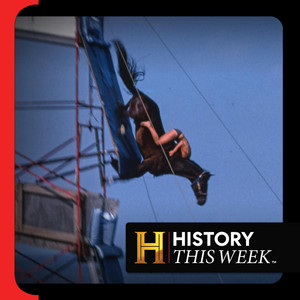
But what's even harder to imagine is that the diver in this show is a horse.
He's a Pinto named Red Lips, and he's been wowing crowds across America with his death -defying dives for more than a decade.
On cue, Red Lips begins galloping up the ramp.
A true showman, he pauses just before reaching the top and turns his head to one side, looking out over the spectators as they hoot and holler.
He then turns to the other side, taking in the applause, before continuing up to the platform.
There, waiting for Red Lips, is his co -star.
A woman wearing a swimsuit and a football helmet.
Her name is Sonora Carver.
As Red Lips gallops by, she grabs the harness around his neck and swings herself onto his bare back in one fluid motion.
She has done this so many times over the past 14 years.
its muscle memory. Their timing is perfect.
At the edge of the platform, Red Lips pauses one more time and drums his four hooves on the wooden boards for dramatic effect.
Then head first, he leaps.
They fall 40 feet. Moments later, the horse and his rider disappear into the tank with a splash.
Then resurface, triumphant.
The crowd erupts with applause.
What they've just witnessed is hard to believe, but what they don't know makes it even more unbelievable.
Sonora Carver, who just dove into a tank of water on the back of a horse, is completely blind.
Today, a woman, a horse, and a 40 -foot plunge.
How did diving horses become one of America's most popular attractions only to fade into near complete obscurity.
And what does Sonora's story reveal about the complicated relationship between risk, resilience, and entertainment?
The story of Sonora Carver and the Diving Horses starts with a man named William Frank Carver, better known as Doc.
Doc Carver was born, depending on who you ask, either in 1841 or 1851.
That's Cynthia Brannigan, author of The Last Diving Horse in America, a horse that she actually cared for in the 1980s.
As she learned writing the book, back in the 19th century, Duck Carver never let the facts get in the way of a good story, and he spends different versions of his past for different audiences.
He's a true showman, standing at 6 '4 with broad shoulders, long dark hair and a bushy mustache.
He gets his nickname, Doc, working as a dentist, but he's unfulfilled and at the age of 25 Doc moves west and takes up sharpshooting.
Within a few years, Doc earns the title of champion rifle shot of the world.
This lifestyle clicks in a way that dentistry never did.
he tries to distance himself from his past profession, branding himself to his audiences as a true Wild West old -timer, which is maybe why he starts lying about his age to make himself seem more experienced.
And soon, he joins up with one of America's most famous Wild West old -timers, William Frederick Cody, better known as Buffalo Bill.
Radio doesn't yet exist in the 1880s, so entertainment means live performance.
The two men team up to create a traveling show.
The Wild West Buffalo Bill and Dr. Carver.
Rocky Mountain and Prairie Exhibition.
It was sensationalized, featuring reenactments of frontier battles, trick -riding by cowboys, and displays of death -defying marksmanship.
Americans had not any familiarity with what was out west, but cowboys and Indians, it was a big deal.
So when they went to a Wild West type show, they really thought that they were seeing the real thing.
Duck Carver and Buffalo Bill debut their show in May 1883 in Omaha, Nebraska.
You would think, well, there's a perfect marriage.
They're both the same swashbuckling kind of guys.
But the problem was, of course, that they both had big egos and they both thought they were the star of the show.
Their show doesn't even last a full season.
After the split, both men spin off their own versions.
Buffalo Bill continues touring with his for decades.
As for Doc Carver … He took that all over the world, but he got tired of it at some point.
Doc wanted something even more thrilling, something that would top the spectacle of his sharpshooting days.
For this next act, Doc tells a few different origin stories.
In one version… It was a dark and stormy night.
He was going across a bridge and the bridge gave way into a river, and he found that the horse was able to dive into the river and then swim to shore, as he did.
That was one version.
The other version was that he was being chased by Indians, and purposely leaped off a bridge into a river and swam to a shore.
There's a third, totally different version of the story too.
That he performed in a play in Australia called the Scout.
And in that, they had a horse jumping off a pier into water.
Maybe he thought, hey, I could take this on the road.
So he did. Duck bills himself as the first person to train diving horses, but that might not be true either.
He is, however, definitely the first person to make horse diving a mainstream attraction for Americans.
In 1894, Doc debuts the stunt at an amusement park in Kansas City, Missouri.
A rider -less horse named Black Bess dives from a 40 -foot platform into a tank of water below.
And the crowd went wild.
The stunt is an instant success.
Doc tours with diving horses in his Wild West show for more than a decade.
at a certain point he thought, you know, it's good, but it could even be better.
How? By having a beautiful woman in a red swimsuit ride the horse bareback, of course.
In 1906, for the first time, Doc's show features a 20 -year -old blonde woman billed as Lorena Carver.
That isn't her real name.
She was likely born Lorraine Lawrence.
But Doc thinks Lorena sounds more exotic.
And marketing the act as a family business has its appeal.
so eventually he introduces her as his daughter, Lorena Carver.
Lorena joining the stunt marks a turning point.
The more dramatic, high -stakes performance quickly draws bigger crowds.
Horse diving becomes the centerpiece of Doc's Wild West show and, eventually, a stand -alone attraction.
Doc and Lorena travel from town to town with their horses and, over the years, they become a national sensation.
It was a big thing if the diving horses came to town.
It was impossible not to have heard of the diving horses.
By 1923, hundreds of thousands of Americans have seen Dr. Carver's Diving Horses.
After 17 years on the road with Lorena, Doc Carver wants to hire another rider so he can run two shows in different locations.
At this point, Doc is at least in his 70s and telling people he's in his 80s.
While in Georgia that October, he puts an ad in the newspaper, seeking, quote, an attractive young woman who can swim and dive, likes horses, desires to travel.
That ad is how Doc connects with our leading lady, the woman who would become the most famous diving horse rider of all, Sonora Webster.
Like Lorena, she'll also later adopt the last name Carver.
But in 1923, Sonora is 19 years old, living in her mother's boarding house in Way Cross, Georgia.
Surprisingly, it's Sonora's mother, who reads the ad and encourages her to go for it.
She was another mouth to feed.
If she wasn't living in the house, that was one less free border.
Sonora is resistant to the idea at first. In large part because it's coming from her mother.
But Duck Carver's traveling show happens to be in town.
Her mother takes her to see it the next day.
The horse diving that day is a dapple -gray mare named the Duchess of Lightning.
Sonora, a lifelong horse girl, falls in love at first sight.
In her 1961 autobiography, Sonora recalls, I thought she was the most beautiful animal I had ever seen in my life, or was ever likely to see.
Watching Lorena ride Lightning off the platform thrills her.
Sonora has always been curious and gutsy with a hunger for challenges.
The next day, she tells Doc that she's in.
Three months later, in early January 1924, she's on a train to meet his team down in Florida to begin training.
It doesn't take long for Sonora to learn that Doc Carver is not an easy man to work for.
He was a stern taskmaster.
He would do things such as berate her after a performance if she didn't bow to the crowd, and she was to always wear modest clothing, except when she was on the horse.
These things frustrate her, but she also has a great respect for him.
She writes, I was too fond of him and too proud of his pride in me to take an independent stand.
Sonora is also struck by how meticulously Doc cares for his diving horses, both on and off season.
He believes their comfort and dignity are essential to their well -being and performance, and he insists on letting them follow their natural habits whenever possible.
Still, the obvious danger of the stunt set off alarm bells for animal welfare groups.
They would make surprise appearances and really they were looking for abuse but by and large they weren't hurt.
The horses were treated well.
And crucially, as Sonora quickly learns, these aren't just any old horses.
She said the horses were like people.
Some had nerve and some didn't.
They would pick a horse at an auction that they thought had an interesting background that might lend itself to bravery.
For example, if a horse had been in a rodeo, then they would start off by having it jump a foot.
Then two feet, then they'd put water on the other side.
And if it flinched, if there was any hesitation at all, that was the end of it.
They would get rid of the horse and then start with somebody else until they found the right one.
When they did find the right one, They would gradually raise the height of the platform, little by little, up to 5 feet, 10 feet, 20 feet, and eventually the full 40 feet.
Sonora also starts her dive training on a lower platform, 12 feet high, after spending 3 weeks just learning how to ride bareback.
She's trained by Doc Carver's younger associate Al Floyd.
Al is a showman like Doc, with a short fuse, a big ego, and little patience for sugarcoating.
But he and Sonora work well together.
The first horse he trains her on is a thoroughbred named Klatawa, who's the liveliest of the five in the troop despite being the oldest. He's one of Doc's original divers from the days before he introduced a rider.
Sonora makes 21 successful dives from the training platform before Doc deems her ready for the full tower.
But to her surprise, he decides that her first full dive will be for an audience.
It's opening night at an amusement park in North Carolina.
Sonora wears the signature red swimsuit, brown football helmet, and white canvas sneakers.
7 ,000 spectators fill the stands.
From her dressing room, the electric hum of their voices turns her nerves into excitement.
But finally, it's time.
As Sonora climbs up to the platform, a numbness washes over her.
She's no longer nervous.
At the top, she waves to the crowd and pulls on her helmet.
She's ready. Then, the whole structure begins to vibrate.
Kletawa is galloping up the ramp.
A moment later, he's beside her.
She grabs the harness on his neck and swings herself on to his bare back, just like she practiced.
Klatawa pauses at the edge of the platform taking his time to pump up the crowd.
Sonora can only wait, the horse decides when they go.
Finally, he leaps. She talked about a sensation of absolute freedom, that she was separated from all earthly concerns.
It was she and the horse, and they were doing something magnificent and impossible and yet they pulled it off.
Sonora and Kletawa emerged from the tank, soaked and victorious.
Having passed the final test, Sonora earns a nickname from Doc, Daddy's Girl.
She starts calling him Daddy Carver and before long people assume that they're actually related.
Like Lorena, she doesn't correct them.
From that point on, She's a core member of the show touring and performing multiple dives a day and Doc props her up as a true co -star to the horses doc often had it billed as the bravest girl in the world and At a time when women had very few rights, they didn't have a voice That's a big deal so I can see she would like that who wouldn't but that title the bravest girl in the world will soon be put to the test. History This Week is now in its sixth season — kind of crazy — and we love bringing you these stories.
All of our work is supported by the ads you hear on the show, but if you don't want to hear those ads, we're now introducing History This Week Plus, available exclusively on Apple Podcasts.
For just $2 .99 per month, you will get all of our new episodes without any of the ads, And we'll be adding ad -free versions of our older episodes too.
So subscribe now and get your first week free.
History This Week Plus, exclusively on Apple Podcasts.
I'm CBS News chief Washington correspondent Major Garrett, and you're invited to The TakeOut.
No reservations required.
Every weeknight, our podcast serves up a balanced menu of politics, policy, and pop culture.
The day's happenings with curiosity, informality, and humor.
Serious discussion, but we don't take ourselves too seriously.
Follow and listen to The Takeout with me, Major Garrett, on the free Odyssey app or wherever you get your podcasts.
In 1927, Doc Carver dies at the age of 76 or 86.
His death is allegedly brought on by the death of one of his horses, the Duchess of Lightning, who drowned rehearsing for a special show in California, diving into the Pacific Ocean.
It's the only time one of the diving horses is killed by a stunt, and Doc is bereft. He starts experiencing heart problems, and dies weeks later.
When Doc passes, Al Floyd, his right -hand man, takes over the show.
He makes a few changes, like letting Sonora choose her own swimsuits, no more standard red, and she decides to stop wearing the helmet.
They have their first performance without Doc just three days after his death in Sacramento.
It goes excellently.
Despite their grief, Lorena, Al, and Sonora carry on what Doc started.
And the following season, they acquire a new horse who Sonora bonds with more deeply than ever before.
His name is Red Lips.
Touring together in the year after Doc's passing, Al and Sonora spend pretty much all of their time together.
By now, she's 25. He's 20 years older than her, but at the end of the 1928 season, he confesses his love.
They get married. It seems Doc Carver's habit of stretching the truth for the sake of a good story rubbed off on Sonora.
In her autobiography, she consistently refers to Doc as Al's father, and Al as Doc's son.
But Cynthia Brannigan says...
Doc had no sons. He had no daughters either, for that matter.
So the whole story of Ensign Ora fell in love with his son.
It's not true. It's a good story and they even made a movie out of it, but it didn't happen.
He didn't even use the name Carver until after Doc died.
In reality, it was all part of a carefully -crafted fiction, — a way to enhance the wholesome family business appeal of the act.
Sonora, too, legally adopts the last name Carver.
There were so many things that were exaggerated in those days.
Extreme exaggeration.
Even everybody thinking all the people were named Carver.
They weren't. That's Vicki Gold -Levy, a cultural historian and expert on Atlantic City.
Which brings us to the next big chapter in the story of the Diving Horse Act.
Just a week after Al and Sonora are married, they land a season -long contract at the Steel Pier in Atlantic City.
Today, Atlantic City is largely associated with gambling and rowdy spring break trips.
But in 1929, it held a very different place in the consciousness of the American public.
Atlantic City had ocean, emotion and lots of promotion.
Teddy Roosevelt said any person who didn't know Atlantic City wasn't a good citizen.
And the Steel Pier specifically was the centerpiece of it all.
The Steel Pier built itself as the showplace of the nation, and I think it was.
In 1929, it's a cultural landmark, America's premier entertainment destination, epitomizing the exuberance of the Roaring Twenties.
There are vaudeville shows and movie theaters, and a General Motors exhibition showing off cutting edge technology.
At the end of the pier, more than 2 ,200 feet from shore, a grand ballroom hosts nightly live music and dancing.
They had a lot of animal acts.
They had a seal that they fed and that did tricks.
They had the boxing cats, which were little gloves, and then they had the boxing kangaroo.
And I don't know how it was cared for.
But I know the boxing kangaroo could not get out.
Other acts in the water circus include daring aerialists, water sports performers, so -called Hawaiian high divers who weren't actually Hawaiian, and a human cannonball who launches into the ocean.
The steel pier management initially wants the horses to dive into the ocean too, but the team refuses.
The trauma of the Duchess of Lightning's death is still fresh.
So instead, the pier builds an elaborate extension, a grandstand for 8 ,000 spectators, the iconic ramp and tower, a water tank supported by hundreds of pilings, adjoining dressing rooms and custom stalls for the horses.
The horses were visual on the pier.
They had their own stalls with glass in front of them.
The show is a spectacle and a massive success.
From mid -May to mid -July, Sonora performs three times a day on weekdays and four on weekends.
From mid July through September, that number rises to four or five, even six shows a day.
The grandstands are almost always full.
The Diving Horse Act has never been more popular or more profitable, and Sonora has never been happier.
It was a good fit for them.
Doc never stayed in one place, but it was Al and Sonora who decided this is the way to do it.
After a roaring first season on steel pier they re -signed their contract in 1930 and 1931.
Sonora Carver and the diving horses become the main attraction at the premier venue in the nation.
They're flying high, but that's about to change.
It's July 14th 1931 on the steel pier, a night like hundreds of others for Sonora and Al Carver.
Al theatrically announces the show.
Sonora waits for red lips on 40 -foot platform, grabs his harness as he gallops by and swings on his back.
The horse does his signature dance at the end of the platform, and then he leaps.
But his angle is off, way too steep.
Normally, Sonora is tucked against the horse, but now she pulls her entire body back to adjust their path to the water.
It was just a matter of putting your head down and tucking it against the horse's neck, and for that one second she didn't.
Remember, Sanora is no longer wearing a helmet.
She hits the surface of the water face -first, instead of on the top of her head.
Her eyes are open as she hits the water.
They sting, but the pain quickly passes.
She slides off red lips back and waves to the crowd.
Then she walks backstage, changes out of her wet swimsuit, and starts putting on her dry one in preparation for the next performance that night.
Suddenly, white patches start to cloud her vision.
Al wants to call a doctor, but Sonora refuses.
She insists on continuing to perform that night.
And the next day, and the next two weeks after that.
But at the 9pm show on August 1st, it happens again.
Sonora hits the surface of the water face first. This time riding Klaataua.
When she returns to the dressing room, her vision dims, as if the room is filling with dark smoke.
She can make out only the largest, brightest shapes around her.
And still, she changes into a dry swimsuit.
There's one more show that night.
Al tries to stop her, but she insists.
The show must go on.
She and Red Lips make the dive.
Al wires a former rider to come replace her, but it'll take two days for them to travel to Atlantic City.
The next day is a Sunday, the pier is most popular, and Sonora refuses to cancel.
So with her vision rapidly fading, she performs another full slate of dives.
Finally, more than two weeks after her initial injury, she and Al go to a doctor.
The news is devastating.
The impact of the water ruptured tiny blood vessels in her eyes.
With each subsequent dive, the internal bleeding worsened.
Blood clotted behind her retinas, detaching them.
Doctors try everything, but in 1931, treatment for retinal detachment is extremely limited.
Sonora undergoes multiple operations and spends weeks in an inpatient facility, tortured not by pain but by forced stillness.
Despite these efforts, As the days pass, the gray fog darkens into an infinite black.
The damage is done.
At 27 years old, Sonora Carver will never see again.
Abercrombie's vacation essentials are 25 % off right now, and Spotify listeners are getting an extra 15 % off with code SpotifyAF.
Abercrombie's perfect pack means denim shorts, your favorite swimsuit and tons of boho dresses.
So book the trip and use code Spotify AF for an extra 15 % off through June 9th, 2025.
25 % off vacation essentials is valid in US and Canada through June 9th, 2025.
Applies to select styles as indicated price or flex discount.
After years of performing countless death -defying feats perhaps the most remarkable thing about Sonora Carver is how she handles going blind.
At first, of course, it's difficult to accept.
But then she writes, After considering the matter from every angle, I decided that the best strategy I could adopt would be to treat my blindness as if it were a minor detail rather than a major catastrophe.
I think that was the part where she was the bravest woman in the world because she didn't just say, Well, that's the end of my life.
Cynthia Brannigan, again.
She accepted her blindness and didn't want her husband to coddle her, she wanted to learn how to do things on her own.
After her time in the clinic, Sunora insists on feeding and bathing herself, her first small triumphs.
She refuses to use a cane, and after a few bruises, learns to navigate her apartment on her own.
Her other senses sharpen, and soon she's able to dress herself, apply makeup, iron her clothes, and pick up subtle details about the world through smell, sound, and most of all, touch. A lifelong bookworm, she finds the hardest part of blindness is not being able to read for herself, but she overcomes that obstacle too, by learning braille at a high level within just a few months.
She writes about that time, I never allowed myself the luxury of mourning over the loss of my sight, nor indeed had I any inclination to.
I was too busy learning to live in a world entirely new to me and usually managed to think of it as a kind of adventure.
But by spring, she's restless again.
Her husband, Al, begins prepping for the 1932 season at the Steel Pier.
Sonora can't bear the thought of missing it.
Then it hits her. If she's learned to navigate the world by touch, why not horse diving, too?
to her surprise and joy both Al and her doctor are on board with one condition she must wear a helmet with eye protection on their way home from that same doctor's appointment sonora and Al put in an order for a custom helmet and right away she starts training to rebuild her strength it's june third 1932 less than a year after sonora carver lost her sight she's going to make a dive with red lips.
Sonora hasn't done a single practice dive since losing her sight.
And the audience, they won't have a clue.
The audience didn't know she was blind.
Nobody knew. I mean her husband, doctor and Cluse Associates, but basically nobody knew.
Sonora wants to keep her blindness a secret out of pride and dignity.
And she is able to do so because her injury is internal.
There's nothing visibly different about her eyes, and she's trained herself to keep looking toward people when they speak.
If people knew, they might not want to see the act at all and just write it off as cruelty.
They want to maintain that air of magnificence, that they're doing something remarkable.
Sonora Carver buckles on her new helmet and begins to climb the ramp.
Counting the steps as Al theatrically introduces the act.
They're perfectly synchronised.
She arrives at the platform right as he concludes his introduction.
She had done it so many times she remembered, and when the horse eventually was set loose and came to the top she knew exactly where to grab and what to do, and she did it.
The crowd goes wild, even without knowing she's blind.
a standing ovation.
Back in her dressing room, despite not being able to see her reflection, Sonora knows she's smiling in a way she hasn't since her very first dive eight years earlier.
Sonora would continue diving blind for another 11 years, longer than she had dived while sighted.
Some seasons are spent at the Steel Pier, others take her to places like Lake Worth Casino Park in Fort Worth Texas.
It isn't until five years into this chapter of her career that she finally acknowledges her blindness publicly in an interview with a reporter.
The story quickly makes national headlines.
After it breaks, letters begin pouring in, dozens from people with disabilities, thanking her for inspiring them to continue living full, meaningful lives.
Realizing her impact, Sonora never tries to hide her blindness again.
Going blind isn't enough to stop Sonora from diving.
But in 1942 the strain of World War II finally does.
She and Al are unable to find enough laborers to set up a tower and water tank.
Then come restrictions on tires and gasoline, which have a big impact when you're a traveling show.
So Sonora and Al Carver decide that finally, after 18 years, it's time for the show to end.
Sonora is only 38 years old, AL -58.
They move to New Orleans, where he gets a job working nights as a motel desk clerk, and she becomes a typist for a nonprofit, the Lighthouse for the Blind.
Sonora becomes a staunch advocate, and lives to see the Americans with Disabilities Act get passed in 1990.
But Lorena Carver, Doc's original diver, isn't done with her act in 1942.
She brings her show to Europe shortly after the end of the war and then revives the stunt at the Steel Pier in 1953.
The act continues in Atlantic City for another two decades, concluding with its truly final performance on Labor Day Weekend in 1978.
Cultural historian Vicky Gold Levy got the opportunity to see this iteration of the show as a child.
Not only do I remember it, but here's a true story.
I worked on steel pier in the publicity office.
They were actually looking for a young rider for the horse and I was so enamored.
I wanted to try out riding the horse.
So my father came home in his Solomonic wisdom.
He said to me, I'm gonna meet you at the pier tomorrow.
I know you're working there and have your bathing suit ready.
So we went to the pier and he told me to go up the ramp and jump off without the horse and I couldn't do that.
So my fantasy about about being a horse rider was over.
Cynthia Branigan also saw the diving horses at the Steel Pier in 1964 at the age of 11.
She still remembers it vividly.
When the man brought the horse out, he let the horse loose at the bottom of the ramp.
He could have turned around, and said, I'm getting out of here.
I never was cut out for this line of work.
But he didn't. He ran right up.
And when he got to the top, There was a woman who leapt onto his back.
I saw him look at the crowd, then he looked out at the ocean.
He shook himself a couple of times.
And then without warning, he leapt off at the end.
A perfect arrow. You know, his front legs were outstretched and it was over in no time.
I think 10 seconds or something.
But despite the brevity of it, it seemed like it was in slow motion.
And you just saw that beautiful form of the horse.
and when he went into the tank, there was certainly a splash, but it wasn't like what you would expect.
It was smooth, it was pure.
I was kind of awe -stricken.
I was afraid for the horse, certainly I was.
Oddly, that was part of the allure.
Everyone was afraid, like, "'Oh my God, a horse isn't supposed to do that.'" But at the same time, he did it, and he did it beautifully.
It was sort of a life -changing moment that I didn't realize was life -changing at the time.
It was life -changing because Brannigan's book, The Last Diving Horse in America, isn't just a history book, it's a memoir.
Brannigan began working in animal welfare in her early 20s.
In 1980, she learned that the last remaining diving horses from the steel pier were being auctioned off.
Representing her employer the Fund for Animals, she attended the auction in New Jersey and successfully bid to rescue a horse named Gamal, the last diving horse in America.
She and the horse were both 26 years old.
Gamal lived under Brannigan's care for nine years, and they developed a profound bond.
Each of us had something to teach the other.
In the beginning, I would never think people work for a living.
Maybe some animals, if they're treated properly, they can work.
You know, I thought they should all be pampered pets.
cows, chickens, pigs, horses.
Now I can see it somewhat differently.
There's dignity in work.
He was a very dignified horse.
He was very proud and I came to understand that.
There is an attempt to bring horse diving back to the Steel Pier in 1993 by Donald Trump of all people whose Atlantic City casinos sponsored the revived act with mules instead of horses.
But animal rights activists convinced Trump to shut it down.
Should they have been doing it?
It's still something that I find very difficult to put together the risk and the reward. There is value in what they have to contribute.
Even if it is, quote unquote, just entertainment.
Because for me, when I saw the horse dive When I was 11 years old, it was some kind of a lesson in the impossible becoming possible.
And I wouldn't have had that lesson if I hadn't seen a diving horse.
Thanks for listening to History This Week, a Back Pocket Studios production in partnership with the History Channel.
To stay updated on all things History This Week, sign up at historythisweekpodcast .com.
And if you have any thoughts or questions send us an email at HistoryThisWeek .com.
Special thanks to our guests Cynthia Brannigan, author of The Last Diving Horse in America and Vicki Gold Levy, author and cultural historian of Atlantic City.
This episode was produced by Lyric Bowditch and Ben Dixstein.
It was sound designed by Dan Rosato and hosted by me, Alana Casanova Burgess.
For Back Pocket Studios, our executive producer is Ben Dickstein.
From the History Channel, our executive producers are Eli Lair and Liv Fiddler.
Don't forget to follow, rate, and review History This Week, wherever you get your podcasts.
And we'll see you next week!