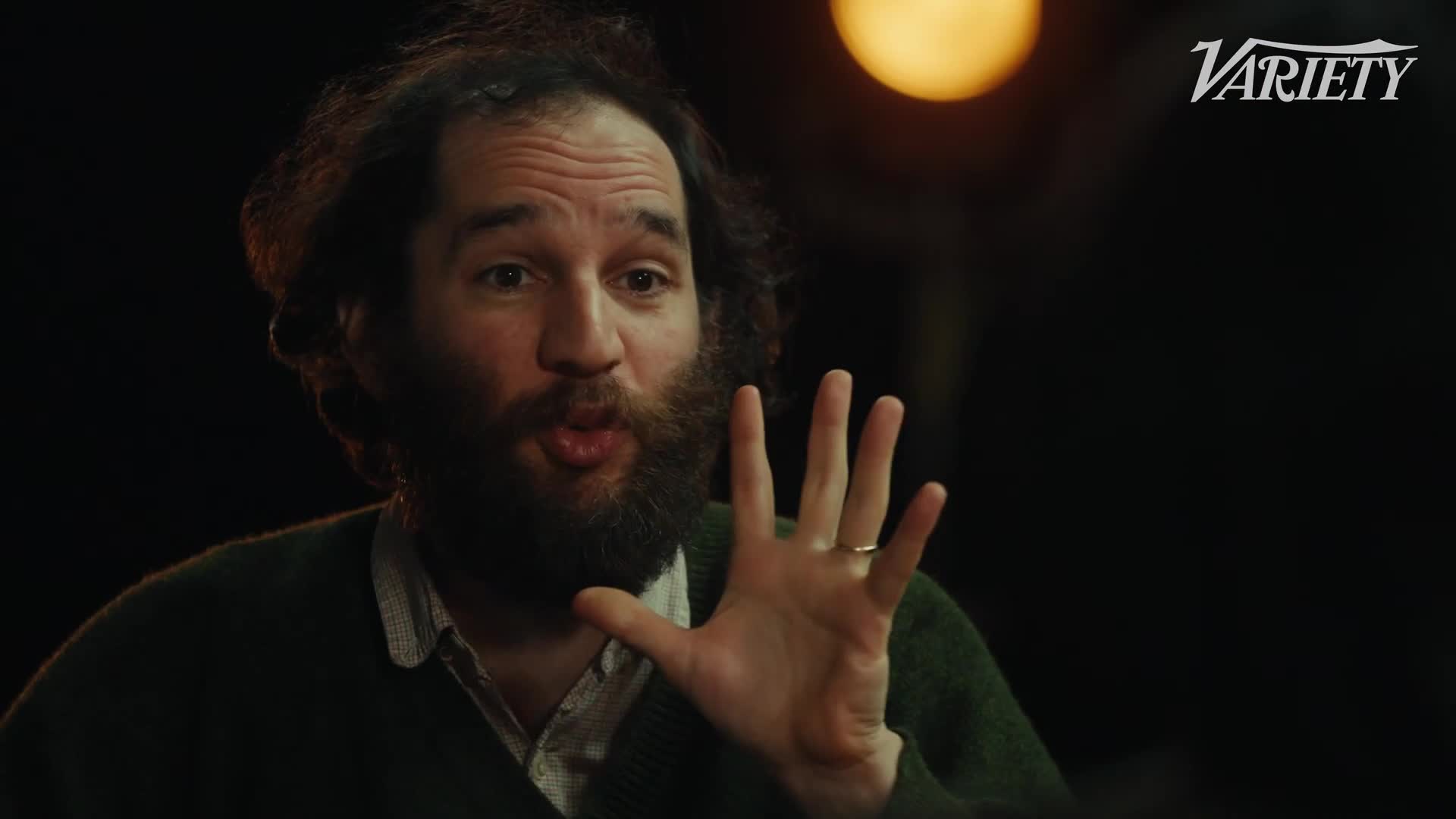
Told Tyler to really push it.
He threw his hand into Timmy and pushed the glass, his glasses, into his face.
We talked about different shades of menstrual blood.
Amazing.
I would smoke weed.
It was a self-punishing experience.
I would do it to inspect all of the things that I hated about myself.
I like your green sweater.
Thank you.
Yeah, I think we're both wearing green today.
Well, they said to me I couldn't wear black or navy.
And I had, because I guess I would blend in with the... They didn't tell me anything.
Maybe they just didn't want to tell you anything.
For me, they're trying to control... I thought this was like a handmade, you know, green.
Oh, I guess so.
I should have worn orange.
For... For the ping pong ball.
Oh, okay.
Yeah, it's funny.
You accidentally create these things that become iconic, like the burgundy dress.
So how many versions of the burgundy dress does Jessie have on?
Because it's like she's so centered and, you know, she's very centered.
It's great that you caught that.
We talked about different shades of menstrual blood.
Oh, amazing.
To the scalp of a wound, to a beating heart, right?
Everything in our body, there's all shades of red.
And depends on where Agnes is on her emotional journey, that red brown, burgundy will reflect where she is.
And that corset was made of tree bark.
A tree bark?
Wow, that's unbelievable.
What's interesting is like the new age movement.
I found your movie to be incredibly new agey, which in a beautiful way.
I love like, I once read this story about this kid who lived with his mom.
They had a pretty kind of fucked up life together and he and his mom would go to this New Age store where they sold rocks and different sorts of Oh, that New Age.
No, New Age is great.
It's a very special Obviously, like film, scores wouldn't exist without the New Age movement and your score is incredibly New Age.
But he and his mom, they would go and there'd be a rack of tapes and he would flip through them and each tape would have a different color and on it would have a different feeling.
So it would be like anxiety.
So you buy the tape, but they wouldn't look at the artist and the artist would become these legendary artists like Steve Roach or Peter Davison.
What do you think when you see red?
When I see red, it's so funny.
Just with my daughter, we were drawing and I was trying to get her to think about colors in an emotional way.
So red, I said, was anger.
Oh, well, she's got some rage, very righteous rage in there.
Oh, yeah.
Absolutely.
So what's the color?
It's passion, too.
That's an interesting question.
It's a fascinating question.
It's not the orange, right?
Brown.
Why?
It's my favorite color.
Whose favorite color is brown?
My favorite color.
Really?
Yeah.
Brown and orange are my favorite colors.
Because they said don't wear brown.
I wasn't allowed to wear navy or black and I asked if I could wear brown and there was like a kind of a hesitation.
So I was like, all right, let me see if I have anything else.
Please include this part.
I really enjoyed it.
But I love orange.
I love, like always loved orange.
What is the feelings of brown then?
Brown is earthy, is of the earth.
To me, it's like the color of fate.
Of fate?
Of fate, yeah, because it's a return, and your fate is what you were born into.
That's beautiful, like source.
Yeah, kind of.
It has like a poetic melancholy to it.
You know, I'm not a depressive person.
I'm actually quite, can be quite exuberant and enthusiastic.
It's how I like get everybody to do, to basically perform, including my co-writer.
But I think like at the end of the day, it's brown.
It's sad.
You know, there's a little bit of sadness and That's in your films.
The kind of paradox of emotions that are weaving through your films are between these
Yeah, that's interesting.
I mean, I like to think of my movies as like happy about happiness and like trying to chase it.
But that's the saddest thing.
A hundred percent.
Happiness is a very sad thing, which is a strange thing to say, but because it's so haunted and fleeting.
But I want to stay on that Brown for a second, because it seems like I've seen many, many of your films, including the earlier ones.
There is a running away from self, like the fear of staying still, which is so paradoxical to Brown.
Because brown is, like you said, returning.
It is that stillness that you could just be right here.
It's earth.
And yet, let's say in March or spring, right?
And I've gone through a midlife crisis recently realizing I was chasing horizons.
I was afraid of myself to stay still.
So your favorite color makes sense to me now.
The melancholic color?
Yeah.
Interesting.
Yeah, I didn't know if we were going to be talking about the colors today, but you never know.
But I do think that the menstrual color of Agnes makes a lot.
You know what's amazing?
And it goes back to this idea, this concept you're talking about running away from self and like and the earth, like all of your films, like the apex of Hamnet is in being in touch with nature.
Like all your other films, they're like about nature in many ways.
Human beings are about nature, but the land itself, and like the calling of the land and like to embrace it.
But this one was psychedelic almost.
I mean, when I say new age, I'm talking about like embracing in the ambience of a space.
And, you know, again, I consider my films quite new agey as well.
They're psychedelic for sure.
I think both of our films are pretty good to watch when on psychedelics.
Oh, really?
I can't.
My relationship with drugs is such a bad one.
When I would smoke weed a while ago, it was a self-punishing experience.
I would do it to inspect all of the things that I hated about myself and then put them in a category to study.
Hey, that's a form of work.
It was work.
When I would get stoned, it was a form of work.
Your inner dialogue with all your shadows.
Oh, it's terrible.
Just thinking about it right now is making me stressed out.
But your film, Touch the... Oh, it's real, great, good.
Yeah.
But your films, what I love about them is that they're not afraid, like Shakespeare's plays, right?
They're not afraid of the shadows.
You know, to me sometimes it's difficult to watch with your films, you know, because you really like your characters.
It's hard for me to get my character to the places that you get your characters to, story-wise.
Just the saturation.
They're in the kind of allowing their shadows to come up and like these compulsions to grab them completely and then to do things that are almost like unthinkable and then sometimes unforgivable, and yet still somehow give them humanity right.
And that's what I think a lot of the characters in Shakespeare's plays are like, because he was swimming with his shadows nightly.
Do they?
You capture that about him.
And I'll admit, I did not do well in school when it came to Shakespeare.
And this is no disrespect to people who love Shakespeare.
He's one of the godfathers of drama and tragedy and comedy. but just he never was like mine.
What was fascinating about Hamnet was, because I can always get into the psychology of somebody.
And if you look at someone's work, you can see it as an extension of their psychology.
And you certainly set that up in an interesting way.
And actually what I thought was really cool, which is something that I've struggled with in my own life, and people I know also do that.
Any person who expresses themselves.
You know, an expression comes from an experience, usually a shared experience, and someone else was always a part of that.
In film.
I end up like me and my writing partner when we're writing, we're both mining from real life, but we then obfuscate it with just so much, so many other ideas that come from who knows where an idea comes from.
Was that something that was a personal thing for you?
Of all the films I made, this is the one that I let myself seeing the most.
Back at you, which film of yours would you say?
You.
No, but just tell me and then I'll start.
Which one do you think is like you reveal yourself the most?
Sometimes it's usually the latest one, because we're older, now we feel safer to.
Yeah, my second one was pretty, But that was when I was a kid and that was me like telling the point of view of Daddy Long Legs.
Yeah, which I was so young when I made that, that...
I was able to see the character as a young person and somebody who was like in between you know.
I guess you know youth and becoming an adult.
What's interesting is all of your movies up until this one I saw, like your previous films as studies of others, which is so.
You know I can respect that as somebody who made documentaries as well and always was interested in fusing hybrid.
You know real life and using real people.
But it was crazy, you know, and I'm sure we can both be doing the period.
You don't have the luxury of being able to go and do that.
Which is why I initially said no, because I didn't know how am I gonna do the things I'm supposed to be good at.
But with the right support still, and just let go a little bit of the shackle of what is period correct.
Same here.
Right?
So just like oh, that sentence isn't period correct, but it came out of my actor in the present moment.
And then that is my truth.
So you gave them lots of freedom.
Lots of freedom.
Which I think, our films, even though we're such different on the surface.
Filmmakers cannot be more different.
But I think presence is big for us and because when I watch your films, I feel like you're not having some kind of vision of what you think things should be and controlling it to become exactly that.
But it does feel like things happen, like energy on.
Every day is different and you would go with that and then make sure you bottle something.
That is true because it happens in the moment and yes, still somehow control and make sure it works as a film.
That's the sweet spot and I do think we share.
We do have that in common.
Well, I saw in your extras casting.
You know I thought that.
You know I did that on my film.
Yeah, yours are so good.
I had 4000 extras or 3800 extras and I went nuts casting them all, because one face can ruin the entire period.
You know, you're known for really good extra casting since when I was in film school.
Is that true?
Yeah.
I always have the films that have great extras.
Well, lots of the time I don't even.
They're just the main characters that are, just Because at any moment I could, I want.
That's why, when I'm casting them, I want to know that at any moment I can bring them into the scene.
But I felt that way watching Hamnet and I thought that what was so impactful for me was the fabric of the movie that you really felt through the casting.
I mean, like, you know, Emily Watson's so...
She's amazing in the film.
Obviously, Jessie is so in tune.
We don't really know each other, but I felt like I got to know you just through your films and how you've always been so interested in nature and figuring out a way to tie yourself so closely to it.
Who am I?
Well, I don't know you, but I've heard this.
I'm the daughter of a forest witch.
Yes, people say that.
I am my mother's daughter.
When I watched Marty's frame, I was thinking about Timothy's character, and I see myself in that.
How so?
Well, the reason why I'm talking about menstrual blood, I'm talking about Earth and I'm trying to bring Agnes' character into my own consciousness.
You're right, all our characters are part of our own psyche.
And I'm very comfortable in Will's character.
But my own inner Agnes has been locked away for a long time.
That character did never exist in any of my films.
And you see yourself in Shakespeare too, I'm sure.
That's easier.
You know, someone who escaped into the fantasy.
So I can see myself in Timothy's character.
You know, I can see that and I can understand the return in the end when he, When he realized we can't control everything,
We become a film director.
You know, we're literally trying to control.
That's why I'm having anxiety disorders.
So the whole, the antidote to anxiety is control.
And you try to, and then when you do these period pieces I don't know if you found this, but working with Jack Fisk and you working with your production designer, like you end up I know the fact that he said I know.
You don't understand that first meeting with him.
I actually bothered him when he was making Killers of the Flower Moon.
And I wanted to know... Did you do it like Timothy in Mario Supreme?
Oh, every single person I have, yeah.
You're talking about selling of the ball and everything?
No meaning, like getting to Jack and get him to Oh.
Every single decision that I make within myself is a goal, and they're always impossible.
So it's like, I need Jack Fisk.
How am I going to get Jack Fisk?
And he says no to so much stuff.
And it was the footnote of history that was very interesting to him.
He loves like uncovering these secret paths and stuff that no one knows about, that you can't just see a picture of it and recreate it.
You have to use different parts of your brain.
Marty?
Yeah.
This woman said she bought a pair of shoes from you.
Oh, yeah, you bought the brown Mary Janes, right?
Yeah, I did.
They're great.
How are they treating you?
I wore them out of the store.
Okay. your films, you know, are very free.
You know, you feel like you can, you know, introduce a real person, and their soul and their life experience is gonna actually become a part of the writing.
But when you're doing these with these more structured, this period of, you know, Hamnet's period film, I felt that even in the people at the play at the end, like all the people around them, again it's this extra scatting, but all the
Clothing.
I went nuts with Miyako, my costume designer we, because for me, like the clothes that someone wears, It's like thinking about well, it's not the period, It's actually ten years prior.
If they don't have money, or if it's someone who has money, They're buying something from a week before.
And I sense that in your film in the level of detail I hope other people can like sense these things, because the the, The control, the idea of trying to control, but also give the freedom.
Because it's creating an environment that you have to pick the garbage that's on the floor.
You have to think about that.
You pick the garbage.
Well, Jack texted me at three in the morning once.
He's like, how are we going to find 38 millimeter balls?
Because they stopped making them when they tried to make the sport more entertaining in, I think, 2006.
So they don't make them anymore.
So we have to find 38 millimeter balls.
Amazing.
Because you can tell the difference.
That's why they created it, so that you can see it better on camera.
So he thinks that way.
And you would love him.
He's such a soulful, spiritual person.
Every person you hire, and you know this, is an addition.
Their souls are addition to the greater piece of the work.
And I believe you feel that.
Not to get too new agey, but I do think that.
I think with you and me, it's hopeless when it comes to the new age thing.
Let's just embrace it.
I know, because when I said that to someone, they were like, your film is New Age-y.
It's the most, they said it was like a panic.
And I never see them as panic attacks.
But the New Age movement is about getting in touch with your emotions.
And that is anxiety and stress and trying to control is a real one.
But I do think what you were talking about is this concept of control.
It shows up in your other films in a more kind of overt way, this idea of like what is a dream and like these things that keep us alive, to dream.
And i believe dreams are a way to try to control your own fate.
That you're like they're like my movie's like a heist film, but it's like a heist on fate, because this guy has this dream and he's gonna systematically and programmatically control it and win and get the bounty from his fate and it's gonna figure out what it is.
And in your previous films, dreams are like these eternal foundations of hope.
And in this one I found obviously Shakespeare has a very specific.
He has this idea of breaking out from the monotony.
But I think that she has this dream to be returned to Earth.
And her mother.
And her mother, that's right.
And her own motherhood in a way.
And when she can't go and give birth in the.
That was the most visceral moment in the whole film for me.
Because when she's not allowed to run and... give birth to ends up being the twins.
You know, that moment was very emotional for me, because she wasn't allowed to do what she wanted to do, what she believed was the right thing to do.
And in her mind, Having a child, you were meant to do it in nature.
And obviously my film, without spoiling it, is very much about that's the great creation.
And it's a very spiritual, cosmic experience.
Your movie is very cosmic.
But was that something that you and Jessie talked about?
Because that's kind of like when she's peak panic in the film.
No surprise I related to it. take that one moment.
That was in the book.
You know, because we adopted this from the book and this idea of at that time.
Now it's gotten better, but at that time, men and women in the body, the body has been restricted and controlled of how it should be and how a woman naturally gave birth that is most comfortable to the instinctually.
When the women know what to do is against how society thinks she should be right.
So to be in nature connected to her lineage, and that's where her mother probably gave birth, gives her that kind of strength that she would not get in the house.
I understand that.
However, If we're talking about control, recently a really dear friend of mine, a man, somebody who works in a field where he is in charge in control and he said to me The only time in my life and it's freaking me out that I feel like I can't control is when I am watching my wife having trouble giving birth.
Yeah, of course.
And it suddenly shook my foundation as a man.
And I realized in that moment, it's an illusion, you know, my control.
And I'm looking at the person I love the most.
I could lose her, and I could lose the child, and there's absolutely nothing I can do.
And what is beautiful about that is that One must come to that conclusion, which is why your films are powerful in the end, because the mystery Cannot be controlled.
Yeah and order and mystery order and chaos Is why the universe exists the masculine the feminine?
Which one's the feminine?
Chaos.
Chaos.
Yeah.
Our society condition us to be in control.
Ultimately, it's the fear of death.
The ultimate chaos is to return back to the brawn, to the womb, right?
And we're escaping from it.
So when you can no longer get to a point that you're in control in some weird way, that she's trapped in the house now.
She can't just go do whatever she wants.
And in your character, Marty's case, it got to a point where there's no, and that's the blessing, because then you surrender.
And once you surrender, and then you know the mystery. and then suddenly death is not as scary.
I think, in some ways, all your films are pushing them to the point of trying to hold on, and then that's the spiritual awakening happen.
Bam, they have nowhere to go.
This one, and I see it in yours as well, is about change.
That's why the first word you hear in the movie is change.
And I think dreams are the only real agents of change.
The success or failure of them or the journey with no end to that.
The dreams are often more about the journey.
But I'll say, I disagree.
I think the man is chaos and the woman is...
Well, it's not a gender thing.
So you have both energy inside of you.
Of course, absolutely.
So I would say your chaos energy is strong.
Oh, I see what you're saying.
You're saying centered inside of us, isn't it?
Oh, yeah, yeah, we both have those.
I think yin-yang, right?
So it's not a gender thing.
We both have, some people have more of that chaos energy.
Some people has more order.
And it turns to be that if your energy is more chaotic, your life is more about control, and vice versa.
So you see the super chaotic people actually has a lot of control and vice versa.
What is beautiful about it, because in nature it's like that, complete chaos and yet total order.
And I find that being on set say working with the actors trying to get them to go can you hold the tension between knowing and not knowing?
Because I need you to have a container for the character, but I also need you to let go to the mystery.
You're having that exact conversation.
Well, I asked them at the beginning.
I said, hold it.
That means coming in, have some intention, but not knowing where the scene is going to go.
They don't practice where it's headed.
If I come in every day and know exactly what's going to happen, then it's just mine, and that's pretty damn small.
There's something so much bigger.
But then if you don't have a container for it, it's just chaos.
It's not going to be a film.
So how do we find that balance to be half of the time a container, half of the time a channeler for whatever comes through in honor?
Time is kind of a container in general.
That's one, for sure.
That's one.
There's few things that exist outside of time.
Love exists outside of time.
I remember Einstein once tried to explain relativity to somebody.
He said, Everyone knows that an hour with your hand on a stove is an eternity.
An hour with the person you love is over in like a second.
And I'm pretty sure Einstein said that.
I just tried a layman's term to try to explain.
It makes him look good if you just say that.
Yeah.
I mean, he was a romantic.
But I tried to find meaning in like the micro.
And I believe in psychoanalysis.
I believe in... you know, the development of a brain, early childhood trauma.
And I try to give all the actors that so that they can have some semblance of internal monologue which is some version of.
That is absolutely container.
Yeah, that's exactly.
And then when I'm on set, sometimes you know I'm chasing something like I spent all this time writing, writing the script, six years in this one and in the scenes I'm chasing I'm somehow always trying to transcend the you know the situations, trying to get the actor to transcend.
But you can only do it so much, and you, I would rely on being on set with the performer and bringing them and having seeing them attach themselves to a moment and all of a sudden it transcends past the page, the camera even.
And you push the actors to that place and the best way to do it is by throwing stimuli at them so it catches them off guard.
Give me an example.
It's because you clearly you brought things out of a lot of your actors that you haven't seen them do before.
It's a huge moment in the movie.
It's so small though.
And if you watch it in film Tyler Carey, Tyler Kahneman, who plays Wally, who's like his friend, who doesn't have the luxury to dream.
And there's a frustration there based on who he is, what body he was born into.
And they're doing this hustle at the bowling alley.
And it's a play.
Marty's an actor.
And in this moment, Wally is too.
And Marty's playing the heel.
And Wally's playing the victim.
And he's getting everybody to kind of buy into him.
And they're rallying behind him.
And I told Tyler to really push it in his anger at Marty.
And one take, he really pushed it.
He threw his hand into Timmy and pushed his glasses into his face.
And in that moment, you're seeing all the extras.
I had extras throwing lines in all the time to catch Timmy off guard.
So he's constantly having to interact with them.
So he's trying to hold his own in this performance, which is the performance inside the scene.
And in that moment you're seeing Timothee Chalamet kind of be like, oh my God, this guy just pushed me in my face in front of all these people.
And there's a humility in that moment, but it's underneath the performance.
And it's one of the most moving moments in the film.
And I always tell Timmy that, and I thank Tyler for being able to go there.
Because the first take, he did it, and I didn't say, do it again.
I just was like, oh, that was interesting.
I saw Timmy, but then he took it to the next level.
And those are the moments when you can again, where you're seeing your actor transcend and kind of fuse with themselves.
So satisfying.
Oh my God, yeah, it really is.
But I thought, you know, again, like, That's when you set up the scenario in such a way that gives them the freedom to do that.
I felt that at the end of Hamnet.
I mean, the beautiful moment when everyone's reaching their hand out.
You know, you really can feel again.
It's the faces, it's the costume, it's the beautiful way the film is shot.
It's also the energy of the people there which, in that scene, you're talking about.
Not only you handpicked them.
There was a synchronization.
There's an energy that builds and builds, builds right.
And it comes through on screen.
And for us, we had, we worked with this amazing woman, Kim Gillingham.
She is a dream work coach, come from a union tradition.
So before I even wrote the script, Jessie and I were doing dream work together.
So our dreams already started mingling.
And by the time we got to the Globe, the cast and crew all went through DreamWorks the kids, and then she would be on the stage and she would drop in, drop 300 people under in the somatic meditation.
So everyone went through that.
Oh yeah, so they're all in a collective dream.
And then we have Max Richter's music playing on repeat.
So there's something about- On set.
On set, always.
And there's something about somatically harmonize the vibration of people.
Because we are made of vibrating particles from the universe.
And once they got vibrate to the same place, is incredible how much, how little I needed to do.
Because then they're moving as one organism, which in your films, they are.
They just had a different vibration as mine, but they feel like an ecosystem.
They're plugged into the...
My sound mixer, he came up to me.
He had a hard job on this film because I just let everyone talk.
And there you have 12 bowling lanes.
You have four ping pong tables.
And you have 30 people who are just talking.
And he came up to me.
Whatever did a good job.
Oh, it was hard.
He came up to me.
He's like, you're not going to be able to use this.
I was like, can you hear it?
He's like, technically, yes.
I was like, then it's fine.
Then it's fine, yeah.
It was hard.
Skip Livesay, my recording mixer, he like really did a lot of work to fix it.
But it's kind of like the anti-meditation.
I'm trying to get everybody.
Yeah, a different kind.
Yeah, for sure.
No, but he's...
I would play music for in certain scenes.
I would play music that would like when they're pulling up to the farmhouse in Odessa.
And also the people you're casting, like they're bringing an energy.
Mitchell Wenning, who I worked with a few times, he just doesn't stop.
And I would tell him, talk about your brother, talk about your brother.
And he'll just go into the story.
And it just became this background noise.
And then I'm playing music and sounds like someone's playing music.
Who is that?
I was like, it's me.
I'm playing music off of the walkie.
Yeah, because meditation doesn't mean it has to be like that.
It is about harmonizing everyone into the same vibration, whatever that vibration level.
You can be at a football game. and everyone is chanting with the most intensity, and you still live.
It's tribal.
Totally.
Warriors come back to war.
What is helpful?
Back in the days they're beating drums, they're screaming, they're dancing around the fire.
That's what your film sometimes feels like.
There is that kind of... pulsating, what's the word, throbbing.
Energy to it, so mine is on the other, the leaves blowing, when it's the other side of it.
I would call it, in some way, beautifully masculine and feminine.
And I do think that when you get to the end And it's just knowing you now, where you are in life, and also just seeing how it is, the things, the feelings, the love,
You can't control it.
You have to surrender to it.
And in a way, for Agnes, it's the same.
If you truly love something, someone, let them go.
I see you in London working with your father.
Yeah. this year.
I would just say from earlier that the details that you're talking about in the Globe Theatre my production designer, Fiona Crombie.
She would put on little posters of the plays that were happening around that time.
She would do this little research and then all these details.
I didn't know they were doing, but Poe and Jesse I like hearing them talking about it more so than me noticing the production design.
As an actor, when I go around the set, Yeah, absolutely.
Because they are, especially if they're given freedom, they're going to be interacting with that world.
How it smells, you know the texture of everything.
So I think both of us got very lucky with production designers.
That's going to build a world so we can work with our actors that way.
Absolutely.
McCabe and Mrs Miller.
The production designer was a hero of Jack's because he saw me in my casting process with Jen Venditti and she and I went through like we went through our entire.
She loves your film.
We went through our entire history of working together and we went and was like everyone who didn't make it into the previous films.
Let's bring them back.
Because they're all the people we were attracted to because she does these intense interviews.
So I was saying to Jack, I would show him, these are the faces in this scene.
And he's like oh wow, you know, on McCabe and Mrs Miller, They went and grabbed the production design team, went and grabbed people from the town and put them on the set because they'll just make it come alive.
And he thought the same way.
And he met his wife, Sissy Spacek.
He fell in love with her on Badlands.
He was the art director and he would put little flirtations inside the set.
I think I've heard about this.
I mean, so that's like, and you're seeing that.
She has that.
She has that vibe in the film.
You know, it's interesting about what you're saying.
And, you know, I saw your film in a theater.
You could feel the energy of the people around me.
And you know, there was some older women who were completely hysterical, like inconsolable, to the point where I'm like, oh no, you can't help but notice it.
But it added to the moment.
And, you know, I think that that's a...
It speaks to the power of a theatrical experience because it really did.
I've seen some of my favorite films I've watched on my 10-inch television at the foot of my bed.
But then you go and revisit them when they're in theaters and all of a sudden you're feeling some sort of collective energy.
Even if you're the only one in the theater, just the void that you're in.
You're in this negative space.
Time doesn't exist anymore.
When you come out and the light hits you if you see a matinee I don't know if when you saw what you feel like when you see films in theaters or if that matters to you.
It does matter to me.
But I also have a feeling both ways, because on one hand I spent a lot of time in South Dakota many, many years, you know, on the reservation.
And the fact that Daddy Long Legs can be seen by a kid on the reservation, who had a similar experience as you did, and that's the only way they have access to that is online.
The greatest filmmaking, film-watching experience I had was on the street with some of the homeless kids who I was researching with.
And we watched an entire film on a cell phone and it was very powerful.
And then I brought some of the lead actors into a movie theater and they were just like oh wow, we get to be in a movie theater.
The accessibility aspect is great.
At the same time, like you said about being with people in a space, right?
Like we kind of we come from the lineage of people like Shakespeare.
When Hamlet was written, it was around the time of the plague.
So many people experienced so much death and loss.
And his job is to every day ceremonially bring a group of people together into a sacred shape.
And then tell a story so they can have an experience together.
It's a form of like church going if you're not belong to a traditional one.
And so sometimes with theatrical I think, we keep focusing on the specs.
You know how big the screen is, what the screen is made of, what format we shot all these fancy things.
But sometimes we forgot about the importance of the human being part, which is cannot be replaced by any, you know?
Yeah, you're pointing out the right thing.
They're two completely different experiences and they're both incredibly.
I mean look, a thousand years from now, you know, barring an electromagnetic catastrophe, you know, the only thing that will be left are the films.
And, you know, some other intelligent life force, they might not have eyes.
They might be gone, except the ones like Sean Baker, who did the 35-millimeter plan.
I do that too.
I do that too.
I knew you did.
Yeah, I do that too.
You guys, because I got a call, I said Chloe, you gotta- Because all you need is light to understand what it is.
Yeah, I said, you gotta have to have your film printed in a 35 millimeter can.
Expensive though, yeah.
And then bury it somewhere in the north, somewhere in a time capsule.
I remember hearing that and I think, I'm gonna surrender.
Yeah well, I mean, it is scary when you think about an intense solar flare or something, and every hard drive is wiped.
It sounds kind of freeing, you know, like they say.
I'm okay with that.
In the future, everyone's going to want to be anonymous for 15 minutes.
It's like...
You start to think about that.
I'll have you and Sean's film in the North.
We'll go find it.
It's just the idea that you won't need any technology to see it.
Carl Sagan did the Voyager record and on the back was the etchings of seminal human achievements, so that they can see general physics and equations and drawings.
And on the back was music that he thought was essential to give a portrait of America.
But that's kind of hard.
You get a disc, and you have to understand that there's information buried inside the grooves.
But I think film is more intuitive because you just literally hold it up to light and you're like oh, there's a sequence of images.
Where do you think the compulsion and the desire of leaving something behind come from?
For human race?
I think impermanence.
There you go.
You know, I think that that's you know, that's like the, you know the big fear of death and things like that.
It's just, you die when someone stops remembering you.
Which is, your film has that.
Impermanence 100 completely when you were starting to think about the film, had you met with Jessie?
Because she's so in tune with the character.
So I actually did not, wasn't sure if I would do the film, for the reason you mentioned earlier about being a period film.
Am I going to be able to have the freedom?
Also the subject matter, I wasn't sure.
And then I actually met Paul first.
Didn't know who he was, but there was something about him, which I assume you cast that way as well.
There's something, it's not about their resume.
No, not at all.
But there's an energy.
Otherwise I wouldn't cast first timers all the time.
Exactly.
And so there's something about the energy of them and also something about them.
Maybe they have not allowed the world to see that I can have an opportunity for that.
And you like that too.
Absolutely.
Film, if it has any pure value in terms of pragmatic value, is that it's documenting you know well the human spirit and the human beings themselves.
And the characters are really what keep you invested.
And you know, being able to cast certain people to play certain characters you just want, I mean, I'm always rewriting for the casting decision.
I'll watch, like, Emory Cohen's audition tape that Jen said shook her soul.
She was, she called me freaking out.
And I watch his decisions and his improvisation, because I just gave him a one-page description of the scene and he improvised it.
And it was the scene when he's throwing shit around.
And it was just, you saw a man frustrated by their place in the planet.
He's so good.
Yeah, he's great.
And Timmy, like, it's strange.
I wanted to work with Timmy, and I hadn't seen him in anything.
After I had met him, someone was like, oh, he was in Interstellar.
I was like, oh, yeah, he was in Interstellar.
Oh, that long ago?
Yeah, I met him before Call Me By Your Name came out.
And I just met this kid who had this supreme vision for himself.
And he felt like he was a dreamer, like an intense one.
Like the dreaming almost was pathologized.
And I could tell he was trying to control where he was going.
And the energy was intense.
And then I'm watching him in these other films.
I was like, no one's exploring that.
You know he did great in those other films.
But I was like, oh wow, this side is still kind of untapped.
And he did Dylan and Marty in the same year.
And we had about four months in between.
And I would never want one of my actors being bothered with the script during production.
So I didn't send him anything.
I respected what he was working on as I would want someone for me and my production.
And so when he rapped that day, he came to my office and like, I gave him all this booklet of, you know two, three hundred pages of just images and research, and you know the script.
Because he had been reading stuff before he went into production on Dylan.
And he was still, like, in Dylan voice.
He was still, like, acting like Dylan.
But Dylan did unlock a certain way of trying to control your narrative.
Oh, that makes sense.
Which was interesting and helpful in a way.
Uh, you know the doc on dylan, there's so many scenes inside of that penny baker film that are evergreens of inspiration and he saw the scenes that he saw that aren't necessarily in that film where he was like, oh i could see marty in this scene.
So that was helpful in one regards.
But it was over the years and getting to know him, things that I knew were very impactful in his life.
And that's the trust that you have with an actor is they're willing to share lots of personal things that you can then express.
You hope that it's a tool for the actors as well to express themselves.
And that was the case with every single person involved in the movie, which was helpful.
You know, Gwyneth is coming out of not working and she felt there was a vulnerability there.
And the first thing we shot, I made sure it was her returning to the stage.
So not only is she acting in a film again, I put her on a stage And I have David Mamet's running around directing her.
I didn't even I just kind of said, David, you do it.
Lock it so I can see how the actors respond.
Even Abel Ferreira, like him bringing, and when you cast somebody, you're bringing all of your baggage with them, which is why first timers are so, you know, impactful because you don't know them.
You have no baggage.
You just have their existence.
But with an actor like Gwyneth, you're you're bringing every movie that she's done.
And to play a movie star, it's kind of, it's cashed in your brain.
No one even remembers that he's in the movie because he's so incognito.
But Penn Jillette, the magician, you know, you don't know if he's telling a lie when he's saying the, I don't know what you're talking about.
That dog is my dog for years.
So you're trying to align yourself with who they are as people like you're saying.
For someone who, you know, needs to be in control or... You're in control too, though.
I'll come out with both control.
Yes, of course.
But we're working on that, you know.
Are we, though?
I am.
Okay.
You should.
But for people like us, who you know, for various reasons, how we grew up, we had to to survive as children.
And I think when we come to work, we try our.
We are, in a way, healing ourselves by allowing people to come as they are and then allowing ourselves to let go a little bit of that, because we can't deny that.
And that's satisfying for us, right?
For someone like Agnes, if you sat in the theater and you look up at the screen and you felt dissonance, that she's hiding something from you, she's wearing a mask, she's not giving you same with Timmy's role, that she's not being present and giving you everything that's coming through you.
You're gonna be gone.
Yeah, absolutely.
She's a woman of the woods.
Yeah, absolutely.
So for me, sometimes vanity is very dangerous because it kills authenticity.
It makes an actor to stop themselves from being present.
Unless the character is very vain.
Unless the character is very vain.
So I find that Jessie had that ability, that vulnerability.
She was a rock.
And you're able to somehow.
However you did with the environment you created, we both did just through different vibration, but somehow their masks are down.
And I think that's why, even though we're so different, we actually have a lot in common.
And I think this is time to say goodbye.
They are telling us to say goodbye to each other.
Yeah, I don't know.
I'm being told to say goodbye.
So we're gonna break the fourth wall.
Yeah, we're gonna break the fourth wall.
And we'll say goodbye even though we're gonna talk to each other probably.
Yeah, so as soon as we cut, we're gonna keep talking.
Yes.
Yeah, it's good to see you.
Nice to see you too.