NPR. This is The Indicator from Planet Money, I'm Weilin Wang.
And I'm Darian Woods.
Yesterday, the Federal Reserve decided to leave interest rates unchanged.
The bank said the labor market is still solid.
But it said there is more uncertainty about the economic outlook.
Fed chair Jerome Powell also said that if the announced tariffs remain in place, there's likely to be higher inflation and unemployment, plus a slowdown in growth.
Powell signaled that the Fed is in no hurry to take action.
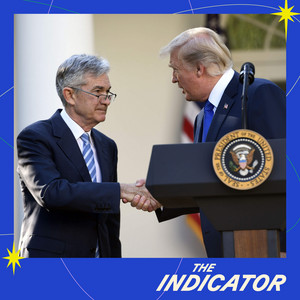
This stance is unlikely to sit well with President Trump.
He wants the Fed to cut rates.
And his animus towards Powell is well -known.
Take these comments in an interview to add over the weekend.
He just doesn't like me because I think he's a total stiff, and, you know, it's just one of those things." These insults echo the verbal diatribes that Trump made against Powell during his first presidency.
Today on the show, an economist and Fed watcher tells us why Trump's attacks on the Fed chair represent a greater threat than the first time around.
Chris Hughes has a certain morning routine that goes something like this.
I try to make a cup of coffee and spend about five whole minutes not looking at my phone before I sit down.
So I try to have five minutes of sanity but every morning it never stops.
Chris is an economist and writer.
He's also a big Federal Reserve history buff.
And so lately when those five minutes of sanity are up and he ventures a peek at his phone, he's scanning the economic headlines looking for news on the Fed.
Like, last month, when Trump told reporters he wasn't happy with Jerome Powell.
If I want him out, he'll be out of there real fast. Believe me.
If I want him out, he'll be out of there real fast. Chris says just about every Fed chair has drawn criticism from the Executive Branch since World War II.
This has been especially true of Powell, who Trump picked for the position.
And remember, the Fed's job is not to do whatever presidents want.
It has a mandate from Congress to keep inflation in check and promote maximum employment.
One of the Fed's most important tools here is setting interest rates.
Interest rates have been Trump's big grievance with Powell going back to his first presidency.
Trump wants lower interest rates to stimulate the economy and he accuses Powell of being too slow on cutting rates or only delivering rate cuts to help Democratic politicians.
Trump's complaints about Powell are basically the same as they were during his first presidency.
Still, Chris says, this time feels different.
This is not just pressure from the White House, this is a threat to the very nature of the institutional design.
And so that's what makes this moment different.
Yeah, so institutional design, as in how the Fed was set up by Congress.
Congress is its boss, and Congress has decided that the president should appoint the chair every four years, and so the President has some ability to direct its operations.
But as an institution chartered by Congress, Congress has also decided that it needs to be insulated from the ups and downs of the political environment, so that when a President, for instance, wants looser monetary policy, the Fed does not need to immediately respond.
I think that institutional design really matters.
I think of it more as insulation, to be honest, than independence per se.
What's the difference there, and why is it important to you?
Well, I think independence conjures up this idea, the Fed's going to do what the Fed's going to do.
It doesn't really care about Congress.
It doesn't really care about the executive branch. That's not consistent with the facts of history.
You can see in their transcripts from the 1950s to the contemporary environment that live in, that they are thinking about how their monetary policy will dovetail or be in conflict with what Congress is doing, with what the White House is doing.
How it's going to look and seem to financial analysts, to the media, to voters.
And so independents suggest they're on some other planet or the moon or something and I don't think that's right.
And whether you call it independence or insulation, the consensus is that this relationship is vital for a well -functioning economy.
Academic research shows that central bank independence is correlated with lower inflation.
There's also the matter of the law.
Powell has said the president is not legally permitted to fire him.
Chris says this is because the law only allows the Fed chair to be fired for cause, and that's generally interpreted to mean really bad behavior, like negligence or malfeasance.
— The precedent for this legal protection actually dates back to a 1935 Supreme Court case.
It's called Humphrey's Executor v.
United States — or Humphrey's Executor for short.
Humphrey was an FTC commissioner who President Roosevelt tried to fire.
— The Supreme Court was clear that the president can't do that.
Congress has decided that this institution has leaders that are appointed by the president, but cannot be fired unless there has been negligence or some kind of abuse of power or something that rises to the four cause standard. And that's the law.
And that's that's basically the the guardrail we have against Powell just being kind of fired on a whim.
It's the law. I mean, is there a case to be made, if you were so inclined, to say that Powell's leadership of the Fed has been negligent?
I'm trying to imagine how you might try to spin this to make it fit within the bounds you're shaking your head.
Well, I think the use of the word spin is the operative one.
I mean, they might try to spin it in all kinds of different ways.
But I think it's quite clear that folks inside the building at the Fed do not think that Powell has made any mistakes that would rise to the four -cause standard. I think folks in Congress, for the most part, don't think that.
Economists certainly don't think that.
People on Wall Street certainly don't think that.
I can imagine the White House trying to develop a spin, to use that word, to make that case.
But I think it would be Orwellian if they did.
What does worry Chris, is that the Trump administration is now challenging this legal protection.
It has fired other agency officials whose jobs are supposed to be shielded in the same way as Powell's.
These people include a Democratic member of the National Labor Relations Board and two Democratic members of the Federal Trade Commission.
These are folks who can only be fired for a cause, it's in the law, in the FTC act, for instance.
And that is also true in the Federal Reserve Act.
And so now there's actually a fact pattern of him just ignoring the law.
And so it feels much more real that he might do that at any point.
The firings of the FTC and NLRB officials are now moving through the legal system.
The Department of Justice is arguing that this legal precedent from 1935 prevents the president from adequately supervising officials who execute laws.
Back in 2018, Powell reportedly said that if Trump were to fire him, he would personally spend his last nickel fighting Trump to retain the Fed's independence.
If Powell feels the same way today, that could lead to a messy legal showdown that would cause upheaval in financial markets.
The calmer scenario is that Trump sticks to his most recent public statement that he has no intention of firing Powell.
The Fed chair has just a year left in his term.
Chris says the rational thing for the President to do would be to let Powell just finish it out.
Listen, lots of presidents haven't liked their Fed chairs.
What you do is you wait until their term is up, you say thank you very much for your service, and then you appoint the person that you want.
So, laws are one thing, but I think it's worth pointing out that whether it's Wall Street or academic economists or Washington advisors, there is a huge groundswell of people who believe in the independence of the Fed.
And so that is one thing keeping drone power in their job.
Yeah. I mean, we've seen what happens when markets get spooked, especially bond markets.
I mean, the administration responds, right?
So that might be at work here too.
The fourth branch of government.
The market. Oh no. Yeah.
Like, who needs... who needs the media?
We just have financial markets.
People thought it was the media.
No, it's Mr. Market.
This episode was produced by Julia Ritchie with Engineering by Sina Lofredo.
It was fact -checked by Sierra Juarez.
Kate Kinkanen edits the show and the indicators a production of M .P .R.