This BBC podcast is supported by ads outside the UK.
Have you ever wiped with a piece of dry, single -ply toilet paper and wondered, is this as good as it gets?
Well, it's not. It gets a lot better thanks to the wet, extra -large cleaning power of Dude Wipes.
They comfortably clean up whatever TP leaves behind on your behind.
It's time to stop being an A -hole to your B -hole and start experiencing the confident clean of Dude Wipes.
available at amazon and at major retailers nationwide dude wipes best clean pants down from coast to coast unlock adventure at red lion hotels by senesta where restful sleep friendly service and local knowledge await whether for business or pleasure spend less and make more of every trip when you sign up for the senesta travel pass you'll get their best rates instantly Go to Synesta .com to book your stay and unlock their best rates with Synesta Travel Pass.
Here today, Rome tomorrow.
Join now at Synesta .com.
Terms and conditions apply.
This is the Global News Podcast from the BBC World Service.
I'm Valerie Sanderson and at 13 hours GMT on Thursday the 26th of June, these are our main stories.
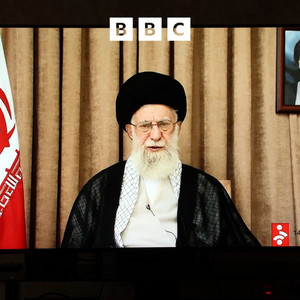
stories. Iran's Supreme Leader Ali Khamenei has said U .S. strikes on his country's nuclear facilities achieved nothing significant, a claim strongly refuted by the U .S. Defense Secretary.
After nearly two weeks of war, what do Iranians want from their leaders?
Put your microphones in front of the people.
Go and ask them what they really want.
What do they want? Freedom.
Simple as that. Ukraine's top general says the army has stopped a Russian advance in the Sumy border region, but there's an urgent need for more fortifications.
Also in this podcast, North Korea opens a huge beach resort and...
The genie is out of the bottle.
If an organisation who has access to the appropriate machinery decided to just simply start synthesising anything, I don't think anybody could stop them.
Scientists begin work on a controversial project The Supreme Leader of Iran has been in hiding ever since Israel began its attacks two weeks ago.
In the past couple of hours, he's given his first televised address since the ceasefire, in the form of a video recording broadcast by state media.
Ayatollah Ali Khamenei claimed victory over Israel and said Iran had delivered a heavy slap to the US.
And he gave his take on the big question of the moment, how much damage did the U .S. bombing at the weekend do to Iran's nuclear program?
He acknowledged that the Americans had attacked the Iranian nuclear facilities, but said they couldn't achieve anything significant, and the U .S. president exaggerated the description of what had been done.
He also threatened to carry out more strikes on American bases in the region if Iran came under attack again.
Siavash Adelan from the BBC Persian service gave us his analysis of the Iranian leader's message.
Predictably, he presented Iran as a victorious side in this war, very much along the narrative that state media has been pushing over the past two days since the ceasefire came into effect, that Iran managed to defeat Israel, managed to impose a peace both on the US and Israel.
So the Supreme Leader here congratulates the Iranian nation on two counts, on counts of defeating Israel, crushing Israel, and also defeating the United States, making direct references to President Trump's statements yesterday about the Iranian attack on the U .S. military base.
Now, depending on whose side you listen to, President Trump made it sound very easy.
We're just going to hand them a piece of paper.
They're going to say we destroyed their nuclear industry.
They don't have a nuclear weapons capability, so there's nothing really to talk about.
whereas what Ayatollah is saying is very different.
He is saying that U .S.'s attacks did not inflict significant damage on Iran's nuclear centers, very much at the same time when in the U .S. it's embroiled in its own controversy over how much damage has been inflicted.
He said it didn't inflict significant damage.
The issue of nuclear enrichment was just an excuse for an attack.
He didn't say that Iran will continue to stand by the enrichment issue, but he said they're asking for our surrender, sometime under the guise of ending enrichment, sometime under the guise of human rights, sometime under the guise of missiles, but we will not surrender.
Siavash Adelan from the BBC Persian service.
By contrast, the US Defence Secretary Pete Hexeth said the operation against Fordow and other Iranian nuclear strikes had been an historic success.
And he accused some in the US media of giving too much weight to a preliminary intelligence assessment that questioned the effectiveness of the operation.
President Trump directed the most complex and secretive military operation in history, and it was a resounding success, resulting in a ceasefire agreement and the end of the 12 -day war.
There's been a lot of discussion about what happened and what didn't happen.
Step back for a second.
Because of decisive military action, President Trump created the conditions to end the war, decimating, choose your word, obliterating, destroying Iran's nuclear capabilities.
I can say here that the assessment is that we significantly damaged the nuclear program, setting it back by years.
I repeat, years. The Iranian foreign minister, the spokesman, our nuclear installations have been badly damaged, that's for sure.
I'm sure that's That's an understatement.
John Radcliffe, the director of the CIA, putting out a statement just last night – CIA can confirm that a body of credible intelligence indicates Iran's nuclear program has been severely damaged by recent targeted strikes.
This includes new intelligence from a historically reliable – very different than preliminary assessment with low confidence – he's saying historically reliable and accurate source method that several key Iranian nuclear facilities were destroyed and would have to be rebuilt over the course of years.
CIA continues to collect additional reliably sourced information to keep appropriate decision makers fully informed.
The U .S. Defense Secretary Pete Hexeth.
Meanwhile life in the Islamic Republic is slowly returning to some kind of normality with airports reopening opening and the internet restored.
Our chief international correspondent Liz Doucette is being allowed to report from Iran on condition that none of her coverage is used on the BBC's Persian service under an Iranian law that applies to all international media agencies.
Last night she went to a concert in the capital of Iran to hear directly from Iranians.
it's a warm summer's evening here in the heart of tehran listen to the sounds of the tehran symphony orchestra the square azadi square freedom square is filled with iranians coming here to savor this moment the stillness on the second day of a shaky ceasefire underneath the soaring arch, a white monument built in the Shah's time that became a gathering place for the revolution of 1979.
And now in this defining moment for Iran, Iranians gather here again.
Hello. Hello. What's your name?
My name is Mohamed Amin.
Mohamed Amin, and this is a friend of yours.
What's your name? My name is Hamed.
Hamed. Yes. You've got big smiles on.
Why did you come, and laughing, why did you come to Azadi Square tonight?
We were told that there would be an orchestra here, so we decided to participate to see how they would play.
That's pretty much it.
And it's a very important time for Iran.
How would you describe this time?
I think most people would be relieved that it's over right now.
Right now, being happy that our country won or anything, that's not the ideal thought process for most people, I think.
You're relieved, but what about tomorrow or the next day?
Are you optimistic that this calm will hold?
Hopefully, yes, because right now we're going back to that daily routine, just going back to uni, giving our exams, going to our jobs.
And if you were a government advisor, would you tell them to return to diplomacy?
There are powers involved.
For example, attacking a nuclear base to show off that you have to do as we say, that's sort of going against the word diplomacy.
That's the only problem I think everyone would have. Why did you come here tonight?
Well, I'm interested in music, especially the violin, and it's international music that's a nice song about our country.
It's a patriotic song.
Yes, exactly. It's an important moment.
Were you here during the 12 day of the Israeli and then American strikes?
Yes, well, it was not really good days.
Were you scared? Were you angry?
Yes, mostly sad about this.
I'm so sorry. What makes you sad most of all?
I see my people and they suffer from it and it's really heartbreaking.
work and in our future in our we try so hard for our lives and we try for our future we didn't see any future in these days what's your name my name is az ali reza zarin and you live in tehran yeah yeah i was born in I went around Iran a lot, so I know Iran well.
I've read its history well, so maybe my opinion could be valid.
If you had to advise your leadership, what would you tell them?
Hear what people say, okay?
That's all I can say right now.
They have rights, they have votes, so please listen to them and see what they say, okay?
Put your microphones in front of the people.
Go and ask them what they really want, they really think.
What do they want? Freedom.
Simple as that. Let the people choose, OK?
I'm not going to say more.
That's all I can say, OK?
A song about Watan, homeland.
You can feel the emotion in this crowd, whether they support the government or don't.
That's not the point.
These are people in a country of 92 million who were shocked and some terrified when their country came under attack.
And now they gather, all of them uncertain about what will come next.
All of them hoping that the worst is over.
and many know we, there could be more to come.
Lise Doucette reporting from Tehran.
While the ceasefire between Israel and Iran seems to be holding, hostilities continue in Gaza, with Hamas -controlled health authorities saying more than 50 Palestinians have been killed by Israeli airstrikes and gunfire on Thursday.
Some of the dead were reported to have been waiting for an aid convoy.
Speaking to the BBC, the Israeli government spokesman David Bentser defended the controversial US and Israel -backed food distribution system, the Gaza Humanitarian Foundation, after the United Nations called it a death trap.
He rejected claims that Israel had deliberately targeted civilians.
Why would Israel push hundreds of thousands of millions of tons of aid into Gaza than to carry out those acts which you've accused us of?
It simply doesn't make sense.
The Gaza Humanitarian Foundation, separate from Israel but supported by us and our American allies, makes a very clear distinction.
It wants to get the aid directly to the people and get Hamas out of the equation.
Now the Israeli government has moved to suspend aid deliveries into Gaza over the next 48 hours after accusing Hamas of being behind looting of aid supplies.
The BBC's Gaza correspondent Rushdie Abu -Aloof is following developments from Cairo.
Yesterday, there was about 70 trucks of food were allowed into southern Gaza, but overnight they were looted.
Medicines, supplies, flour, aid for the people were looted by gangs and by some of the clans belonging to families in the south.
I spoke to Hamas officials today.
I did ask him about the Israeli decision, and he said Hamas did not involve at all in securing or stealing the aid from Gaza, but suspending the aid means more suffering and more starving.
Even with opening the distribution centres backed by the Americans in the south, that was not enough because like 80 % of the people who queue every day did not end up with getting any food.
So this decision will no doubt worsen the situation.
The BBC's Gaza correspondent Rushdie Abu -Aloof in Cairo.
Now to a controversial but possibly groundbreaking development in the world of science.
A project to create the building blocks of human life from scratch has had a major boost in funding, nearly $14 million, from the world's largest medical charity, the Wellcome Trust. The research has been taboo until now because of concerns it could lead to designer babies or unforeseen changes for future generations.
The technology will give researchers unprecedented control over human living systems. some including the genetic scientist at edinburgh university professor bill erinshaw say its misuse could have grave consequences the genie is out of the bottle we could try to impose a set of restrictions now but if an organization who has access to the appropriate machinery decided to just simply start synthesizing anything i don't think anybody could stop them but many argue that the benefits of the new research could outweigh any potential negatives as immunologists and geneticist Professor Sir John Bell
explained. Our handling of genetic material has reached the point where you can start to synthesize whole stretches of DNA.
And given the fact that we've been spending the last 25 years understanding the human genome and what it does, there is a potential of using that understanding to actually create novel bits of gene and change organisms or change the way organisms work.
It will allow us to move faster than evolution does.
So of course evolution has led to this massive array of different biological products around the world.
Every living thing has been generated by the change in DNA.
What we can now do is we can do that faster and more efficiently and we can use it for things like developing much better manufacturing processes to make biological products, to develop cells that could be used to treat different diseases.
to use it to treat a wide range of genetic diseases, to make plants much more robust and capable of surviving in these days of climate change.
We can use it for chewing up plastics with bacteria.
There's a long, long list of things that could be done.
All the manipulations that we did on DNA in the 1970s, when we originally understood cloning, that was a sort of first step of moving little bits of DNA around.
What we couldn't do then is, of course, synthesize whole stretches of DNA.
And so this is quite a big step.
There was a lot of concern when we started first to move little bits of DNA around, and the scientific community has handled that pretty well.
And when you look at the enormous benefits medicine and society has had from understanding the genome and using it effectively to create new products, new medicines, new diagnostics, I think that it's heavily weighted on the positive side with very few things on the negative side.
We have the ability to regulate this and I'm certain that that will be regulated pretty aggressively around the world.
Professor Sir John Bell.
Coming up, we'll be heading to Glastonbury, one of the world's biggest music festivals.
I love the Thursday.
I love the energy of the Thursday.
I love that everyone's here without an agenda, roaming free across the valley.
And we find out what it takes to set up.
Have you ever wiped with a piece of dry, single -ply toilet paper and wondered, Is this as good as it gets?
Well, it's not. It gets a lot better thanks to the wet, extra -large cleaning power of Dude Wipes.
They comfortably clean up whatever TP leaves behind on your behind.
It's time to stop being an A -hole to your B -hole and start experiencing the confident clean of Dude Wipes.
Available at Amazon and at major retailers nationwide.
Dude Wipes, best clean, pants down.
As a parent, you wear many hats.
At dinner, you're the chef.
When your kids play, you're the ref.
And let's face it, you're basically a full -time chauffeur.
Fortunately, when it's time to wear your teacher hat, Abeka makes things easy.
Our proven, flexible homeschool curriculum is designed to let your kids retain and build on the knowledge they acquire, setting them up for success later in life.
A Becca. Learning for life begins with the right homeschool education.
Learn more at abecahomeschool .com.
From coast to coast, unlock adventure at Red Lion Hotels by Sonesta, where restful sleep, friendly service, and local knowledge await.
Whether for business or pleasure, spend less and make more of every trip.
When you sign up for the Sonesta Travel Pass, you'll get their best rates instantly.
Go to Synesta .com to book your stay and unlock their best rates with Synesta Travel Pass.
Here today, Rome tomorrow.
Join now at Synesta .com.
Terms and conditions apply.
Hi, I'm Cindy Crawford, and I'm the founder of Meaningful Beauty.
When Dr. Sabah and I decided to do a skincare line together, he said to me, we are going to give women meaningful beauty.
And I said, that's exactly right.
We want to give women meaningful beauty, which means each and every product is meaningful.
It has a reason to exist. It's efficacious.
You're going to get results.
And then you just go out and live your life.
Meaningful beauty. Confidence is beautiful.
Learn more at meaningfulbeauty .com.
For much of this year, Ukraine has been on the back foot in its efforts to stop Russia Russia taking more of its territory.
But after a visit to the front line, the head of the Ukrainian armed forces says they've stopped Russian advances in the north -eastern region of Sumy.
Europe Regional Editor Danny Eberhard told Oliver Conway more about what's going on there.
Russia has occupied part of the area to the north and east of Sumy city.
It holds territory that's within about 20 kilometres of the city of Sumy, which is obviously worrying for Ukraine.
Sumy itself, as many listeners will remember, was occupied at the very start of the war after the full scale invasion for a couple of months before Russian troops then precipitously withdrew under pressure from the Ukrainians.
So although Russia can target Sumy city itself with longer range artillery, Ukrainians are worried that if they carry on the advance, they'll be able to get within range of shorter range artillery systems such as mortars, being able to submit it to a much more intense pounding over the months ahead.
So one of the things that General Sierski has emphasised is the need for fortifications and to accelerate fortifications there.
You're talking about not just trench systems, but also things like anti -drone corridors, which are netted corridors to stop roads from being attacked by drones, very, very dangerous weapons these days.
It would protect troops and also help logistics.
So these sort of things really matter in the months ahead for Ukraine.
Ukraine? Yeah, the area we're talking about borders the Russian region of Kursk, parts of which were seized and occupied last year by Ukrainian forces.
The Russians, it's said, have been trying to create a buffer zone in Ukrainian territory.
How have they been faring?
Yeah, so what Russia's trying to do is exactly what Ukraine was trying to do when its troops went into the Kursk region in a surprise offensive in August last year.
Ukraine Ukraine held large areas of Kursk for a number of months.
Russia said they were all kicked out by the end of April, so two months ago.
But Ukraine still says they do still hold small pockets of Kursk.
And what Ukraine tries to do is keep a pressure on Russian forces there because obviously if they can pressure Russian forces in Kursk, then there are fewer Russian forces to invade into Sumy.
So this battle has been going on now for a number of months.
Tanya Bahad. Malawi has one of the highest inflation rates in Africa, hitting 28 .5 % this year.
In some areas, commodities have been going up daily, which is making it hard for families to afford the essentials.
Malawi's economic woes are partly down to a shortage of foreign money in the banks, driving businesses to get dollars off the black market, which they need to import their goods.
The black market has a high exchange rate, forcing traders to raise their prices steeply to cover for this.
At Amode's home in Area 49 in Lilongwe, Malawi's capital, 43 -year -old Susana Kathumba, who works as a housemaid here, starts preparing lunch. She begins by frying onions and tomatoes.
Susana earns around 80 ,000 kwacha, 46 dollars a month, which she uses to support her four children.
But her income is no longer sufficient because of soaring prices of goods and commodities in Malawi.
What's surprising is that the salaries are the same, but the price of commodities keep going up on a daily basis.
I can't save anything.
The money finishes before you have a chance to use it for what you had planned.
Malawians are struggling with one of the worst cost -of -living crises in decades.
kids. Earlier this year, inflation rose to 28 .5 percent.
Malawi is one of the poorest countries in the world, according to the World Bank.
Just look at the price of soap.
We now buy a tablet of soap at 1 ,000 kwacha.
We usually enjoy sweet tea during Christmas, but this season it will probably be beyond our reach because the price of sugar is currently at 4 ,500 kwacha.
Like many Susana says the rising costs have forced her to make changes to her life.
One of the commodities we are trying to save is soap.
I've told my children not to get too dirty when playing, so they can avoid having many baths and we can save the soap.
Economists have put Malawi's current inflation problems partly down to the shortage of forex in the banks.
Many businesses need forex to import their products into the country and so they have been buying dollars off the black market.
But the black market rate is high and so traders have raised their prices of commodities to cover this cost. In a stationary shop in the capital, I met Mohamed Hanif, the owner.
His shop is stocked with notebooks, pencils and office supplies.
Our banks, I can't remember when they gave us forex. We had to put up our prices.
Our sales have drastically dropped.
The crisis sparked protests among traders earlier this year.
Steve Magombo is the chairman of markets in Ilongwe.
We as the traders, we are really affected because after we make our businesses, we're supposed to get a profit.
But the way things are, we are failing to get something.
Earlier this year, it was announced that a loan agreement of $175 million with the IMF has recently been suspended temporarily.
With elections around the corner, the governments say they are taking action.
Vitumbiko Mumba is Malawi's minister of trade and industry.
We have looked at essential goods and services.
So all traders, we are helping them.
We are rationing in terms of allocation of forex through the other instruments of the government like reserve banks, minister for finance.
Bad traders are deliberately infreighting prices, not for any particular reason.
Back in era 49, Susana finishes cleaning the living room and gets ready to go back home to see her children.
She tells us she's going to start soybean farming to help her finances.
Like many, she hopes that the upcoming elections will bring much -needed change.
Anukomu reporting. exporting four kilometers of sandy beaches hotel rooms for 20 000 holiday makers food sport and entertainment north korea is putting out all the stops for tourists with the opening of a brand new resort on the east coast supreme leader kim jong -un was at the inauguration along with his wife and daughter so is the so -called hermit kingdom now opening up to the world oliver heard more about the resort from our asia pacific editor celia hatton is supposed to be a really really dazzling beach resort on the east coast. According to the guide map at the front, which is really one
of our only indications of what really is contained inside this resort, there are 54 hotels, shopping malls, mini golf, all sorts of things.
We even saw Kim Jong -un sitting quite formally, really dressed in a full suit, watching people test out new water slides at the opening of this resort.
It's taken a long time for this to come together.
You know, they first announced it a decade ago, more than a decade ago, and it's taken quite some time to get the necessary supplies, the money together, all throughout the pandemic to be building this resort.
It's finally coming to pass, we believe, although we can't quite tell how finished the resort is.
They say there are 54 hotels.
Who really knows how completed those hotels are beyond the façade?
Why are they opening?
Do they want to become a tourist destination?
Well, that's the tricky thing.
They're still quite isolated.
I mentioned the pandemic.
North Korea was the first country to shut its borders at the start of the pandemic, and it still hasn't really reopened yet to foreign tourists.
However, this is part of North Korea's medium term strategy, I'd say, to try to get foreign currency into the country.
It's one of the only ways to get around UN sanctions is to allow tourists into the country.
And so it's expected that they'll start to allow a certain number of Russians into the country, a relatively small number.
At first, this resort will really only be used by North Koreans themselves, perhaps the regime dishing out political favors to those loyal to the regime by allowing them to visit this beach resort.
And then we're expecting groups from Russia to start visiting, although they really will be held under tight constraints and a very careful watch. Our Asia -Pacific editor, Celia Hatton.
Next. Five, four, three, two, one.
Ignition. And liftoff.
That was the sound of the successful launch on Wednesday of a SpaceX flight bound for the the International Space Station, a moment marking the return to human spaceflight after decades for India, Poland and Hungary.
The commercial craft transporting the astronauts has now docked with the International Space Station, making astronaut Captain Shubhanshu Shukla the first -ever Indian to visit NASA's orbiting laboratory.
His participation in the mission is being hailed as the beginning of India's long -term venture into space exploration and has been met with jubilation by his countrymen, as Divina Gupta told us.
It's being covered quite closely by the media here as well, some of the headlines in our local newspapers, quoting what a ride, which is what Captain Subhanshu Shukla, who is also a decorated Indian Air Force officer, said when he got onto the space mission.
He is, of course, the second in command on this four -member mission, but it's not a free ride for him because the Indian government, through its space agency, Indian Space Research Organisation, or ISTRO, has paid $59 million dollars for that seat and to train him.
And it's not just symbolic, but also strategic move from India because it wants to have its own human spaceflight program, and it's hoping that it can fly Captain Shubhanshu Shukla and three other astronauts from India by 2027 on Gaganyan.
So whatever Captain Shukla now learns from this mission will be used there.
So it's an investment it's hoping to reap.
Other than this, Captain Shukla will also be carrying out some experiments.
He'll be looking at whether, for example, seeds can grow in space.
And he'll be also closely monitoring his muscle movements and how people react to watching screen in space.
space because these are experiments that the Indian Space Research Organisation, ISTRO, will be looking carefully at.
The results again will be implemented in their own space programmes.
Divina Gupta. The Glastonbury Festival is one of the largest and longest running music festivals in the world.
It takes place in Somerset in the south west of England and those lucky enough to have a ticket have been arriving ahead of the main stage's opening on Friday.
This huge influx of people gives the Thursday a quite particular atmosphere.
After attending last year BBC presenter Roz Atkins was so taken with the experience he wanted to learn more.
So he's been speaking to the festival organiser Emily Evis.
Normally Thursday afternoon is when we reach capacity.
I get a message when we know that the site is full.
I love the Thursday.
I love the The energy of the Thursday, I love that everyone's here without an agenda, roaming free across the valley.
You don't know where they're going to go, you don't know what they're going to find.
Emily Evis is the organiser of Glastonbury Festival.
Last year, in an unlikely development, I was booked to DJ there.
I arrived on the Thursday and one thing struck me straight away.
Everywhere I went, there was this sense of release, of the wait being over.
I'd never seen or felt anything like it.
There's a palpable feeling of excitement, anticipation.
People want to see everything and touch everything and be there together.
It's a sort of feeling of community and big gangs of friends all reuniting.
Five, four, three, two, one!
My dad to Glastonbury!
Traditionally, it would be me and my dad who go down to open the gates on Wednesday.
And that's something that we've always done.
And it's, I think, one of the more emotional moments of the festival because it's like letting people into kind of Christmas in a way.
You know, it's sort of like musical Christmas.
Keep going to the top, please, guys!
Because they're in the best state of mind.
They're so excited and so up for it.
One of the things that I really love the most is when people arrive and they put their tents up, they often burst into impromptu applause and it kind of goes through the whole site, the whole valley, like a sort of Mexican wave of applause.
And it's just for pure excitement and joy, and it's the best sound.
And you just hear it ripple through the whole valley.
Emily Evis, Glastonbury organiser, speaking there to Ros Atkins.
And that's it from us for now, but there'll be a new edition of the Global News Podcast later.
If you want to comment on this podcast or the topics covered in it, send us an email.
The address is globalpodcast at bbc .co .uk.
You can also find us on X at BBC World Service.
Use the hashtag Global News Pod.
This edition was mixed by Ben Martin and produced by Tracy Gordon and Stephanie Zachrisson.
The editor is Karen Martin.
I'm Valerie Sanderson.
Until next time, bye -bye.
you