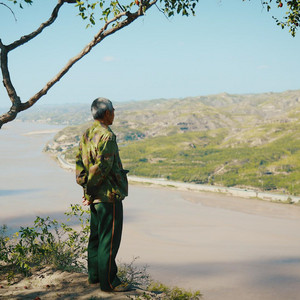
For centuries, the middle reach of the Yellow River had served as an important waterway connecting central and northern China.
The Yellow River raised my whole family.
However, as time went by, its significance as a transportation artery faded into history.
The kids are not even emotionally attached to the village Let alone the river Join us as we visit He Ye Ping An ancient ferry port and birthplace of the renowned song titled 99 Bands on the Yellow River And talk to the songwriter's grandchildren Stay tuned to episode 4 of our 12 -part series, The Yellow River Mosaic, Echoes of the Boatman Shanty.
September 28, 2021, at He Ye Ping, an ancient port village along the middle ridge of the Yellow River.
Standing on a cliff by the Yellow River, 58 -year -old Lee Haifu was singing a song of his grandfathers.
The song had been heard across China for a century.
Do you know how many bands there are along the Yellow River?
And many bands do you know how many boats?
In Shanxi dialect, the song is entitled 99 Bands on the Yellow River.
It sins the life of the boatman working along the meandering Yellow River in the Middle Reach in the early 20th century.
One of the boatmen was Li Sining.
He was a third -generation helpsman in his family at He Ye Ping, a mountain village by the riverside.
He wrote the lyrics and composed a song in the 1920s, based on the numerous work songs chaunted by generations of boatmen.
It became an instant hit along both sides of the Yellow River.
At that time, this section of the river was the main highway for freight transportation and bustled with business activities.
hundreds of boatmen made a living there transporting grain, coal, fern leather and all sorts of goods up and down to places such as Ningxia and Inner Mongolia The song, also named the Yellow River Changti made He Ye Ping a symbol and relic of the Lowest Land Civilization fed by the Yellow River A century passed.
Our trip to the village was made much easier with a newly built road.
Lee Haifu, the grandson of the songwriter and composer, told us Lee Siming's story.
My grandpa lived a hard life.
He had followed his father's footsteps to work on the boat since he was a teenager.
That had been his life for over 40 years.
The shipping history on the Yellow River dates back to 200 BC.
During its peak from the early 1900s to 1960s, the waterway was packed with boats like our modern highways.
The locals send their teenage boys to work as apprentices on the river.
The young man would work as boatman every year from spring to early winter months, except only when the river froze up.
Given time, the most skillful and courageous ones would grow into first -rate helmsmen.
The elder helpsmen in the village showed us how they commanded their crew on the boat.
Manning his steering boards, the helpsmen shouted out their instructions.
At his command, the five to seven -member crew would manoeuvre their boat through the 700 -kilometre -long Jinshan Grand Canyon on the lowest plateau.
passing the narrowest points and sweeping turns of the waterbed as smoothly as snakes slithering through underbrush.
A single tiny mistake or miscalculation could be fatal and the boat would crash into the cliff walls on either side of the river.
I know there are 99 bands on the Yellow River.
99 boats are on the 99 bands.
Li Haifu's family had worked as boatmen on the Yellow River for generations.
The Yellow River raised my whole family.
Both my grandpa and dad made a living on the river.
I worked on the boat as well, but just for two years.
He said by then he could make more money doing other odd jobs.
In fact, the water volume of the Yellow River had been significantly reduced in the 1970s.
So was the volume of shipping.
With the development of rail transportation blockage in waterways due to the increasing number of hydropower stations, freight boats were finally washed away by the tide of history.
Those who had worked on the river had to seek alternative jobs for a living.
Li Haifu now works in the village's jujub tree garden.
I do whatever makes money.
We are not picky about work.
He Yiping, the once bustling port by the Yellow River, has become a quiet village and is no longer attractive to young people.
Li Haifu's fellow villager Zhang Jining said the place has a registered population of 800, but less than a quarter live there permanently.
People aged 60 and under have chosen to leave and find jobs in cities.
Those who are staying are mostly sick or older ones and little kids.
We have 36 ,000 jujube trees in the village.
The remaining villages have been organized to take care of the trees.
Jujube cannot sell at a good price, but they bring some income anyway.
Lee Haifu told me he had an annual income of about 10 ,000 won.
That could make his ends meet.
He added that he didn't leave the village like others because he had to take care of his mother within her 80s.
75 -year -old Zhang Jinin was once the village head.
He later went to work in the county town and returned to Heye Ping upon retirement.
He couldn't help sinning the boatman's chong -ti where he recalled passionately how dependent the village was on the Yellow River.
He said he could not bring himself to leave the river, even though his kids were all living in cities.
I can't run away from the river.
I love it so much. The fellow villagers of my age are still playing the river in summer.
We dive into the river and just splash around.
We pump water from the river to water the farmland when there is a drought.
Talking about the younger generation's connection to the Yellow River, Zhang shook his head.
They are not even emotionally attached to the village, let alone the river They attend schools in a town or a county Then they work in cities and come back only during holidays like the spring festival How can you expect them to love the village or the river?
Young people from the village no longer sing the Bodnans songs They no longer dance the local Yongko dance.
The villagers said many of them could not even farm the land, as the father's generation had done.
All those who can navigate and guide the boat on the river, as how they describe their old profession, are in their 70s.
Like the final link between Avani's culture and the modern life in He Ye Ping, Zhang Jining has been trying hard to keep the memories of the once -notable riverside village alive.
He said the Yellow River played a critical role during a time when villages like He Ye Ping were filled with vigour and vitality.
He hopes one day the river will revive his village.
I take photos and videos of the village and local activities and upload them onto the internet, to my social media account, so more people can get to know about the village and our Mother River.
He said the cine villagers hope they can develop local tourism and invite people to see the Yellow River.
Now that a new road has been built, he believes more tourists would come and visit.
I have been following Zhang Jinin's WeChat account since we left.
He posted there regularly each month with interesting pictures and videos.
But I'm getting increasingly concerned this year because he has not been as active on WeChat.
Only three updates had been posted by the time I finished this podcast.
I hope all is well with him, and with He Ye Ping.
Just the new mountains Just the new mountains Just the winter mountains