Discussion keeps the world tuning.
This is Roundtable.
In an age of information overload, where everything is a click away, museums are resetting or reasserting their places, not aesthetic halls of artifacts, but as living, breathing spaces where history meets innovation.
This year's International Museum Day theme challenges us to ask, in a rapidly changing society, how do museums stay relevant and even lead?
This is roundtable with me, Lai Ming, and Yushan.
So museum day, I know both of you are museum goers.
you like art, you like culture, you like history.
So you would enjoy museum day?
Of course. Wow, this is big every year because, well, around May the 18th, we're around this date each year.
Ever since 1977, it's dedicated to be the International Museum Day.
And that's according to the International Council of Museums, the ICOM, setting the date to raise awareness about the fact that museums are an important mean of cultural exchange, enrichment of cultures, and development of mutual understanding across different cultures.
So, actually China joined the International Council of Museums back in 1983 and has since then held International Museum Day events every year.
And this year, the Grand Canal Museum of Beijing is serving as the main venue where a series of events will be hosted from May 17th to the 19th, so in the following weekend we'll see a lot of well highlighted events being hosted and held, well not just in the Grand Canal Museum of course but also in the various museums across Beijing and in China in general.
One of the highlights is that this year's celebration centers on the future development of museum amid the rapidly changing society, which showcased the latest achievements in China's museums and just promoting a greater public engagement for people to, you know, just come, come and visit museums and learn a bit more about, you know, whichever that's being showcased.
That's Yu -Shan's slogan, come, come to whichever museum, which actually makes sense because this year's theme is the future of museums in the rapidly changing communities.
Right. In different communities there would be different focus and different fun museums and there are really a lot of museums in the country here and for those of you who are in china around this time you're in great treat because of the international museum day many of the museums in china are free of charge while most of the national ones and most of the provincial, ones the public ones are free anyways, but there are some really good private ones and some themed ones that are also free during this period of time.
So great treat. It makes a lot of sense for China to be an important member of the International Council of Museums because of its long history and there's a lot of cultural heritage to be Cherished and protected and presented to the public and to generations of Chinese people if not global travelers as well.
So, this year, for instance, in the capital city of Beijing, there are several interesting events.
A major blockbuster has to be the Xi -Ying -Shang exhibition held at the Grand Canal museum of Beijing which was mentioned earlier.
And this will feature 338 Shang dynasty which is, wow!
More than 3 ,600 years ago, 338 Shang Dynasty artifacts from 28 museums across China, with key cultural relics being showcased in rotation.
And the thing about Shang culture is that it's unlike the following dynasties in China.
Shang people, they were more superstitious.
They believed in human sacrifices, a lot of ghost stories.
Three thousand years ago, makes sense, c'mon. And they were strong in bronze technology, related technology, so it was something to see and something to admire.
And I know that the ticket is very affordable for this one because I've already booked one for the last day of May, attending this very exhibition myself.
And it only is sell as 58 won which is roughly eight US dollars per ticket.
So it's relatively cheaper if you look at the general price for specific or specially designed exhibitions.
So yeah, and also there they're showcasing 54 first -class cultural relics or relic sets, many of which are being displayed in Beijing for the very first time as well.
So every time when there's exhibitions are like where the iconic relics from local museums are being shipped to Beijing and being They're on a business trip.
Yeah. They're on a business trip.
And people from that local city will be like, hey, we're just borrowing, a few months later is going to come back.
Yeah. So these are some very interesting activities that are happening.
So the 2025 Beijing museum season is going to kick off on May 18th.
The season, well we're calling it the season because each month there is a theme for the museum season.
May is designed as the exhibition month.
June is the technology month.
July is cultural creativity month.
Meaning that a lot of different activities, especially the interactive ones could happen under these sub -themes.
Yeah, I really like the idea that many museums, they're transforming into this interactive cultural hub or city walk center for people to invite people to come in and visit for free and actually not just view the artifacts and read what this is, what that is from, which era is this built, but rather...
The tablets with words written on them, which is displayed in poorly lighted display rooms. You see, I was interviewing my archaeologist boyfriend previously, who mentioned to me with a very interesting quote that museums nowadays are storytellers who use artifacts to tell a certain story to you, whether it's chronologically or based on a certain theme.
That's what museums are doing nowadays whether it's using high -tech or you know different Narratives where even video games for kids to participate in that's all very new and interesting ways for people to remember what they see instead of just going around and reading and knowing which is which is which Well, I remember last international museum days roundtable special I shared about a online museum about video games.
So you enter the well by saying enter the museum it means that you actually start browsing on the on the site of that online museum and there are step into the virtual virtual world it is a virtual room it's in the shape or it looks like a real hole and of course you can interact with each and every artifacts on the wall the virtual Wall, which is a iconic game.
That being said, my point was actually we do International Museum Day special every year and we observe the new trends.
We introduce the new activities happening around this time because people's love for museums are getting stronger and stronger.
More and more people are going into different museums. And I see that is probably the biggest trend in the world of museums. But what are some other trends?
Well, the trends, for instance, the trend, one trend that I have observed in taking my kids, my kids to different museums is that I see the introduction of business models into almost all the museums I've been to in the past year.
So there is the stamp collection, collecting tables.
How old are your son?
He's now five years old.
He shares the same interests that I do.
I like the stamps too.
Please continue. You're certainly very young.
So every museum he goes he will try to look for the stamp collection tables.
Yes, we love that. He even will bring a notebook of his own to get stamps to get stamped on them.
And also the other trend that I've observed is almost in the same line and that is the stress on interaction.
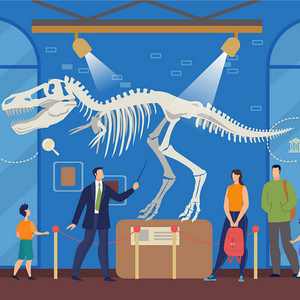
So at the Palaeontology Museum, if I can translate it that way or the Geology Museum, there's a lot of fossils of dinosaurs and ancient reptiles.
So at one point during the day at least once, the staff will put on costumes of dinosaurs and try to be really horrifying.
And then try and walk around the museum and interact with kids who aren't afraid.
And I think that's something to experience.
And there's also the mindset to try and involve parents in there as well.
So parents and children, the exhibitions are designed at different heights.
So for adults, you may read, you know, with the tablets on your level.
then for children they will tap, there will be tablets at much lower places where they can interact with.
So that those are the trends that I've observed so far.
The museums are being more considerate, it is trying to lure people in, being very welcoming and being interactive and making a little sight pocket money by selling out the very beautiful exquisite notebook that I cannot resist with the theme of the museum.
So things like these are happening.
The question I always ask every year on the Museum Day Special, if you get to recommend a museum to our listeners out there, what would that museum be?
Actually, I think I've mentioned the name of this museum in previous shows, but I'm gonna mention it again.
And I'm going to mention every time when I'm asked which museum I'm going to recommend, which is the Chinese Archaeological Museum.
That's a place that I've...
And I would feel like going back over and over again because it's China's first, say, national museum dedicated entirely to archaeology.
And it's operated by the Chinese Academy of History and the museum itself provides a focused and scholarly presentation of China's vast and rich archaeological heritage as well.
So it's not just any museum, history museum that goes through each of the dynasties.
it dates back all the way to the ancient age time, back in about 8 million years through ancient Chinese dynasties and step by step to the modern era and just tell you a whole holistic story of how this land becomes what we call China today.
So that's something very unique and for history lovers who are visiting Beijing, instead of just going to say the Summer Palace, the different city, There's somewhere else that you can dig into and find more joy at.
That's the Chinese Archaeological Museum.
I will recommend the Museum of Chinese Gardens and Landscape Architecture every year.
That's for sure. Because I go there at least three times a year.
But this year, something new, and that is the Chinese Traditional Culture Museum is on the north side of Beijing.
It is also named China Intangible Cultural Heritage Museum since 2022, and it boasts a collection of a wide range of artworks and handicrafts, including jade artworks in the forms of incense burners, floral baskets, greens.
Some of them are very massive, some of them are very tiny incites, but they're all very exquisite.
So those of you who are not familiar with Chinese and handicrafts and culture, you will be impressed, definitely, if you had time to pay it a visit.
Whether it's a Shang dynasty relic or a skeleton of a dinosaur at a neighborhood exhibit, the act of engaging with beauty and history is never passive.
That brings us to the end of today's roundtable.
I'm Nihong Lin with Lai Ming and Yuxian.
Thanks for listening.
Bye bye.