This message comes from Osea, who believe the key to good skin is hidden deep in the ocean.
Osea's Andaria Algae Body Oil harnesses the powers of Andaria seaweed for silky, soft, and glowing skin. and to improve skin elasticity.
Osea's Andaria Algae Body Oil isn't your typical body oil.
Get 10% off your first order with code SEAWEED10 at OSEAMalibu.com.
Plus free samples with every order and free shipping on orders over $50.
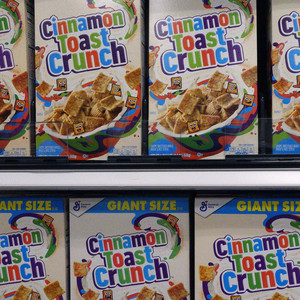
This is Planet Money from NPR. What drove the young man named Rocky to the Cinnamon Toast Crunch that day? his inner child, perhaps, memories of Saturday mornings and cartoons and pajamas, maybe, but...
There he was, in the cereal aisle, holding a box of Cinnamon Toast Crunch and losing his mind.
Okay, y'all, I might be an unk for real because since when is cereal $8 a box?
What the hell? Rocky turned to TikTok to sort of work through his feelings about this apparent serial inflation.
Am I tripping? He's addressing a friend here.
Gee, am I tripping? Has cereal always been this high?
I guess. I don't know. Okay, he acting like it's normal.
Maybe I'm just broken. Inflation has been and continues to be one of the single biggest economic concerns for Americans, according to a regular survey from Gallup.
And that anxiety is very easy to understand.
People are worried about the impact of tariffs.
There are rumblings of possible inflation upticks to come.
And maybe most obviously, prices are indeed way up compared to before the pandemic.
Like, groceries are 30% more expensive than they were just like five or so years ago.
Look, those prices are not going to come down.
That is simply not how inflation works. We always have some inflation, prices go up, The question is, at what rate do those prices go up?
And two years ago, the rate of inflation dropped. did come way down.
It's been decently close to the target inflation rate of 2% for a couple years now.
So inflation has cooled a lot. but you know what has not cooled off?
TikToks like Rocky's, which I have come to love, and call the, I'm sorry, groceries cost what now?
Social media post. The basic structure of one of these goes.
Holy cow, I just got back from Target. Person goes to the grocery store.
Went to Sam's Club for four items. Often buys 20 items or less.
Two bags of groceries. Three items at a small town grocery store.
These are notably not unusual items. Bananas.
Some Chips Ahoy. A case of Diet Coke. Some peppers.
A bag of pizza rolls. Just like basic things.
But you know what? When they go to check out, I'm sorry, these groceries cost what now?
$20. These are five items. Six items, $88.
Four items, $101. What the ? The rate that we're going right now, next week, these four items will likely be $120.
I'm serious. I'm not joking. Now, that would be 20% inflation.
And I very much understand this fear. Because for the majority of Americans, we just lived through the highest period of inflation in our lives, and we're reminded of this every time we go to the grocery store, and we see what this period of inflation did to the price of our Diet Coke and our pizza rolls and for our TikTok friend, Rocky, his Cinnamon Toast Crunch.
Like, I'm almost positive that cereal was never almost $10 a box.
It's true. I, too, have nearly crashed my buggy specifically because the prices of cereal stunned me.
I get this. And yet, it is my job to know the inflation data.
And the official inflation statistics say that the price of groceries over the last year has increased 2.2%.
Like, not ideal, but not the 20% inflation it may feel like we should expect.
And I think there is something mysterious about the way we experience the mix of these dramatically higher prices, and the not-as-dramatic inflation that we're in the middle of right now.
We're not wrong. The data's not wrong. But maybe we can take a lesson from TikTok Rocky, who, when confronted with the proverbial $8 box of Cinnamon Toast Crunch... had the instinct to just try and talk through those inflation feelings.
Hello and welcome to Planet Money. I'm Kenny Malone.
And I'm Jeff Guo. Inflation. Feelings. In...
Feel-shin. In feelings? Yeah, sure. Okay.
Economists have been studying our... In feelings.
Because when there is a mismatch between inflation and our perceptions of inflation, It matters.
It changes our behavior. It affects who we vote for, what we buy, when we buy it, which mortgages we take out, all sorts of choices we make.
And so today on the show, we talk to the economists who have studied us and hear what they've learned about why our sort of Personal inflation calculators don't always match the professional ones.
So grab a spoon and a bowl and some dang expensive cinnamon toast crunch. and see if we can all work through some infusions together.
This message comes from Grammarly. From emails to reports and project proposals, it's more challenging than ever to meet the demands of today's competing priorities without some help.
Grammarly can instantly generate well-written drafts with AI to get your ideas down on paper.
Let Grammarly take the busy work off your plate so you can focus on high-impact work.
93% of professionals report that Grammarly helps them get more work done.
Download Grammarly for free at grammarly.com podcast.
That's grammarly.com podcast. This message comes from NPR sponsor, US Bank.
With US Bank Business Essentials, you get more than just a bank. you get a dedicated partner that provides you a powerful combo of checking and card payment processing with quick access to the money you've earned. proving that there is nothing as powerful as the power of us.
Visit usbank.com today to learn more. Member FDIC Copyright 2025 U.S.
Bank There is a lot of good research on the ways our brains process changing prices.
Before we started calling the economists names on those research papers... a more important phone call.
Is this Rocky? Hey, yeah, what's up, Denny?
Rocky Walker, 27 years old, security guard by day, TikTok creator by night.
At Rocky Rare, Rocky tells us that on the fateful day of his $8 cereal video, he did not enter the grocery store intending to talk about Cinnamon Toast Crunch.
It's been forever since I've really sat down and just had a bowl of cereal and watched some cartoons.
So you really were looking for that nostalgia bump?
Literally, just, yeah, I haven't bought some Cinnamon Toast Crunch in a hot minute, but Did you end up buying that cinnamon toast crunch for $8 or?
Hell no. Rocky is not typically TikToking about economics, but if you are documenting your life these days, prices and money and economics, they're just all part of that.
I mean, with everything, like say for instance, not even with just groceries, I feel like what my generation are, or like Gen Z, like we're the new adults, quote unquote, but it's just- quote-unquote.
Do you not feel like you're an adult? I mean, you know, when I met her for the first time, I really just tried to slim, but...
With these prices, it's so hard to try to budget between fun, between responsibilities and just necessity.
And I feel like it's not a lot of weight on your shoulders because this stuff is not cheap at all.
Yeah, because inflation is cumulative. It adds up.
Overall prices are still about 25 percent higher than they were five years ago.
And these new higher prices. Now, those prices are no longer going up at a wild pace.
The rate of inflation has slowed way down by comparison, but... our fears, our feelings, that things will spiral out of control again?
For some of us. For me, personally, I'm not sure that has slowed down.
We told Rocky that his TikTok had helped inspire us to talk through our inflation feelings. with the economists who have been studying this stuff, writing papers about it.
Along the way, would it be OK? if I shared some of the things I've learned, like from the economists I've talked to and some of the papers that we've been reading, would that be cool?
Of course. I love getting informed, man.
OK, so we will check back in with Rocky from time to time.
But that thing he said about his generation feeling this inflationary weight on their shoulders. reminded us about some very specific research about how different generations react to price increases.
Because Living through inflation can leave a kind of economic scar that has a big impact on our...
To talk about that research, we turn to one of the authors, an economist who thinks of her own inflation anxieties as a kind of heritage.
I'm German and definitely the general anxiety of the Germans about inflation at all times has been transmitted to me and I don't think I will ever get rid of it.
Ulrike Malmendier is a finance and economics professor at UC Berkeley and indeed from Germany, which had bonkers inflation in the 1920s.
Uh, wheelbarrows full of German marks, more valuable as bonfire kindling, that kind of stuff.
So yes, she jokes that she has inherited disproportionate inflation anxiety.
But her research has specifically looked at what happens when someone actually lives through periods of high inflation.
The main emphasis of that research can be typically boiled down to saying, well, Give me your birth year.
And I get a very good idea of how optimistic or pessimistic you are about inflation.
Yeah, depending on where you live. So let's say you lived in the United States during that huge double digit inflation of the 1970s and 80s.
Ulrika found that this scars people. It makes them more likely to expect inflation in the future, no matter who they are.
Even the best informed people who are, I don't know, serving on the Fed board, even these people we've been able to show to put a lot of weight on experiences they have had themselves.
But what I was curious about were the more recent generations.
Because, you know, for example, I'm 40. Our friend Rocky is 27.
And neither of us has really seen or thought about inflation until the relatively brief spike around COVID.
Yeah. So where you are going is also really interesting because you have had very stable inflation experience much of your life.
That was your world. You know, if you studied economics, you knew about inflation from textbooks.
It was theory. It was totally theory for me.
Exactly. That was just theory. And suddenly your world gets turned upside down.
People in these younger generations grew up taking for granted that inflation was always low and stable, And then when inflation rates spiked in the early 2020s, it was extra disorienting. it really shocks you so much because you can't even handle that data.
And that's what we are seeing in the kind of younger generation, your age, but particularly even younger, that's when, you know, you don't know how to move forward, where basically...
You keep trying to process this and you can't fully process it.
So you do these cool TikTok videos about cinnamon crunch toast, which is, of course, a great cereal.
Oh, Ulrika knows. I mean, she knows about Cinnamon Toast Crunch being the greatest cereal of all time, but also... why the price of Cinnamon Toast Crunch might have a particularly outsized effect on our assessment of inflation.
This brings us to the second major area of Ulrika's research that we want to talk about.
And it has to do with the way that we, as individuals... perceive inflation versus the way economists measure inflation.
So just to step back for a second. You may be familiar with the Consumer Price Index, CPI.
This is like the main measure of inflation from the Bureau of Labor Statistics.
And the way this is calculated is they have this massive list of things that we pay for.
They monitor the changes in those prices.
And then they blend that all up into a single measurement, CPI, which tells us things are getting this much more expensive.
That is inflation. It's meant to capture all of the price changes affecting everybody in the country in one single measurement.
Now, what Ulrika has found is that we consumers are each doing a version of this for ourselves.
But the list of items that we monitor, it is very small.
It's really just the stuff that we look at and we buy all the time.
Hence, all this emphasis on the gas pump, right?
And then groceries. And we found, you know, people think a lot about bread, milk, eggs, men also beer, beer prices matter.
Men, beer prices. Why not? Yeah. Each of us has our own version of frequently bought items that we really notice price changes in.
TikTok Rocky, for example, really watching the prices of chips.
Anywhere from the Lays to the Doritos. Also, meat.
Mind you, I don't even eat beef or pork anymore, but.
But chicken, salmon, and watching most of all, eggs.
Rocky loves breakfast, loves baking. Eggs definitely is one of the things that I'm going to have to buy no matter what.
No matter what. And I do want to know your number one bake.
Like someone's coming over your house for the first time and you want to impress them.
That would involve eggs. I would definitely like, everyone loves mac and cheese.
I like to cook for my friends. So I would definitely make them some baked mac and cheese, like some soul food for sure.
So Rocky may not realize it, but Ulrika's research would suggest that he is likely getting a big chunk of his take on inflation from the prices of chips and chicken and eggs because he is buying those things frequently.
And- All of us do a version of this. And Ulrika says that can mislead us.
For starters, frequently bought grocery items, they don't actually We'll be right back.
Also, food prices happen to be some of the most notoriously unreliable prices to watch. which Rocky has noticed with regards to his beloved eggs.
But yeah, like that's one thing that always kind of like gags me a little bit because sometimes it'll be like two dollars, which is like the normal price.
And sometimes it'll go up all the way to like six or seven for like. a dozen, which is crazy.
Yeah, food prices and gas prices too, they jump all over the place, up and down the for reasons that may not be signs of overall inflation.
Because inflation, by definition, is a rise in prices all across the economy.
As opposed to a situation where, say, bird flu messes up the egg supply or OPEC cuts oil production or a natural disaster devastates a corn crop.
Those may just be temporary shocks in a specific sector that may go back to normal.
And the irony of it all is that as a researcher, And as a monetary policymaker, you are always pushed and asked not to look at exactly those items, energy and groceries, because they fluctuate so much.
But we, humans... That's basically all we look at all the time when you think about inflation.
There is a different inflation calculation that you may have heard of that takes out volatile things like energy and food.
It is called... core CPI, core inflation.
And it is something policymakers will look at to get a sense of overall inflation trends without the noisiness of those volatile price swings that we're talking about.
And there's one final thing about volatile prices, which is that other research has shown that we really notice when prices swing up. but we don't notice as much when they swing down. people really seem to latch on to the up part and get totally upset about it.
And then on the down part, they're like, whatever.
You know, they're not kind of spending as much emotional capital on it.
Well, Rocky is not going to make a TikTok when Cinnamon Toast Crunch is on sale for five dollars.
I have to remember that anecdote going forward.
Now, look, going to the grocery store, it's not going to be an anxiety free activity anytime soon.
Everything we buy really is more expensive than it used to be.
And while the data show that the median income has generally kept up with that inflation, it doesn't mean that everyone is benefiting from those increasing salaries.
But it is also true that there might be, might be, some additional stress we do not have to bring to those grocery store trips.
Like the fact that we instinctively look at just a few grocery items to gauge all of inflation and the fact that we latch on to the volatile ups. of price swings but not the volatile downs, it does create a situation where we may be stressing over sudden grocery price jumps a little bit more than we have to.
So what are we grocery shoppers supposed to do about these volatile prices playing tricks on our minds?
Well, we asked Ulrika, and she says it sort of boils down to... could you find ways to blunt the ups and downs of those groceries, that volatility that isn't actually inflation?
So if I could convince grocery shops to kind of average out prices, so take out some of these fluctuations, or I could convince you not to look at the price.
Yeah, it's like the classic advice you hear about the stock market, right?
Don't look at the ups and downs of your retirement account every single day.
Just look once a year at the Focus on the general trend.
You could possibly try the same thing with your groceries, I suppose.
Like... Just buy what's on your list and don't look at how the prices are jumping up and down and up and down.
And then at the end of the year, we look back and say, okay, on average, it wasn't so bad.
So I don't have to get all nervous about it.
So if I could do that, I would love that.
You know, that's an idea. In theory, that would make sense.
Yes, I guess. And we did run that idea past Rocky.
What do you think about that idea? Just close your eyes and buy the things.
Um, I mean, I don't know. Like, um, I guess I can like understand the, like the...
The setup is just, I don't know if that would work.
I don't know if that would work for me. Yes.
You know? I do know. With everything going on, you kind of have to go into things like grocery shopping with a game plan.
Because, say, for instance, if there's some things that you know might go on sale later, You might like hold off on that or make that stretch a little bit until you know you can get it at a decent price.
So I don't think that would work for me.
Yeah, it's not going to work for Rocky or probably most of us.
It is very difficult to ignore the prices that we see all the time.
But we can remember Ulrike's research that we may be putting too much emphasis on too few things or on things that change in price all the time and may not be an indication that overall inflation is actually on the rise again.
After the break, we look at maybe the single most important thing we measure for inflation and why those measures, too, are sometimes hard to believe.
This message comes from Vanta.
In today's fast changing digital world, proving your company has trustworthy security practices is essential.
Vanta helps companies of all sizes earn and prove trust with the industry's best AI, automation, and continuous monitoring.
So whether you're a startup tackling your first SOC 2 or ISO 27001, or an enterprise managing vendor risk, Vanta's trust management platform makes it easier.
Visit vanta.com slash NPR to sign up for a demo today.
This message comes from ServiceNow. People should do the creative work they actually want to do, not boring busy work.
Now, with AI agents built into the ServiceNow platform, you can automate millions of repetitive tasks in every corner of your business.
IT, HR, and more. so your people can focus on the work that they want to do that's putting ai agents to work for people It's your turn.
Get started at servicenow.com slash AI dash agents.
$8 Cinnamon Toast Crunch, obviously my favorite TikTok by Rocky Walker.
A close second, though, is this. Picture this.
Rocky is sitting in his apartment, which is maybe seven stories up in his Chicago apartment building.
And some just told me to turn around and look out the balcony and look what I see.
The camera flips around and we see snow on the balcony.
We see a couple bikes on the balcony, but also Perch there on the railing.
Hello there. What's up buddy? It is the floofiest little bird you will ever see.
It kind of looked like a baby hawk or eagle.
It's so fluffy though, oh my God. I will try to give you some food, but I feel like if I open the door, it's going to fly away.
But I mean, you free to chill there as long as you want, buddy.
I would watch that channel 24-7. That's all I'm saying.
But relevant to this episode... is that when I talked to Rocky, he told me he was currently looking to move out of that bird balcony apartment.
And he's been very surprised at the prices he is seeing to rent apartments.
Rent is crazy. I haven't moved in five years and the difference between prices when I moved five years ago and now is insane.
Yes, the price of rent. It is arguably, arguably more noteworthy than the price of Cinnamon Toast Crunch. like a one bedroom, one bathroom here in Chicago, you could very much find something within like the thousand range.
So now we're like, They're very much asking for a good $1,500 or above to be in a decent neighborhood with decent appliances and something that doesn't look ancient.
And I feel like that's crazy. The average price of rent is about 29% higher today than before the pandemic.
And how much we pay to live where we live is one of the single biggest things that goes into the consumer price index.
It's like a third of the total weight. The term you'll hear for this is housing services.
And that housing services bucket in particular is an area that produces a lot of in-feelings And also produces some pretty interesting conundrums for economists when they are trying to measure inflation.
Test one, two. We brought economist Louise Shainer into the studio to talk about all of this.
Have you had any dreams of mic checks you've ever wanted to do?
No. Mic check one, two, three. Brookings in the house.
Brookings in the house. See, that one's good.
That's good, yeah. Louise is a senior fellow at the Brookings Institution.
She's done a lot of work around housing prices and how those prices are factored into inflation data.
We asked Louise to get extra nerdy with us and explain how the numbers are collected and calculated.
And Louise said... A, of course she would do that for us.
And then B, that we should start perhaps with how we get the cost of housing for renters like Rocky.
It's pretty simple. It's your rent, right?
How much you're spending, you're spending rent.
What happened to rent? It's very simple.
No real issue there. That's pretty easy to measure.
You could call me and ask me what my rent is.
Exactly. Okay. All right. So that's easy.
The data is easy to collect. More or less, you go around asking people what they pay in rent.
And the people who track inflation for the Consumer Price Index They're contacting all kinds of renters, people who just moved into a place, people who have lived in the same place for five years or 20 years or 40 years.
And this is a very reasonable way to calculate overall rent prices for inflation.
Because CPI... is trying to measure the cost of rent for everybody.
But the thing is, if you are like Rocky and looking for a new place, it doesn't matter. matter what people are paying for rent if they've lived in the same place for 20 or 40 years and aren't moving.
Those are not the kinds of rent prices that Rocky is going to find if he's looking for a new apartment on, let's say, Zillow.
Yeah. And generally speaking, those live market rate rental prices for places that are available right now, they can change a lot faster.
Yeah, way faster, man. It's really crazy.
Definitely faster than what is reflected in the CPI.
Yeah, so there can be this disconnect between what you might see for market rates on Zillow and then the measurements the Bureau of Labor Statistics, BLS, takes.
And that disconnect created a whole thing during COVID, Louise says.
Because rental indexes using big data, like the Zillow Rent Index, was showing much bigger increases than what BLS was showing on their rent index.
And so people would look at the official CPI numbers and be like, wait, what?
Those official numbers seem too low. But the reality is CPI is simply a slower, laggier indicator. in part because it's not just looking at those new market-level listings on Zillow.
Just to give you a sense of this lag, After the pandemic, it took official inflation numbers, like a year longer than Zillow numbers, to show that rent increases had fallen finally started to slow down.
This is simply how it works with a CPI and rentals.
Yep. And OK, things get even trickier when we try to measure inflation for homes people own. which makes up an even bigger portion of the CPI than just rentals.
The majority of people, like two-thirds, live in homes they or their family own.
And Louise says it is deceptively tricky to calculate what homeowners are paying for their version of housing services.
The hard thing is when people own their homes.
They are not writing a check for housing services.
Okay, well, they're writing a mortgage check.
They might be writing a mortgage check unless they fully paid off their mortgage.
Their mortgage check will depend on how big their down payment was.
Their mortgage check will depend on When did you take out your mortgage?
And so you cannot just call people up and ask how much is your monthly mortgage payment because.
That would drag all those other variables into the equation.
And so you hear the word owner's equivalent rent.
Owner's equivalent rent. O-E-R. O-E-R. O-E-R.
Do we try to pronounce it O-er? No, we say O-E-R.
Okay. So to measure inflation when it comes to homeowners, there is this clever little trick.
The idea is that you look at some owner-occupied house and then calculate what would likely be the rental price for that home.
How much rent? Could you rent your house out for?
Oh. That's what it is. What is the opportunity cost of me...
Staying in this house. As opposed to renting it to somebody else.
So I'm renting it to myself. This is how much I'm paying.
Well, great. That's not complicated. It's not complicated.
Well, how do you get that? Ah, yes. Well, what the statistics people do is go looking for similar houses that are available to rent, which is clever. but perhaps comes with some trade-offs.
Because quite literally, this means our official inflation statistics Use the experience of home renters to stand in for the experience of home owners.
Yeah, so one issue is that, generally speaking, there just aren't as many rental versions of houses on the market.
The rental homes that are on the market... how equivalent really are they to the houses that people own, right?
That is always a question. Yeah, and then question, or I guess issue number two, is that this OER is also a lagging indicator.
Because just like rental prices, OER is made up of the same rental price information ultimately.
So again, any big sudden swings, it's going to take time for the official statistics to catch up.
But look. there is no perfect solution to measuring the experience of inflation for homeowners.
And in fact, there isn't agreement across countries on how to measure housing services.
Some people in the European Consumer Price Index, they don't include unoccupied.
They just take it out because it's too complicated to measure.
Right. That's the, like, yeah, that's the slacker's solution.
I don't know, it's too hard. There are a lot of people trying to think about, well, how could you use Zillow and house prices and big data?
And like, is there a way of doing a bit better?
But nothing yet. And the thing is, whenever we try to measure things and then process that down into a useful amount of information, there are going to be trade-offs.
If you wanted a housing inflation number that people could look at and feel reflects their personal experience...
Well, you might need a different number for long-term renters versus new renters versus homeowners versus people looking to buy their first home versus people looking to sell their home. each of those groups could look at the current inflation data and feel like, wait,
Does that number actually capture what I'm feeling about housing inflation right now?
Do you have a sense of whether we've chosen an approach that is more about capturing the feeling versus whatever the alternative would be?
I think we've chosen an approach that is economically sensible.
Look, I was on National Academy of Science panel, and we voted on webinar.
We thought the current method was kind of right.
Amazing. But it was all economists, and we said yes.
Oh, okay, okay. So I think we recognize that it doesn't necessarily capture people's feelings.
And people's feelings are very important.
So there is something about ACPI that is on its face wrong because ACPI
Everybody has a different CPI. What are you buying?
What do you care about? How much is this quality improvement worth to you?
We have to get a number that kind of gets it right on average.
But there's a million things happening underneath, and we have this one summer statistic.
Economists and policymakers, they need those summary statistics to understand how the economy is doing overall. how much we need to worry about inflation as a country.
That is important. But as Louise said, our individual experience.
Experiences are also important, our infeeltions.
And so we knew we did need to check in one more time on the infeeltions themselves. that started this whole episode to begin with.
Rocky. Hey, what's up, Kenny? Are you at the grocery store?
Yeah, I'm walking in right now. wanted the most recent update on the very personalized TikTok Rocky price index.
Yeah, the TRPI. And so we asked him to go back to the grocery store and to, you know, reprice a few items for us.
Rocky's first stop, the chip aisle, one of his frequently bought and priced items.
I'm looking at the Doritos. So regularly they're $6.30.
Whew. But they have a deal for like two bags for $7.
So pretty much $3.50 each. But yeah, I'm not going to lie.
That's an instant grab. Okay. For sure. That's one that I can't pass up.
Okay, great. But keep going, Rocky. Keep going.
Because the real reason we're here... The Cinnamon Toast Crunch, of course.
Surprisingly, they're on sale right now.
Really? Yeah, they're on sale right now.
What's the price? So they're on sale for like $6.50.
But they have like a deal where like if you buy four, you get them for $2 each.
What? Yeah. That's crazy. I mean, Rocky, how many boxes of Cinnamon Toast Crunchy are we buying?
Six? Nine? This is stockpile time, man. Rocky takes a moment, considers all of this.
If you want my honest, honest reason why that I'm like skeptical about it is because four boxes of Cinnamon Toast Crunch that's going to be like just staring there at the top of the refrigerator at me.
That is, I mean, that is kind of a lot. You're doing some preventative willpower work here.
Yeah, if you feel me, because literally having four boxes of sugar just... All right.
Yeah. Fair enough, Rocky. Fair enough. Before we go, a quick shout out to our Planet Money Plus listeners.
Your support helps keep NPR going. We'll see you next time. plus.npr.org.
This episode was produced by Willa Rubin with reporting from Emily Crawford.
It was edited by Marianne McCune. It was fact-checked by Sierra Juarez and engineered by Jimmy Keeley.
Alex Goldmark is our executive producer and a very special in thanktions this week is to our own In Mary Child's Shin for coining the term infielshins.
I'm Kenny Malone. I'm Jeff Guo. This is NPR.
Thanks for listening.