Discussion keeps the world turning.
This is Round Table.
Surprise! Gigantic balloons are popping up in the most unexpected corners of Chinese cities.
Peek inside, and no, it's not a circus.
It's a fully operational construction site.
These massive air domes are designed to keep the dust and noise of construction under wraps.
Let's step inside and find out what really holds air.
Coming to you live from Beijing, this is Roundtable.
I'm He Yang. For today's program, I'm joined by Steve Hatherly and Yu Shun in the studio.
First on today's show.
Giant balloons, some as big as a football field, are popping up across Chinese cities.
But don't be fooled by their playful look.
These aren't party decorations.
These are high -tech, air -supported membrane buildings covering construction sites.
These inflatable domes help block dust, reduce noise, and shield nearby communities from the mess and chaos of usual construction.
Some sports arenas are also using them.
Imagine playing football or basketball inside a ginormous balloon, rain and shine.
Let's start with the basics.
What exactly are these gigantic balloons over construction sites arrangement and how well do they work?
Yeah, when we, you know, when I first got the topic of, you know, big balloons, gigantic balloons around the city, I initially thought it referred to some hot air balloons.
Were we thinking the same?
You know, floating in the air?
Some kind of like celebration of something, right?
But it's not like actually floating in the air.
That's that's not the case.
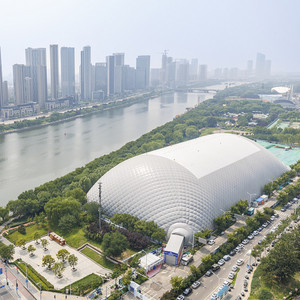
These balloons are mostly just white dome shaped and right straight up from the ground.
So they are mostly large, but about the size of two soccer fields, half sphere or oval bubble that looks like a smooth, inflated tent on the ground.
Yeah. If you imagine two things, one, you're in a downtown area and you look to your left and you see this giant construction site.
right? Maybe they're building a high rise tower there.
We see that all the time, right?
In many cities around the world.
Now you look to your right and you just see a white dome.
Well, what's happening in both cases is they're constructing a building.
One is covered for the reasons that Ho -young just said to keep the dust and the noise inside as opposed to outside.
And the other is less friendly to communities, right?
People tend not to like that when there's that level of of construction happening in highly populated areas or busy areas of a city.
And it's exactly like you just described it.
It just looks like a big white dome.
This was in the news, actually.
It was covered here in China, but foreign media outlets were covering this as well.
It's pretty cool. 20 ,000 square meters.
This is in Jinan, by the way, which I looked on the map slightly south of Beijing, just ever so slightly, and maybe a little bit east as well.
50 meters high and 20 ,000 square meters.
And it's reported that it's the biggest of its kind in the world.
Wow. Yeah, and that is why it's often being used for construction sites and also, as you said, sports arenas.
So these balloons are professionally known as air domes or air -supported structures or inflatable domes.
And in the context of construction site, we call them as air film buildings.
And they operate as a two -layer shell made of these reinforced dense textile or high -strength polyester fiber membrane material.
And the structure's shape is achieved by introducing air below the membrane and creating internal overpressure.
And that is why there is space inside, right?
And people can conduct all of that construction work.
Yeah. And then they use blowers or fans inside that continuously supply fresh air into that membrane, which is how it helps it to keep its structure.
And I'm curious because from the outside, this thing looks so big.
I mentioned, you know, it could be as big, if not bigger than a football field and it looks really smooth.
smooth. So does this have any pillars inside?
Or is it just, you know, you use air to blow it up into that shape?
And how does that work?
Yeah, that is why it is quite amazing, I would say, you know, one of the key features of these structures is that they do not require any internal beams or columns, also creating wide and unobstructed internal space.
And also the the entire construction process inside the structures can proceed largely unaffected by the external environment and weather conditions like raining and windy days.
Yeah, and because you don't have beams and columns inside holding it up, that means that the construction happening inside can easily take place.
Yeah, you're right.
They're super smooth, right?
I saw one Chinese media outlet said it looks like a giant baozi, like a giant steamed bun downtown.
town. Yeah, well, you just gave it more of an adorable flair.
Now we know what they are.
Let's talk about why they're being used.
What are the benefits of using these big balloons during construction?
One thing you guys mentioned, it has no beams, no columns whatsoever.
Well, that's really good for safety, I would think.
Also, it's probably really easy to blow up and take down as well.
So guys, you know, take it over.
Yeah, I think Steve actually mentioned a little bit of it when you were seeing a construction site near if it's a downtown area, it could be quite disturbing or it's releasing a lot of pollution, right?
Right. So actually, one of the main reasons for using this type of structure is that some construction sites are located near, let's say, residential areas.
If the work were carried out in the open air, it could easily just cause various forms of pollution and then negatively impact the lives of nearby residents.
And a project manager of such structure in Beijing explained that these structures from, you know, they can form a fully enclosed workspace with overall dust prevention effectiveness reaching over 90%.
And they can also reduce the noise generated by internal operations by 60 % to over 80%.
And that's minimizing the impact on surrounding residents.
Yeah, that's amazing, isn't it?
Reducing the dust by 90%.
That's basically eliminating it all together.
And then the noise reduction is important as well.
You remember on Roundtable, maybe back around February, we talked about China completing the construction of over 2 ,000 quiet communities all over the country.
It was part of the effort to tackle noise pollution.
And the goal with that project was to create residential areas with reduced noise levels so that people can have a better sleep at night.
And it would address one of the more common environmental complaints in downtown or at least urban areas.
I think this is connected to that somehow, because if you're able to reduce the sound of construction by 60 to 80 percent, that means the communities are going to be quieter, too.
Yes, and that's what we really enjoy during nighttime.
And also this would make me think of, you know, some plenty of really suitable scenarios and using them and setting up this big air balloon.
For example, now in Beijing, we've sort of passed that phase, but still we see continued construction of the subway.
And as a Beijing resident, I remember 20 years ago, whenever, because back then Beijing was still building its spider web of subway lines.
and this means a lot of the downtown area or you know just very busy areas within this big city will have these big construction sites and they're noisy they're dusty and everything like you mentioned but having these big air balloons to sort of shelter everything inside i mean that's so useful it really is and just think about the aesthetic value too right because you don't have have to look at the construction happening.
So you just get to look at a pretty steamed bun, if you will.
That's another benefit.
Here's another one.
They can ensure the construction continuity.
And by that, what I mean is they can shorten the construction period up to an estimated 30 percent.
Totally makes sense, right?
Because, you know, if you're working in adverse weather conditions where sometimes it doesn't allow for construction to take place, put a dome over it it and you can work all day every day if you so please.
Also the amount of energy that they use too.
That film material itself, that membrane, normally has really high energy efficiency and that can reduce the energy consumption by about 20 % during the construction process and they call these things new green construction processes because of the energy efficiency.
Also the fire fire resistance and the fact that they can make all of those great changes makes them very smart indeed.
Well, I really want you guys to talk more about the fire resistance in a second, though.
You mentioned improving efficiency, and I think that has been sort of a belief of the Chinese people.
When we think of any project, designing any sort of work routine or whatever, people People often talk about, oh, how can we make this more efficient?
And if it's more efficient, often we would like to sacrifice other things, including cutting corners or whatnot.
I mean, just by how you guys are introducing these ginormous air balloons over construction sites, I think it's great that it can improve efficiency in the sense that weather isn't really a big deal that affects construction work that much anymore.
But considering how hot the weather is right now, and considering how hard working Chinese people can be, and how pushy the bosses can be when they want to achieve certain work targets, I would just like to float this idea that first of all, if you can work around the clock 24 hours around the clock, then please at least maybe have three, two to three, three shifts of different people working.
So to guarantee that their work hours are not overworking, and also considering how hot it is right now in so many places around China.
You guys mentioned that there's air conditioning within this building, temporary building.
That's great. But I hope the air conditioning is sufficient enough.
Because just imagine this, if you're working in an air balloon, how hot is that going to be?
Yeah, right. You need proper ventilation, for sure.
Yes, and that's really necessary.
Just one more quick advantage.
I'm not sure about this 50 meter tall, 20 ,000 square meter dome and genome.
But I know for other domes, one of the big advantages is that they can be taken down.
You just use the word building, right?
Well, this building, if we want to call them that, they can be disassembled.
They can be folded up and stored.
They can be recycled, and they can be reused, which is another major win, talking about sustainability.
Yeah, you can take them down and use them again and move them to a different spot.
Although, I did see one comment on the internet about this particular dome in Jinan saying, how do you even make a sheet that size in the first place?
It's huge. It's absolutely huge.
Yeah, with China's manufacturing prowess, I don't think that would be too big of an issue.
Yeah. And beyond the basic structure and all the benefits you guys mentioned, these inflatable domes are full of smart surprises.
What kinds of technology are packed into these air -supported buildings, if I may use that word again, quote unquote, buildings, to keep construction sites running smoothly?
Aside from just AC, as you mentioned before, He Yang, some people just might wonder, don't you like risk running out of oxygen inside a giant balloon like that?
And I would say technology ensures that's not an issue at all and internal or the structure can be equipped with, let's say, sprinkler systems to lower dust concentration.
Also ventilation systems with multiple air vents for fresh air and lighting system to create a relatively comfortable and suitable working environment.
and all of these can be controlled through some intelligent intelligent apps and uh just through an app on your phone you can control everything uh with um um by the manager yeah everything's monitored right yeah and um i actually have experience of getting into some of one of these big balloons but it's not a construction site it's a sports uh venue um i played frisbee in the winter and at that time you go to an enclosed sports place for, for, for soccer field.
And then that facility I went to was actually managed by one of these, you know, things.
And the staff there would use their phones to control everything.
When we get in there, okay, I'll turn on the light for you.
Really cool. They can monitor pressure differences inside and outside the the membrane.
They can monitor wind speeds and temperatures and humidity levels and gas concentrations like carbon monoxide and dust levels.
And they can do all that in real time.
And then what they do is they upload that to a cloud platform.
And then if there's any sort of abnormality that happens, the system will automatically set off an alarm and then the staff members are able to take appropriate measures such as like increasing the fan speed if that needs to happen.
Yes, one of the first things that came to my mind when you guys speak about working on a construction site but in this enclosed environment is dust. If we can, well, this very useful arrangement can prevent dust or most of it to get out into the air, which is a serious issue that the Beijing municipality has been keeping in check for a long time because if you live here, you probably know during springtime and various periods of the year, sometimes we get strong winds and then you don't want dust to be blowing everywhere.
And, you know, air quality is something that is the local municipality is very serious about to keep it good.
So I was thinking if folks are working inside with all that dust around, around, well, I would think you probably need to wear a face mask.
And also, you guys mentioned that there's monitoring of dust level, and there's even an alarm system that goes off if it's too much work hazard inside.
So could you also talk a little bit about how to, you know, ensure workers health and safety when it comes to working inside at this inflatable dome?
When you have all of that information in your hand right um and uh and it's uh there will be alarms and warnings and for timely evacuation of course and when you have all of that air conditioning and ventilation system there and the air actually will not be just so still in that air balloon to be honest and there will be like fresh air going in and out yeah and they're equipped with um sprinkler sim systems or or at least they can be, to lower the dust concentration inside.
Ventilation systems, of course, you'll have air vents for fresh air.
And they have lighting systems, of course, as well.
Otherwise, it would be pretty dark inside there trying to work.
All of those things can help to create a really suitable working environment inside.
And then the membrane materials itself, they're strong.
They can withstand heavy loads.
For example, snow loads of up to 250 kilograms per square meter, which, again, you speak to the worker's safety, right?
If you're worried about, like, precipitation on top of the dome and causing that to maybe collapse, it can hold a lot of weight.
And then in terms of weather resilience in general, they're strong.
They can handle strong winds.
They can withstand up to level 11 winds, rain, heavy snow, as I mentioned.
fog, smog, all of that helps to avoid delays due to freezing in wintertime.
And you said you wanted to come back to the fire rating before as well.
Yeah, the material itself that the domes are made out of, it has a B1 fire rating and it's described as not easily flammable.
If it comes into contact, for example, with an open flame, then combustion will stop once the fire source is removed.
That's very good to know.
Yeah. Even though maybe let's say the membrane was damaged or there's a leakage on it, the upper structure of the air membrane is designed to descend slowly because the, you know, the fence is keeping giving it fresh air.
Right. And so it is making it like descend very slowly at a speed of approximately 30 minutes to drop two meters.
So that's allowing sufficient time for personnel for evacuation.
Yeah. So it's rain, wind, snow and fireproof and slow dissension should something happen to it.
That sounds pretty good.
Yeah. So what happens when the construction is finished?
Is it as easy as pack up and go?
Yeah. For construction applications, the structures are, as we say, temporary structures and also are planned to be removed once the main body of the project is completed.
And after these constructions, the fans are dismantled or air is stopped and the membrane deflates.
And then the supporting cables and membrane materials are removed and recycled for maybe another construction site to use.
And the recovered membrane can be recut and reused.
And equipment like steel structures, fans, and power distribution cabinets can also be directly reused.
Oh, well, it turns out construction isn't these ginormous balloons only gig.
Where else are these inflatable balloons being used?
And how far can this technology really go?
Yeah, sporting facilities.
Actually, if you look out the window, which we do not have in this studio, but if you look out across the street from our building here, you can see a couple of different domes.
One is a hockey rink, an ice rink for ice hockey and figure skating, and another one right next to it.
I don't know if you, did you know that that's a curling rink?
I know there's a Baton Minotin court.
I didn't know that.
I only saw the - Curling?
Right across the street.
Probably the only one or three in Beijing.
Maybe. But anyway, yeah, right across the street, there's three of these domes apparently, and they're really cool.
And I'm a big fan of the NFL, the National Football League, American football, and there are some big, big stadiums where the professional teams play inside these giant domes, sometimes called Super Domes, because of what they can do.
And then the advantages of using these are quite a lot, you know, with sports.
In the sporting world, it tends to create a more modern atmosphere for people.
They appreciate that.
I don't know if that still is the case or if it's the case here in China.
And a more controlled weather condition.
Yeah, exactly. You know, these super domes are very, very smart buildings, very smart structures, so they can do almost whatever they want with them.
And also to maybe storage, grain storage, right?
You know, these places are absolutely you can control the, you know, the temperature, the humidity and everything inside.
So you can elevated grain air membrane warehouses are capable of storing these kind of large quantities of grain and with excellent, let's say, insulation and moisture proof properties to preserve grain quality.
And that, yeah, that would be really important in the farming industry, because if that were to get humid, it could lead to mold and then you'd lose the crop.
Right. Right. So we're talking about possibly thousands of tons of maybe soybeans, rice, you know, all the grain that, well, you know, we do rely on.
And here's a high tech and new way to store them.
And also, I remember in the past there have been concerns about fires or when the weather gets too humid.
and then you know all of that spoils the grain and you know such hard work go into harvesting these important staple foods for us so it's good to know there is a safe place to store them and even leisure structures yeah like exhibition structures catering film studios you know studios yeah sure why not i mean anytime you wanted to have because these can be permanent structures structures but they don't have to be right in the case of the construction domes they're often taken down and you can do that with exhibition structures and and film studios for example if if you want to have a temporary
exhibit if you think about like um like a big music festival like a rock festival or something that takes place in a big open field that can accommodate a lot of people in stages they can pop up a dome to have food and beverage inside and then when the festival's completed they just take it down and move on to the next place i like that idea and you know what if they want to do that they better up their aesthetics now we're looking at you know single color or stripy ginormous balloons this is a great place for advertisement you know the top of them yeah like have these you know projection machines
and you see this all over the world you know to you can project anything on it and you know for example like the oh i can't remember remember what it's called the sphere in las vegas yeah right i was thinking about that but that could be more expensive if you have all of the equipments even though it's a projector like getting images on that huge ball it can be the lighting the electricity and everything yeah well if it's going to be used for a music festival or something to generate more of traffic wanting to come in then I think that could be one thought you know there's a blank canvas for all
you took the words right out of my mouth right it's just this giant empty white space why not sell some advertising there yeah and no technology is perfect these domes come with their own set of concerns what are the risks and are there enough rules to keep them safe it's not like we've discussed a lot of advantages of these materials and the structures right and even it's not that easy to flammable but we have materials inside we have a lot of different flammable materials and interiors inside despite the membrane materials fire resistance right the presence of materials like wooden flooring
structures or stored clutter inside can contribute to fire hazards and that That could be very, very dangerous as well when you have no timely evacuation and if you don't detect that very in advance.
There might be an issue with a lack of regulation as well.
That's why when we were talking before and you said building and I said, oh, building, structure, what do we call it, right?
Right. The distinction between a facility or a building or a structure that might depend on local building codes.
And then that might require some complex or lengthy approval processes.
If you're looking at, you know, putting one up somewhere for some reason, that could be a downside, too, I suppose.
Yeah, because if it's a building, it probably requires more complex requirements and stricter requirements on building one thing like that.
But if it's a structure and it is destined to be temporary, maybe there won't be that kind of hard and tough restrictions.
constructions imagine you know we have a lot of these pictures of these construction sites and these bubbles are so different from the one that is next to our um office yeah and with buildings you have building codes right so you have strict strict rules that need to be followed for safety purposes and when you have these domes constructed you want to make sure that they are as safe as they possibly can and to address that possible risk this was back in 2023 that's when the Beijing Municipal Commission of Planning and Natural Resources, they at that time drafted what they called the Guidelines
on Regulating and Strengthening the Planning and Management of Newly Built Inflatable Membrane Sports Buildings.
That was a long title.
A long title when they come up with stuff, huh?
The aim from that was to put some standards in place, right, to standardize and enhance the management of these structures to make them safer for everyone Yeah.
And with these new innovations, we're seeing that the regulation is evolving with it and it's promising to see that it's evolving at a good corresponding speed.
And that will definitely be important to guarantee safety.