Discussion keeps the world turning.
This is Round Table. You're listening to Round Table with myself, Hey Young.
I'm joined by Yushun and Brandon Yates in the studio coming up in scorching heat.
Swimming pools are no longer enough.
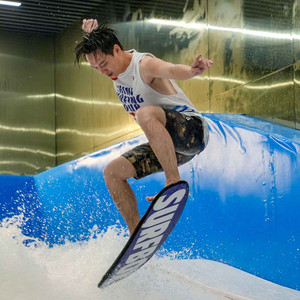
Urban dwellers are now flocking to indoor surf parts for a more exciting aquatic experience.
These urban surf spots are bringing ocean thrills to city centers offering a cool new way to escape the summer heat.
We take a look at this cool new shift indoors.
And a renowned Buddhist temple announced its spiritual getaway program.
And boom, it was fully booked before you could say, um, the tricky part?
No phones allowed. It's a digital detox meeting spiritual awakening.
Talk about plot twist in your summer plans.
Our podcast listeners can find us at Round Table China on Apple Podcast.
So you just Spotify and all major international platforms.
If you have a question that you like us to answer in a future show, whether it be about something that happened in the news or something you've been wondering about, you could email us a voice memo to eZFM around table at boxmail.com.
Now let's move on to the next topic discussion today.
As the summer sun blazes and temperatures soar, sports enthusiasts are beating the heat by heading indoors.
And there's a new way of making a splash in the world of indoor sports.
Let's dive into the rising trend of indoor surfing centers where you can hang 10 anytime, rain or shine.
These urban oasis are bringing the thrill of the ocean right to the heart of the city, giving landlock, surfers a chance to ride the waves year round.
Let's paddle out to explore this new frontier in indoor recreation.
So how does indoor surfing work?
This is pretty new for most Chinese people I would think.
So first of all, indoor surfing also known as flow boarding or flow riding.
And from the name we can actually tell a little bit it is an artificial wave riding sport that simulates the experience of ocean surfing in a controlled indoor environment.
And mainly there are two systems that simulate waves.
One is flow rider. This system pumps a thing layer of water mostly less than 9 centimeters up a slope.
Slope to surface at high speed and creating a kind of a stationary wave.
Another one is called wave pool.
These are larger facilities that generate periodic waves in a pool.
And in China, the flow rider system is more common due to its compact size.
In recent years, due to the popularity of a lot of these outdoor sports like skiing and surfing, these corresponding indoor sports have also become increasingly popular.
And this actually provides people in areas without natural conditions like the sea, the opportunity to enjoy the fun of outdoor sports.
However, the experience might still defer due to the different environments.
And participating in these indoor sports is not particularly cheap because most of the time the cost for one person per session for an indoor surfing from what I saw is around 300 yen.
That's about 41 US dollars.
Is that true? Yes, it is.
It's a great way to get a good experience.
But I think in China, it sounds like it's popular because it's a way to get away from the heat in landlocked areas in particular and to take part in a sport that they wouldn't ordinarily have the opportunity to take part in because they aren't near any surfing spots.
And there is the surfer culture and then we've seen that kind of culture being portrayed in Hollywood movies.
Is that the movie? Or Kate Bosworth?
I can't remember. All this one with Keanu Reeves.
There are so many. There are so many.
So surfing culture has been big for decades.
I was like, I was like, I was a teenager, but I never surfed or have I surfed.
I lived that dream. So I went to a high school.
So literally at the end of school, whether if you weren't taking part in rugby or hockey or water polo, there was the surfing club and every day there would just pop into a car, drive 20, 25 minutes and they would be at the greatest surfing spot in the world.
I'm chasing the wave. Yeah, so I mean, I did a bit of surfing and life saving.
And so we definitely lived that like school to beach culture, which was amazing to be a part of.
It is. And then this is a lot to do with the climate and literal environment.
And the things in the movie.
Yeah, that you're raised in.
And then now with these indoor surfers places, I guess they give a lot of regular Chinese people a chance to test the wave, try it out.
That kind of thing. But it's a great introduction to the sport.
Yes. And it's also just a fun activity.
I mean, even if you don't end up taking surfing particularly seriously, I think it's a fun way to just enjoy time at a mall, for example, instead of going bowling or, you know, I'm skating.
You know what I mean? Like those typical mall-like activities.
I think surfing is a great alternative option.
Yeah, absolutely. And when you were mentioning that there are so many indoor surfing facilities, even in South Africa, where there are so many hot spots of actual surfing, I was thinking maybe the newcomers or learners of surfing may choose these kind of indoor facilities because they're safer and they're safe guards over there.
And it is not that deep of the sea because it's less intimidating.
Yeah, personally, I think, you know, the fear of the deep sea is quite odd and like a, yeah, I'm afraid to even just swim in the ocean.
But there's also one thing, as I was doing research for this topic, try to look up some prices.
And then I realized everything starts from like 201, which is pretty expensive for me.
And then it even said that if you're doing outdoor surfing, surfing in the ocean, then the price is even higher.
And I was like scratching my head.
Why isn't like surfing out in the open on the ocean of free activity?
Then I realized because it assumed the paper assumed that all Chinese people don't know how to surf.
So you have to hire an instructor to teach you and keep you safe, that kind of thing.
So that's why, you know, and you'll have to hire the wetsuit potentially higher the board.
So I think for in terms of like surfing in the ocean, that's maybe where some of the additional costs come in.
But you know, 200 to 300 you and for indoor surfing for me still seems pretty steep.
Quite, quite expensive.
Yeah, so that would be a 40 US dollars, something like that.
And you shouldn't do tell us though, despite, you know, all these pros and cons and, you know, a distant dream as such.
How popular is indoor surfing these days?
Yes, recently we can see the popularity is increasing according to a market director of an indoor surfing parking Beijing.
Child and district. Currently, over 1,000 people visit the park each month and generating sales of approximately 600,000 yuan.
That's about 82,000 US dollars.
And as some are approaches, the foot traffic has doubled compared to previous months.
They also organize one to two public surfing competitions per month.
And in collaboration with some other indoor skiing facilities and other fitness clubs to actually introduce these indoor surfing to the wider audience.
And also, overall, the whole activity of surfing is also very popular with, along with other water sports has seen a substantial increase in popularity.
According to Chinese tourist agency, a tourism business consultancy in 2023, demand for surfboards, surf leash, strange strings and paddles has increased by 460%, 420% and 290% respectively.
Over a six month period, basically, you can see there are like tripled amount of people are joining the crew of surfing or, you know, a lot of these water activities.
I find it interesting that all of these indoor surfing spots are now popping up now that surfing is an Olympic sport.
It sounds like a tricky tactic by, you know, Chinese sports enthusiasts to identify some surfing talent for the future.
Maybe that's the end game.
And maybe we'll have a Chinese world champion surf, well, Olympic gold mid-list surfer in the future, maybe.
Oh, well, I do look forward to that.
That is really interesting when you've got, especially if it's an individual sport, you know, which China generally thrives at.
I'd say compared to a lot of other countries, individual sports, very good.
Versus some of the team sports, some of.
Actually, when we are mentioning these kind of surfing culture, we may say, oh, China or Chinese people don't have that much of, you know, attention or history in that.
But actually, maybe in some areas in China, like in high-nan, there are people and there are like a popular trend in China that there are a huge amount of people that maybe, you know, they resign, their previous jobs, and then they get into high-nan and stay there, start surfing and enjoy their lifestyle over there.
And a lot of people are enjoying this kind of, you know, enjoy the moment lifestyle or concept to actually, to enjoy this kind of surfing culture and be actually into it.
But you know what's interesting about surfing and surfing culture for me is that a lot of very hard-lined surfing culture enthusiasts are very anti-competitive surfing.
So, I think the growth of, or the lack, the supposed lack of surfing culture in China is not necessarily going to affect their potential performances in competitive surfing going into the future.
But it is also good to hear that there are some areas in China where there is a surfing culture emerging.
Because I think a big part of surfing is not just competitive surfing, it's the lifestyle that it creates.
And I think that there are many areas in China where surfing enthusiasts can enjoy the surfing lifestyle and not have to go to Hawaii or to Heathe or whatever it is.
When you say the surfing lifestyle, is it sort of the exact opposite to the stereotypical rat race we envision in big cities?
Is it like really chilled?
You might bartend, you might do something really casually just to earn a few bucks or you on and then you just go surf and then have a beer and then chill and then, you know, the next day sort of repeat that kind of lifestyle.
I've always found the surfing from my experience, the surfing culture, but what's the word?
Hypocritical, because it is very relaxed and chilled and that's the lifestyle that they promote, but they also very aggressively protective of that lifestyle.
So if people go to like secret surfing spots and they're not locals from that area, sometimes the locals can be very aggressive with outsiders and sometimes there's also divisions among surfing crews and there is that sort of element to it.
But I think the overall surfing lifestyle is inclusive and is open to newcomers and they also don't promote competition or judgment or, you know, that sort of lifestyle that's more about integrating nature and enjoying surfing into your day to day life.
And yes, it's definitely an opposition to the whole rat race kind of lifestyle that we see in some of the bigger cities.
So I think I'll just touch upon a couple of really interesting points there.
One is I remember we talked about a topic a while ago about this surfing wave prediction app and then a lot of the surfing like purists hated it because it directed traffic to their secret surfing spots.
They do not like that, but for the wider surfing population, then they know where the great waves are and where to go.
And here again, I think this directs back into indoor surfing, one of the advantages that it boasts, basically you know the kind of waves you are expecting when you are arrived once you've paid the money.
It's just one wave. It's one constant wave.
No sharks, no sharks, no reefs.
That's good. Also, you can crank it up a notch or two and then that's, you know, something you you you paid for it.
So you can enjoy it. But when you actually go into mother in nature and then sometimes you don't even you wait a whole day and there's no wave that that could be possible.
So while indoor surfing can provide a fun and convenient way to experience writing waves, some surfers may prefer, like you said, Brandon, that is the authenticity and connect to nature that comes with surfing in the ocean and the feeling of being in the open ocean surrounded by nature.
It's a unique aspect of traditional surfing that cannot be replicated indoors.
And I think this is what's going to be interesting to watch with the growth of surfing going into the future is the battle between the surfing lifestyle enthusiasts and the competitive surfers.
So I think, you know, with things like surfing being involved in the Olympics and the growth of indoor surfing venues and, you know, with technology giving people greater access to secret surfing spots.
That battle between, you know, traditionalists and, you know, the growth of surfing as a sport.
That's going to be something to keep an eye on going into the future.
And I think that ultimately competitive surfing and the growth of surfing will eventually outgrow that more traditional surfing lifestyle, which I think is it has its pros and cons.
But I think that's the way that surfing is going to go into the future.
It's a quick question, though, when you mentioned competitive surfing and why traditional surfers aren't really are kind of against that, is it just because competitive surf thing is basically you're chasing after the trophy.
Yeah. So it can't direct the surfing lifestyle.
So it's not chill. Yeah, exactly.
Okay. Very interesting.
And then besides indoor surfing, what other emerging indoor sports are trending in China and around the world?
One activity that I saw is indoor diving.
You know, they have that kind of a huge facility that allow you to dive.
In Beijing's Chaiyong district, there is a diving center with an indoor pool that reaches a depth of 16 meters.
And this center's manager stated that scuba diving in China is currently experiencing rapid growth.
And the center receives an average of about 2,000 visitors per month.
It's scuba diving in a pool.
Yes. What are they looking for?
Deep scuba diving. It's a scuba diving like the whole purpose to see like coral and fish and what do you see in a pool?
It's a good way to practice scuba diving, I guess, like indoor surfing.
Yeah, of course. It's mainly about learning how to scuba dive.
And also there are some people, there is a second activity that's hot mermaid.
Say it properly. We need to give it a spotlight.
Mermaid egg. Mermaid egg.
Or just mermaid courses.
And these are quite popular in China that a lot of people are learning to be the mermaid or scuba dive.
And they're actually paying about 2,000 yuan for a whole session of their course.
And then, you know, that is why it's popular.
Brandon is shaking his head.
He's paying 2,000 RMB to learn how to be a mermaid.
Let's get involved in that business.
Well, we're in defense, in defense of all the mermaids and mermaids out there.
Come on. This is an emerging.
All ten of them. There's going to be more than that.
It has to be. Yeah. Last year we covered this topic.
Apparently it was the hottest summer emerging sport.
Or, you know, aesthetic recreation, leisure activity last year in California.
But we are the state. Well, people have different ideas, you know, and choices of life.
And this is actually offering people more job opportunities.
We can see a lot of, you know, Korean or, you know, in these kind of areas.
You can see they are just, you know, swimming in a lot of these among the reefs and something.
And a lot of kids just love them.
Yeah. And also ever since Beijing hosting the Winter Olympics, we've seen in China that there's this enthusiasm growing in all kinds of winter sports.
Yeah. Yeah. It's really had a big push for it, I suppose.
And there are so many indoor skating rinks and also indoor skiing centers.
Ice hockey and curling and, you know, there's loads of indoor winter sports venues.
Yeah. So indoor rock climbing, indoor trampoline parks.
Like, like giant hamster cages.
And you can just, you know, jump and then the next summer trend hamstering instead of moving.
Oh, that's going to be the next trend hamstring.
Everyone's going to be dressing up like hamsters and trampoline pox.
But anyway, these are all of these, I think activities that can offer people opportunities of a great sense of release and a relaxation.
Yeah. And also avoiding sometimes, you know, really crazy, harsh summer weather, yeah, and avoiding the sun.
That's always a, you know, as a face skin guy, that's always a big thing for me.
Yeah. But on some sunscreen, right after the show when you get out of here coming up from urban hustle to spiritual tranquility in the forest.
We take a look at young people's retreat choices this summer and it's going into a temple.
Stay tuned. Looking for passion?
How about fiery debate?
Want to hear about current events in China from different perspectives?
Then tune in to Roundtable.
Where East meets West and understanding is the goal.
Is the hour around table of myself, how young I'm joined by Yushun and friend and Yates in the studio?
Recently, the renowned Ling Yin Temple in Hongzhou city announced online that it will host a temple forest retreat from August the 9th to 14th.
The retreat aims to promote Buddhist teachings, offering the public a chance to experience monastic life and help them find peace in spiritual refreshment.
The program became fully booked in less than a day.
Internet users are clamoring to get in, but there are no vacancies left.
Here's the kicker. Participants have to give up their phones for the entire retreat.
Despite this rule, the retreat's popularity shows that many are eager to unplug and immerse themselves in this unique experience.
What requirements for participants are there in this program and what benefits and experiences can participants expect to gain from this retreat program?
This event is organized by Ling Yin Temple in Hongzhou, southern China, running from August 9th to 14th, 2024.
There are some rules and requirements.
It needs to be aged between 23 to 30 years old.
I don't know why the range of this.
That's the only rule that caught my eye.
That's a bit limiting. If you're 31, then...
I'm 31. Bye bye. Sorry. Also, full participation in all activities following the group and temple arrangements, and good physical and mental health, knowing factious diseases, or history of heart disease, or hypertension.
Respectful attitudes towards Buddhism and willingness to learn, adherence to temple rules, and maintaining the sanctity of the monastery.
The most importantly, mobile phones need to be handed during the program and all personal affairs need to be handled beforehand.
Your work can't call you.
If your phone has been snatched, you've surrendered it, so they can't reach you anyway.
Let your family work know your whereabouts, so they don't look for you.
And, yeah, during this program participants will be led by residents' monks to learn temple etiquette, experience, monastic life.
And listen to Buddhist teachings in solemn lecture halls, practice walking meditation among lush forests and bamboo groves.
I would love that, and engage in silent meditation at dawn.
If the food's good, I'm done.
The food is not supposed to be good.
No, no, but I feel like this all really appeals to me, and I love the idea of surrendering my mobile phone for a week, but for me, the food has to be on point as well.
Then I could definitely do this for a week, no problem.
Right, well, what about the digital detox aspect?
Would it be a struggle, or if you've signed, and then you would want that, right?
And what are temple forest retreats, main attraction for especially young people?
I think it's a great way to disconnect and kind of de-stress and also learn something new and participate in something that's culturally enlightening, while that's a difficult phrase.
And just a way to kind of connect with nature and religion and learn about a different way of life, a different, you know, a more historical way of living one's life.
And I also think that China is the perfect country to host these sort of retreats, because I mean, there's temples all over the country.
So this could really easily become a nationwide trend that could really boom.
And it's also a great way to offer an escape for young people that feel constantly connected to their technology or constantly being bombarded by work and social media and those sorts of things.
So I think this is something that could really take off.
Yeah, absolutely. I think especially in such kind of a fast-paced society, young people would like to take this as an opportunity to escape.
The pressures of digital overload or urban stress.
And these retreats offer a kind of a digital detox and allowing them to disconnect from technology and engage in, you know, these kind of spiritual exploration and mindfulness practices maybe with within this kind of natural environment.
And in today's society, this kind of provides a suitable opportunity for urban dwellers to catch their breath because I think another point is that, yes, there are these kind of temples or areas are located in cities.
So they actually offer young people a chance to, you know, getting to there and escape from the business or, I mean, business area just during the weekend.
So that is a good chance for them.
And no ultra-fast deliveries.
Right. No super-fast anything.
The mantra here is to tell you to slow down and to meditate in nature.
I have always been drawn to that idea.
And once on my trip to, my reporting trip to Yunnan, I kind of wanted to try that because we had this chance to stay in a botanic garden.
Did you hug a tree? No, I borrowed a yoga mat and wanted to sort of meditate a little bit in the middle of this beautiful garden with limit which I knew I could call no names of all the plants around me because everything was just so exotic.
And guess what? I just feel like I'm just in sex everywhere.
So, you know, my beautiful dream was quickly spoiled.
And then I guess, you know, from your dream to it.
And realizing, becoming true, there are always some intricacies and unexpected things that you will encounter.
But that's just part of, I guess, trying something new and maybe enjoying life.
And we'll see you next time on Roundtable.