This BBC podcast is supported by ads outside the UK.
If journalism is the first draft of history, what happens if that draft is flawed?
In 1999, four Russian apartment buildings were bombed.
Hundreds killed, but even now we still don't know for sure who did it.
It's a mystery that sparked chilling theories.
I'm Helena Merriman and in a new BBC series I'm talking to the reporters who first covered this story.
What did they miss the first time?
The History Bureau, Putin and the apartment bombs.
Listen on BBC.com or wherever you get your podcasts.
This is the Global News Podcast from the BBC World Service.
I'm Paul Moss, and at 4.30 GMT on Tuesday, February the 3rd, these are our main stories.
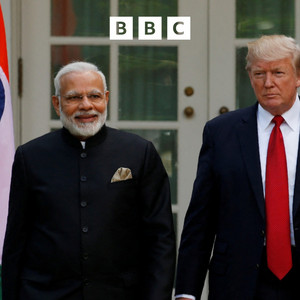
The US and India have apparently reached a trade deal, but does India see it the same way as Donald Trump?
Bill and Hillary Clinton have agreed to testify in Congress about Jeffrey Epstein days before.
They risk being held in contempt if they fail to show up.
Also in this podcast, what's it like being our man in Moscow?
The BBC's Steve Rosenberg reveals all.
Plus... We said the sport will take girls forward.
They will be able to get government jobs that are allocated to sportsperson, how girls in India are using football to fight back against illegal child marriages.
And it's dress rehearsal time for Artemis, the NASA space mission to send men and women back to the moon.
This is not going to be just a brief visit.
The goal for the future is to get a permanent presence.
Has Donald Trump really pulled off another of his much-touted trade agreements?
The US president likes to see himself as a man who makes deals.
And on Monday, he was hailing his latest.
He announced that America would cut tariffs on goods imported from India and said that in return, India had promised not to buy any more Russian oil.
Trouble is, it's not clear that anyone's told India's prime minister.
Commenting on the deal, Narendra Modi welcomed the tariff reduction, but he didn't mention anything about Russia or its oil.
So what's going on?
Here's our Asia business correspondent, Archana Shukla.
So far, no, Paul, there has been no word around any deal on oil purchases.
And right after President Trump's Truth Social post announcing this trade deal, the fact that India will be buying 500 billion worth of American goods, or that India would reduce tariff to zero for all American products and also stop buying Russian oil and instead buy more from US and Venezuela.
The only thing that Prime Minister Modi tweeted was thanking President Trump for reducing tariffs from 50 percent to 18 percent, and also showering praises about their friendship and the fact that the two largest democracies would come to work.
But no word, neither from the trade minister or even the home minister here in India.
Could there be a reason why India's Prime Minister, Mr Modi, would promise Donald Trump various things like buying more American oil, not buying Russian oil, but not want to make that public?
Paul, it seems unlikely that India will completely cut down on Russian oil for two main reasons.
One, it's cheap for India's import bills.
And secondly, Russia is one of its oldest allies.
And even from a geopolitical lens.
If you see, since the sweeping tariffs came into effect Beijing, Delhi and Moscow have actually strengthened their ties.
So completely cutting down on Russian oil may not really be on the cards.
But yes, the purchases have come down.
And in fact, over the last few months, India has bought more oil from the U.S.
So these could be indicators that Prime Minister Modi and President Trump would have discussed.
And there had been a lot of pressure on India to buy more oil and buy more arms from the United States.
And those could be some of the bits where India would have pushed it through.
Which sectors of the Indian economy are most likely to benefit?
This really helps big export-heavy sectors like textiles and apparels, auto ancillaries, gems and jewellery.
Jewellery is a big segment of exports from India to the US.
And also seafood, things like shrimp.
The US is the largest consumer of shrimps and India is the second largest seller of shrimps.
And these are very export-heavy industries that also employ a lot of people here in India.
Millions are employed in these sectors and they had really suffered because of these tariffs.
More than 30 to 50 percent of their business had come down.
So it would really help these sectors now that the tariffs are down to 18 percent.
It's only days since India announced a trade deal with the European Union.
And as I'm speaking to you, I'm just seeing it reported that the Mumbai Stock Exchange has surged after the announcement.
It sounds like these trade deals are good for the Indian economy.
It certainly is.
And you know it's a change in the last one year from India's very protectionist trade mentality and policies to now opening up to trade deals with the US, with the European Union, Australia and the others that India has signed.
And India now wants to be competing with the Asian peers whether it's Vietnam Indonesia, Bangladesh and sell to the rest of the world markets.
They're also looking to diversify trade.
And with this tariff uncertainty, actually, there was a lot of pressure on the stock markets.
A lot of foreign money had moved out of the Indian stock markets.
The rupee had been under pressure.
And all of this uncertainty, at least for the moment, seems to be going away.
And that's why you see so much cheer on the stock markets there.
Say what you like about Jeffrey Epstein, the fact is that most people implicated in the various scandals around him don't want to say very much.
Most have issued brief statements of regret or been silent.
Not so former US President Bill Clinton and his wife, the former Secretary of State Hillary Clinton, who've now said they will testify before the ongoing House investigation into Epstein and his associates.
It's worth mentioning that the Clintons had been threatened with contempt charges if they refused to testify, and that they wanted to do so on their own terms, terms which the committee chair has rejected.
I asked our North America correspondent, Peter Bowes, first of all why the Clintons' testimony was being sought.
Well, they're being asked to testify because US lawmakers want to question them about their past interactions and connections with Jeffrey Epstein.
They are known to have known each other and to have moved in some similar circles.
Now, there are multiple photos of Bill Clinton in the Epstein files.
He has not been accused of any crimes.
The former president has repeatedly denied charges.
Thank you very much.
The Republican-led US House of Representatives was expected to vote on that matter this week, which could potentially have had serious consequences for the Clintons.
They earlier provided written sworn statements to the committee, which their lawyer argued contained all relevant information that they had about Epstein and Ghislaine Maxwell.
But now, as we say, Bill and Hillary Clinton have agreed to appear in person with their spokesperson, interestingly saying that they look forward to setting a precedent that applies to everyone.
Now also.
On Monday, the Department of Justice in the US said it had to take down several thousand documents included in the so-called Epstein files because they may have revealed information about victims.
How did that happen, given that we were told the Department of Justice was delayed in revealing these documents because it was so busy carefully redacting anything confidential?
And the question as to how it happened is the big question.
And this could eventually result in legal litigation, as these survivors are furious that they say, their identities have, in some cases, been exposed.
At least one woman who had not previously come forward with abuse allegations.
Her identity exposed, the lawyers say, has been revealed.
The Department of Justice had these names they promised to redact and clearly it seems that they didn't accurately do that.
And so there is now an appeal to the Department of Justice to, in effect, take down this website completely until they get to a position where they can fulfill their original promise to provide privacy for these survivors.
Peter, you're in Washington.
I wonder how all these ongoing revelations are going down there.
I mean, have people in the United States begun to get a little inured to all the stuff coming out about Jeffrey Epstein, or is it still making waves, making headlines?
I think it is fair to say it's still making waves and headlines.
It's reverberating around the United States as it is around the world.
Clearly, much of this is deeply disturbing to many people.
And the fact that we journalists and independent observers around the world are still sifting through all of these documents, leaving open the possibility that there could be more potentially serious revelations.
I think that means that this is going to continue and that in this election year and I think this is a key issue for the Trump administration it will continue to be in the headlines.
It's certainly something that Donald Trump wants to see not in the headlines.
He would prefer the media here to be focusing on what he sees as his achievements from the past year.
At the moment, there is no sign of this going away.
Peter Bowes in Washington.
The Epstein scandals have been distinguished by the sheer range of people they involve.
And that, of course, includes royalty.
Britain's former Prince Andrew lost his title as a result of the revelations, and his wife, Sarah Ferguson, is also implicated.
But so too is the crown princess of Norway.
Mette Marit is married to the heir to the country's throne and, in the normal run of things, will one day become queen.
The newly released email suggests she had a closer relationship with the disgraced financier than was previously known.
As Tove Talason explained, she's royal correspondent for the website Natavizin.
She's mentioned over a thousand times and it's a lot of text messages and emails between these two.
And it seems like it's an intimate and very personal relationship between these two.
Almost like they are very close friends.
Like they were sharing messages about books they were reading and...
He was giving her health advices and they were also talking about the meeting.
And we also learned that she was staying in his property in Florida.
And that was very different from the information that we had.
She had a statement late Friday night where she told us that she was very sorry and, of course, very embarrassed.
And that's the only thing we heard from the palace.
Both the king and the queen said, They are almost 90 years old and as always did their duty.
So this is very sad.
And, of course, the big discussion these days are is it possible for our crown princess to become queen?
Do we have trust in her?
And this is the first time we have ever talked about this, because this is so serious and we are not sure if we trust her judgment anymore.
Tove Taliesin.
Even before the allegations emerged about the crown princess and Jeffrey Epstein, Norway's royal family was already in the midst of a scandal.
The princess has a son from a previous relationship, 29-year-old Marius Borg Herbie, and he is due to go on trial on Tuesday charged with domestic violence, drugs offences and four counts of rape.
Paul Kirby reports.
For the next seven weeks, Norwegians will be transfixed by what unfolds in the modern district court complex behind me in the heart of Oslo.
29-year-old Marius Borg-Hobi faces 38 charges, ranging from rape and sexual abuse to drug trafficking and speeding offences.
He is not a royal, but ever since his mother, a commoner, married Crown Prince Håkon when he was four, he has seen the heir to Norway's throne as his dad and King Harald V as his grandfather.
That life within the royal family, but not a member of it, changed in August 2024.
I got a telephone call the night of 4th August from a source saying The source told me that Marius Borg-Höyby was involved in a big fight in an apartment in some part of Oslo.
The story was broken by Ulf Andre Andersen at celebrity magazine See & Hear.
Initially, Crown Princess Metamarit's son admitted assault and vandalism, but prosecutors later charged him with raping four women between 2018 and November 2024.
One charge involves intercourse while the woman was asleep.
The other three involve sexual assault while the women were incapacitated, which counts as rape in Norway.
He's also accused of physical abuse and violating a restraining order and transporting three and a half kilos of marijuana.
Marius Borg-Herbe's defence counsel, Petar Sekulic, has said he doesn't acknowledge wrongdoing in most of the cases, especially those regarding sexual abuse and violence.
For the 88-year-old Harald V, sworn in as King of Norway in 1991.
The trial marks the biggest challenge to a monarch who, until now, has competed with the late Queen Elizabeth II for the title of most beloved royal in Europe.
No member of the royal family will attend the trial.
The palace will be comforted by recent poll ratings that show 73 support, a view largely reflected on the streets of central Oslo.
I respect the king and the queen and I think our crown prince is pretty good, but I don't like his wife.
Oh yes, I love the royal family, really.
I think they are very, very nice people and I think our king is a very wise man.
Norwegians know that King Harald and Queen Sonja will not be around for many more years, and it is not out of the question, when Crown Prince Håkon accedes to the throne, that future Queen's son might be in jail.
Paul Kirby in Oslo.
Still to come in this podcast.
Two hours without a life jacket on and yeah, he made it.
Yeah, superhuman effort.
The teenager who braves strong winds and rough seas to save his family.
If journalism is the first draft of history, what happens if that draft is flawed?
In 1999, four Russian apartment buildings were bombed, hundreds killed.
But even now, we still don't know for sure who did it.
It's a mystery that sparked chilling theories.
I'm Helena Merriman and in a new BBC series I'm talking to the reporters who first covered this story.
What did they miss the first time?
The History Bureau, Putin and the apartment bombs.
Listen on BBC.com or wherever you get your podcasts.
This is the Global News Podcast.
What is it like to be a journalist operating in today's Russia, a country where dissent is, to say the least, discouraged?
And even the mildest criticism of the government can earn you a long prison sentence.
That is the challenge faced by Steve Rosenberg, the BBC's Russia editor, who's been reporting from the country for 25 years.
Since the invasion of Ukraine, he's been one of the few Western correspondents still allowed to live and work in Moscow and is now the subject of a television documentary.
Our man in Moscow followed him for a year as he carried out his assignments and also reflected on how Russia has changed.
There are many moments in my life when I think this is very strange.
One of the most bizarre things that happened to me happened in the 1990s, when Russia first took part in the Eurovision Song Contest.
I was being given a tour of Russian state television and wandered into a studio where they were rehearsing for that evening's Song for Europe.
And I got talking to the director and told him I liked Eurovision.
He said, oh, well, come back this evening.
You can co-present the program.
Things like that happened in the 1990s.
There was this buzz in the studio and it felt like after the fall of communism.
Russia was now part of this European family and we were going to do great things together and the world was going to be a better place and a safer place and a happier place.
I mean, you know, when you're young, you're completely full of hope and optimism.
And it just didn't work out.
Since Vladimir Putin came to power, Russia has become a very different country.
It felt as if this huge black cloud had come over.
Russia had taken a very dark path.
Simply calling it a war can lead to 15 years behind bars.
We've seen journalists detained, arrested, put on trial.
No one is protected from prosecution.
Virtually all of the independent media in Russia has closed down.
Many journalists have already left the country.
I would never criticize any reporter for having left Moscow.
But living and working in Russia trying to report on what's happening right now, it does feel as if I'm walking this tightrope.
I remain fascinated by Russia and want to know how this is going to end.
Steve Rosenberg and an extract from the BBC documentary Our Man in Moscow.
It's called a wet dress rehearsal, but this is no practice run for a play or musical.
It's the name NASA gives to a critical test run for its rockets.
And the wet dress rehearsal which began on Monday is perhaps NASA's most high profile in decades, because it's getting ready for the Artemis II mission, which aims to take four astronauts on a trip round the moon.
But as we heard from astronomy reporter Clara Moskowitz, it's already hit a snag.
This rocket has only flown once before.
And so there's a lot they still don't understand.
And they need to make sure that the rocket is going to be safe and ready to go when the actual launch happens, hopefully next week.
So they're going to fill both the liquid oxygen and the liquid hydrogen and make sure everything goes as planned.
And already it is not going as planned.
They have had to pause the hydrogen because there's been a leak, which is a pretty normal thing to happen.
That's exactly why they do these rehearsals.
Technology has completely changed since the 1960s and there's still a lot left to learn about the moon.
And these missions are really all about trying to get our capabilities up for being able to live and work in space.
This is not going to be just a brief visit.
The goal for the future is to get crews out there really studying and living there and practising, establishing a permanent presence.
Clara Moskovitz from Scientific American magazine.
There may be laws against it, but in India, millions of girls are still married in childhood, something which often means that their lives are permanently limited to domestic chores and dependence on their husbands.
However, some young girls are fighting back and, in an unusual way, using sport to become financially independent and to carve out their own identities, resisting the pressure to marry early.
Divya Arya met some of them in the northwestern state of Rajasthan.
Munna was only 14 when she was told she will be a bride.
When they told me, you will be married too, I started crying.
I said, I don't want to marry right now.
I am in grade 9.
I want to study.
She would have joined more than 200 million girls and women in India today who were married before they turned 18.
Except Munna rebelled.
And she resorted to an unusual method to fight the threat of an illegal child marriage.
Football.
I didn't know anything about football.
We were told it is played by using the feet.
So that's what we did.
We were hitting the ball here and there, feeling scared.
Then our clothes would get in the way.
We couldn't even run properly.
So we would lift our clothes and try and run with the ball.
First, Munna had to fight to be allowed to play football.
Then to be allowed to wear shorts.
And then to travel out of the village to play in tournaments.
Sport is out of reach for many girls in India because they are poor and drop out of school when their families force them into child marriage.
Munna's mother was a child bride herself and married off her eldest daughter early too.
They say that if girls step out of their homes, they will be exposed to bad influences and run away with boys.
We do the marriage quietly.
We don't print a wedding invitation or put up a tent.
It's hard to challenge deeply entrenched social norms.
So how can football prevent child marriage?
Padma Joshi was the one to introduce Munna to football and to 800 other girls across 13 villages in Rajasthan.
She's been leading the Football for Freedom project at MJAS, a women's rights organisation.
We said the sport will take girls forward.
They will be able to get government jobs that are allocated to sportsperson.
But when we worked with the girls and they learned about their rights, about the country's constitution, the ill effects of child marriage, and because girls were stepping out, they were able to raise their voices.
This is Munna's village football team and I want to find out how many of the girls here were forced into early marriage and I'll ask them to step up.
That's 9 out of 12.
Just Munna, her sister and one other player were able to resist the pressure to marry early.
So it's incredible that all of these girls are here on the field and have been able to fight for that right.
Even though football hasn't been able to prevent all these girls from marrying, a sea change has been achieved.
Now even child brides are able to train in football, opening the possibility of some independence and a different life.
Munna is 19 years old now.
Football not only helped her fight the threat of child marriage, but also opened up her world.
She has trained to be a coach and hopes to become a school sports teacher.
It's a path which promises financial independence and a freedom to take decisions about her life.
And it allows other girls to dare to dream too.
Divya Arya Now picture the scene.
You're a family having fun at the beach, kayaking and paddle boarding, when suddenly everything goes wrong.
Rough weather and strong winds push you far out to sea.
That's what happened to a mother and her three children, who were on holiday in the southwest of Australia.
And they may well have drowned were it not for an extraordinary swim by the 13-year-old boy of the family, who set off to raise the alarm.
Our Sydney correspondent, Katie Watson, told me what he did he decided to swim back and raise the alarm.
Now he started off in his kayak, but that started taking in water.
So he ditched that and swam about four kilometers before reaching land.
And according to ABC, he did it for two hours in his life jacket but then decided to ditch that and swim for another couple of hours before reaching land where he was able to raise the alarm.
And I gather things weren't easy for the boy's mother, who was still out at sea trying to keep the rest of the family together.
Yeah, so he got back onto land about six o'clock in the evening.
Then that sparked a massive search.
There was assistance from obviously the police, rescue authorities, marine rescue service.
And about 830 in the evening, his mother and two siblings, 12-year-old boy and an 8-year-old girl.
They were clinging to a paddleboard.
And that was about 14 kilometres offshore.
So they'd floated out quite considerably.
And of course, you know, it was choppy waters.
It was very windy that day.
But also it's Australia and there were also big sea creatures such as sharks.
So I think it was just a remarkable effort.
In fact, rescue services called him superhuman for doing this to save his family.
And they were all checked out at hospital.
They all left hospital and they're all absolutely fine.
I saw that the rescuers had said that this incident serves as a reminder that ocean conditions in that part of Australia can change rapidly.
I mean, are these waters notoriously treacherous?
Yeah, I mean, this is peak summer holidays.
So there are an awful lot of people out enjoying the beaches in the warm weather.
In terms of marine wildlife, there's a huge risk there.
Certainly here in Sydney, there's constant concern because of the weather that has been bad.
There's an increased sighting of sharks, for example, and that's something that people are are particularly concerned about, but obviously you know huge parts of the coast when the winds turn and the weather conditions change quite dramatically.
But actually the authorities did also say that the fact that they were all wearing life jackets did contribute to their survival, and that's something that the authorities have made sure to emphasise that importance of wearing life jackets.
Katie Watson in Sydney.
And that's all from us for now.
This edition of the Global News Podcast was mixed by Holly Smith and produced by Alice Adderley.
The editor is Karen Martin.
I'm Paul Moss.
Until next time, goodbye.
In 1999, four Russian apartment buildings were bombed, hundreds killed.
But even now, we still don't know for sure who did it.
It's a mystery that sparked chilling theories.
I'm Helena Merriman and in a new BBC series I'm talking to the reporters who first covered this story.
What did they miss the first time?
The History Bureau, Putin and the apartment bombs.
Listen on BBC.com or wherever you get your podcasts.