This is The Indicator from Planet Money.
I'm Waylon Wong.
I'm Darian Woods.
And we're joined today by Planet Money's Sarah Gonzalez.
Sarah, it has been too long.
It always feels too long.
Sarah, you truly could not have picked a more beautiful day to come into the Indicator orbit, because today is Indicators of the Week.
This is the day of the week when we talk about the most interesting numbers from the news.
On today's episode, we're talking about the Trump administration's ICE recruitment strategy.
China's world record beating trade surplus.
And pack your Dippin' Dots.
We're going back to the moon.
I'll bring some crackers for the cheese.
This message comes from ServiceNow.
People should do the creative work they actually want to do, not boring busy work.
Now, with AI agents built into the ServiceNow platform, you can automate millions of repetitive tasks in every corner of your business IT, HR and more.
So your people can focus on the work that they want to do.
That's putting AI agents to work for people.
It's your turn.
Get started at servicenow.com slash AI dash agents.
This message comes from NPR sponsor, Zoom.
Work isn't just meetings.
It's calls, chats, docs, emails, calendar invites, events, and more.
And Zoom brings it all together on one platform.
Everything flows together so that you can finally focus on what matters.
With Zoom, ideas happen faster, projects move forward, and your workday finally works for you.
Zoom is more than meetings.
It's a unified platform powering how people get work done.
Learn more at zoom.com slash podcast and zoom ahead.
Indicators of the week, Sarah, you're first.
All right.
So my indicator of the week is $100 million.
That is how much the Trump administration has set aside to spend on a one-year so-called wartime recruitment strategy to hire more immigration and customs enforcement workers.
So this is all according to a document that the Washington Post got a hold of.
It says that immigration officials plan to flood the market with millions of dollars worth of social media ads and to pay for.
That's a quote.
Well, they're already making these, right?
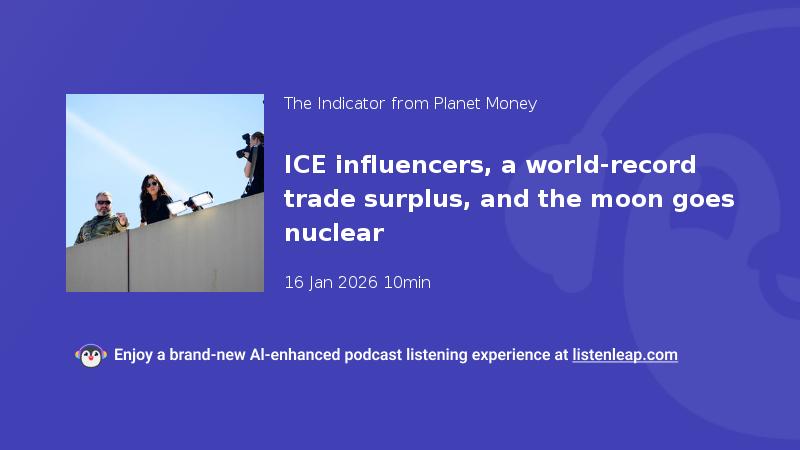
I mean, I've seen footage of videographers trailing after agents, and then they put together these slick videos and post them on social media.
So I think some of it's already happening, right?
The Washington Post couldn't confirm whether this strategy has been implemented or how much of this strategy, but it certainly seems to coincide with ads and ad campaigns and social media content that we're seeing online.
Apparently, at least 8 million of the 100 million is supposed to be spent on this influencer program.
They say that they are particularly interested in veterans, former agents, and pro-ICE creators.
And, like the idea behind recruiting influencers according to this document is to build trust through authentic peer-to-peer messaging.
So they want to reach people with like a big Gen Z and millennial mindset following and apparently also people who are tactical lifestyle enthusiasts.
I mean, this is the kind of language you know like.
Build trust through authentic peer to peer messaging.
This is language that I'm used to hearing from the advertising industry when they talk about working with influencers.
But how unusual is it for the government to be recruiting influencers in this way?
I mean, this is where you reach people these days, right?
And they do partner with like marketing organizations.
So the Biden administration also did recruit influencers for its own public health campaign around the COVID-19 vaccine.
So I remember one influencer did like a Q&A with Dr. Anthony Fauci.
Remember that guy?
Other influencers were just kind of encouraging people to get vaccinated.
Yeah.
All right, so this may be the future of marketing, even for the government.
Future and present, I would say.
And so the money for this comes from all the new ICE cash that Congress approved last year as part of the One Big Beautiful Bill right.
Yeah, the budget just for ICE's enforcement and deportation activities alone. tripled this summer.
It's almost $30 billion now.
And so that money can go towards everything from like, modernizing deportation planes to yeah, hiring more ICE officers and staff.
Now, according to the Post, a Department of Homeland Security spokesperson did not dispute their reporting and actually said that she was thrilled to see the outlet highlighting their quote.
Wildly successful ICE recruitment campaign.
Now, a little update on where ICE is in their recruitment efforts.
Earlier this month, the Department of Homeland Security said that their hiring push has shattered expectations, that they've hired 12000 officers and agents in just about four months.
So there used to be about 10,000 ICE workers, and there's now over 22,000 of them.
And their priority is really doing this quickly.
Okay.
Thank you, Sarah, for that update.
Now, Darian, what do you have?
My indicator is $1.2 trillion.
That's the size of China's trade surplus last year.
It's the largest trade surplus any country anywhere in the world has ever had.
Whoa.
They exported more than they imported.
A lot more.
A lot more.
Yes, there has been big growth in exports to Europe, Latin America, Africa, and Southeast Asia.
Those countries are seeing container load upon container load of inexpensive Chinese goods come through their ports.
So I guess whether you see this as a good or bad development depends on whether you're buying those cheap laptop stands and toasters or whether you're making them.
Yeah, like if you're competing against them.
So, because of the ways that this can hurt other countries' manufacturers, we are seeing countries like Mexico push back.
To protect its own industries.
Mexico put in place sweeping new tariffs on countries like China over the new year, most topped out at 35.
Guess everyone's doing the tariff thing now.
Even though Ecom 101 says that trade overall makes both countries richer.
But the benefits of cheaper goods does tend to be spread out among many consumers and the costs, you know.
When that undercuts local producers, that can be quite concentrated.
And I mean, that is the rub for the politicians, right?
That's the problem.
Yeah, you'll hear this wave of Chinese goods being called overcapacity.
And overcapacity is really in the eye of the beholder.
Does this mean the Chinese government subsidizing its manufacturing to dump goods all around the world and hollow out their manufacturing sectors?
Or is it a gift to the globe?
Is it giving us cheap solar panels, electric vehicles, and smartphones if only we would accept them?
But wait, what does this say about the US tariffs?
It doesn't sound like it's slowing down Chinese exports.
Yeah, so China's surplus to the U.S. did shrink last year.
But what we're seeing is that China has redirected a lot of the goods that would have gone to the US to other regions and then more.
In many cases, the goods are selling for cheaper than what they'd go for in the U.S.
There's always going to be a buyer.
Yep, so next shopping trip, I don't know, head to Vietnam.
Or to the moon.
Which is our next indicator.
You guys want to hear about the moon?
How much can I buy a labubu there for?
Labubu, economics work differently on the moon because of the gravity thing here, and I'll explain that to you later.
Okay, so my indicator is 2030.
That is the year that a lunar surface reactor will be developed for deployment to the moon and its orbit.
Wait, so you're talking a nuclear reactor?
Yes.
Okay.
This is energy.
We want energy on the moon.
We want energy on the moon.
Why the moon?
Are we moving to the moon?
Yeah, pack your bags.
This reactor is part of NASA's Project Artemis.
This is NASA's venture to explore the moon and establish a long-term human presence there.
Basically, you know, like trying to figure out how to eventually live apart from Earth someday, you know, on the moon, maybe even to Mars.
Okay, when's this nuclear power going to be set up?
It's unclear, but NASA, along with the Department of Energy, announced a renewed commitment to develop a planetary power source this week.
It follows an executive order late last year from President Trump.
That order called for a permanent lunar surface base by 2030 and at least one reactor on the moon that same year.
It's worth adding that this order was preceded by another order, to quote usher in a nuclear renaissance.
Okay, and so how much power might get generated?
Well, they're planning on building a reactor that can juice up to 40 kilowatts of electricity.
That could power 30 households for 10 years.
The Department of Energy says it can theoretically be scaled up.
It can also work quite literally where the sun don't shine.
So that's consistent power no matter what.
What a bright future, you guys.
30 households, maybe they could come around for potluck dinner.
I will happily watch those 30 households attempt to live on the moon from here on Earth.
The real housewives of the moon.
That's what's actually going to happen, Waylon.
You hit the nail on the head.
That's for sure the next step.
It's going to be astronauts throwing mimosas at each other's faces.
But unable to connect because it's just going to like flow out.
Yeah, exactly.
All right, well, Sarah, Darian, thank you, and see you on Earth sometime in the future.
Looking forward to it.
Thanks, guys.
This episode was produced by Angel Carreras and engineered by Maggie Luther.
It was fact-checked by Vito Emanuel.
Julia Ritchie edited this episode, Kate Kincannon edits the show and The Indicator is a production of NPR.