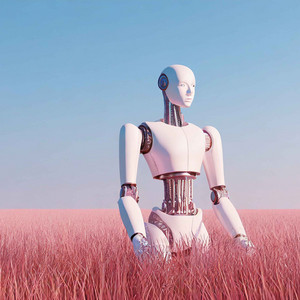
Discussion keeps the world turning.
This is Roundtable. Hello everybody, welcome to Roundtable.
Coming to you live from Beijing.
I'm her young. Just a quick note, my voice might be a little bit off today.
I'm just kind of battling a cold.
But that won't stop me from sharing some great content with you today.
On a day's show, from factory floors to our living rooms.
That's the journey robots are making.
And China is accelerating this transition.
From industrial robots that we've talked about before on the show.
Well, they've revolutionized men of factoring in so many ways.
And now we're talking about humanoid robots.
They are poised to transform our everyday lives.
Unlike their industrial cousins, humanoid robots are designed to work alongside us, mirroring our movements and even our emotions.
Today we're exploring the technological strides being made and the ethical questions they raise.
And we'll be talking about a groundbreaking development in entertainment.
Audio described movies for the visually impaired.
Imagine experiencing epic battles and hilarious comedies through vivid descriptive narration.
Join us as we discuss how this inclusive approach is opening up the world of cinema to everyone.
For today's program, I'm joined by Youshun and Youshun in the studio.
First on a day's show, forget the clunky assembly line bound robots of yesterday.
The future of robots is walking, talking and looking surprisingly human.
Visualize this, the HBO sci-fi series Westworld coming to life, where human-like robots walk among us.
While it might sound like a dystopian fantasy, this reality is closer than we think.
With a few major Chinese cities have recently unveiled new models.
And on a side note, Elon Musk of Tesla and SpaceX has announced plans for humanoid robots next year.
The conversation around this technology is heating up.
As these robots become more life-like, they're also bringing us face-to-face with the uncanny valley.
That eerie feeling when something almost human isn't quite right, we discuss what it means for the future of society, work, and even our concept of humanity.
So let's set the table first, Youshun.
Why do we use the term humanoid for these robots?
Isn't the dear old robot not enough?
I mean, I was sharing the exact same curiosity as you, Hui-Yong, until I read from this report from Association for Advancing Automation, which is North America's largest automation trade association.
And they explained that the main reason why we're making human-like robots these days is to allow them to navigate an environment that has been shaped by humans, by us.
So this means that the robots that looks or reacts or kind of share the same features and shapes as us are built to mimic human motions and interactions and thus sharing human features or size or details such as walking with two legs up straight or having, you know, called on-quote fingers, will help them, will help the robots to fulfill automating tasks, like very
day-to-day, down-the-earth kind of real-life tasks, such as cooking for us, folding clothes for us, lifting heavy items for us, etc.
So that's mainly why we're talking about or really like heading all the way towards humanoid robots these days.
And ever since 2024, humanoid robots have entered a high point with the concepts of large models and embodied AI driving the trend.
And in case you're new to this idea of embodied AI, the term actually refers to the integration of machine learning, computer vision, robot learning, and language technologies plus AI.
So ultimately, the concept discusses on how to make robots that can perceive, that can act, and collaborate through deep learning.
And like you said earlier, Hoyoung, they can really interact with us and work on monness in the future, if not now already.
So this is basically why people go one step, if not more steps forward, to just make them humanoid and make them kind of like a service provider for us.
I get the point, when these robots are being human-like and they are getting used to, or they can just do the things that we design for human size.
But perhaps my understanding is just that narrow, but I still think that robots having their own functional forms will be more convenient or efficient, I would say, such as vacuuming or mopping robots.
Of course, in the future, the ultimate goal might be to have humanoid robots that can fully perform all human operations in which case you mentioned the specific functional robots would no longer be needed and they can do everything that we do, like cook and cleaning everything.
So maybe that is another direction or the huge step forward.
Okay, sorry, this is all still a little bit fuzzy for me, somebody who's obviously enamored, and I would really appreciate it if you guys could enlighten me further.
So are we saying that this is called humanoid robots, mainly because of its function and partially because of its appearance that do you mean that the appearance has to bear strong resemblance to human-like?
Yeah, I mean, based on my research, the reason why we call them humanoid is mainly because, well, take a look at the existing models that just came out recently, they all kind of look like a human.
Like they stand up with two legs and they walk and run and perform tasks like slicing fruits or baking a piece of bread for you, just like some iron-shaped, mock human kind of existence that's being displayed while still in conferences by now because they're just models for the products.
But if we're already talking about them as a futuristic products, then I'll just see one day these humanoid robots just walking in your home, like doing tasks for you.
Quite the leap from Rumba, the round-mopping robot, which now doesn't even qualify to be called, well, you know, it's just to root a entry in comparison.
And also we're seeing that rounds and rounds of investment is going to humanoid robots.
It seems like this is the frontier of robotics.
Tell us more about this.
Yeah, and obviously it's not just Elon Musk who is investing a lot on it because humanoid robots already has a relatively large market up and running globally.
According to incomplete statistics released by Chinese content creator, called Chinese, it sounds sent in Chinese, but its English name is actually code-side AI, according to my research, that there were overall 22 financing events in the global humanoid robot sector during the first half of 2024, with a total amount exceeding 7 billion yuan, which is $972
million US dollars. And among them, it's worth mentioning that the Chinese humanoid robot sector completed 13 financing with a total amount exceeding 2.5 million yuan, which is $347 million US dollars.
So we are really panning out rapidly on this market and we're trying to build our own innovative products in this realm as well.
And this is citing from recent Global Times report that China's humanoid robot sector is set to grow faster than the global average.
And the market domestically is expected to reach 2 billion yuan, or almost $300 million US dollars by 2024.
And the sales volume is predicted to rise from around 4,000 units to over 271,000 units during this period, indicating such a huge potential in the Chinese humanoid robot market.
Yes, and you mentioned, yeah, currently the total amount exceeding 2.5 billion yuan with the capital B.
It seems like this is definitely one of the really hot areas with promising investment coming into it, but also for any kind of major technology to develop in the AI day and age, it feels like a lot of it has to come from data collection, as well as a vast amount of capital that goes into it.
So I'm also curious to see if those two factors are in play here.
But for you shouldn't, who is our in-house tech enthusiast?
Oh, yeah. In my opinion, tech guru, he's so much far ahead of the game than I am.
So tell us about how this market has rapidly developed in China, and especially the latest models, which can be kind of eye-opening.
You know, actually, recently, there is a conference named Huawei Developer Conference held in late June, and there is a humanoid robot named Kwafu.
It is actually the name of a Chinese myth, and it caught everyone's attention because it's probably showing people that, you know, how humanoid robots will be, like in maybe future three or four to five years.
So Huang Zhengxiang, the humanoid robot designer and producer of Kwafu, expressed his belief that in the near future, perhaps in as soon as two to three years, or at most four to five years, humanoid robots may enter thousands of households.
I think that is the way that most people can see when, you know, we're actually talking about humanoid robots, because right now, I don't think we have that much of examples that we can see in our daily lives, mostly them probably in factories, or they are going to be in factories, as Tesla is going to use it.
The development speed is very, very fast, according to Huang Chinese humanoid robots have quickly gone through the, you know, early exploration stage with the lag functions aimed at achieving simple walking and the hand functions designed to mimic appearance and perform simple movements, and they possess, you know, basic perception capabilities.
And now, currently, we are entering an advanced stage of intelligence that includes technologies such as artificial intelligence, machine learning, and computer vision systems.
So this way, you know, one of most important parts of these robots is their brain, or their operating system.
So with all of these, you know, advanced technologies, you know, they can actually be the one that can interact or be the robot that can move by themselves.
Am I the only one that's feeling a little unsure about introducing a robot assistant that's mobile?
Yeah, into your home. I mean, by now, we probably have all checked out some kind of video of, let's say, a robotic arm building a car on the assembly line, or a couple of years ago, I remember seeing in a video some futuristic restaurant in Beijing or elsewhere, I'm having these robotic chefs, which is essentially a robotic arm and a machine cooking, but it's stationary.
I know it's not going to bother me if I mess up the code or whatever it is.
But I mean, thankfully, this is not happening just yet, but am I the only one that's still feeling that I need multiple reassurance about introducing a mobile, movable, portable robot into the household doing all kinds of things.
And let's say if it can dice up cucumber, what stops it from dicing up my finger?
If, you know, I don't know something happened, got for bed, but, you know, there are many, like, loopholes, hurdles, things to overcome before letting it into your house, especially for somebody who don't know technology.
And I think most of us don't know what's under the hood of technology.
Actually, I was, sorry, I was thinking, you know, right now we are having that kind of consumer level robot dogs.
You know that, right? We can't actually buy these kind of things.
That's also a strange invention in my very, you know, leadite mind.
Yes, so right now we are at the stage of consumers can buy it, but we don't actually know what more specific tasks these robot dogs can do.
So I was thinking maybe that is the statement that, okay, in the near future, we can have these in our house, but what functions that they can do or what kind of tests they can accomplish?
Maybe we can discuss it.
Right. When you mentioned the robotic dogs, I see what you mean.
Those robots are really useful.
Let's say out in the field.
Let's say if, you know, professionals are trying to, to sort out minds from like years ago, and then setting out a robot is so much safer than sending out a human being.
And then having those small robotic dogs or, you know, this kind of robot in doing so, I think makes a lot of sense.
But in the household, a robotic dog can't give you the kind of warmth or, you know, consolation that many people pet lovers want from a real blood and flesh dog.
So I suppose the user scenario has to be very specific and that should be in the minds of the designers.
So you, Shen, I know you're a pet lover and also you're very much into this topic.
So, yeah, do you have any of the quandaries or maybe some of the promising prospects that you see for these robots?
Well, I definitely share your concern if not just a little bit of anxiety plus worry here because I do mind to be honest of imagining just a being that looks like human to freely walk around my home under the title of House Service.
Or, you know, just any other sort of services that these products claims to provide.
And at the end of the day, I think we need to look at humanoid robots as just a product.
And this is also according to code side AI that unlike AI and other software based online technologies, humanoid robots shares closer attributes with products like cars or mobile phones.
I think that's a more, say, reasonable way for us to see it at least for now.
I think just see it as day to day devices such as cars or your mobile phone and see that it's just there to provide services and to be used by human.
I think it's enough for our current state at least because we do not have enough say users in our real to prove that it's going to function otherwise than how we coded it to.
So, it's not that advanced yet, which is in a way.
And it's also too expensive to enter every household.
Yeah, I think that's for sure.
And also we're seeing that the competition is on in cities in China are racing to become the hub for humanoid robots.
And tell us why it's so important to try to get a strong foothold into this market.
At least we can see there is a market right there, right?
The market scale we mentioned earlier proves that the development potential of this industry.
So the future demand should certainly not be underestimated.
I mean, so this rapid expansion presents substantial financial opportunities for companies that can establish a strong market presence early on.
And also the technological leadership is very important if at this early stage that these development and deployment of humanoid robots involve advanced technologies such as artificial intelligence, machine learning and robotics, companies that you know lead in this market can kind of establish themselves as a technological pioneer and gaining a competitive
edge and attracting talent and investment, of course.
And this leadership can also facilitate partnerships and collaborations to further strengthen their market position.
That is what I was thinking when you are kind of a being a pioneer in this whole industry.
Well, I understand that there's the obvious first mover advantage because you gain a strong market recognition, even brand loyalty before every other entrant gets into the market and the perfect example would be Tesla in the global electric car market.
But you see that it's suffering from that position as time moves on as well.
It's really interesting to see how these companies are really trying to sort of bank on the future of humanoid robots.
You Shen, what do you see as the maybe the advantages or maybe the strong suits that China as a huge manufacturing hub can bring to the table and also what about the possible difficulties that China is facing?
Well, I think China is really known as a world factory previously, but right now we are trying really hard to get our own innovation up and also provide our own domestic and humanoid robots as per the field we're discussing right now.
And this is quoting from Huang Xiaoxing, founder of Shanhai based intelligent robotics company, data robotics.
And according to him, well, China is well developed manufacturing industry with complete supply chains and that we do have the advantage in intellectual mechanical manufacturing, which provides a solid foundation for the production of humanoid robots.
And in the future, and this is quoting to quoting from Mr Huang, countries like the US may have to rely on China's manufacturing capabilities and industrial infrastructure for producing humanoid robots.
And also take Huang's own company as an example, his company has achieved complete technological independence in producing all core components of their robot joints, including speed reducers and other materials and equipped with technologies such as AI machine learning and computer vision systems, these humanoid or human like robots, they produce is taking
the lead in the white range of application scenarios as well.
And I was just thinking earlier when we talk about how big amounts of cabitals are flowing into this industry in China.
And I see it as a two side development.
One is on the intellectual part where you know, founds are being supplied to labs in major cities all across China to do the, you know, the designing and building of the robots.
Where the other part of the capital goes to the upper and lower stream manufacturing sites where you know, enterprises that collapse with it, with together with the lab will be, you know, supported in a way to help make more of such domestically made humanoid robots in the future.
So I think, yeah, all of which combined together, I think this is like looking good and also looking massive as we're talking about the market here in China.
So yeah. Yeah, also speaking of challenges, you shine, you mentioned a good point actually, we do need a lot of investment into R&D, but still we need a huge environment for it as well.
There are both software and hardware may be constraints in this area in China, according to I was looking at an interview, you know, so the industry inciders are saying that we all know the artificial intelligence requires massive amounts of data for training and tuning to achieve further upgrades.
And this data needs to be generated in practical applications, for example, Tesla's humanoid robots will assume maybe deployed be deploying their own factories.
And this process will generate a large amount of scenario data in real life, in real, you know, use.
And this data will be used to further optimize the performance of their humanoid robots, which is something currently China, and the second is the robot operating system currently there are relatively few domestic robot operating systems and overall the, you know, the whole availability with various robot hardware is not that high.
And the lack of software software will also limit the development so to solve these problems, it requires, you know, joint efforts from multiple parties from government enterprises and also the market to create a high quality humanoid robot ecosystem to enable the industry to grow better and faster.
And when we talk about humanoid robots, how human can it be currently we see that these robots are faceless, although they might have the torso, they might be of human real size height.
But they don't have faces and is there a discussion brewing that they might should have faces?
What's up with that? I mean, many companies have already started trying to build faces for those humanoid robots.
And the recent released models, they're just having a little black screen as their quote unquote face, but well, the way I see it, I don't think they need a face like come on their robots.
Okay, quick, yes or no. Would you like the face or not?
Without a face. I'm not going to talk about the face.