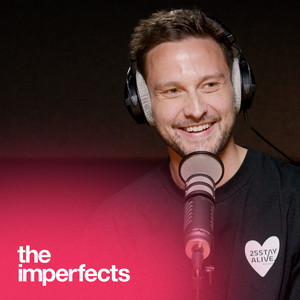
My name's Hugh.
I'm a co-host on The Imperfects.
I'm the son of Sri Lankan and English immigrants, and I call Australia home.
We at The Imperfects acknowledge the Wurundjeri people of the Kulin Nation as the traditional owners of the land on which this podcast is recorded, and we extend our respects to the elders past and present.
I've spent much of the last decade travelling around this country sharing stories.
In doing so, I acknowledge and pay homage to the Aboriginal and Torres Strait Islander people's rich history of storytelling.
I also acknowledge that whenever I talk about or practice resilience, there is no greater example than the one set by the world's oldest living culture.
Hugo has been to hell and back twice.
At just 26 years of age, Hugo was diagnosed with not one, but two completely unrelated cancers.
I said, Dad, I've got this lump on my right testicle.
Pretty much later that day, he found out that I had testicular cancer.
You know, I even bloody... I got a fake testicle every now and then.
I'd play a game called Real or Fake.
LAUGHTER
Two months after getting that five year all clear scan for testicular cancer, sorry to say you've actually got bowel cancer.
I felt like I was putting my family through it all again.
It's a thing that's often not spoken about enough.
Is that something like cancer impacts so many people?
When you're going through it, you can't help it, but you're putting them through it too.
I mean every episode we consider a special episode, but this is undoubtedly a special episode in content, in person and in format, because this we're breaking the rules, baby.
It's not a tea house, not an original, and it's not the other one we do, Academy of Imperfections.
This is very different and very, very, very exciting.
Yeah, it is.
So today's guest is Hugo Toovey.
Or not Toovey.
It was obvious that I was holding on to that, waiting for you to say it.
Have you heard that before?
A few times.
But it landed well.
I've got a few more Shakespeare jokes that I'll throw in later, if you've already heard that one.
I'm sort of the Shakespeare joke guy.
And I would like to really elaborate on why this is such a special episode.
And I've written a short bio here to help people to understand that.
But I think before we do that, the reason we're doing this episode might be really helpful.
This has come about because of, I guess, a friendship I was very lucky to have with a young man called Luke Johnson.
It would have been probably two years ago now.
I got an email from Luke's brother, Nick, and he said, my brother is really unwell.
He has bowel cancer and he would love to meet you.
And with all that he was going through, life's very busy, it took us a while to catch up.
So when we eventually did catch up, I remember the first thing he said to me was I'm cancer free, with the biggest smile on his face.
But he talked me through bowel cancer and everything that was involved and I learned a lot and was shocked and stunned and with all that comes with bowel cancer um, and we just got on so well that we just we just became friends and we caught up quite a few times and and i remember we caught up once and he didn't look well and he said to me um uh, he said two bits of news.
He said um, cancer's back um, and it's not good this time.
He said um, He said I've been given about five months.
And he said, the other news is that my wife and I are expecting our first child.
And he said, she's due in six months.
And I remember just the first thing I said with complete ignorance and naivety.
I said mate, you will meet your child.
You'll absolutely meet your child.
He was such a strong person.
He did.
And I was so lucky to spend time with him at his house with him and his child and Tegan, his wife.
And that's a memory that I will have with me forever.
It was one of the most extraordinary experiences.
Sadly, Luke passed away a couple of weeks after that.
And through that friendship and through the friendship with Tegan, his incredible wife, I had a few people reach out.
His brother being one of them saying, you need to chat to Hugo too.
In fact, Nick wasn't the only person.
Quite a few people messaged me saying, we'd love to hear, we'd love to have Hugo on the podcast.
And here we are today, I guess, connected for Luke and his journey.
So let me get to your bio and then we'll let you talk.
I mean, you talk when everyone.
Welcome.
How are you, first of all?
No, thank you.
And thanks for having me, gents.
But that was really special.
Yeah, really appreciate you sharing that.
So Hugo has been to hell and back twice.
At just 26 years of age, Hugo was diagnosed with not one, but two completely unrelated cancers.
First testicular cancer, then bowel cancer.
Each time facing surgeries, chemo and the kind of fear that most of us couldn't imagine.
And yet somehow he found purpose in the pain.
He's now the founder of 25 Stay Alive, a movement dedicated to getting young people to take their health seriously, and He's also an army captain, a mental health advocate and one of the most honest voices you'll ever hear on what it means to live fully, even when life falls apart.
But what makes Hugo truly remarkable isn't that he survived.
It's how he chose to live afterwards.
He's open about his anxiety, PTSD, and the ongoing impact of his surgeries.
Hugo's story isn't just about surviving cancer.
It's about courage, vulnerability.
And refusing to waste a single day because, as he says, we can't control how long we live, but we can control how we live.
There is so much to talk about today.
I think the first thing just to ask is how are you now?
How's your health now?
Yeah, my health hasn't been great, to be honest.
It's been a pretty full-on year.
And essentially my current situation and my quality of life is pretty poor.
And so my sort of last resort is to – have a major surgery, which will be, as we're recording this time, next week, on the 14th of October, and I've had over 10 or so major surgeries, and this is probably the biggest one I've ever had.
Wow, you've had 10 major surgeries.
Yeah, it's tough.
Wow.
You know, they've opened me up so many times down the abdomen.
Dad always jokes I should have installed a zipper and it would have made things a lot easier when I go in.
But yeah, truthfully, it doesn't necessarily make it easier.
And I think some people and it's not a bad thing, I guess you know they're just trying to be supportive, but you often get, you know.
Oh, you'll be fine.
You've done this before.
Like, you know, it's almost just like assuming that I'll be fine.
But I don't know, for some reason, this one, I've probably got the most anxiety going into it.
And for me, it's another stint in hospital.
I think now the fact I'm a dad, that definitely changes everything.
It's now I've got something so much bigger than just myself and my wife.
So all of those things just start flooding through.
But I also know I need to do it.
So I think where I'm sitting now, I'm on some strong painkillers.
Came here from Sydney.
I was saying pre-chat that for me, getting on a plane and doing this stuff's great because it's a great distraction but it's.
It shows myself that I still can do this stuff and that my health doesn't define every part of my life.
So it gives me a big boost.
Yeah.
So I mean so you are.
This is interesting to me because you're cancer free now, having battled it for quite a long time.
Yeah.
And I think the perception I have in my head, and maybe a lot of people, is that when you're cancer-free, that must be just an incredible feeling and life's great, and you're like I feel amazing because I've defeated cancer a couple of times now.
But I'm getting the feeling it's not quite like that now.
The aftermath is really difficult.
Yeah, it's a very good point and I think that's almost a guilt that I've had with me for a number of years is the fact that I'm cancer free, and I'm grateful for that, don't get me wrong.
But then, Like your good friend Luke and many others who I connect with in that online cancer community who unfortunately have a terminal or a stage four diagnosis, and here I am cancer free, albeit of going through all of this stuff.
I'm grateful, but it's the... for me to get to this point was quite significant.
And, you know, the major life-holdering surgeries, you know, I don't have a large bowel, colon, rectum, missing big chuck of my small bowel, and, you know, all these other things that have gone on, the side effects from treatments and stuff like that have put me in a position where –
90% of people wouldn't see the behind the scenes, my quality of life where I'm up every night.
My wife, Amber, runs me a bath and I'm always in significant pain.
And my just the internal J pouch, which is sort of the, it's like my remaining small bowel.
They turn it on itself, stitch it together and then stitch that to the anus area.
And I've had that for five years and I've had times where it's been okay, but all in all, now it's it's failing and it's it's reached that point where they need to remove that and get a permanent ileosomy.
So I mean you said earlier and you sort of explained a bit then about your quality of life being really poor.
I mean, I...
I don't want to just assume what that looks like.
And I'm really curious to know what that actually practically means for you on a day-to-day basis.
What is going on for you that makes your life quality poor?
Yeah, it's things like you know every day, knowing that what I'm going to eat or drink is essentially just going to go straight through me.
And that will dictate, you know, multiple bowel movements.
And to put in perspective at the moment, because I've, you know, having this failed pouch and I can go up with it 20 times a day.
And- not only is that an inconvenient thing to do, it also means I'm not absorbing any food.
I've lost a fair bit of weight recently.
I continue to lose weight.
So my health is poor from that side of things because we need food to absorb nutrients and live essentially.
But then it's the pain.
So I've got these – anal fissures and fistulas and I had a seat and drain in there that they recently removed.
What's a fistula?
A fistula is like something in your anal tract that like causes these perianal abscesses and infections and it causes a lot of pain, essentially down in the anal area.
Um.
And then fissures are another one, which are these like tears or cuts in the anal area which you know you can't really?
You can try and treat them but you can't really cure them.
They just, they, they occur.
Um, and.
Every time you go to the toilet, it feels like, you know, this razor blade sort of feeling.
And, as you can imagine, if you're doing that upwards of 20 times a day, it's not a pleasant thing to feel.
The amount of times that I'm taking 12 plus gastro stops a day to just try and slow things, and strong opioids, which I've now been on them for a long time.
You start to then have the reliance on those, which has other issues.
The amount of times I'd think I've just finished a bowel movement and I've got literally like wipes and bloody baby powder and creams and numbing gels and you've done the whole thing and that bowel movement might take me, you know 10, 15 minutes.
You've just done it and I'm like, okay, I'm in a pretty good state.
You know, I've taken the painkillers and like, literally 10 minutes later I have to go again and then you have to just go through that process again.
So they're things that i try and live as normal life as i can, but it's um, it can be very challenging, especially in social situations or even, you know, at work.
You know i'm still doing the military and you can imagine if you're in a meeting or you're at work and you have this urgency.
And I've gotten so good over the years, even with the setup that hasn't been working too well, that I can hold my bowel movements.
As a male in your early 30s who's in the military, it's quite an embarrassing thing to do.
And even recently not being able to make it through the night with having accidents and putting bloody adult nappies on and stuff like that it's you know it does a lot to your self-esteem.
And although I've been through a lot and I'm a pretty positive guy, they're things that you kind of.
You know it takes a toll.
I can't even imagine.
Yeah.
Eventually just, yeah, you get over it and naturally that then plays with your mental state.
And I've had some really dark times and I'm still working my way through the mental challenges.
But it can be pretty difficult.
Can we go back in time a little bit?
I'm interested to know if you remember what it was like to sort of almost go from being someone who's perfectly healthy and, I'm guessing, extremely fit and strong and capable to first finding out that potentially you weren't that that you had cancer.
Do you remember that?
Yeah, absolutely.
I think it's a common misconception with cancer.
And I was very much like, this is a young 21-year-old bloke.
It's that, you know, it's what you see in the movies, you know, TV.
It's the person that looks really unwell.
You know they might be going through chemo.
They've lost all their hair and they look like they're a cancer patient.
And that's what I kind of always thought cancer was, or it was something that only impacted old people.
So it's like, you know, when you're 50 plus, that's when, when cancer will start to impact you.
And that's just, I had no family history, so I didn't know anything different.
And then this particular day, I remember it well, 18th of June, because it was my dad's birthday.
I was 21 years of age.
I was in my final six months of four years of military training.
So it's a pretty significant block.
And then you graduate as a young lieutenant.
And I...
Yeah, I remember the day very well and I called my old man and, on a very unrelated side note, kind of awkwardly, I said Dad, I've got this lump on my right testicle.
You know, what do you think?
Like I felt like...
I needed to tell someone, and I thought my old man would be the one person that could, kind of you know, talk to me about it.
And he said, how long has it been there for?
And that's, uh, when I said, oh, probably over six months.
Um, I remember him saying, mate, have you gone to a doctor?
And I said, no.
He said, don't be a bloody dickhead.
Go see your doctor.
And I felt a bit stupid in that moment because I knew I had this lump.
And just picture like a frozen pea.
We seem to all have them in the bloody freezer.
So picture a frozen pea.
It's hard, painless slump.
It's on your testicle.
You know it's there.
And it's like every time.
I'd like after a shower I could feel it, but I just hope it will just disappear.
And I remember I literally would type on bloody Dr Google, lump on right testicle and I'd find the least severe thing I could find.
So sure there were things like cancer, but there was also things like benign cyst and things that weren't serious.
I'm like, oh, that's obviously what it is because I was otherwise very fit and healthy.
And something like cancer wasn't even an option, because it's like well, it couldn't be, because I feel fine.
And that's often the misconception is yes, there are signs and symptoms which we need to absolutely look out for.
But they're not always the sort of.
You know I'm really unwell.
You know I don't feel right.
I need to go to the doctor.
But eventually went to that doctor and yeah, he had a feel around, sent me off and then, Pretty much later that day, he found out that I had testicular cancer.
But what made it harder was because I was that ignorant 21-year-old guy who put off that little – frozen, pea-sized lump for over six months.
It meant the cancer had spread through my body.
So what would have been relatively routine surgery, remove the testicle.
Yep, happy to age your cancer free.
It meant I was in for a pretty grueling couple of years of chemo and surgeries and treatment, all because I gave cancer that opportunity to spread through my body from being an ignorant young bloke.
What was that feeling like when you, like how did you feel when you got told that it was cancer?
Yeah, it's very interesting compared to my first diagnosis and my second diagnosis purely from age maturity, where I was at in life.
But that first one being so young...
I remember it was a bit of a shock, especially when I heard that it had spread and I heard the words chemotherapy and those things.
You think, hang on a second, what?
That sounds pretty full on.
But even through those earlier years because I was so young and probably naive I'd I always had this thought that you know, it's not going to be a big deal.
I'm just going to get through it because why wouldn't I?
I'm young and that's what we do.
So I was almost a bit like bulletproof.
I'm invincible.
I'll get through this.
And that's not to say that –
Those couple of years were challenging and I'm not downplaying it for those who have gone through testicular cancer.
And the chemo for TC is particularly brutal, but it's also very effective.
So survivability is quite high.
So I guess you go into it knowing that, okay, there's a great chance I'm going to get through this.
I just have to get through it. you know, the treatments and the surgeries.
But because I was young, I had that mindset of, I'll get through this.
This will be fine.
And sure enough, I did.
But yeah, that was very different compared to my second diagnosis.
So can you talk us through the second one then?
I feel like the feeling of finding you have a completely unrelated cancer I mean so much must go through your mind at that point.
Yeah, and that was the really challenging part, because when you get, for anyone listening or for those who have been impacted by something like cancer, that five-year mark is of getting a clear scan and being in complete remission is quite significant.
It essentially means that chance of relapse pretty much non-existent.
You shake your oncologist's hand, you never see him again.
And it's an It's a milestone that any cancer patient or survivor strives towards.
And I remember I was just sort of ticking off those milestones, the yearly one, that two-yearly one, and I got towards this five-year mark.
I was deployable in my medical classification for the Army.
I was physically fit again.
I was healthy.
We got posted to Brisbane with my partner.
And I remember this moment of feeling like a normal adult again.
And I guess the cherry on the cake was getting that five-year clear scan, and it was sort of mid-2018.
I was 26, so I was kind of, you know, still pretty young, but I had my whole career and life ahead of me and we got that five-year mark and it was a beautiful moment, remember it well.
We celebrated, we had a champagne and it was like that first time in my life I'd Felt a sense of freedom and happiness.
And it was a beautiful moment that was unfortunately pretty short-lived and You know, to paint a picture, I was even lined up for deployment overseas and everything in my personal life and my professional life and career changed.
It's like I'd click resume and it's like, it's back on track.
I'd like this weird five year, you know, break.
And it's like, now I'm back on track.
Sure.
I missed out a lot in those young 20 age group, but it was, it was click resume.
We're back on track and make up for lost time.
Yeah, literally make up for lost time and that's exactly what it was.
I really did make up for lost time and after getting that five-year-old clear scan, as little as two months after that I started experiencing some bowel issues.
And I've always had a bit of an inconsistent gut growing up.
I only ask this because this is such a big part of what you're doing now with 25 Stay Alive.
But when you say that you noticed something wrong, what exactly were you noticing wrong?
So for me, it's knowing your normal and this was different to my normal.
Okay.
Like my normal is probably different even at the time to you, Josh, Ryan, your respective normals.
Mm-hmm, but it's being aware what your normal is and for me this was.
It wasn't unusual for me to have a you know about, a diarrhea or just a bit of that real inconsistent gut with what you eat and that sort of a bit of ibs right, um.
But then this was worse than my normal, and i'm talking it was that, The urgency, the increased bowel movements.
I'd started to get this abdominal pain.
And these were things that was enough of a red flag for me to say to Amber, my wife, and said something just doesn't feel right.
And I think that...
Learning the hard way as that young 21-year-old bloke who had that lump on his right testicle.
He put it off.
It taught me a very valuable lesson, and I did learn it the hard way the importance of not being ignorant with your health.
And if something's not right, go off to your doctor.
And I guess I'd learned that over the years and it was time to use that and take action.
And I did.
And I went off to the doctor and, given my history, they ran a few tests and bloods and then they sent me off for a colonoscopy.
Which out of interest, has any of you lads had a colonoscopy?
No, I haven't.
You have?
Yeah.
You would know that the bowel prep's the worst part, which- Yeah, it's shocking.
I shouldn't say shocking, but you've been through, but it's not fun.
It's not fun.
I didn't enjoy it.
For those who haven't had a colonoscopy, you have this bowel prep.
It cleans you out.
You bloody feel a bit lighter.
I look at it as a good bowel cleanse, you know.
And you go in, you have a little 15-minute power nap, great sleep, and you wake up and you're feeling quite relaxed because of the after effects of the twilight anaesthetic and you're always –.
It's the best turkey sandwich you've ever had.
The little tea, the biscuits.
People are next to you being pulled out in the beds.
You're bloody waving at an old mate next to you.
And then like you're just feeling in this real great mood.
And like something like cancer would not even cross your mind.
I remember just lying in that bed and my gastroenterologist Terry, came over and he said Hugh, there are a couple of nasty polyps, which is a bit unusual for your age.
But look, we've sent them off for a biopsy.
Let's see you in two weeks.
I remember thinking, yep, Terry, two weeks, in my phone, happy days.
You weren't nervous or anything?
Not nervous at all because it's almost like I just didn't think anything of it.
To put it in perspective two months earlier I just had that five-year all-clear scan for testicular cancer.
You tend to think and I'm not a clinician, I'm not a doctor but you think that if I have an all clear scan geez, I must be healthy.
There's nothing going on inside me.
And then so I thought maybe there's a bit of inflammation or something like that that we can deal with.
And then went to work the next day in my army uniform.
I remember literally where I was.
You remember those fine details, with those significant times in your life.
And I was typing away at my computer and I got a call from Terry's receptionist and she said Hugo, Terry needs to see you.
And I remember saying yep, I'm due to see him in two weeks.
I've booked him the appointment yesterday.
She said no no, he needs to see you today.
And I'm having that – you know, you get that sinking sick feeling in your stomach.
We've all had it where you're just like, that's when I thought, okay.
It's typically not good news.
He's not getting me in there to pat me on the back to say I've got a pristine bloody colon.
So I knew it was –
Knew it was pretty bad news at that point.
But even then, my default of the whole, you know putting on a smile.
My partner was a nurse you finish your shift.
Went to the appointment together.
But I felt so sick.
I just knew it was bad.
And since saying all of this, my wife, Amber, was going through exactly the same.
You know, her...
Being a nurse.
She knew that it wasn't good either, but we were kind of both just like pretending it was fine.
And that waiting room, getting called in by Terry.
When you say pretending it was fine, do you mean like just talking as if everything's normal?
Yeah, just kind of like.
Like, you know, remember to get the dog food tonight or like that sort of stuff.
Like almost pretending that, like we weren't going to this appointment to see a specialist that day after you know receiving the news of some stuff going on in there.
But it was just that kind of trying to distract us.
I mean, it's probably almost like I can imagine, like subconsciously trying to kind of hold on to normal life before you worry.
Things are about to change.
I think so.
I think it's the natural human, like default setting is to try and like just distance yourself from reality when you know it's going to be bad.
And that's what we were both doing.
Yeah.
Yeah.
Terry had this look on his face and he's just like, fuck, this isn't good.
And he sat us both down and turned his screen around and tried to explain it as simply as he could.
But he just said, Amber Hugo, sorry to say, you've actually got bowel cancer.
I remember hearing those words sitting there at that point in time, two months after getting that five-year all-clear scan for testicular cancer.
And that was such a pivotal moment in my life where I kind of knew at that point my life probably wouldn't be the same.
Did you know much about bowel cancer at that point?
I did.
I did.
Okay.
Not as much as I was like the testicular cancer guru.
Like, you know, any time a mate's had anything wrong with their nuts, I'm your man.
Give us a look, yeah.
Give us a look, boys.
And you know, I even bloody.
I've got a fake testy and every now and then I'd play a game called real or fake.
LAUGHTER
And by people actually, like, looking forward to playing real or fake.
I mean, that is the ultimate test.
It is.
And then a bit of a side point, but I only did this recently, to be honest, so that's why you know.
I'm so open in talking about it that I forget that some guys aren't as open to me, just getting their testicles out and showing them.
But I've got this fake one and I'd never heard this story before.
But this other testicular cancer survivor – after Movember function.
I did a lot of work for Movember and he came up and said mate, love real or fake, I'm going to take that one.
I said, mate, welcome to use it.
And he said, out of interest, have you ever played the lantern?
I said, no, it's the lantern.
He's like, well, I've always got a fake nut to it.
When you get your iPhone light and put it up against the fake nut, it's like this silicon base.
It's just like this beacon of light.
It's this beautiful lantern.
And you can imagine the first thing I did, like any bloke would do.
I went straight to the toilet, got the lantern out and it's lights off lantern and it's like this beautiful glow.
Like this holy grail beacon of light.
And I'm now very proud of the lantern, very proud of my fake nut.
Yeah.
You are a remarkably optimistic person.
You can sort of feel it the moment you meet you.
Very true.
Because I know, if I was 21, I think, even if I was 21, just not having that inbuilt optimism, if I found a lump, I would think the worst straight away rather than the best.
I'm wondering if and maybe that was the point, but I'm wondering if that optimism faded at any point or if you'd started to get a sense of doom.
Yeah, absolutely it did.
I think I liked... being the optimistic guy and the super positive guy.
And yes, that was my natural response.
But I think the more you hear that you know, the more you kind of think that that's who you have to be all the time.
And over those years I constantly was told even now I still am told by people I don't know well, or people I even do know well that geez mate, you're so bloody positive and optimistic and inspiring.
I don't know how you bloody do it, mate, but good on you, mate.
And I think over the years, that's very hard to carry that and be that person all the time.
And unfortunately that did result me in.
Probably some of my real darker days with my mental health was when I was just by myself and I felt like I could now take that guard down and it was very isolating and it was kind of like that's how I was.
And it got to a point where it was, like you know, I don't know, 80 positive 20, not 50-50, and then it kind of started skewing the other way where I was just –.
I was not a very happy person.
I didn't even want to be here.
And then there were moments that I'd kind of just have to carry all that weight and then Amber would walk into the hospital room or whatever and I'd just pretend I was all right and I wouldn't even be able to tell her about this.
Sorry, this is just from a timeline point of view.
When you had these feelings like I don't want to be here anymore, was this during bowel cancer treatment.
Yeah, so it was during the bowel cancer treatment.
I think it kind of does stem from what Josh was saying about that optimistic trait and being an optimistic person.
When I was then diagnosed with bowel cancer, cancer and I did know the seriousness of bowel cancer and you know the The information that I did have, which was still minimal, but it was enough to know that shit.
Okay, this is pretty serious.
I think from that point was when I started to chip away almost at that optimistic figure.
Yeah.
As soon as literally and this is, I think, explains it Josh from leaving that doctor's rooms and I was pretty quiet in that 40-minute consultation.
Amber was asking a lot of the questions and we were talking about next steps and he said look, you've got an aggressive type of bowel cancer.
You've got it early enough.
We can treat it.
All these conversations.
And I remember literally leaving that doctor's rooms and vividly remember it.
I was probably two meters in front of Amber.
I was in my army uniform and I just burst into tears.
And it was...
Probably the first time in my adult life, up until that point, where I had like a proper cry, not just a I'm tearing up here.
I'm like a proper full sob.
And I remember getting into that car and I was so emotional that Amber even asked if I was right to drive.
Cause she's like, geez, you can't drive in this state.
And I said, no.
I'll be okay but I have to call my parents.
And that is a very interesting moment for me, especially now being a father.
At the time I wasn't, but I remember calling my dad and he didn't even know I was having a colonoscopy.
And I've got a very supportive family, but my dad in particular is the sort of guy that would just drop everything.
Get on the next plane, I'll be by your bedside, sort of thing.
And I remember giving him a call and he said he calls me Doogie and he goes Doogie, how are you mate?
And I said Dad, I've got some bad news, had a colonoscopy and I've just found out I've got bowel cancer.
And You know those moments well and my dad's not an overly emotional guy, but I could hear him get really emotional on the phone, choking up a bit.
It's at that moment for me that I realised the seriousness of it, but also i felt like i was putting my family through it all again, and it's even to this day.
It's um, i always get emotional talking about it, but it's a really hard one for something like cancer, because you put your family through so much pain and discomfort, and especially someone like Amber.
And, like I know, coming up to this big surgery really impacts her.
She, she holds it together, but it really impacts her and I feel um guilty, thinking maybe I could have done more.
Here I'm going to this major surgery and then she's having to look after our son, look after me.
I know she's been struggling and it's um.
It's a thing that's often not spoken about enough.
Is that?
Something like cancer impacts so many people and your loved ones?
You know you shared your relationship with Luke and how it impacts partners and family and families and children.
And when you're going through it, you can't help it, but you're putting them through it too.
And it's really changing, because they're the people you love most, but you're causing them so much pain.
And all you want is to take that pain away from them.
But I think that's what's made me so closed over the years, because I've really felt like I've had to just deal with it myself.
Because how the hell can I open up to Amber saying I'm struggling if she's already going through this pain?
So I feel like the best – my defense mechanism is – is to not open up and to deal with it myself.
And that's just my response over the years.
But naturally, it just kept chipping away to the point that I had those dark days.
And after multiple bowel cancer surgeries and removing big chunks of my bowel, and There's one particular hospital visit.
I was in there for a month, had multiple surgeries.
That's when they removed my whole large bowel.
And then I had the emergency surgery and I was in such a, such a bad way that you know, hooked up to all those tubes and painkillers, that there was a moment lying in there and I just kind of escaped with the pain relief and, you know, the fentanyl, whatever they gave me.
There was a moment where I just kind of escaped enough and I just had those thoughts of wanting to be here in a way.
I feel like I can take my pain away, but take the take the pain away from from others and I wouldn't, you know, be a burden anymore and having Amp happy to visit me in hospital.
And that's how I was feeling in those moments.
It's a real dark place to be and an isolating place to be, but something that's often not spoken about enough, with people going through cancers and chronic illnesses, the mental load that people carry.
Look, I'm absolutely probably extra emotional now because I've obviously got this big one coming up and then I start thinking shit, I'm going to have to go through it again and then be extra strong.
But then I think, what if I'm not?
What if I'm not strong?
I got a message in the airport before from someone saying, like you know, you've got this, you'll be fine.
Like you've done it before.
And I'm like, well, what if I'm not fine?
What if it's not going to be okay?
Yeah, naturally, Josh, it has weaned over the years, my optimism.
And that's just because I've just been going through it for 12, 13 years.
And it does get taxing.
And I'm in this stage now where you're like, shit, I'm still going through it.
When's this going to stop?
It also seems like there's so much pressure on yourself.
Like, does it feel like you're putting a lot of pressure on yourself?
Does that ring true?
Absolutely.
I feel like I put pressure on myself to just need to be resilient.
And I think no one really necessarily in these situations chooses to be resilient.
I think I've built up the resilience from what I've gone through, but that doesn't mean there are times like this thing coming up where I'm I'm anxious and I don't feel like I can get through it.
So there is that constant pressure of feeling like I need to be someone for others.
And I often get in that situation of feeling that what if I'm not?
I think it's such a privilege to really see what you're carrying around and you're clearly a leader and people look up to you and people, obviously for a long time, look to you for leadership and guidance and advice.
And you've no doubt been the strong, resilient person.
And so I just want to I appreciate how, how hard it might be for you to be in a situation where you can't always do that in a way that is traditional.
But having said that, even saying it out loud, it's like actually seeing you show your real self and be that vulnerable is actually the most inspiring.
Uh really, because it's, because we need to, we need to see that like that's that's.
It's clearly so hard And it's really quite inspiring to see you express yourself like that.
No, thanks, Ryan.
I think it's – I really do appreciate that and I completely agree with you and I think that's one thing I have learnt that those times where –
I haven't shared those emotions as freely or as openly as I do now.
I'd learned the hard way of how bottling that up and dealing with it by yourself is obviously not the answer.
And.
I know you guys often talk about this and you regularly, for your own different reasons, can get emotional.
And I used to apologize when I would do a talk or share my story.
Every time I got emotional, your natural response is to kind of say, sorry.
You go, sorry, I'm...
And it's kind of what we do, especially as men.
We almost apologize for getting emotional.
Sorry for making the space uncomfortable.
That's kind of what it's saying.
And it's why you guys have such a beautiful podcast and platform where you can allow people to feel comfortable in getting emotional.
But then we need to have that into wider society and realize that if you're feeling emotional and you're needing to have a cry, that's completely okay.
Also just like, I think, for people to see you or any guy be emotional if they feel like they want to be, and then to kind of get to the other side of it and say like oh, everything's okay.
I still respect this person even though they cried.
If anything, I respect them more.
And I think that's sort of like the fear that men probably have is like trying to hold things because I don't want to show weakness.
I don't want to lose status or power or whatever it might be.
But actually it has the reverse effect.
Can I ask something off the back of that?
What was it like the first time you shared with Amber that you're not doing okay?
It was one of those moments where Amber had recognised that in a way, probably not to the depth of it, but for her it was that she felt like she could see – my true self in hospital.
And I think once she saw that I was struggling and to be able to talk to her about it, it was almost probably freeing for her to feel that.
And then now we have such a beautiful open relationship where we can do that more regularly.
And it was almost like that was the first –
The icebreaker that I just needed to do to then just make both of us feel that sense of like freeness, of being able to do it, and having someone like Amber, or just having someone to talk to, to share that with those emotions, those feelings, can make such a profound difference.
For me anyway, and I'm sure Amber would say the same you know, they're those moments where our relationship has become so much stronger, in every facet of what we're doing.
What we're going through is just having that.
You know, I remember the time and that moment and the moments after that.
Just you know, being so emotional and just hugging her in the hospital bed.
Like they're beautiful moments where you're experiencing something together, because it absolutely is something you're experiencing together.
But as a result of that, Very shitty, unfortunate situations.
We've become so strong now as a relationship and as a husband and wife.
So I guess it's a silver lining from that moment.
And I think it's something that now I try and, you know, especially for next week.
To leverage off and go.
Okay, if I'm having a really shitty day or I'm not doing too well, I can actually talk about it.
Yeah.
Hey, Hugh and Ryan.
Yeah, Josh.
I am so excited about our brand new live show Together Again.
That's going to be around the country in so many cities which we'll tell you about in a second.
It's all new.
It's kind of like it'd be like if you've watched the first season of Game of Thrones and you're like oh, that was good.
I like that.
And then the second season comes out and you go, I don't need to see the second season.
I've seen the first.
I mean, that doesn't make much sense.
Not really.
Hang on, which bit?
What we're trying to say is it's a whole new season of our live show.
Brand new episodes, brand new bits.
You've never seen it before.
You would never even dream of missing.
If you're into Game of Thrones, you'd never dream of missing season two.
So please don't dream of missing our...
Season two.
And if you're desperate like I am, I cannot wait to see Hugh flying on a dragon across the stage, just like Game of Thrones.
That's what we're saying.
It's season two of Game of Thrones, live on stage.
Without orgies or anything like that.
No.
Let's not give too much away, Josh.
Well, if you want to find out what's happening on stage, you can get your tickets at livenationcomau.
I'm still really... I'm still very in the five minutes ago in the conversation where you shared...
I guess from when you walked in the room, I think probably you guys felt the same.
Just like this incredible personality or like this just – you sort of have this ability to make people feel good or just happy and bring joy and just – and you seemed like somebody who's really good at facilitating – a good time for everyone who's around you.
Case in point, the lantern.
Sounds like a wonderful way to spend some time.
I know.
I mean, as soon as you walked in, I was like God, you're such a bright light, but now I know where it's coming from.
Add the lantern out, that's why.
And I really...
I can only imagine that feeling of like, I've got to be this.
I can't think of anything else.
It feels like for many years you weren't okay, but you just went.
No, I don't want other people to feel low, so I'm going to pretend I'm okay.
I'm going to act like I'm fine, even though I'm so far from fine.
That exhaustion it must have – and I think I'm just saying this to say I completely understand how you got to the point where you thought I don't want to be here, because it seems to be a big part of you as a person is bringing everyone else joy and being – being that person just makes everyone happy and making sure everyone's okay.
And to feel like you're doing the opposite for people it must be an awful feeling, but then to cover it up for so long.
And just picturing you calling your dad to say those words to him, when all you're probably going to do is make your dad happy and proud.
Not that you wouldn't be proud, but you feel like this is going to make him really upset.
It makes sense.
It totally makes sense.
And I just really want to validate that experience for you because, my gosh, i can, i totally can understand that.
No thanks, you and it's, it is, it's um.
It can be very isolating and when you're going through it you feel like you know you need to be a responsible adult.
You know i was 26, you know you're, you're living your life, you're on your own as far as you're not with your family support, as far as you know the medical expenses and living under their house, their parents roof.
It's like you're You're living with a partner or by yourself.
You're starting a career.
But it's a very vulnerable age too, because you're expected to know everything, even though it's far from what you know.
And I think for me it was almost that moment of – feeling like I had to be, you know, that positive person to everybody all the time.
And I think we've all been in a situation when you get told that, oh, Ryan, mate, you're bloody –
You're so positive all the time and, geez, mate, you inspire me all the time.
When you hear that enough, you like hearing that, right?
We all like receiving compliments.
But then when you hear that, that's the version that you then want to be the whole time.
You change chasing it.
You're chasing that all the time and then by chasing that, when the other side of you comes out well, you can't show anyone that side because remember, you're meant to be that real positive, strong person to everyone.
That's right.
So you then try and go back to that autopilot mode and You know, the analogy works really well, because I've quite literally got an army uniform, but you put that uniform on, that mask on, and you feel like, all right, here we are.
It's showtime.
And then whether it's your closest friends, your partner, your –
Your parents, whoever it is, that's the person you are all the time on the outside.
But then it got to the stage where it was far from the truth.
And I think that's something that it's such a vulnerable, pivotal age, when you're exploring all of that in your 20s and 30s.
I just happened to go through that something like a second cancer diagnosis to eventually learn the hard way.
I could be wrong here, but I also imagine there's an element rather of just trying to hide what's going on, also trying to cling onto some normality as well, in that, like I'm going through all this stuff but I don't want to.
I would like an escape from it to be normal, to what it was before, potentially around people, and that could mask a lot of mask, a lot of what's going on underneath.
Does that make sense?
Yeah, no, for sure.
And I think you're spot on.
I've got a twin brother.
We're not identical, but we're very close.
And You're right.
You do want to try and escape from that.
And there are healthy ways to escape and there are not so healthy ways to escape.
And I think, unfortunately for me sometimes escaping using things like painkillers and things that can kind of almost numb that pain in a way.
That's not a healthy way to escape, but it's something that I've done over the years.
And that sense of living a normal life is something I haven't really lived for a number of years.
And I do get that sense of jealousy almost with you know whether it's my twin brother or close friends or people who are living that normal life.
You know going overseas and you know their health is, you know, for the most part pretty good.
And then when you're sort of stuck in hospital or having an Epsom salt bath at 2am and you're on social media and you're seeing all these people living a great life and you're thinking this fucking sucks it's a really really sort of challenging time to be in so then I think those moments that I can live a normal life and you're out with your mates having a beer and you know you're trying to be that that normal dude with them even though it's you know the furthest thing from the truth because i'm scanning where the closest bathroom is and i'm in discomfort and pain i'm kind of sitting there kind of just putting on that that front because i'm with my mates you know i want to be normal with them too having that beer yeah yeah yeah So you get through bowel cancer, which from what I've read, it's a huge killer.
And when people get bowel cancer, there's a high likelihood that they won't survive it.
Am I right in saying that?
So bowel cancer, it's now the biggest cancer killer for those aged 25 to 44.
So it's now really impacting younger people.
And Australia is.
Interestingly enough, it's got the highest early onset bowel cancer for under 50s globally.
Anywhere else in the world is little old Australia.
So they're putting a lot...
Down to the diet and lifestyle has to be a big part of it.
Things like emulsifiers and random things you see in ingredients in foods, barbecued meats and stuff that we live in that culture in Australia the real charred meats and they're putting a lot more into diet and lifestyle.
But the simple fact is the statistics say that Australia and early onset bowel cancer under 50 is leading globally.
And you're right by saying if you don't get it early and you are diagnosed later on, survival rates are not very good if you have a stage four diagnosis.
And it's something, it drops off significantly, even if it's sort of stage one, two or three.
And then if you go to stage four, it's like you know don't quote me on it, but stage three is around that 70 percentile five-year survival rate.
If you go to stage four, which means it's spread to other vital organs, it's around that sort of 10 or even lower five-year survivability.
So it's quite a significant drop-off.
And that's why the importance of especially young people now we know these statistics and we know young people like Luke, like myself, being impacted with something like bowel cancer is not to ignore, whatever those warning signs are.
And now, not everyone always gets the signs and symptoms with bowel cancer, but typically it is one of the cancers that does show signs and symptoms, especially if you're later on um, you know in in the diagnosis.
So if you've ever got any signs and symptoms, not just to dismiss it.
If you're in your mid to late 20s to think oh, you know, i've been eating pretty poorly or i've had a few big weekends, it's probably nothing.
Because if, as soon as you've found something and I'm not saying this for someone listening to this on the drive home who's had a few upset bowel movements, that's going to panic and run off to their doctor tomorrow.
The general guidelines, they say, is the two-week rule, where if something is continuing for two weeks or more, and that abdominal pain or the diarrhea or the getting up during the night or whatever it is has been happening for more than two weeks, it's a pretty good indication to say okay, I might go off and see my doctor here.
That being said, if you ever do have blood in your stool at any stage, whether you think it's bloody hemorrhoids or whatever, if you ever have blood in your stool, once again the medical guidelines is to go straight off to your doctor.
It's an interesting one though, Huwitt.
It does impact a lot of young people.
Unfortunately, it is taking far too many young lives.
Yeah, because I did a – after Luke's funeral, I did a post on Instagram just sharing what you can do to get a check.
So I think it's a –
Ironically, once you're over the age of 45, I think it's a free – it just gets sent to your house for free.
And I just did a link to that, not knowing a great deal about it at this point.
I still don't think I've ever had so many – replies and responses to an Instagram post I've done of people sharing stories of what they or their friend or their relative had been through.
I just did it as a here's an awareness thing and I was flooded with the most heartbreaking stories.
It is so much more common than I realize and probably a lot of people realize, but you can get it checked early.
Yeah, and it's a really powerful thing that you've done that Hugh, and it's something that I've said to Tegan Luke's wife and Nick Luke's brother.
Luke's legacy will live on because it really will.
And I remember Nick shared something with me about, since Luke's passing, one of their dad's mates went oh shit, I need to go and have a test.
Had a colonoscopy and he got diagnosed with stage one bowel cancer.
And that's just their immediate impact from a close family friend.
But then the impact that Luke has had Whether it's through yourself sharing that or just the ripple effect he's had and will continue to have will quite literally save countless of lives.
And that's not just flippantly saying that, it will.
Because people will read about Luke's story and read about the person he was and then hopefully listening to this podcast episode and if someone is experiencing symptoms or signs for them to go.
Geez, I've been putting this off.
What am I doing?
I'm going to go off to that doctor because we all need to start – being proactive and realizing that something like cancer doesn't discriminate.
Use this as that motivation to do it because you just never know what it could be.
But guess what?
If you get it early, you give yourself the best possible chance of living hopefully, a long, happy life.
Yeah.
So we spoke at the start in your bio about how you've discovered purpose through your pain.
Can you tell us about 25 Stay Alive?
Yeah.
So 25 Stay Alive was essentially.
It was created as a result of what I've gone through, but it was constantly being told that, geez mate, you're so young for going through this.
You could say I'm unlucky.
I've since had genetic testing, got no mutated genes.
They've honestly put it down to a bit of bad luck in getting the two separate diagnoses.
But I'm not young.
And so when I constantly was told that, I realized that there was so much out there for it for sort of older people with cancers and then sort of younger people, which is obviously both hugely important, but this sort of that mid-age group was kind of missed.
There wasn't really that spotlight on what happens if the person in their 20s and 30s are going through this.
Where is the conversation for that age group?
And essentially the 25 is the new 50 was kind of created as a conversation in a medical sense.
In other words, you know, when you turn 50, you get your bowel screening kit.
It's just been lowered to 45.
You know, you get your mammogram test.
You hear it all the time, you know, when you're 50, oh, now I need it.
We like I don't know if you're old man back in the day or whatever goes.
You know geez, I'm old now.
I need to bloody go off and start taking my health seriously.
It's kind of, that's the language we're told, but you know we're sort of saying well, that needs to happen a lot earlier.
And so when you turn 25, you know our vision and we're in early chats with government is that When you turn 25, every young 25-year-old Australian will get sent an information pack through their MyGov account and a bit of the did you know?
Happy birthday.
But now's the time to take your health seriously.
But, most importantly, getting a complimentary GP consultation.
We've developed, or developing, a five-point checklist to make it real simple.
And then the GPs, just as importantly, need to be educated on this too, because far too often you hear GPs that dismiss people that come in.
And it's a really good point to talk about that people hear these conversations.
They might be listening to this podcast episode and they go into their GP and it's taken a lot of courage for them to even go see that doctor.
And they go, you know, I've got blood in my stools or whatever.
And unfortunately, you hear far too often they get dismissed, turned away.
Oh, you know, here's some bloody gastro stops.
You know, you've probably got some hemorrhoids.
You'll be right.
You're only 28 or whatever.
But then hopefully you know for that point on for the rest of your life Ryan, Clean Bill of Health mate, we'll see you in 12 months' time.
Or, hang on, a few little markers here, full blood counts, a few red flags, family history.
We might, you know, cover colonoscopy, refer you to a specialist.
And then every year, like when your car's due for a service, you'll be told yep, you're due for your annual service, your annual checkup with your doctor.
We just want people to be educated and empowered to make a decision but, most importantly, take charge of their own health.
Your life is complicated and kids are complicated.
It seems like a big decision to have children over the last few years, or I imagine it would have been, was it.
And what led you?
How did that all come about and what led you to?
Yeah, I've always wanted to be a dad.
You know, like when I was younger, I've always really liked the idea of having a family, but it's typically not something that you – you strongly think about until you've obviously got a partner and you have those conversations.
And it wasn't until I was – before I went through chemotherapy.
You probably haven't even thought of this.
I was single at the time, didn't have a partner, but fertility and freezing your sperm was something that my mum spoke about and I'm so glad she did, because I started to think about it going shit.
Actually, that's such a great point.
This chemo, the major surgeries I was having even for testicular cancer can make you infertile.
You know, at the young age of 21, I went off and got some frozen sperm.
And over the years, I've kind of renewed it and topped it up with some better quality sperm.
I've been told I've got above average swimmers, which is a really important thing to know.
Congratulations.
It kind of gives you a bit of a boost when you look at it.
Yeah.
So knowing that though, has always given me a bit of a okay, great if I want to have kids one day, but I can't, naturally.
I've at least got that stored away.
So we –
We went down the path of speaking about having a kid and trying to conceive naturally first.
It took a lot longer than we thought it would.
And I think that's because our friends around us at that age you've been with someone, you're married.
Let's try for a kid.
They were seemingly conceiving very quickly.
And so it was almost one of those things like as soon as you stop using contraception, you're going to fall pregnant and you're going to have a kid.
So for us, it took a lot longer than people around us.
And it did really play with Amber for a while and I got so used to seeing those pregnancy tests and getting to a stage where a few months, six months, a year or so starts going by and you then start to doubt the fact that maybe this whole natural contraception won't happen.
But hey, guess what?
I've got some frozen sperm.
It's all okay.
And as soon as we stopped talking about it and worrying so much about the ovulation period and all that sort of stuff, it happened very, very unexpectedly.
And so much so that Amber only decided to do it because we were heading back to Adelaide and she had a hen's party where she was probably going to let a little bit loose and thought that she would be responsible, just in case.
And she did one more pregnancy test.
And this is like 5.30 in the morning.
Uber was like a few minutes away.
And there was another pregnancy test on the kitchen bench.
Oh, God, there's another bloody pregnancy test.
I literally went to throw it in the bin and it had the line saying pregnant.
And I'm like, Amber, what the hell does this line mean?
It's just, what do you mean?
And then she kind of ran downstairs and gave me this big hug and we were like, oh my God.
And we conceived Teddy naturally, even though we had multiple doctors, and people say that the likelihood of natural conception is very low and we didn't think it would happen.
And as soon as you weren't even deliberately trying, it just happened.
And we always say it's just that. lyrical miracle baby that we just needed at that point in time.
And it was this beautiful moment that we both experienced.
And then we were both so excited to be parents.
And it was this beautiful distraction.
I know Luke.
I know we've spoken a bit about Luke in this podcast, but He sent me this beautiful message um only five days before he passed, and it was quite a beautiful thing.
He said, and it was about, you know, how good is being a dad and how good is parenthood.
He said, I'm so. glad I could experience this.
I often think about that moment, to think that you know what?
I'm so lucky that I get to experience this, because there are plenty of people that don't.
You know, even with this upcoming hospital stay, or you know when this is released, I'll be in the thick of it.
But knowing that I'll have him walk into the hospital room and With that smile now he says Daddy, and just sort of runs up to me.
Just making sure he's not pulling out too many bloody tubes and stuff.
Actually, his recent hospital admission earlier this year, I was in there.
I've had a few this year, and he –
She said, everything okay?
I'm like, yeah, yeah, it's not too bad.
And she's like, oh, because you pressed the emergency button.
And we're like, what did I do?
And then Teddy's in the bathroom and he's clicking the emergency button and he kind of comes out just with a little grin on his face.
They're moments that give me a smile and a chuckle, which he's doing.
They don't even know he's doing it.
You know, hopefully you know, one day we can add to the family and then give him a brother or sister.
But, you know, if we can't, you know, we've always got Teddy and Adam.
It was only recently where we tried to conceive again because this upcoming surgery, as I mentioned, there's a real high chance of infertility and essentially it means you have dry orgasms, which means that you don't ejaculate but you still have the sensation of it, but naturally you can't conceive again because you don't have that sperm.
So that's a high possibility.
And we thought, oh. probably a bit sooner than we were thinking, but maybe it's not a bad idea.
It's a really good distraction for Amber and have that to look forward to.
And we did.
And then unlike Teddy, which happened –
And almost a year later, this just seemed to happen very quickly.
And then Amber did, she did fall pregnant.
This was only very recently, which was a beautiful thing.
And we were both really happy.
But unfortunately, only a number of weeks ago, she had a miscarriage.
Just as we started telling our parents and stuff.
It was a really challenging time, especially for her, because she was so upset and really looking forward to it.
And it was a really difficult time.
I know she won't mind me talking about this because, you know, she's –
She's open to discussing it.
For the very real fact that it happens, unfortunately happens um quite often.
And I must admit I was that one of those ignorant blokes that didn't realize the impact it can have, the emotional impact it can have on on, on both.
You know both partners.
Yeah.
But in particular for the female going through it and how can the changes in the body?
And like I just wasn't aware of all that.
And I've now got such great sort of empathy for those that have experienced that.
And it can be a really emotional time.
And what you go through as a couple can be a lot.
Yeah.
Absolutely.
Thank you for sharing what you and Amber are going through at the moment with the miscarriage.
I've experienced the same thing.
And it was the thing that surprised me.
So I wasn't with Sophie.
And I was so sort of sideswiped by it that I couldn't not tell my mates that I was with Sophie.
And it started this conversation with them.
There's about 15 of them there and like at least a third of them had experienced it as well.
And we all talked about it and how hard it was and it went and it wasn't a huge conversation, but it was like maybe 20 minutes of chatting about it.
And it just made me feel so much better better.
I felt bad that i wasn't around her and she wasn't able to be in a room having that conversation, but i think it's really important that it's talked about how common it is, because Not many people I think, for many legitimate reasons, I think don't want to talk about it with people, and you only learn this when you start going through it yourself.
How common that is.
Yeah, no, thanks for sharing that, Josh.
And yeah, sorry you had to go through that and experience that, because at the time it's an awful thing to go through.
But then the fact that you were able to share that with, you know, a large group of 15 mates –
It's probably not an easy thing to do, but that's what we probably need to do more of.
Cause you're right.
Often, if we just don't talk about it, then if someone else experiences it and they think that you know they're going through it and other people can't relate, then you know how nice, in a very unfortunate circumstances, would it be to go oh Josh, recently went through that and they can then all of a sudden start reaching out to you and just getting a bit of that comfort as a guy-to-guy chat, which is yeah, I guess, a byproduct of sharing that.
But no, I appreciate you also sharing that, mate.
Awesome.
Can we um what?
What is I mean?
It's, it's very, it's coming through very strongly.
But what does Amber mean to you?
Yeah, look Amber's um.
She's a beautiful human, and anyone who knows Amber would would say the same thing.
When I met her, just not long after my testicular cancer, my hair just sort of started growing back, so I was sort of confident enough to go out to the bars and start to go out there and meet people.
I met her not long after that and one of the sort of the earliest conversation we had was about me having testicular cancer, what I'd gone through, because I just felt that she's just already in that short moment of knowing who I could feel comfortable in talking to about it.
And then, you know, here we are married with a beautiful son.
But I think she yeah, she's just done so much for me over the years and she's been very selfless and she's had to put up with the behind the scenes of when I haven't been a very great person, when I've had the anger of not wanting to to keep going through this and the why me life sucks and unfortunately, i'm angry at the situation.
I'm not angry at amber, but because she is in the vicinity of living with her, she sees that side of me which not many people do, and So I think the fact that she's had to put up with that then comfort me, then support me, but then look after herself and now our son.
It takes a very special person to do that.
A nurse.
A nurse, correct.
And nurses are beautiful, beautiful people.
Not just for a year or two years or even five years, doing that, for a decade, having to do that and constantly be that pillar of strength, certainly in my life but then other people's life.
And often I think about what it would be like to be a carer or a support person, because I've never really been a carer or support person with someone with significant health challenges.
And I do think it would be a lot harder than the patient or the person going through it.
Because often we're in this little bubble, right?
Like when this hospital admission coming up and I'm in hospital for call it.
You know a few weeks recovery for another month or so after that.
You're in this bubble where like your only life thing that you're going through is that.
But then for someone like Amber she has to then drop our son to childcare, come and look after me, be the supportive person when I'm going through these very challenging times, then hold it together herself, then leave that hospital room and then go to work, you know.
Then to pick the son up from daycare.
And she has to do that.
Yes, we've got support and family support, but she has to go through all of that.
She has to live her life as well as that little bubble life of supporting me.
So it'll be hugely challenging.
And I always say that the carers and support people and there'd be people listening to this who are those people?
They're the ones that they're the unsung heroes, that they don't get the recognition or the wow you're amazing as much as the person going through it does but they're the ones that need that support themselves.
And often I've spoken to Amber about that.
She hasn't been the one who has had that support.
And she's had times where she would tell me she would leave the hospital room and she would be the one that would burst into tears.
But she's trying to hold it together for me.
She can't walk in there crying, because she needs to know that she used to be that strong person for me.
And I know she won't mind me sharing this, but she only very recently saw her GP and said that she was –.
She had been sort of struggling a bit and you know she's quite a stoic person so it took a lot for her to say that.
And, you know, she's been referred to see a psychologist, which I think is absolutely brilliant.
But for her, that's a big thing.
Well, for anyone, it's a big thing, but it took her a lot to do that.
And I've been trying to support her and gently push her in that direction for a while.
But you need the person, needs to want to go and seek support.
So that's only happened very recently and when she did it I was like so proud of her.
I was like That's amazing.
I'm really proud of you.
Don't be put off if you have one bad experience with this psychologist.
It can take a few to your fire one, but you've taken the step in the right direction.
It was this beautiful moment where I realized that it's so great that Amber is now getting that support that she needs and it's not just me.
So yeah.
At what point and I only ask this because I know people will want to know at what point in the relationship with Amber did you feel comfortable enough to show her the lantern?
Oh, good question.
Now I'm just going to think.
On the disco ball.
Yeah, the disco ball.
Look, I think early on I did tell her I had a fakey.
Yeah.
Just in case she got freaked out when she kind of, you know.
Did you light it up though?
Didn't light it up.
I found out about that recently.
Yeah, that was later on when someone told me about the lantern.
Of course, it was a couple of weeks ago, yeah.
She's got a big advantage with fake or real, hasn't she?
She can actually touch it.
She can pick it.
She's rarely got one wrong.
Shit, but it was a moment where you're forced to kind of You can't really play it twice though, can you?
It's not like Monopoly where it's like, well, every game's different.
No, every game's pretty similar.
No, no, but here's the thing, though.
On visuals, it looks the same.
So like if you look at it and if I just drop my DAX now, you couldn't pick the fakie.
But she knows left or right, surely.
Don't you tell me what I can't pick.
No, no.
I know we're getting into a lot of detail.
So when I get it out, right, the testicle –
You kind of, you hide it in the fact that you don't know if I've got the left or right.
So it's more of a sleight of hand.
So it's more of a, yeah, it's more of a magic mic, buddy, getting the nut out.
So people think that, no, that has to be, and they go, no, and then they're surprised.
Yeah.
The reveal now is the lantern.
It used to be.
Now this is getting real weird.
It used to be because I can't feel sensation in the testicle.
So the real way to do it?
I'd be like if it was the real one, I obviously wouldn't flick it because that would hurt.
The fake one, I'd flick it and that would be the giveaway.
That was the reveal.
Now the reveal is the lantern.
What kind of noise does it make?
No, it's not that impressive, unfortunately.
It's just kind of like a bit of a... It's like a silicon... I don't know.
Oh, okay.
Like a bouncy silicon texture.
And I've had it for a while now.
But I was only having a chat to a mate recently about he asked how long does it last for?
And I'm like, that's a very good question that I don't even know.
So I might be due for an upgrade at some stage.
And I'm hoping it's changed a lot.
And it's got LEDs in it.
Yeah, I'm hoping now.
Oh, yeah.
Imagine that or like you can get one of those, like the spikes on it or something to make.
Like a massage ball.
I know this is getting weird, but you know how some condoms have ribbed condoms.
That's the word I was looking for.
So you could potentially get a ribbed fake nut.
Which means- Potentially.
Amber might be all for it.
I'm sure.
She's doing a lot of work there.
Well, sometimes it is fun when you get a new cover for your iPhone.
Yeah.
I just don't know how the market would be as popular for new covers for Fake Nuts.
But you never know.
You never know, actually.
You never know.
I feel so – I've spoken on behalf of everyone in this room here and everyone listening.
I feel very blessed to have – I thought you were going to say I've had a ball.
I feel very blessed to have spent time with you and listened to you, and I speak on behalf of our entire audience when I say that.
One of the things I hadn't ever thought about before, but I think you've spoken about so well then, with Amber, is just, if you know someone going through this, have a think about their carer and potentially give them the same amount of praise that you give the person and support as you give the person, because they would not be expecting it but gosh, they probably need it.
Oh, for sure.
And you know the next step.
And you know she's recently gone back to work and out of that, you know, trying to get back into a normal life.
That can be so challenging too, especially when it's, you know, recently it was a year um, you know, a year, two years, years after it, you know you're still carrying that weight for the rest of your life.
But you're expected to sort of still live that normal life again.
But yeah, you're spot on, Hugh.
It's for those carers, those beautiful support people that support a loved one or have lost a loved one that's going through this.
They're the ones that arguably need more support than the person going through it.
Yeah well, a few people have said over the years on our show that with mental health struggles particularly, that it's like the person struggling with it, but it's almost like if it's depression, depression's in the house and everyone's dealing with it in their own way, even if only one person is has depression.
I think it's probably the same with cancer.
It's like cancer is in the house and everyone has to deal with it in their own way.
Yeah, good luck In a week's time.
We'll all be thinking of you.
And when this comes out, probably you would have been through it and you'll be dealing with a whole new battle, which is the recovery from that.
And we all wish you the best.
We love you.
We think you're amazing.
And it is just such a privilege to spend time with you today.
No, thank you, Hugh and Josh and Ryan, for creating this space but also putting a spotlight on these really important conversations.
It's obviously what we're trying to do.
As a charity and for me going into this surgery, you know, with that mindset of knowing that.
You know, if it wasn't for what I'd gone through, I wouldn't have met Amber.
I wouldn't have my beautiful son, Teddy.
So that in itself gives me a lot of hope.
Yeah, i have no doubt you've saved many lives today from this conversation, so thank you.
Amazing thanks lads.
The Imperfects are really excited to be included in Apple Podcast Creators.
We Love campaign.
And to celebrate, we wanted to let you know that our bonus episodes A Little More Imperfects are now available on Apple Podcasts.
Our latest ep is with Dr M and you can trial that as well as all the other A Little More Imperfects episodes with a free trial in Apple Podcasts.
The Imperfix is not a licensed mental health service and is not a substitute for professional mental health advice, treatment or assessment.
The advice given in this episode is general in nature, but if you're struggling, please see a healthcare professional or call Lifeline on 13 11, 14.