Every day at Sierra, you'll find top brand apparel, footwear and gear for 20 to 60 less than department and specialty store prices.
And during clearance time at Sierra those incredible prices are And when you shop clearance at Sierra you can save a whole lot more on everything you need to get active and outside.
That's a lot of saving.
Epic brands, fast selection, teeny tiny prices.
That's Sierra.
Visit your local Sierra store today or shop online at Sierra.com.
For Scientific American Science Quickly, I'm Kendra Pierre-Lewis, in for Rachel Feltman.
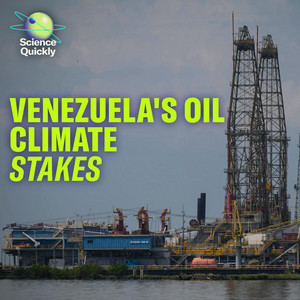
Over the past couple of weeks, oil, specifically Venezuelan oil, has been all over the headlines.
It started late on January 2nd, when President Donald Trump ordered US military forces to enter Venezuela and capture the country's president, Nicolas Maduro, which they did early the next morning.
Last week, the country's interior minister said the action killed 100 people.
In the intervening weeks, President Trump has made clear that at least part of his motivation for the operation was the nation's oil fields, which are home to an estimated 303 billion barrels of oil reserves more oil than Saudi Arabia or any other country in the world.
To dig into the situation, we spoke with Amy Westervelt, a climate reporter and executive editor of the multimedia climate reporting project Drilled.
We talked to Amy about why Venezuela has so much oil, the history of the country's oil industry and how this obsession with oil is impacting climate change.
Thank you for joining us.
Thanks for having me.
You perhaps know more about oil in South America than any other climate reporter I've met.
What got you interested in it?
Actually, Guyana is what got me interested in it.
So I got this press release from Exxon in I want to say 2020 that said that Guyana was going to be their most productive basin within the next five to 10 years, that it would outpace even the Permian Basin in Texas.
And I thought, how did they go that big that fast?
And then, shortly after that, I got some press releases from an attorney that had filed various cases in Guyana trying to stop the offshore project and arguing that part of the reason that they had moved so fast was that they had ignored various environmental regulations.
So those two things kind of came in the same week and I thought oh, this is really interesting and I haven't really seen much about it.
So I started working with a reporter in Guyana and then going back and forth myself to report on this, like new oil industry that was being created in, you know, 2020.
OK, we will get back to Guyana, I promise.
But before we get there.
Yeah.
As you know, the Trump administration recently invaded Venezuela and captured its president, Nicolas Maduro, under allegations of drug trafficking.
Your recent article in Drilled mentions access to the region's oil is a big motivator of what's happening there.
And kind of focusing primarily just on Venezuela.
For right now Venezuela has a lot of oil, like an estimated 303 billion barrels of oil, compared to the United States, which has roughly 46 billion barrels.
A very basic question, like why does Venezuela and that area just have so much oil?
Well, they have the Orinoco Basin, which is the world's largest oil reserve, basically.
So Venezuela has the most oil of anyone in the world.
But it's not great oil.
It's heavy crude.
And so it's kind of on par with like Tarzan's oil in Canada.
So what does that mean?
Because i think for most people we don't really think about like grade of oil.
Right, we don't often see oil.
If we have a vision of what oil is, it's like the beverly hillbillies and like yeah, like trickling out of the ground.
So so what do like grades of oil actually mean?
So the venezuelan oil is heavy crude, which means it's got a lot of stuff in it, which means that it is more expensive to refine, which cuts into oil companies margins.
And it also is less favorable for a lot of different like types of engines, types of uses, which means that it gets a lower price on the market.
So as the price of oil has come down, the price of heavy crude comes down even more, because what we generally think of as like the price per barrel is is sweet crude.
It's like it's the good stuff.
So whatever that's at, which is lower, heavy crude is going to be even lower than that.
And then on top of that, Venezuelan oil has had all these sanctions against it.
Trump has been part of that both in his first term and more recently.
So you know, because I feel like the question is always like why isn't Venezuela, Saudi Arabia, right?
It has this much oil.
And there are a few reasons, one of which is the quality of oil, the distance to markets for it, and then the fact that it has sanctions on these markets.
More people are more interested in the stuff that doesn't burn quite so heavy.
Partly that's driven by environmental regulations as well.
But then on top of that, they've known they have this oil for a long time now.
I mean some people will say, like the Spaniards knew it when they were colonizing Venezuela, and all of that.
But for sure, they've been developing it since around World War One, when everyone was looking for more oil, because that was the first kind of big fossil fueled war.
And American companies have been in there like pretty much since jump.
So you have this weird thing that happens in a lot of situations where US oil companies feel like this attachment to the oil industry there and this like entitlement to the oil that's there as well.
But like Venezuela started trying to nationalize its oil industry in like the 30s and 40s.
We found some documents from this old PR guy who got sent by Standard Oil to go try to like stop this from happening in the 40s and was successful, and a big part of that was labor and the fact that workers were annoyed that they were being badly paid and badly treated by these foreign companies that were making so much money off of Venezuelan oil.
So at that time in the 40s it was all about kind of like dealing with the labor unions, getting rid of the labor unions, getting contracts in place that would prevent that from happening.
But they could only kind of stave it off for so long.
And in 1976, Venezuela did nationalize oil, but they allowed a lot of joint partnerships.
So it didn't really overly affect U.S. oil companies until Chavez in 2007 said, OK, enough of this.
You can be here, but the majority shareholder in any oil project in Venezuela has to be the state oil company.
And if you don't like it, you can get out.
And both Exxon and ConocoPhillips.
And so they left and he seized their assets.
Chevron stayed as like a minority shareholder in some of the projects there.
But that has been kind of up and down in recent years because of U.S. sanctions as well.
So Chevron's kind of been teetering there.
But when Exxon got kicked out, they had this backup plan already in mind, because they had been camping out on an exploratory license in Guyana since the late 90s.
Yeah.
And so my understanding is much of that infrastructure that Venezuela had is now quite old.
And so just to summarize kind of the lay of the land, Venezuela has oil, but much of it is not that great.
And it would need significant infrastructure investment to really get it pumping again to the degree that we seem to be talking about.
And it wouldn't necessarily command a great price.
To the tune of like tens of billions of dollars.
Like it's not a small amount of money that we're talking about here.
And right across the border is Guyana, which has a ton of sweet light crude.
Can you talk about the conflict that has been playing out over the past few years between Venezuela and Guyana?
Yes.
So...
That conflict actually goes back all the way to like the late 1800s.
So...
Venezuela and Guyana have argued over this one area that's called Esequibo.
Venezuela has claimed that it's a Venezuelan state for a long time.
In the late 1890s I think it's 1899 there was an international arbitration ruling over this dispute that said no, this is where the border is.
Esequibo is in Guyana.
And that, you know, was kind of... fine for some period of time.
In the early 60s, this dispute kind of like came up again.
Some people think actually it was around oil then as well, because there was some early exploration happening and some thinking that possibly there was oil off the coast there.
And at that time, there was another treaty that was signed that's called the Geneva Accord.
And it was signed by The UK, Venezuela and British Guyana, which is what Guyana was at the time, because it had not been given independence.
Yeah, exactly.
So it was signed, made official in 1966.
And then just actually like a few months later, Guyana was just kind of added to it.
Like they were like made independent.
So it's like, oh, now it's you guys.
But they never really like agreed to any of this stuff.
So...
In 2015, Exxon announced that they had found this enormous reserve of oil offshore Guyana.
And immediately Maduro started saying, you know, actually, that's Venezuela.
I talked to some petroleum engineers in Guyana and some of them actually think that part of the reason Venezuela was concerned about the oil in Guyana was also that they think the reservoirs are connected.
And so they were concerned that if the oil is getting taken out like over here, it would reduce production in Venezuela as well.
But regardless, this whole dispute has flared up again since 2015.
And in the last two years in particular, Maduro started to get really aggressive about it.
And this is the piece that I feel like has been missed by a lot of the coverage around Venezuela is that you know he started sending like Navy ships to like patrol around this area.
In December of 2023, Maduro just like once again declared that Ezequibo is a Venezuelan state.
He had a referendum where the people of Venezuela voted.
And you know, the voting system in Venezuela has been under a lot of scrutiny for various reasons for a long time.
But he claims that Venezuelan voters overwhelmingly agreed that this is part of Venezuela.
And then, in January 2025, he announced that they would be holding elections for the governor of this Venezuelan state.
As this is going on, Guyana has now taken a claim to the International Court of Justice to ask them to rule on it.
They've filed that claim. in 2018.
It's been very slow moving, but the ruling has so far said hey, you guys have to keep the status quo until we make a final decision, which hasn't happened yet.
But then, in March of 2025, Venezuela sent naval ships to Exxon's floating offshore production vessel and told staff of that boat that they were in Venezuelan waters.
You know, were like aggressively asking a bunch of questions.
It was a very aggressive act and it was directly at Exxon's vessel.
And that really got the U.S. involved.
So all of a sudden, both the U.S.
State Department kind of issued a statement about it.
There were like various entities that were saying like, hey, you guys can't do this.
You need to calm it down.
And then Marco Rubio actually went to Venezuela in late March of 2025 and gave this press conference with Guyanese officials where he said Venezuela is going to have the US military to deal with if it doesn't calm it down with this stuff.
So undergirding all of this jockeying for oil is the fact that It's real.
And the reality is that if we want to maintain conditions that are suitable for human life, we need to stop using oil and fossil fuels altogether.
It very much feels like we're in an early 2000s redux, but the climate is much warmer.
Yeah, it's so much worse.
I mean.
This actually to me was also.
What drew me to the Guyana story in the first place is that 90 of the population of Guyana is on this tiny sliver of coast right next to Georgetown that will be underwater in about 10 years.
That's shocking.
90% of the population needs to move, and yet they were going all in on this new oil industry.
I was like, what?
Make it make sense.
But to me it's like such an illustration of the total failure of the international community to do anything about this problem, to figure out, you know, any kind of climate damages or reparations policy.
Because Guyana, which was also like the early poster child for paying developing countries for carbon sinks and working with the Global South on carbon, carbon credits and all of that stuff.
Norway put a bunch of money into preserving forests in Guyana for the purpose of maintaining a carbon sink there.
They're one of the world's largest carbon sinks still.
They were like, we can't pay to move our entire country away from sea level rise.
Without this oil money.
So it is like the biggest robbing Peter to pay Paul story I have ever heard of.
And it's just, it's mind blowing that like they are now at the mercy of oil companies to pay for climate adaptation.
That's really tragic if you think about it.
It's totally tragic.
Yeah.
From a climate perspective, what do you think is missing from the conversation?
Well, I mean, I think the climate in its entirety is missing from that conversation.
I feel like the fact that both of these countries are going to be massively hit by climate impacts is, like it's almost entirely missing.
Even you know Guyana is kind of saying like oh well, you know, if we have all this oil money then we can pay to like move everyone out of harm's way.
Well, where is out of harm's way?
What happens if there's a blowout?
Well, all of the Caribbean gets impacted by that.
You have an oil spill that hits.
I mean.
Exxon's own environmental impact report on this shows that if such a thing were to happen, it would impact 14 different Caribbean countries.
14, and all of which are at least somewhat dependent on tourism for their economy.
So once those beaches are destroyed by an oil spill, how's that going to go?
Not to mention like food source.
Yeah, fishing.
Exactly.
So there's so many layers of problems here.
And again, I just feel like When I talked to people in Guyana too about what's going on here, I thought you guys were so concerned about the environment and climate and whatever.
They're like, yeah, we are.
But how are we going to pay for all of this stuff?
And they were like, a little bit, and I don't think they're wrong in this.
Well, what's the difference between taking money from the Norwegian government to keep our trees to taking money from Exxon to drill our oil?
Right.
Well, this has been...
I won't say a lovely conversation, but it has been an illuminating conversation.
Thank you so much for your time today.
Thank you.
Thanks for having me.
That's all for today.
Tune in on Monday for a weekly Science News Roundup.
But I have a favor to ask before you go.
I need your help for a future episode.
It's about kissing.
Tell us about your most memorable kiss.
What made it special?
How did it feel?
Record a voice memo on your phone or computer and send it over to sciencequickly at sciam.com.
Be sure to include your name and where you're from.
Science Quickly is produced by me, Kendra Peer-Lewis, along with Fonda Mwangi, Sushmita Patek and Jeff DelVecchio.
This episode was edited by Alex Aguirre.
Shana Poses and Aaron Shattuck fact-check our show.
Our theme music was composed by Dominic Smith.
Subscribe to Scientific American for more up-to-date and in-depth science news.
For Scientific American, this is Kendra Pierre-Lewis.
Have a great weekend.