This message comes from Capital One!
Say hello to stress -free subscription management!
Easily track, block or cancel recurring charges right from the Capital One mobile app.
Simple as that! Learn more at You're listening to Life Kid from NPR.
Hey, everybody. It's Marielle.
Have you ever seen that meme of a shrimp in a desk chair?
Normally, I try not to explain memes or jokes, but this one's pretty straightforward.
You know how shrimpies get curled up into sort of a hook shape?
Imagine that, but sitting in a desk chair trying to fill out an Excel spreadsheet.
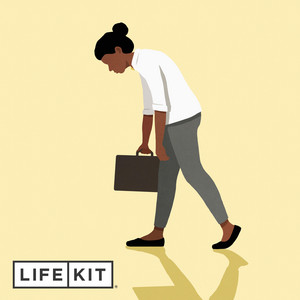
A lot of us sit like this or in equally tortured positions.
And that's bad, right?
I always laugh as a physical therapist because people send it to me all the time.
the reality is it's not so much the posture in itself but the time and and the amount of movement that we actually get throughout the day to interrupt those stagnant positions.
That's Lita Malik, she's a physical therapist and author of the book Science of Stretch and she says if you hold your body in a shrimp like shape for a short amount of time probably not a huge deal if you do it all day every day that's when you start hurting.
Katie Bowman is a which means she studies the effects that physical forces have on the body.
She says you may have felt this effect after a long time intelligent therapist and author of the book Science of Stretch.
And she says if you hold your body in a shrimp -like shape for a short amount of time, probably not a huge deal.
If you do it all day, every day, that's when you start hurting.
Katie Bowman is a biomechanist, which means she studies the effects that physical forces have on the body.
She says you may have felt this effect after a long time in transit when everything in your body feels stiff.
Usually on a plane or a car you don't get to have any movement breaks whatsoever, you're really really stuck in a position.
So what do you do in those moments?
You shake out your muscles stretch and move your body into other positions.
Katey who wrote a book called Rethink your Position says doing that throughout your life is what leads to good posture.
We've got so many parts and I don't think we're really fluent in all the options that we have for positions despite the number of joints and hinges and levers that really spare us to assume many different shapes, we're kind of stuck in the same set of shapes.
On this episode of life kit, how to improve your posture, we'll talk about what posture is exactly, how to know if yours is serving your body and what you can do throughout the day to mix up the shapes your body is making.
This message comes from Charles Schwab when it comes to managing your wealth, Schwab gives you more choices like full -service wealth manager.
Unleash the potential of your team at Atlassian .com.
This message comes from homes .com the right agent can make or break your home search That's why homes .com provides an agent directory that details each agents experience So you can find the right one and ultimately the right home homes .com.
We've done your homework Donald Trump is starting his second term as president What will his administration do and what policies will it promote on the NPR politics podcasts will break down what the new administration does and explain?
why it matters. Listen to the NPR Politics podcast every day.
I used to think good posture was determined by whether you could glide across a room with a book on your head.
Leda Mallick, the physical therapist, says it's not that.
And it's not as simple as saying sit up straight.
In reality, that posture may not be right for everyone and every single body.
So really, the best posture is one that's fit for the things that you need to be doing, and one that is adaptive and dynamic, and one that you can change in and out of.
Good posture isn't about how you look.
It's not about being graceful, or a ladylike.
It's about how your body feels.
So a good posture is one that is dynamic, one that is not susceptible to pain as often as possible, and one that is best fit for what you need to get done.
And bad posture is a set of patterns that cause you pain or make you prone to injury over time, the way you hunch over when you're washing the dishes or bend down to do your laundry or strain your neck reading in bed at night.
Take away one, the first step in fixing your posture and eliminating posture induced pain, is to drill down into your habits.
What shapes are you making all the time?
And what do you know or flaring up for you is positioned?
Maybe you feel tightness in your shoulder blade.
If you feel that most when you wake up, the problem could be your sleeping postures.
You might notice like oh, uh, that shoulder that, yes, get sort of folded underneath me when I'm sleeping, that it makes this particular arm constellation at night.
I notice that it's really similar to the same arm constellation that I'm making at work and that arm constellation is also showing up when I'm driving.
And you start to see yourself as a collection of shapes.
You might also realize, huh, I've been carrying a heavy tote bag on that shoulder and that's probably not helping.
Looking at the constellations your body makes throughout the day will reveal your habits.
And we have a lot of asymmetrical habits and so over time you feel the effects of not having movement really distributed throughout the body.
Your body adapts to you repeatedly making these shapes.
Now, your bone mass is slightly adapted to the way you load your leg bones throughout the day and you've got just a little bit more tension in the parts that have to shorten to accommodate the fact that you slouch in one particular direction and they get more etched into the body and then over time,
that becomes our physical experience.
Katie has another tip to help you check on your body's alignment and what shapes your repeatedly making.
It's called the wall test.
You can use this one if you're able to stand.
Put a wall behind you and let your hips sit against the wall.
Your heels don't need to touch the wall.
They can be a few inches out to give your butt some space.
Bring your middle back against the wall and then try to bring your head back there.
Calculate. I did this in the studio during our interview and Cady also had me reach my arms out to the side against the wall.
And your arm can your wrists touch while all those other pieces stay on the wall Yeah, and then you can go overhead to my hands go above my head Can I risk touch the wall there without nothing not that needs some work?
Do we find one? looked at it Yeah, there's not well one of them can but the other one can't quite write and that's a big part of that asymmetry too, you know There's just injuries.
There's hobbies or habits that we all have that will at chin these different ways of using our body.
But without checking in with your ranges of motion and the way things are stacking and able to articulate relative to each other, you just miss out that things are declining.
You start to go, wow, I don't know when my hips got so tight, I don't know when I stopped being able to get my arms overhead, and then it becomes, I didn't know when I lost the ability to get up and down off the floor, and a lot of that is being set now just in the fact that we're not utilizing a large
number of shapes, we're kind of stuck in these same repetitive shapes and those shapes are leaving, they're leaving their mark.
This isn't to say that we always need to move perfectly evenly or symmetrically, but we want to start giving our bodies more options.
Take away two, create moments of posture counter programming.
Let's say you're a desk worker and you spend most of the day sitting in the same position.
Just stepping away and doing a three -minute workout.
Walking, doing lunges up and down your room or whatever it might be.
That could help a lot.
Now, if you work on your feet in retail, or at a warehouse, for instance, your posture breaks are going to look different.
Typical movement breaks for that person might include actually sitting down for a bit, again, stretching the hip rotator the hip flexors standing up, stretching the calves, maybe even doing some calf raises.
Leader recommend stretching your back too.
Especially if you're lifting heavy trays or boxes.
And Katie says you can create natural cues so these movement breaks become second nature.
Like changing positions every time you cross something off your to -do list or touching the top of the doorframe each time you leave a room.
Create these little environmental cues that just remind me that these parts needs movement.
Then my shoulder position when I go back to sitting at a desk and you know writing a book or working on a piece, doesn't really bother me because I've nourished my shoulder and all these other positions.
Just for minutes, here there, sprinkled throughout the day, here's another fun idea.
Try a game of solo charades.
You're going to contort your body to look like an animal or a fruit or a vegetable, or letter of the alphabet.
I find bananas are a good starting point.
Elephant, works well for me too.
And giraffe is good if you really want to stretch your neck.
The whole point is you're just trying to not do what you've just done for the hour leading up to that.
Or the three hours, or the six hours, or the 16 years.
But movement breaks are only part of the equation.
Takeaway three, adjust your environment.
If you're constantly feeling pain in a part of you're body, These body resets do help, but it's possible something's just wonky with your work setup or your sleep set up.
That pain could vanish with some small tweaks.
Think about the body constellations you made earlier.
If you were up to look at your monitor or reach your arms out really far to type on your keyboard, Lita says when it comes to your desk setup, everything that you need to reach repetitively should be comfortable.
Make sure that whatever it is you're looking at most, maybe that's your monitor.
That the top of that screen is at or about eye level with you.
give or take a few degrees.
Another aspect is bringing it close enough to use so you don't have to peer forward.
Next, let's adjust your keyboard.
Keeping the keyboard...
We suggest around 90 degrees at the elbows with some support for your wrists so that you're not reaching too far and your wrist isn't flexed too far up because that's the sustained posture that might aggravate, for example, the carpal tunnel.
Now, let's do your desk chair.
Do you feel comfortable and supported the one you have?
Are your feet swinging off the ground or resting firmly on the floor?
You want something that allows your thigh to sit in the depth of the chair comfortably.
The seat cushion should be about two inches behind your knees.
So, if you're leg is going off of the seat, you should have a couple inches before you feel your knee.
Feet flat on the ground, some support for your elbows and your shoulders.
If your pain doesn't go away with these kinds of tweaks, or if it's getting worse, there is professional help out there.
If you have an area that's become very acutely injured and you're noticing other symptoms, you know, radiating pain and things that feel nervy or just the activities of daily living are being hindered because you can't walk in a particular joint, like then you want to go check in and have an evaluation.
You can go see a primary care doctor or an orthopedist and also look for a physical therapist in your area.
As I was talking to Katie about taking movement breaks throughout her was frowned upon at my first job, working for a financial magazine, one of the executives complained to HR that I was getting up from my desk too much to go to the bathroom or the kitchen to chat with a colleague.
It's like they expected their employees to be robots who could sit at a desk without moving, typing away for eight hours street.
Well, it's acting, you know, you're basically acting you're like I will act like a person who doesn't need to move.
I told Katie that has never felt right in my body.
I guess I would describe myself as having sort of a restless energy in my body and I need to like get up and move and stand and stretch and do all these things or else I don't know, I'll just start to fall asleep or I'll feel really really like pent up and and socially that wasn't really accepted for a long
time. I think a lot of that starts in school.
There's a big assumption that if people are moving and taking care of their body's physical needs, that they can't possibly address their educational or you know, mental productivity.
But I think that there's a lot more evidence just to the contrary of that.
That if you are someone who needs to move, of that moving can really help regulate yourself.
It's really just the ability to fidget.
Embracing your fidget especially if it helps you stay more focused in what you're doing.
Embrace the fidget.
That's our fourth and final take away.
So much of life trains us to be sedentary to unlearn all of the ways we moved our bodies as kids.
Let's push back on that.
Let the people fidget.
It is a way of distributing load and it's a very easy way to meet more of the body's needs to move Katty says if you're feeling self -conscious about leaving your desk to do some squats or make the shape of a ...
... and movement is a tremendous, biological need Also think about all the ways your body is trying to shake itself out.
Do you bounce your knee all the time?
Drum your fingers? She says those little movement quirks we have are impulses worth listening to.
I would teach that those fidgeting signals are more like hunger signals.
We really need a language for oh, my body is telling me it needs to change shapes right now and do a little bit of movement.
Katie has one final tip for you to check on the alignment of your hips and lower back.
This is a problem area for a lot of folks.
She says a lot of us have this habitual standing posture where we push our pelvis and hips forward.
So that your pelvis is placing more weight on the front of your foot over your toes than it is the heels.
To see if you're doing this, take off your shoes.
Stand up, and see if you can lift your toes if that feels impossible.
Back your hips up, so that the pelvis is stacked more over the heel, and less over the middle or the front of the foot so that you can lift your toes all the way up and that simple adjustment it changes the way your lower back is articulating.
If this feels really good, remember that posture the next time you're, for instance, washing dishes.
If you notice your hips are resting against the counter, pull them back.
It's like an instant lower body makeover just by backing the hips up.
Do you think that this is what Juvenal was talking about when he said back that ass up?
I'm almost certain that's what I just read.
Or use that body pillow while you're sleeping and take away four Embrace the fidget when you're feeling antsy.
Your body is trying to tell you something It's probably saying hey, I could really use a stretch break right now or this sitting position is uncomfortable So listen and move accordingly no matter what other people say For more life kit check out our other episodes We've got one on the best stretches
for preventing chronic pain and another on how to heal from an injury You can find those at NPR .org slash life kit.
And if you love life kit and want even more subscribe to our newsletter at NPR .org slash life kit newsletter.
Also, we love hearing from you.
So if you have episode ideas or feedback you want to share, email us at life kit, at NPR .org.
This episode of life kit was produced by Margaret Sereno.
Or visuals editor is Bek Harlan.
And our digital editor is Malika Gris.
Megan Kane is our supervising editor.
And Beth Donovan is our executive producer.
Our production team also includes Andy Tagle, Clare Mary Shnider, and Sylvia Douglas.
Engineering support comes from Robert Rodriguez.
I'm Maryell Cegarra.
Thanks for listening.
This message comes from Homes .com.
When you're home shopping as a parent, you have lots of questions about local schools.
That's why each listing for Homes .com includes extensive reports of local schools including photos, parent reviews, student -teacher ratio, school rankings, and more.
The information is for multiple trusted sources.
.