This message comes from Capital One with the Capital One Saver Card. Earn unlimited 3 % cash back on dining and entertainment.
Capital One. What's in your wallet?
Terms apply. Details at CapitalOne .com.
You're listening to Life Kit from NPR.
Hey, it's Mariel. When was the last time you picked up your phone?
Are you holding it right now?
Are you scrolling while you listen to this?
Y 'all, we are way too attached to our phones.
I mean, I fight against it.
I don't keep a lot of apps on there.
But it's still the first thing I look at every morning.
And I find myself compulsively picking it up to make sure I haven't missed any messages or notifications.
I guess it's partly a habit I've formed and partly a craving for whatever flashy new content the apps I do have will offer me today.
You know, technology's kind of got it figured out.
If you can offer a continuous stream of novelty, you never know what you're going to see when you go on there.
And that is maybe part of what makes it so attractive.
This is Katie Bowman.
She's a biomechanist, which means she studies how forces affect the body.
And she's a movement teacher.
We're talking to her because, well, wouldn't it be nice if we craved movement the way we crave our smartphones?
She and Diana Hill, a clinical psychologist, say it's possible to retrain our our brains to do just that.
Even if our mind is telling us things that are unhelpful, we can act independently from what our head says, which is kind of a fascinating and wonderful thing.
Katie and Diana are co -authors of the book, I Know I Should Exercise, but 44 Reasons We Don't Move and How to Get Over Them.
And they're here to remind us that even though scrolling can feel fun.
Over time, what we're finding is that people don't actually feel better afterwards.
words. What we know is that too much screen time can mess with our sleep, and it's also associated with depression, anxiety, and stress symptoms in adolescents.
You know what helps with all that?
Helps you feel better and less stressed?
Movement. And yeah, sometimes it's hard to get yourself moving, to stand up from your chair or lace up your shoes for a walk.
But after a few minutes in, you actually might start to feel better physically and mentally, and even just stress -wise.
So we end up actually when we move our bodies, we actually like it a little bit more over time.
On this episode of Life Kit, Diana and Katie share simple techniques we can use to get ourselves moving instead of scrolling.
That's after the break.
This message comes from Memorial Sloan Kettering Cancer Center.
100 % of participants in a recent A recent colorectal cancer trial saw their tumors completely disappear.
That breakthrough happened at Memorial Sloan Kettering Cancer Center, and it's giving new hope to people with cancer.
This MSK Giving Day, be part of the next groundbreaking discovery and help raise $1 million.
Donate at msk .org slash give, and your gift will be triple matched.
This message comes from Carvana.
Selling your car shouldn't take all day.
With Carvana, it doesn't.
Get a great offer in no time.
Then choose to drop off or pick up and get paid on the spot.
Sell your car today on Carvana .com.
Pickup fees may apply.
This message comes from NPR sponsor Holiday Inn by IHG.
It's a new day for a new stay at Holiday Inn for business travelers.
With modern spaces for meeting and working, plus delicious dining from breakfast to happy hour and dinner, you have everything you need to get work done.
Give your everyday business travel an upgrade.
Book your next business trip at Holiday Inn by IHG.
Visit HolidayInn .com to book your stay.
The House of Representatives has approved a White House request to claw back two years of previously approved funding for public media.
The rescissions package now moves on to the Senate.
This move poses a serious threat to local stations and public media as we know it.
Please take a stand for public media today at GoACPR .org.
Thank you. This is Eric Glass.
On This American Life, sometimes we just show up somewhere, turn on our tape recorders, and see what happens.
If you can't get seven cars in 12 days, you gotta look yourself in the mirror and say, holy, what are you kidding me?
This car dealership trying to sell its monthly quota of cars is not going well.
I just don't want one balloon to a car.
Balloon the whole freaking place so it looks like a circus.
Real life stories every week.
So what is the concept of psychological flexibility?
flexibility? And how can that help us get into the habit of moving our bodies when our impulses are telling us to reach for our phones and scroll?
Basically what psychological flexibility is, is your ability to stay present, to stay connected to your values, what's important to you, how do you want to act, even when you have difficult thoughts show up, maybe uncomfortable emotions show up, maybe a feeling of your attention getting pulled somewhere else, that you can flexibly move towards what you care about no matter what.
And there's a series of processes and skills that you can learn and practice and get better at over time, which is part of what Katie and I are teaching in this book is how to use psychological flexibility to help you get over barriers, inner barriers, like even just the thought, I don't want to, which can be really loud, or it's too hard. Or maybe there's inner barriers like shame or embarrassment or physical discomfort that we need to get more flexible with so that we can stay aligned with and in tune with what we really care about and want for ourselves, which is maybe a little more peace of mind,
maybe we care about our physical health so that we can be around longer for our grandkids, or maybe we care about our focus at work.
Takeaway one, when you're struggling with a craving or having a hard time forming a habit that you know will be good for you, remember the concept of psychological flexibility.
The idea here is that we're able to stay present and stay connected to our values even when we have difficult emotions or physical discomfort.
And in this context, that means we can make a change.
We can decide when we feel the impulse to pick up our smartphones to move our bodies instead.
All right, let's go into some of the techniques.
Techniques. One technique that y 'all give is to surf the urge to scroll.
What does that mean?
Well, urge surfing comes from actually addiction research. There was a really famous addiction researcher named Alan Marlott, and he used it with smoking.
So if you can imagine an urge to smoke, it rises and rises and rises, and it increases so much to the point where you end up giving in on it.
And we can think about the same thing with our technology use.
You have that urge to pick pick up your phone.
Or maybe first thing in the morning, you have an urge to go right on your Instagram or the news feed.
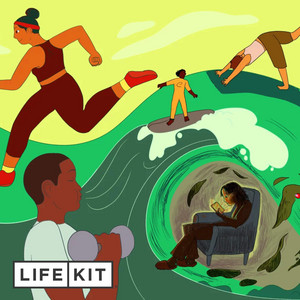
But what we know about urges is that they're a lot like waves.
They rise up, they get bigger and bigger and bigger, and they come back down again.
And the goal with urge surfing is to learn how to get on the board of the urge, ride it, notice that it It increases over time and stay on it without giving in.
But it's not a willful staying on.
It's actually paying attention to the sensation in your body of the urge and then noticing it come back down again without acting.
And the more that you do it, the better you get at surfing it and the less that you feel the feeling of, I have to give in to the urge or it will kill me.
We see people, you know, at the gym that are sitting on their phones instead of actually there to lift their weights.
We can learn how to surf the urge to not pull it out of our pocket and still engage with the movement that we were hoping to engage in.
Okay. And you all suggest that folks stretch, squat, or dance while they're riding this wave of phone craving.
Katie, I'd love to hear from you on this one as our biomechanist. Sure.
Well, I mean, once you get on the surfboard, you want to just not stand there.
You do a few tricks while you're writing it.
And since we are talking about specifically not just not picking up your technology for the sake of not picking it up, but because you've already decided that you value movement and you want to practice it more, that the urge can then become sort of a cue to help remind you, oh, yeah, I wanted to move.
And it really helps to identify a few ways ahead of time that you're going to move, not just necessarily spontaneously come up with it.
But, you know, do you want to do a few stretches during this time?
Would you use like, oh, I just want to reach for my phone right now as a cue to bend over and touch your toes?
Do you want to use it as a cue to squat down, you know, and really shift your weight back and forth and really feel the muscles pick you back up into a standing position?
Do you want to do something a little bit more vigorous?
Do you want to do 10 jumping jacks during that time?
Do you want to practice your yoga tree pose during this time?
Or do you want to dance instead of maybe going to just scroll and wiggle it out for a couple of minutes?
Because then you're capitalizing on the urge, the fact that you're already paying attention to the urge and using that as momentum to push you in the direction that you want it to go, which is being a little bit more physically active.
Takeaway two, surf the urge to scroll.
Urges are a lot like waves.
They rise and rise until at some point they break.
So surf. When you feel an urge to pick up your phone, you can notice that and sit with your rising discomfort until that urge fades.
While you're surfing, try some movement.
Do a few stretches, some calf raises, dance around your living room.
Whatever you want, really.
Really? Okay. So another technique that you give is to savor your favorite physical activities, because we know that by intentionally savoring things that we value, we can train our brains to want them more, right?
Well, so much of our mind goes right to the negative.
We remember all the things that we don't like about exercise or moving, because that's the way that the brain is designed to kind of grab onto the negative experiences and keep them around.
So we actually have to counter that tendency of our mind to grab onto the positive experiences and keep them around.
And that's what we're doing by savoring.
There's some savoring research that's looked at things like savor gratitude.
So could you appreciate your body's just ability to move?
I'm so grateful that I have the ability to do this movement because many of us move in and out of ability and disability over our lifespan.
If you've ever had a knee surgery, once you get your your knees operating, and you can go for a walk, we can really savor that.
You could savor the good feelings of luxuriating in a good stretch, or the good feeling of hitting to the top, getting to the top of a hill.
Or you could savor marveling, like the awe of nature around you, or a sunrise, or a sunset, or a tall building, or getting to the top of the stairs of you.
So there's so many aspects aspects to movement that we don't think about that we could be focusing on the positive.
And it's not to eliminate the negative.
There's a really important thing here because we don't want to say, don't feel the discomfort.
We actually want to allow the discomfort to be there.
But what we want to do is have the intentional flexibility to be able to shift our attention to other aspects of our experience.
There's a whole variety of experiences that you get through moving.
And what if you were to shift your attention to the people that you're with or shift your attention to the gratitude to yourself for getting out there?
Takeaway three, savor the parts of physical activity and movement that you enjoy.
One example, we've been playing softball at work, and I love the feeling of the softball landing in my mitt.
I also love the feeling of hitting the ball with the bat.
It reminds me of when I tap danced as a kid.
because I really liked how it felt when my tap shoes hit the floor.
I was rowing this morning and just listening to the blade of the oar skim across the water and I'm like, this is my favorite part right now.
I'm savoring. I am relishing.
It's like exercise needs a hype man, because I think there's a lot of effort that goes into it.
So just to sort of give it a little boost in your own mind can make it something that you can turn back to too much more often.
Yeah, you have a an exercise here that you wrote about how to savor with a shoulder stretch. Katie, could you walk us through that one?
So something easy to try, whether you're surfing or just listening right now is clasp your hands behind you.
If you can, if you can't get them to touch, you can grab a sweatshirt or a strap to to connect your hands behind there and And then savor for a moment what it feels like to your shoulders.
Now, there can be the discomfort that upwells, wow, this feels really stiff.
I can't get my arms behind me.
You know, all the sort of negative things that come up with the savoring would be to take a few deep breaths in this position.
Wow, I can get a deeper breath while I'm here.
To even look around you while you're in that pose, you know, like my eyes are not on the screen right now.
I can see so much farther away from me right now.
Now I can see the natural sunlight coming in.
Or maybe you can wiggle your shoulders or turn your waist a little bit and feel what it feels like to connect to those parts.
Do you feel more connected to yourself?
Do you feel yourself sort of relaxing over a couple of breaths and then you're able to get a little bit closer?
You're savoring maybe some progress that comes in just in a moment or two?
Yeah, I love that. All right.
Another technique that you offer is to add novelty to your workouts and your movement breaks.
And to me, it feels like this can help your movement compete with the novelty that you're getting from the constant stream of content on social media.
So if you take a 10 -minute walk, can you take a slightly different route?
Can you say, for this walk, I'm going to walk on all of the curbs.
I'm going to walk on all of the cracks.
I'm going to try to add this element of balance or challenge.
Am I going to walk on the lumpy, bumpy part of the grass and not stick to the sidewalk?
Can I add some music?
Can I invite a friend with me?
Or can I ditch the walk all together and maybe do some vigorous stretching or strength training under a tree?
Even though I usually do a walk, I'm going to do something completely different.
And so just keeping in mind that if you don't freshen that up, it's hard for that to win out against something else that's designed to sort of refresh it on its own.
Takeaway four, add novelty to the way you move.
Go for a walk in a different place.
Take a different route to work.
If you always play softball, why not try volleyball?
Or if you're always swimming, maybe you can try running.
The idea is to mix it up.
Another idea you have in here is if it's important to you to stay tuned into the news, right?
Right. To take it to go, to go for a walk while you listen to a podcast, for instance, which, you know, I obviously love that tip.
I have just found that that is the nice overlap between moving towards my value of wanting to stay informed with what's going on, but also valuing taking care of my physicality and also helping me digest what I'm taking in.
You know, there's a lot going on right now.
And I think of movement as a way to sort of masticate some of the information coming in.
If I sit still and I eat a lot of food, I'm not going to feel as good as if I eat a lot of food and then take a walk afterwards.
It just helps me digest, and so I have just found that the Venn diagram of my values of both staying connected and informed and staying moving, the radio podcast show is a really nice way to get outside and make me actually a better container of not only receiving information, but figuring out how I'm going to take action after I hear what I hear.
And that's the final tip, right?
Is to take compassionate action.
Because I think a lot of folks end up feeling trapped in this social media vortex. They think that they owe it to the world to stay informed and that that means being on social media all the time and reading and scrolling and refreshing.
But you talk about transforming that worry into action and ideally pairing that with movement.
Well, the things that worry you the most, that keep you up at night, that when you wake up at 2 a .m. and you're like, I'm so scared about this, are usually the things that are linked to your deepest values.
The things that you actually may want to put your energy towards.
And when you are just in the scrolling around and around and around in them, your energy is getting lost. It's sort of an unwise effort.
You're putting effort into something that actually doesn't manifest into anything.
But if you could identify what is this tell me about what I care about and then start putting your energy there and then bringing movement to that activity of taking action.
And everybody's going to be different on what that looks like for them.
But when you can identify that, then you actually have some agency.
And when you put physical activity into it, you could not only benefit physically for yourself, but you're also giving to the very thing that keeps you up at night.
Okay, takeaway five.
A lot of us want to stay informed, and you can do that while you're on the go or while you're moving.
Also, allow yourself to pull back from the doom -scrolling and take compassionate action instead.
There are ways to pair action on the issues you care about with movement and exercise.
For instance, you might sign up to lift heavy boxes at a food kitchen, or to go for walks with seniors in your neighborhood, or to lead mindful nature walks that can help other folks reconnect with nature.
We learned in another episode of Life Kit that that can inspire us to do better for the planet.
that. It's just a reminder too, that we're allowed to care about more than one thing at a time.
And you're allowed to care about your own body, your own self, your own health and the world at large.
And in fact, to help the world at large, you need to also take care of yourself.
I do think that many people will feel that choosing physical activity because of how how oftentimes it's connected to leisure time and having so much that it can feel selfish.
But it really is a form of self -compassion that allows you to show up, I think, more strongly in your values and the things that you care about.
It's not selfish. It is self -compassion, and it helps fuel your ability to be compassionate in other areas of your life as well.
All right, Diana, Katie, thank you so much for this.
Thank you for having us.
It was always a pleasure to talk to you.
Thank you. All right, time for a recap.
Takeaway one, when you're struggling with a craving or having a hard time forming a new habit, remember the concept of psychological flexibility.
You can stay present and stay connected to your values throughout your difficult emotions or physical discomfort.
Takeaway two, surf the urge to scroll.
When you feel an urge to pick up your phone, notice it, sit with that discomfort until the urge fades.
And try moving during this, you know, do some stretching or some squats, dance around your living room.
Takeaway three, savor the parts of physical activity and movement that you love.
Takeaway four, add novelty to the way you move.
So mix it up, try different sports, try different routes on your daily jog.
And takeaway five, stay informed on the go.
Why not listen to a podcast while you're walking around?
round. Also, allow yourself to pull back from the doom scrolling and take compassionate action instead.
Even better if that action is paired with movement.
For more Life Kit, check out our other episodes.
We have one on how to spend less time on your phone and another on pelvic floor health.
You can find those at npr .org slash Life Kit.
And if you love Life Kit and want even more, subscribe to our newsletter at npr .org slash Life Kit newsletter.
Also, if you have episode ideas If you have any suggestions or feedback you want to share, email us at lifekit at npr .org.
This episode of LifeKit was produced by Claire Marie Schneider.
It was edited by Margaret Serino. Our visuals editor is Beck Harlin, and our digital editor is Malika Gareeb.
Megan Kane is our senior supervising editor, and Beth Donovan is our executive producer.
Our production team also includes Andy Tegel and Sylvie Douglas.
Engineering support comes from Sina Lefredo.
I'm Mariel Segarra.
Thanks for listening.
This summer on Planet Money Summer School, we're learning about political economy.
We're getting into the nitty -gritty of what government does with things like trade, taxes, immigration, and healthcare.
care. So politics and economics, which are taught separately, they shouldn't be separated at all.
I think you have to understand one to really appreciate the other.
So what is the right amount of government in our lives?
Tune into Planet Money Summer School from NPR, wherever you get your podcasts.
You're listening to NPR because you're curious.
You want to know what the world is like beyond the surface.
NPR feeds that curiosity with stories from real people with real experiences and all the perspectives that come with them.
It's our right to be curious and our prerogative to listen.
So keep your curiosity alive.
Hear the bigger picture every day on NPR.
You know those things you shout at the radio or maybe even at this very NPR podcast?
On NPR's Wait, Wait, Don't Tell Me, we actually say those things on the radio and on the podcast. We're rude across all media.
We think the news can take it.
Listen to NPR's Wait, Wait, Don't Tell Me wherever you get your podcasts.