Hello and a very warm welcome back to the Easy English Podcast.
I'm your host Oliver, and it is a pleasure to have you join me today for another exciting episode where we will improve our English through English listening practice.
You're going to learn some great new words today, and you're going to practice a lot of active listening, as well as phrases.
Think for a moment about a recent time when something went wrong.
Maybe your coffee was cold, the train was late, or a friend was upset with you.
In these moments, you know exactly what you want to say in your own language, but in English you might feel stuck.
You might be afraid of sounding rude or a little bit aggressive, or maybe you worry that you will sound weak as well.
Today, we are going to look at two of the most essential skills in daily communication.
Well, two of some of the most essential skills, and that is complaining and apologizing.
Maybe in the future, I will do each one individually.
But today I think it's important to teach you, guys and girls, some phrases to help you with these situations.
This isn't a lesson on how to be rude.
It's a masterclass on how you can navigate, so how you can move through and pass these difficult situations using the right phrases, tone and a little bit of cultural knowledge, cultural information.
So by the end of this episode I hope that in English you will have a few phrases and things to say to correct a mistake, help resolve a conflict and even possibly build stronger relationships.
If you hear some noise in the background, I do apologise.
It is so windy here.
I don't know what's happened, but the weather has really decided to become more extreme when I'm recording the podcast.
But we will continue.
And as always, we break this episode down into sections.
And the first section is always key vocabulary, where I'm going to teach you now, or at least go through five key words.
Some of them you will know and some of them you won't. but they're important for this episode.
I want you to actively listen for each of these during the episode.
Very quickly.
First, I want to ask if you have not yet rated the podcast.
That means to review it.
Please please please, review the podcast.
It really helps us to grow.
If you're on Spotify, you can click the star icon on the show page and and you can rate five stars.
If you're on Apple Podcasts, you can leave a review on the podcast page.
Scroll down and you can leave a review with five stars and whatever you think about the podcast.
It helps other people to find the show and it really helps us to grow.
And likewise, if you're not yet following or subscribed, whether it's on Apple, Spotify, YouTube, wherever you are, make sure that you are following and subscribed.
It's totally free and it's the number one thing that you can do to support the show.
Let's look at our key vocabulary.
So we have five words that are going to be useful in our discussion and topic today.
The first one is to complain.
It's the verb to complain.
Complain.
To complain.
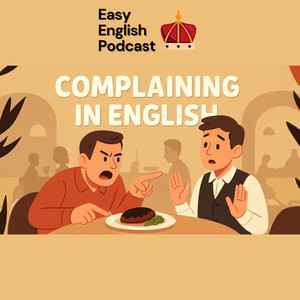
And this is to say that you are not happy or satisfied with someone or something.
For example, maybe you might complain if your food is late.
You're in a restaurant, you're waiting on food.
It's taking ages, and then you might complain to a member of staff.
You're telling them that you are not happy that your food is late.
You are not satisfied with the service.
Our next word is apologize.
Apologize.
You definitely probably know this word, but it means to say that you are sorry for something.
And it's usually something that you have done.
But you can also in English say, apologize that someone else has experienced something.
So you're not saying sorry for yourself, but you're sorry for them.
So you should always apologize when you make a mistake.
Third word is polite.
Polite.
And this is an adjective.
And it means having or showing a behavior that we consider respectful and considerate of other people.
What that means is, when you are thinking about other people, you are considering them as well as yourself.
So, for example, saying please and thank you is very polite.
If you are on a train and you see an old person getting on the train that is having problems standing.
You might get up and give them your seat if the train is very busy and they need a seat.
That is considered polite.
Okay, our next word, issue.
Issue.
And this is a noun and it means a problem or a difficulty.
We had a small issue with our new house, let's say.
So you got your new house and there's a problem with it.
Or maybe let's say a new car.
We had a small issue with our new car.
It's not working.
That is an issue.
And our final keyword for today, conflict.
Conflict.
And conflict is a disagreement or an argument between people.
And talking about apologizing, apologize.
A good apology, which is the noun version, can really help to fix or stop a conflict.
Okay, those are our keywords for today.
I want you to listen for them.
And if some of those were new for you, make a note of them and do try to learn them.
And as you're listening to this episode, you're gonna be practicing hearing them and understanding them.
So now we get to the exciting parts of the episode and we're looking at complaining first and really how to be heard, not just understood.
I want to mention that, if you want to take your support for the show a little bit further, make sure you check out the Patreon link.
The link is in the description below.
For those of you that don't know, Patreon is a platform, a website that you can sign up for and subscribe for a small monthly fee to Easy English.
And on that platform, you can access it through your phone or your laptop.
There's an app as well.
You can get access to all of the podcast episodes with full transcripts.
And starting this week, I'm also including with every episode, a PDF file, which has the transcript.
It has vocabulary and some exercises as well with each episode.
So you can take your learning with Easy English to the next level.
There are also bonus episodes of the podcast every week.
And if you sign up for the Patreon today, you get access to over 50 I think nearly 60 bonus episodes with a different series as well on the Patreon.
So you will never run out of Easy English content.
Thank you to all my Patreon subscribers and those who support the show.
Okay, so let's begin with complaining.
The secret to complaining successfully is not just to be polite, as we talked about, but it's to use a strategy I would say that is quite popular in the UK and the US.
Now, this compliance strategy is more, I would say, for business settings for work, if you're dealing with English in work, but it also can be in everyday life.
And it's a secret that professional communicators use all the time.
And they actually teach this at a lot of conferences.
And you probably have heard about this even in your own language too.
And we call this in English, the complaint sandwich.
The complaint sandwich.
I bet you didn't think we were going to be talking about sandwiches in this episode.
So the idea is simple.
You put your complaint in the middle of two positive comments.
And it's a method that works because it softens your message, it shows respect and it makes the other person more willing to help.
Let's look at how to use this.
We'll get some examples.
Imagine you're at a restaurant.
You go to a restaurant and you order soup.
It's coming into autumn now, towards winter and things it's getting colder and you want some nice warm soup.
So we've ordered soup and it arrives cold.
Oh, it's meant to be warm.
This is a hot soup for a cold day, but it is cold.
So you're going to complain to the waiter.
So how do we do it?
You can start with the top piece of bread, the top piece of the sandwich, the bread, right?
And that is a positive comment.
So you can begin by saying something that you like.
You might say to the waiter you know, excuse me, the food is delicious, which is your positive comment.
And then you want to go to the filling.
So that is the inside of the sandwich, your complaint and say the problem clearly and politely.
So we've already said that the, excuse me, you know, the food is delicious.
And then the complaint, however, my soup is very cold.
And then you can finish with a polite request or a thank you.
For example, you know, I appreciate if I could get another portion.
Thank you.
Or another one.
Thank you.
That shows your appreciation at the end.
So we've said we have the compliment, but we put just a little bit of nice around either side.
You don't have to do this with everything, of course.
If it's a really bad situation and you feel angry and it's the right to complain, just say it straight in English.
Don't worry about the stuff that I'm teaching you.
You can just say, you know, the service is really bad.
Like I'm very disappointed.
But if it's a small thing and it's not really the waiter's fault or it's not necessarily that person's fault, then using this method, the sandwich method, is a good idea.
So let's recap.
You start by saying something a little bit positive, like excuse me, you know, the soup is delicious.
It's very tasty.
However, my soup seems a little bit cold.
That's the complaint.
You know, I'd appreciate if you could get me a new one.
Thank you very much.
That's another polite, nice comment on the end.
And this method in the UK and the US and, to be honest, most English speaking countries, is very culturally intelligent.
You know you're going to use English in a way that is deemed, a way that is seen as normal in our culture.
So it's less aggressive.
It's not considered aggressive, although this may be more normal in your language.
To be direct,
Remember, each language has a different culture.
It doesn't mean that it's right or wrong.
It just means that in some countries, of course, we have different ways of communication.
It's something I've learned over time, particularly because I've taught people from all around the world and lived in different countries.
There is no right or wrong.
There is only different cultures and different ways of doing things.
But when you speak in English, particularly and especially if you are visiting a country like the UK, the US Canada Australia, in general, most English speaking cultures are a extra little bit of nice, especially the UK.
But what about the other side of the coin?
If you are the person that has to apologize.
Someone has complained to you, they've made a complaint.
No matter how they've done it.
How can you apologize effectively as well and show them that you are a responsible and respectful person that really cares?
Well, the most basic apology that I'm sure that you know is of course, I'm sorry.
And we use this for a small mistake, something small like bumping into someone, getting in someone's way.
But for a much more serious situation, a simple I'm sorry is usually not powerful enough.
A powerful apology, so one that is strong for a serious situation, has three parts.
And we can call it the apology formula.
Let's say Oliver's Apology Theory, which I'm going to teach you today.
And the first part of the apology is the apology itself.
That's the first part of Oliver's Apology Theory.
And that's easy.
That is I'm sorry or I apologize.
To say I apologize is a little bit more formal.
So we've said the apology itself.
I'm sorry or I apologize, which recognizes that we are wrong.
It's our fault.
The second part of Oliver's apologizing theory is the reason.
So you want to say the reason.
And that really shows them why you're sorry.
So I'm sorry, then the reason, for example, for being late.
If you're late to class, I'm sorry for being late, or I apologize for the mistake in my report.
And finally, the third part of the apology is the solution or the promise, which is really how are you going to make it better?
Like what actions are you going to take or change?
Because of course it's one thing apologizing, but actually doing something about it is another important step.
So you want to say what you will do to fix it.
And this is the most important.
So let's take the example of being late, right?
So you could say, I'm sorry for being late.
The reason.
Then you want to say um, like next time i will be on time, or next time i will make an effort to be early, or i promise it won't happen again.
With the example of, let's say, you made a mistake on your work or your report for work.
You might say i'm sorry for the mistake on my report.
And then the solution or the correction, you would say I will correct it immediately.
I will fix it.
And that way you are apologizing, you're making it clear why you're sorry and you're saying what you will do to make it better or to not let it happen again in the future.
And this shows that you're really genuine.
You're thinking about what went wrong, why you're sorry, and what you will do.
It's really important.
Okay, so I didn't get a lot of answers for my last listener spotlight.
So today I'm only going to be asking you a question, which I want you to try and answer.
As many people as possible to try and answer this question.
And I will read out some of your answers in the next episode.
I want you to share a time or an experience with me when you had to complain.
What happened?
And how did you complain?
What did you say?
You don't have to tell me exactly what you said.
You can...
You can make it up.
As well, with these comments and situations, if you don't have a real example, don't worry.
You can make up an example for practice.
It doesn't have to be real.
So try and comment about a time when you had to complain.
You had to leave a complaint or you complained to someone.
Give me some examples and I will read out some of your answers in a future episode.
Okay.
As we end this episode, remember this.
The English language has so many tools for politeness and for sounding correct way culturally.
So using a phrase like, I'm sorry to bother you or apologizing when you're wrong.
Or, excuse me, it's not being weak.
It's about being confident and a respectful communicator.
I've had this experience in some countries that I've lived before, where people think, even when I've been teaching them English, that saying please or sorry or excuse me sounds weak.
I've heard this especially from men.
And I think it's a load of nonsense.
It's a load of rubbish.
It has nothing to do with being weak or being strong.
It's to do with the culture of the language.
And in fact it's actually hard for a lot of people to apologize or to say sorry or to respect other people.
And I think that in English, it shows confidence.
It shows that you are willing to apologize and respect other people's space, their time and them as people.
And I think that, Given the sort of cultural situation of it, it's one of the most important things that you can do in English.
So thank you very much for listening to this episode.
I hope it was a little bit more interesting than you even thought it would be.
I think that every episode is a great chance to talk about some of the cultural things behind English too.
So I hope that, even if the phrases were easy for you, it was interesting to hear some of this conversation around complaining and apologising and being polite in general.
If you want to explore this topic further, I have made this week on Patreon a bonus episode about politeness in English, exploring this theme a little bit deeper.
So if you want that more advanced episode, make sure you click the link in the description below.
Go to the Patreon page and become a member.
I hope to see you there.
Thank you very much for listening and have a wonderful rest of your day.