What's stopping you?
I'm asking because no matter who you are, if you're listening to this episode, I'm sure you're facing some kind of challenge or obstacle or goal that's standing between you and your next level.
But would you believe me if I said the biggest hurdle you have to overcome is probably in your mind?
This isn't about manifestation or trying to bargain with the universe.
This is about refocusing your perspective.
Instead of zooming in on the blockers in your way, what if you zoomed out far enough to see the paths around them?
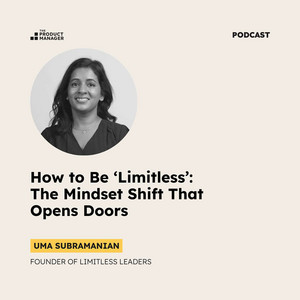
My guest today is Uma Subramanian, founder of Limitless Leaders.
Prior to starting Limitless Leaders, Uma spent 20 years climbing the ranks at Microsoft, where her limitless mindset allowed him to achieve spectacular things light years outside of her job description.
You're about to hear the incredible story of what she was able to pull off even as a junior IC, simply by believing she could.
You'll also hear Uma's tricks for reframing limiting beliefs, how to use your mindset to transform your career, and how to navigate seemingly impossible constraints.
Mild spoiler, they're almost never actually impossible.
Let's jump in. Oh, by the way, we hold conversations like this every week.
So if this sounds interesting to you, why not subscribe?
Okay, now let's jump in.
Welcome back to The Product Manager Podcast. I'm here with Uma Subramanian.
Uma, thank you for joining us today.
Yeah. Hey, Hannah, thank you so much for inviting me to your podcast. It's really an honor.
Yeah. Well, we'll start the way that we always get started.
can you tell us a little bit about your background and how it led to where you are today?
I think I'll have to take you back to when I was a teenager.
I picked up Think and Go Rich by Napoleon Hill.
I don't know if you know that book.
But that book changed my life.
And it taught me that success isn't reserved to a select few.
It is something that we have full control over, starts within our mind, and anyone can achieve success with a vision, action and mindset.
So I carried that mindset with me when I started at Microsoft in 2001, moved from New Delhi to Seattle.
I had 20 incredible years at Microsoft working in developer content and evangelism space.
Never limited myself to my role or title or the resources or the team size.
Just always thought big, came up with big initiatives, pulled people together from all around the company, and really had a great time.
And then after 20 years I joined the tech startup, carried the same mindset with me, was really doing well.
But long story short, I ended up resigning close to my first work anniversary.
That's a separate story.
And without any backup plan ended up resigning.
And then I was like, what do I do next?
And the only thing that came to mind was I realised I've always been limitless.
And so started Limitless Leaders where I now coach tech professionals, realize that they are limitless too, and step into leadership, and thrive in leadership, really confidently and effectively achieving great things and becoming highly relevant and in demand in today's market.
Well, that is super inspiring and I'm really hoping I can pick up some tips from you.
So yes, today we're going to be focusing all on this limitless mindset, which I'm so fascinated by.
So at this point now, this mindset has been with you for so long.
What's the essence of the limitless mindset?
Is it really as simple as just believing that there are no limits or is there more nuance to that?
I think it's a few different aspects.
I would say the first is just starting with believing that you can be more, I mean, we have limitless potential, we can do amazing things and realizing that any given situation, any circumstance, we can think differently and either elevate ourselves or elevate other people or solve something bigger than what is expected.
So I think it starts from there.
So I want to kind of tie it in with two other mindsets that I think are more mainstream, that I think are kind of relevant to this conversation.
So the abundance mindset versus the scarcity mindset, which for anyone who's not familiar, when we say abundance mindset, we're kind of thinking about there's enough potential and opportunity to go around or a scarcity kind of has this mindset that opportunity is finite, really.
So what do those look like in practice and kind of how does that compare with the limitless mindset that you're talking about today?
Yeah, I would say the abundance mindset and the limitless mindset to me is more or less the same.
To me, for some reason, that limitless one day actually two years ago is the first time I realized that I'm limitless and kind of looked back and to flick it on and felt like, Oh, my whole life, you know, it's been a recurring theme.
But I do think it does nothing but just really having an abundance mindset, understanding that there is more to go around, there's enough resources, you know, and having positive expectations from people and life.
This scarcity mindset, on the other hand, is when sometimes, you know, because of our conditioning because of our experiences, childhood, whatever that maybe we end up thinking that there's a lot of limits, a lot of constraints, and I've had them like I've had to work on myself over these years to get out of many of those, you know, scarcity mindset type of thinking.
And I do think that we can work on ourselves and expand our mindset.
And that's what the abundance mindset or the limitless mindset to me is all about, is something intentional, a conship that you can work on and expand yourself.
JILL RILEY -CURTIS Yeah, I love that.
And I'd love to hear also some stories from your career in which you really feel that that mindset played a really pivotal role in determining the outcome.
It sounds like your experiences at Microsoft probably spanned a lot of different roles, a lot of different projects.
Is any experience from that time or your startup past kind of jumped to mind and you think about a time when your mindset really was the differentiator?
Yeah, I have several examples, but let me share, you know, one first. So this was a few years ago, I was at Microsoft, was December, you know, holidays.
Right before my manager going on vacation, we had our last one -on -one.
And he told me, Uma, maybe when we come back in the new year, we should have a half a day event to really help our Microsoft developers learn and ramp up on our AI platform.
I was on a developer content and evangelism type of role for that AI platform in the team.
I said, okay, and then he left. Here I was, really looking at the opportunity, half a day training.
But then my heart told me that I didn't see that opportunity as creating half a day training.
I saw it as an opportunity that our entire Microsoft product teams needed to know about this AI platform.
We needed to evangelize it to the entire company.
And I saw a full -fledged conference, in my vision with executive keynotes, multiple tracks of sessions, Ask the Expert groups, and all kinds of partner showcase, all of that.
And so my next question was, okay, how do I make it possible?
Once that idea came to me, I realized that's the right thing to do.
Our platform really needed that.
but I had no clue because I come from a product engineering organization.
My entire career had no event marketing or conference type of background, but I didn't limit myself to it.
I went and reached out to my network.
I found a mentor who was running another company -wide AI conference.
I asked him if he would help me, he generously agreed, and so worked with him during those holiday time to come up with an entire strategy, have detailed proposal and execution plan.
When my manager came back and we had our first one -on -one in the new year, went and shared the proposal, the strategy, and it was an immediate yes.
Then the entire leadership chain, of course, we had to go and asked for budget, get a buy -in and it just went smoothly.
Everyone was like, yes, let's do it.
Within a few weeks, I found myself leading this initiative across the company, launching this conference with no background truly in that pace.
But, you know, working with like over two hundred and fifteen leaders, subject matter experts, product managers, software engineers, you know, just admins, vendors, partners, I mean, you name it.
And was a huge conference, huge success.
And then every year I did it until I left the Microsoft family.
And also not just within the US like we We did it in India, Ireland, China, like everywhere.
And this was a huge, very successful conference.
So that's a great example of how you can turn a half a day training opportunity into a full fledged conference and goes on for years.
That is an incredible story.
And it's so inspiring too, that you're in a position where many people would see themselves in that company in that role as those things being completely divorced from their day -to -day responsibilities and therefore not something to even attempt.
So, but yeah, I think that what I've heard repeatedly talking to leaders in this space is that a lot of the time, the thirst for ideas and for solutions and answers is within the company and executives have the challenge of trying to find it.
So having that initiative and that commitment and being able to see, you know, the value of that idea and see it through that is just, I sees, please take note.
It was really awesome.
I wanna talk a little bit about constraints.
And now that we're kind of talking about, you know, you're in a situation in this story here where you had a lot of what appeared to be immovable constraints, and you just kind of rejected them.
How can folks who kind of see those constraints around them apply that limitless mindset?
And you know, how do you kind of approach evaluating whether an idea is worth going to bat for like that?
Yeah, so I think it starts with really being laser focused and clear about what is really needed in the organization, what is really needed for our customers.
But being really clear about that.
I think for me, when I came up with that conference idea, I knew that this was something all my senior leaders, everyone's going to say yes because I knew what they ultimately wanted.
They want our AI platform to be successful, and the conference will put it into the map, and make it more, you know create more awareness.
So it's kind of I think it starts with that.
Just really listening, understanding what is really needed in the organization, what our customers need.
And then when these ideas come, believing in yourself and also asking yourself what would extraordinary look like.
That saying that, you know, I've trained myself to ask.
Anything I do, if there is an opportunity that comes up, What would extraordinary look like in this situation?
I love this idea because I think a lot of the time when we apply that to that sort of thinking into product development all the time, we kind of have an idea about the angle should look like and what the requirements are and how that should behave. But when we think about our own ideas that are outside of our area of expertise or that we think are maybe, you know, adjacent to our skill set, we kind of lose faith in that process.
And it's hard to kind of, you know, we might have an but we don't think about what that idea might look like, we just think it's a good idea.
I like that idea of kind of trying to craft a vision of what is the goal so you can reverse engineer towards it.
Correct, yeah, it starts with the imagination.
You know, it starts with vision, it starts with imagination.
That's usually the first step, like, usually I see it, and then I know that it's the right thing, like, when I see things like, you know, the next thing that comes to mind is, oh yes, that's a definite yes.
Because I know that aligns with what the vision of the organization is.
And then I know that, okay, this is something that's worth putting all my effort into energy into and going full in.
Okay, so speaking of which, so you mentioned, you know, aligning your vision with the vision of the organization.
Let's talk about when your vision doesn't align with the organization and you're thinking about making a career transition or, you know, going for a role that's maybe outside or doesn't exactly match your resume or changing companies is when you think that it might be a contentious switch. How do you apply the limitless mindset to something like that?
Interesting question.
So this happened to me when I quit as I mentioned, I suddenly resigned from my tech startup job.
And because of all the inner work that I had done, I didn't dwell in negativity or fear a lot.
Like the immediate thought that came to me was okay, all this is happening, it must be happening because there's probably something bigger better waiting for me, and I filled on to that thought, and just went all in and that, and figured out, okay what is the next bigger, better thing I can do?
So, I would say if you know, we are in that kind of frame of mind where, you know, I want to try something new, or try something that is a little bit scary, a little bit new, I would say just, you know, trust yourself, believe yourself.
I generally ask people, if you look back at your journey, has there anything that has happened in your life that has not turned out to be good?
I've usually, you know, when people in the midst of adversity, in the midst of challenges, we do sometimes not see the silver lining but usually when I ask people, they look back, they always come and say, oh no, like you know, yes, in the midst of it it looked difficult but you know there was this good thing that came out of So that's what I want people to always keep in mind, is anything that you're seeking, anything that you're going after, even if it looks challenging now, just know that there's probably something great waiting for you.
Yeah, absolutely. Going back to the internal sphere.
I imagine that in the time that you've had to coordinate these limitless projects, obviously you have to collaborate with a lot of stakeholders and you have to get buy -in from people who are far outside of your circle of influence, and that can be a really intimidating proposition.
So how would you apply this mindset to stakeholder management and relationship building, and kind of gaining some of that influence without authority?
My example, you know, I have several examples of that and I would say even in this particular example that I shared about the conference, it's about first of all realizing that we don't have to compete with people.
where multiple people can win.
If someone else wins, that doesn't mean I lose.
I can also win. So being willing to put the spotlight on others as well, you know, celebrating others, being comfortable with that, I'll share a couple of practical things that I have done that have really worked well for me.
One is I'm very easy to give the spotlight to others.
If someone is participating in my conference, helping out, you know, maybe a software engineer or a product manager is in a booth, in the Aspect Foods booth, and they are volunteering.
Once they do that, they're going to get an email from me.
I'm ceasing their manager, my manager, really elevating them, and thanking them for what they did, and make sure that they get credit.
So those are a couple of things.
And then the other thing is also, even during the project itself, giving lots of people, other people the spotlight, comfortable with that.
Knowing that giving other people the spotlight doesn't take the spotlight from me.
So those are some things that have really worked well for me, is when I shifted my mindset like that, and people find it very easy to work with.
The next time I ask people for a favor, they are willing to come in, you know.
And you have to think because of the role that I was in, if I'm asking people to come and participate in the conference, it's not their day job.
So if I'm asking a product manager to come and speak, that's not their day job.
So those kinds of things, just making sure that we are giving them the spotlight, celebrating them, understanding what they value, like what our stakeholders value and giving them that.
And that really worked well for me.
And typically like people would love to work on my projects, my initiatives because they are usually very highly visible and part of recognition, plus they get that visibility and recognition and they get to add value and contribute to something that is important and makes a difference.
So all of that together really helps out with getting stakeholder buy -in and support.
And now I see that with my, I help my clients who are product management, And many actually, I have probably 60 % of my clients are technical product managers working in tech companies.
And like I see them once they elevate themselves, once they figure out how to not compete with other people, but really add value, help other people.
We see a huge shift in how they are perceived and how opportunities are coming to them now even more than before.
I'm so aligned with this idea.
This is such an empathetic way of leading to and just interacting even if you're not in a people leadership role I think that that is because I think we tend to think about a lot of work relationships as being very transactional You know, I you ask for something you wait for it to come back to you, but to kind of always be investing in others that way and kind of carrying yourself in a way that yeah, just I think it attracts people's best work when you give you know that good faith and and that recognition.
And yeah, I mean, I think that this really underscores this idea that giving people even just the smallest amount of recognition goes always so much further than you expect.
I really appreciate that perspective.
So let's talk a little bit about things that stand in the way of people adopting this mindset cause it seems like it really is an all win and no lose thing.
So what are some of the excuses that you've heard from clients or from others or limiting beliefs that you hear and how do you kind of reframe some of those thoughts?
Yeah, really good question.
And I do see that, I do hear people saying, I cannot do this in my team or I cannot do this in my role or in my function, this is not possible.
I think it comes down to, at some point, people being open to and willing to just expand their mindset.
It's a conscious position.
And I do sometimes see some people struggling with that because of their past conditioning and the programming that they're carrying.
But the people that I have seen really come in with an open mind, they're ready and they are willing to try things.
I have seen amazing things happen to them.
I'm happy to share another story.
This is a client of mine, when he came to me he was in this toxic culture in a company almost like he thought he was gonna lose his job within a month or two.
And so he was ready to explore his next role, and literally, it was keeping him up at night.
Like, he was not able to sleep.
He was extremely stressed.
And we worked on two different paths.
Like, I coached him on two different paths.
One is, because he had, when he came to me, he had given up on his current organization.
I coached him to actually still continue to add amazing value to his organization, as well as open the path to exploring job opportunities outside.
And within the company, we then worked on really understanding how he can add tremendous value, what is it, and he had those ideas.
Like, you know, once I started coaching him, he had these, he was brilliant, had incredible like ideas to add tremendous value.
So, we figured that out and then he was able to then show up to his senior leadership team, share some of those ideas and put the politics aside, put all this old mindset thinking of, you know, just this toxic culture.
Like, you know, people wouldn't care.
Like there was all this thing that was playing on his mind before.
And we kind of, you know, I coached him to let all that go and just go in with, hey, how can I add extraordinary value to your organization?
And I'm going to share that.
And I'm going to believe that, you know, I'm not even going to focus on like, you know, the outcome, but I'm gonna do this.
And so, coached him on how to show up powerfully and share his ideas and thoughts, and be very strategic about it.
You know, and he went and did that very proactively.
And you will not believe, you know, he went and presented it to senior leadership.
They were so impressed with that one presentation that many doors opened for him within a couple of weeks.
And that time, he also landed another job opportunity outside.
And so he ended up resigning and telling them that, hey, you know, go leaving.
And this old company was like, oh, no way, like, what can we do to make you stay, but he was, you know, he wanted to move out.
And when he said that, they were like, okay, if something happens with that new company with the other role, know that the doors are open, you can come back here.
And that's pretty much how we left, which he also told me that it's never happened, like for other people that have recently left, they wouldn't even try to stop them.
That's just not in the culture.
But we were able to very quickly change that whole situation this way.
I feel like it's these kinds of stories that start to happen, when we believe in our limitless potential and we focus on the right things.
You know, how can we add strategic impact?
How can we look beyond, you know, the nonsense that's happening, and really focus on, you know, what value we can add and how can we work together?
He also positioned himself as a very collaborative team player.
He already was. Like, I want to say that he already was all these things, but it was just taking all of that and showing that and removing some of those things that was limiting him from showing up in his best self.
That made a huge difference.
Okay, this is all incredibly fascinating to me.
I really am a believer in mindset as being something that is so powerful in determining outcomes.
But I also know that we also have to balance that with being a little bit realistic because we can't let How can I put this limitless mindset also competes with realistic and sometimes truly immovable constraints.
How do we distinguish between a limitation we should accept versus one we should challenge?
So I would say even with the limitless mindset, we're always working within the reality.
Like we're not living in some impossible dream.
We are fully aware of all the real constraints and the limits.
And it's just that when you have a limitless mindset, you're thinking creatively.
When you see a constraint, you're not limited by it.
Your creative hat, you put on your creative hat, and you think, is there something that we can do to still make this happen, if this is the right thing?
So you explore options, and there can be structural constraints like budget, resources, teams, that kind of thing, and it can also be just mindset -related constraints where we are just limiting ourselves because we think we cannot do that, or this is not possible.
So really becoming self -aware and digging a little bit deeper to see what kind of a constraint is that?
Is there a creative solution that can be worked upon?
So if it's a budget issue, I've had several, because of the large projects and ideas that I come up with, I struggle with, or I end up with, a lot of situations where I need a lot of budget.
And my team sizes are not that big.
So what I have done is I would ask myself, is there another team that I can go and ask for help?
Is there a different way that we can solve this problem without spending money or in some cases, my team, for example, like the conference or the, in many projects that I've taken before that, my team sizes would be like seven or eight direct reports at Microsoft. And how would I like even think about large initiatives but I never like limited myself to just my org.
I said, okay, it's not just my team, but my entire organization or sometimes multiple like teams at Microsoft. And so just thinking about what is possible, but at the same time, being aware of if you try a few things knowing that, okay, this constraint is not possible to necessarily eliminate, we have to accept it and accepting it and moving faster there too.
See, not getting stuck with getting a no or not stuck with not being able to figure out how to solve a solution.
Sometimes you have to accept and then move fast in those situations.
I wouldn't say it's like, you know, you're gonna have this dreamy, like all like great kind of an experience.
Like, sometimes you do have those very clear constraints that come up.
we just accept them and move forward. Yeah, just adapt around.
I think that's a good answer to that question, I'm sure that those things do come up, but as I'm thinking about it, I'm thinking, well, there's really not so many challenges that can't be solved with some kind of a creative solution.
So I imagine, yeah, there's not really that many, if the goal is beneficial, I'm sure that generally speaking, there's always a pathway if you look for it.
Exactly, and I wanna say that It depends on the level of belief you have. Like when I really know that, okay, this is the right thing to do.
And I know this would be good, I've always figured out a way.
It's possible that few that we had to accept, but, you know, still overall, you know, we've been able to accomplish those projects.
And if you look at Bill Gates or Steve Jones, I mean, these visionaries have thought of like these amazing ideas, you know, many, many years ago.
they made it happen, so you know, I really believe that it's possible to make things happen if we believe and don't give up and we'll somehow break out of the way.
Yeah, I tend to agree, I'm thinking, you know, even things like budget, which seemed like such an immovable constraint, a lot of the time it's possible through things like strategic partnerships and trying to figure out, you know, who shares your goal that's willing to kind of chip into that, even if they're not getting, you know, a just being part of it.
This is really inspiring.
Some deep thought, Uma, I appreciate it.
Very little examples of getting engineering resources from a totally different cost center that has nothing to do with our Microsoft group that I was part of.
They give them resources and supported us with building an entire developer center for me.
Another group actually just literally handed off like 40K for a project that they wanted.
totally different center, they don't benefit in any way by doing that.
But just asking them, presenting the reasoning and going with the belief, you know, just always has worked out for me.
That is incredible.
Okay, so I have to start to really work on my belief muscles.
That's amazing. Okay, so so you said leading with belief and leading with belief also, I think comes with a lot of confidence.
So for someone who's earlier on in their career, who's maybe struggling with confidence or feeling that you don't really have the influence to pull something off like this, what would you recommend as kind of early first steps to start shifting towards that limitless approach and kinda setting the stage for building those kinds of relationships that can support you during that time?
Looking at my life, my journey in this started with Think and Grow Rich by Napoleon Hill.
So I would say books like that would be a good starting point because they make you realize that it's all in the mind and you can, with the power of your thoughts and mind, you can think big and achieve big things.
So I would say one of the things that anyone can do is pick up some good books in that space and work on expanding your mindset.
The second thing I would say is surround yourself with people that are already expanded.
I do that, I start it, it's actually one of the chapters in Think and Grow Rich is about having a mastermind group and having people always, you know, surrounding yourself with people that are more expanded than you doing bigger, better things.
And so that you can look at them and know that bigger things are possible.
And I think that really has helped me.
I've always invested in programs, people who are doing bigger and better things.
Even now, like I'm surrounded by, I'm a leadership coach now, and I have leadership coaches that are doing amazing things right now.
So just by seeing them doing bigger, better things, I know that it's possible for me too.
So that's the advice I would give is, surround yourself with people that have that expanded mindset, so you can work on your belief and keep increasing your belief in yourself too.
Oh, wow. Yeah. That sounds like there should be a community for people like that.
Some kind of like a club for people who really embrace that abundance or limitless mindset.
We have a community at Limitless.
You're welcome. I wasn't even trying to plug that.
Well, there you go.
That's wonderful to know that you've got this group of people, obviously who are embracing this mindset coming together.
And then how do you see this concept evolving in the tech space?
I feel like at this point, right now that we have things like vibe coding, our trending, we've got no code.
we've got so many different opportunities for people to really act in a limitless way.
So what do you think are some of the skills or mindsets that will be really crucial for not just product leaders, but just anyone right now as the tech landscape evolves?
I think it's really getting more and more important for you to stand out, like figure out a way to stand out in this landscape because there's just so much with automation, with AI.
Everyone's now an AI product leader, AI engineer.
How do you stand out in that?
I believe having a limitless mindset, thinking this way, being really strategic, thinking big, going after bold initiatives, working really well with people and making things happen.
This will help you stand out and thrive in this era.
I really believe that now more than ever, it's really crucial that we adopt this mindset because there's so much opportunity.
You know, AI is automating so much of the routine work.
You know, we can use our minds to craft amazing things, you know, solutions, things that, you know, the world needs.
And I believe that that opportunity is available to anyone.
And having a limitless mindset definitely would result in amazing things for the world.
Yeah, I agree. Yeah, I think now is the time especially to grasp onto that.
This is the kind of thing, you know, the ideas, the visionary.
That's the stuff that we can't really automate.
We really need, you know, everyone is kind of in this position of having more power than ever before in that respect.
So this is such a cool message and very inspirational and timely.
So thank you so much for joining us, Uma.
Where can people follow your work?
I think LinkedIn is probably the best bet.
Who watch the Romanian who reach out to me and definitely would love to meet folks and have a really good conversation.
Speaking of very good conversations, thank you for having one with me today.
I really appreciate your time.
Thank you so much Hana, really appreciate it.
Thanks for listening in.
For more great insights, how -to guides and tool reviews, subscribe to our newsletter at theproductmanager .com slash subscribe.
You can hear more conversations like this by subscribing to the Product Manager wherever you get your podcasts.