Sometimes it's just a joy to watch a great filmmaker work.
For those of us who love how movies are made, that's often the real replay value.
Observing how a director puts together a scene that just sings.
It's a taller order than you might think.
The basic questions of where to put the camera and for how long.
What do you see?
How is it lit?
What do you hear?
There are so, so, so many boring answers to these questions.
If you've ever tried to make something of your own, you know that.
You know that doing too much can be just as boring as doing too little.
Often, you don't even know why the scene isn't working.
The writing is good, the actors are good, but it's all just falling flat.
That's when you turn to one of the greats like Steven Soderbergh, an efficient and creative cinematic problem solver.
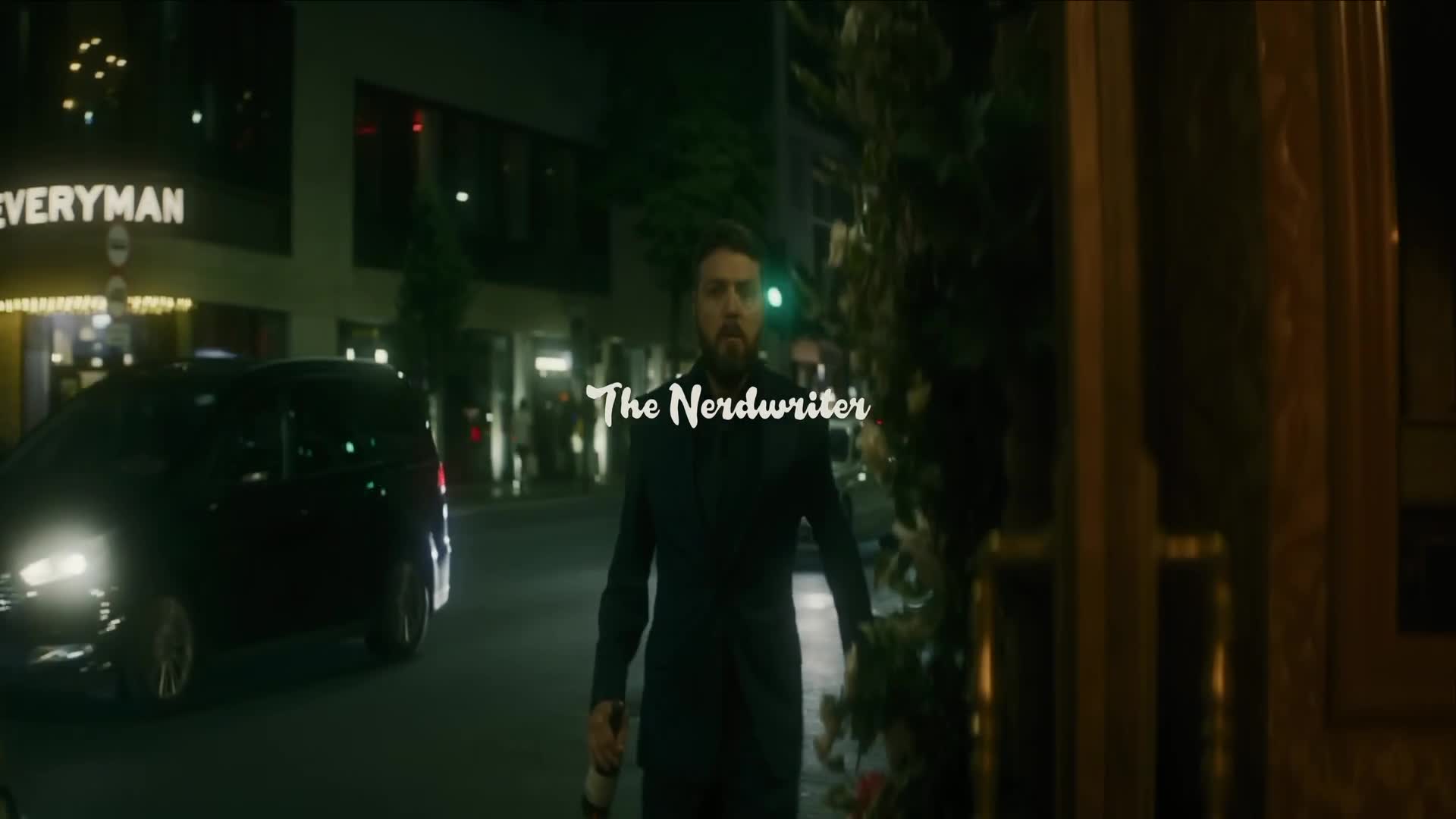
Let's take a look at a short two-minute scene from his latest movie, Black Bag, a smart, propulsive spy thriller that I really enjoyed.
Importantly, this is not a major scene.
It's the transitional scene that leads into a major scene.
But I wanted to look at this one because it's simple scenes like this which every film is full of, that challenge and often stump new filmmakers.
It's very easy to lose story momentum in scenes like this, to lose the confidence of an audience.
How does Soderbergh avoid this?
First, a little context.
Black Bag is the story of British intelligence officer George Woodhouse, who is tasked with finding a mole in the organization from a list of five suspects, one of which is his wife.
The other four are being introduced in this scene.
They're meeting up for a drink before attending a dinner party at George's home.
That was fantastic, by the way.
Absolutely delicious.
Thank you.
Soderbergh opens the scene with this elegant indoor-outdoor shot, starting with a full shot of Freddy and ending with a close-up.
Here, Soderbergh uses one of his favorite techniques, a slow dolly combined with a pan or tilt.
It adds a subtle controlled movement to the shot, like the subtle controlled choices of these spies, and it contributes to both the stylistic cohesiveness and the forward momentum of the film.
From here, we switch to Freddy's POV.
He's looking across the pub to a woman, who we'll soon learn is Clarissa.
She's sitting at a table with others, but Soderbergh obscures them with objects in the foreground.
This serves to emphasize and isolate the relationship between Freddy and Clarissa, before we know what the nature of it is, though from just these two shots we can guess.
Okay, now we're behind the bar for another shot of Freddie that once again frames him in two different ways.
Soderbergh, a student of Spielberg, loves to reframe characters in a single shot, making use of this space in his composition. pays for his friend's drinks, and then in shot four, he leans back in another close-up for one more look at the table.
At this point, I want to mention Soderbergh's brilliant use of a real location.
This is an actual beautiful pub in Chelsea called the Cadogan Arms.
A funny aside.
I was actually looking for it on Google and the Street View car caught the black bag crew setting up for this scene.
When you use a real location, you're limited as to where you can put your camera.
Walls can't be removed like they can on sets, but this is no impediment for Soderbergh.
What I love about these first four shots in particular is their depth.
Each one has objects or people in the foreground, middle ground, and background.
These compositions waste none of the Y239 aspect ratio.
They feel lived in.
The environment feels real, which of course it is, though it's very easy to make real locations feel fake if you don't know what you're doing.
I know they're not that much older really, but I kind of feel like I'm going to my parents' house if they weren't divorced and didn't hate each other.
Now, this might be my favorite shot in the scene.
Unlike shot two, which also comes after a close-up of Freddy, it's not from his POV, but it is a shot of who he's looking at, so the connection between shots makes sense.
Also, Soderbergh has subtly reversed the focal lengths to move us across the pub.
In Freddy's close-up of shot one, we see him from a wider angle, which means the camera is closer to him and we feel closer to him.
Then we cut to Clarissa in Shot 2 at a longer focal length, which gives us the sense of looking at her from afar, from Freddy's vantage.
In the second close-up of Freddy Shot 4, we're suddenly at a longer focal length, as if we're looking at him from afar from the table, let's say which makes us feel that we've moved over there.
And then in Shot 5, the second shot of Clarissa, we're in a wider angle, completing that shift of location.
It's beautifully done.
But what makes this shot special is this slow Dolly back gradually revealing the two remaining characters.
Just as Clarissa says she's feeling like she's going to meet her parents.
It's as if she's a child and her parents are slowly coming into view.
She also mentions the tension between her real parents, which may suggest tension between George and Catherine, or between these two characters who we're about to be introduced to.
Now we get the two-shot of James and Zoe connecting them together, just as James reveals that he and Zoe, as well as Freddy and Clarissa, are both couples, something the visuals have already suggested and prepared us for.
We're in a triangular situation here.
With three people at the table, there are a number of 180 degree lines to navigate.
I mean it's child's play, compared with the six person setup Soderbergh is gonna have to deal with in the following scene, but still.
After the dolly in shot five, Soderbergh places the camera here for the two shot.
Now Zoe has the next lines and she's in this shot, so he could have held the camera here, but instead he moves it here as her remarks get a little more pointed, changing the 180 degree line to isolate this one-on-one.
Now he comes back to the two shot because James doesn't really want to engage with Zoe's point.
And this is the line for Clarissa, who he turns his attention to.
Then, for shot nine, the camera goes here, which is the line for Clarissa and Zoe, who Clarissa turns her attention to.
As the attention of the speakers shifts around the table, Soderbergh deftly puts his camera where it will augment the emotions already present in the script.
And it is his camera.
On all his films, Soderbergh operates his own camera and edits his own footage.
In the credits, you'll see the names Peter Andrews and Mary Ann Bernard.
Those are both him.
The names come from his mother and father.
In shot 10, Soderbergh finally goes for the wide shot as Freddy joins the table.
This is the opposite of the normal pattern of wide first and then close-ups.
But Soderbergh wants to set up specific relationships in a specific sequence.
And once he's done that, once the dynamics are understood, he can cut to a wide and let it play.
We've just learned, for example, that James got the promotion that Freddy wanted.
We get the most out of Freddy's comments and the silence that follows by seeing the charged energy in the space between the four people.
We are celebrating James' well-deserved meteoric ascent through the ranks.
Cheers.
Shall we?
Finally, for the last shot, shot 11 Soderbergh dollies back.
The actor playing Freddy makes great use of a column in the Cadogan arms and the group is gone.
And there you have it.
11 shots, 1 minute and 53 seconds, every shot precisely chosen and ordered.
And precise is the right word.
As Soderbergh says himself, we're talking inches between a shot that's doing what it's supposed to do and a shot that's just mediocre.
Steven Soderbergh knows that there are a million boring ways to stage a scene and only a few ways to make it really sing.
This goes just as much for the small, less important scenes as it does for the big ones.
Of course, in a great movie, that distinction vanishes.
In a great movie, no scene is unimportant.
Hey everybody, thank you so much for watching.
This episode was brought to you by Squarespace, the all-in-one website platform for entrepreneurs to stand out and succeed online.
To get started, you can use Blueprint AI, Squarespace's AI enhanced website builder, to get a fully customized site in just a few steps, or choose from their library of professionally designed templates that are sleek and engaging.
Every website you make will be optimized for SEO so that you'll show up more often in search results.
And you can do so much within Squarespace, like creating members-only content videos blogs courses, Creative work that you can monetize via one-time payments or subscriptions.
The bottom line is that Squarespace is going to make a home for your products or your work that looks and feels professional.
Something that will impress your customers and fans.
Head over to squarespace.com for a free trial.
And when you're ready to launch, go to squarespacecom.
Slash nerdwriter for 10 off your first purchase.
Thanks, guys.
I'll see you next time.