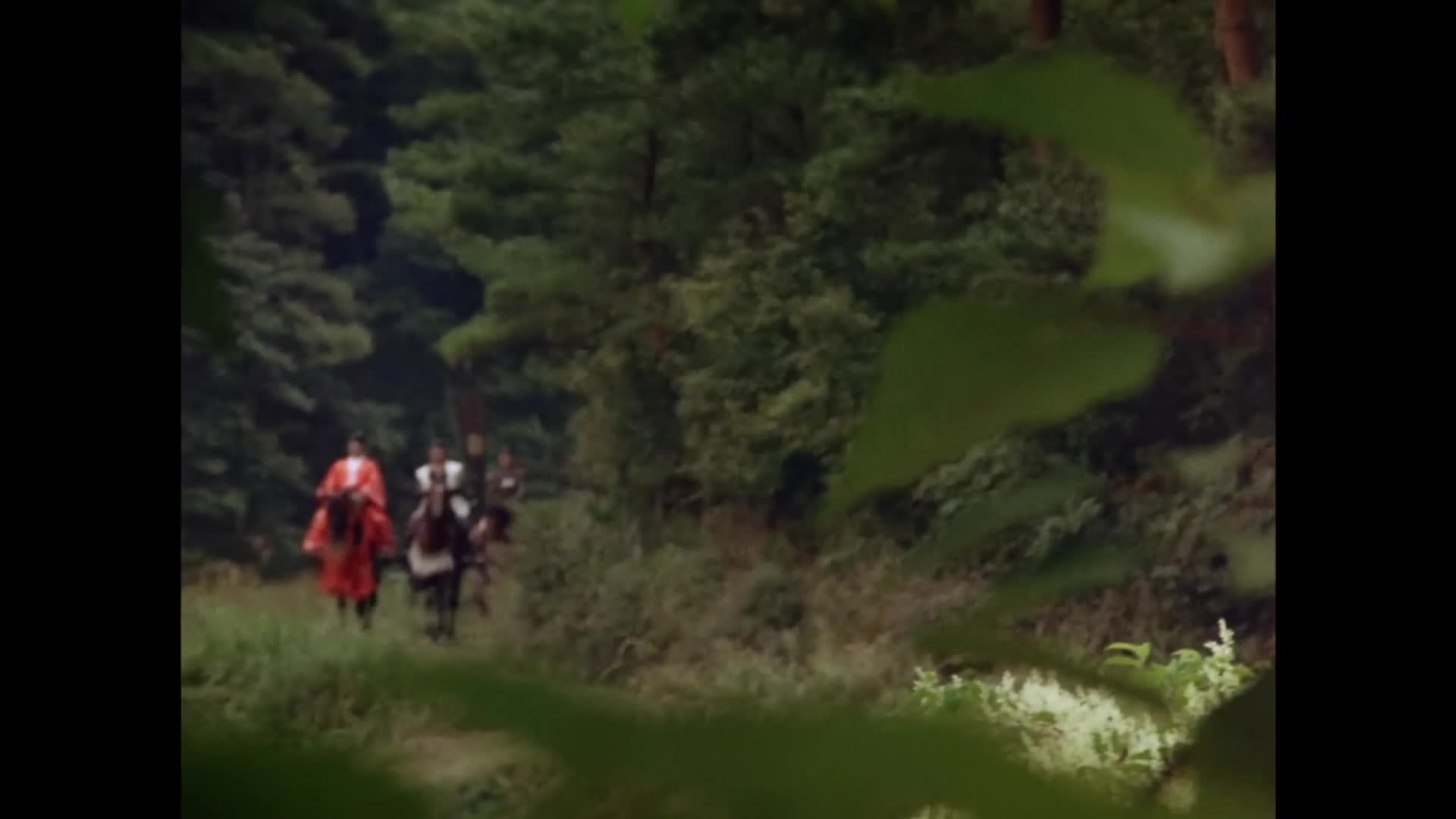
When Paramount and NBC adapted James Clavel's best-selling novel Shogun into a TV miniseries in 1980, the writer Eric Bercovici reframed the source material in a significant way.
And I told James Clavel my idea, which was to take his story, turn it inside out and tell the whole tale of Shogun from Blackthorne's point of view, where we understand what he understands, where we see what he sees, and whenever he is confused, we are equally confused.
To accomplish this, the show chose not to subtitle Japanese dialogue, so American audiences would be as lost as protagonist John Blackthorne, a ship pilot who's based on the first Englishman to reach Japan in the year 1600.
For this version of the story, the subtitle choice is dramatically effective.
We are fully anchored in Blackthorne's perspective, learning as he learns, feeling as he feels.
Want to go in there.
Of course, what you lose by this framing is the interiority of all the characters who speak only Japanese.
And for an epic set in Japan about an important period in Japanese history, the loss is a big one.
Clavel's novel definitely has that stranger in a strange land element.
Blackthorn is still the protagonist after all.
But it also lets us into the minds and conversations of the Japanese characters, which is what FX's stellar 2024 remake of the Shogun miniseries does as well.
Instead of just one focal character, Shogun 2024 has multiple, most of which are Japanese, and all their dialogue is subtitled.
This choice does make the viewer less confused than Blackthorn, but it doesn't downplay the sense of East meets West culture shock.
It just balances it.
What's made this new series so compelling to me is how it uses the act of translation to explore the possibilities and limitations of communication across cultures and communication period.
How do I say?
I understand in your language.
When Blackthorn arrives in Japan, his first translator is a Japanese Catholic who knows very little Portuguese, which is spoken as English on this show.
And it's significant here at the beginning that Blackthorn asks how to say, I understand.
Shogun is very interested, as we'll see, in the difference, or the gap between simple translation and understanding.
His second translator is a Portuguese Catholic priest who speaks broken Japanese.
Once he finds out that Blackthorn is an English Protestant, he refuses to translate honestly.
Instead of communicating Blackthorn's words, the priest communicates the meaning of Blackthorn's presence to him.
Unable to speak for himself, Blackthorn closes the language gap with a gesture.
What be spoken for by Catholics?
Blackthorn's first proper translator is another Catholic priest who honestly relays his words to Lord Torinaga.
In order to ensure this honesty, Torinaga invites another translator, Lady Mariko, who also knows Japanese and Portuguese.
The show communicates the faithfulness of this translation to us by gradually removing the translators until Torunaga seems to be directly speaking to Blackthorn.
And here's the advantage to using subtitles.
Shogun 2024 is able to show a true meeting of the minds between two focal characters who speak different languages.
My lord would like to say that he is sorry for the time you spent in prison.
Later in the same episode, Lady Mariko becomes Blackthorn's primary translator.
I'm grateful to be alive.
And what's interesting is how she subtly alters the conversation.
I hope your time in prison wasn't too difficult doesn't necessarily suggest an apology, and I'm grateful to be alive doesn't necessarily suggest thanks.
Mariko adds these sentiments, quietly controlling the tone of the exchange.
Tell this milk.
This is a role Mariko continues to play most dramatically in episode 5 during a dinner scene with her husband Buntaro Blackthorn and Blackthorn's consort Fuji.
Mariko attempts to smooth out the aggression between the two men by changing their language.
My husband comments on the way you eat your noodles.
The sound you make while eating reveals the depth of your pleasure.
If you look at the 1980 version of the scene.
Mariko still translates, but we're blocked from Buntaro and Fuji's words, so we have to take her translation at face value.
In the 2024 version with subtitles, we get a riveting scene of dramatic irony where the translation itself becomes significant a mediation between the interplay of four minds.
In trying to avoid conflict, Mariko is faced with translating cultural values as well as language, and that's not easy.
When Blackthorn asks Buntaro for war stories, he's communicating a positive English value for boasting that Buntaro considers vulgar and rude.
Those three words carry far more meaning than their basic definitions.
And this isn't the episode's only mistranslation of three words.
When Blackthorn receives a pheasant from Torunaga, he hangs it outside his house to quote-unquote mature and tells his household off-the-cuff.
Eventually the pheasant rots, its stench disturbs the peace of the neighborhood and the kindly old gardener finally takes it down at the cost of his life.
Depending on the context, the same words can carry wildly different meanings.
To translate the correct meaning requires a deep familiarity with the two languages and the cultures that created them.
You know, I don't believe that true translation is impossible.
I don't believe communication between cultures is impossible.
And I don't think Shogun believes that either.
But translation means more than a relaying of words, and the show wants us to think about that.
After all, Blackthorn isn't the only English speaker being translated to here.
So are we, the English-speaking audience.
Shogun's Japanese dialogue was actually written in English, carefully translated into Japanese into period-specific phrasing, then carefully translated back into English to be consumed by us in the form of subtitles.
The showrunners spent a lot of time and resources on this clearly, but I can't help but wonder about the subtleties that I'm missing.
The fact that I'm even thinking about that means the show is doing its job.
Translation is usually something that creators of film and TV try to avoid at all costs.
It takes up a lot of precious time with unnecessary repetition.
Shogun 2024 has found a way to make translation a central theme of the show and the act of translation into gripping television.
This is not in our Lord's interest.
I'm sorry, were you going to translate?
Hey, everybody.
Thank you so much for watching.
This episode was brought to you by Squarespace, the all-in-one website platform for entrepreneurs to stand out and succeed online.
Whether you're just starting out or managing a growing brand, Squarespace makes it easy to create a beautiful website.
And now you can make a completely personalized website with their new guided design system, Squarespace Blueprint.
Choose from professionally curated layout and styling options to build a unique online presence from the ground up.
Optimize for every device and with optimized SEO tools so you show up more often to more people.
You can upload video content.
You can even sell access to your video library.
Basically, a Squarespace site is going to make whatever you're sharing or selling look professional, and that's going to help you get the word out, whatever that word actually is.
Head over to squarespacecom for a free trial and when you're ready to launch, go to squarespacecom.
Slash nerdwriter for 10 off your first purchase.
Thanks, guys.
I'll see you next time.