You're listening to BrainsOn.
We're serious about beingcurious.
Brains On is supported on part by a grant from the National ScienceFoundation.
Ooh, my package ishere.
Hi, I'mMolly. Got a honker of a box foryou.
Just gonna roll itin.Whoa.
Yeah! Here wego!Yeesh,Molly, what's yourorder?
300 bags ofcement?No, but I did order 25 insects fossilized in prehistoricamper.
Yikes. Those must have been some bigbugs.
Okay, we'll have fun withthem.
Ooh, heyMolly, did Penelope's jungle gym gethere?
Oh,hey,Sandin, heyPenelope.
Imean, maybe a jungle gym would make more sense in a box thisbig.
Radical! Let's bust itopen.
Ready?Set? Wreckit! I got one sideopen.
Okay, calmdown. We just got to pull itout.
Comeon,Molly. Onthree.
One,two,three. Holdup.
This is definitely not what Iordered.
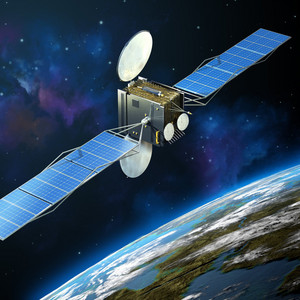
It's all metal andlike, has solar panels onit?
Sandin, it just made asound.
What isit? HeyMolly, heySandin.
Nicesatellite.Wait,Mark, did you saysatellite?
You're listening to Brains on from APMStudios.
I'm your host MollyBloom, and today I'm here with our two fabulouscohosts, Sisters Tessa and Fallon fromHartford,Connecticut.
Hi Tessa andFallon. HiMolly.
HeyMolly. Today we're talking aboutsatellites.
A satellite is any kind of object in space that circles around something bigger thanitself.
The moon is a satellite because it travels around theearth.
And the earth is a satellite because it goes around thesun.
But the kind of satellites we're focusing on today are human-madesatellites.
They're like robots in space circling the earth doing different jobs for us humansbelow.
Tessa andFallon, you sent us a question aboutsatellites.
Yeah, we wanted to know how theywork.
So what made you curious about satellites in the firstplace?
Well, we were driving in thecar.
I forget where we weregoing.
But I noticed my mom's GPS and how it could detect how fast she was going on herphone.
So I wanted to know how satellites were connected tothat.
That's a greatobservation.
So what do you think is the coolest thing about satellites based on what you know at thispoint?
Probably there's like a bunch of them inspace.
Yeah.Excellent. So if you could go tospace, would you wantto?
Yeah.Maybe. I'm not scared ofit.
It's just kind of like being that far from the earth kind of scaresme.
Butyeah. SoTessa, what about space makes you excited about potentiallyvisiting?
I'm just like seeing all theplanets.
So which planets or places in space would you want tovisit?
Themoon.Oh,yeah. What would you do on themoon?
Jumparound.Yes.Yeah.
I know that like lower gravity looks so fun to bein.
Do you like going on like trampolines andstuff?
Yeah. So be like the moon is trampolines but like timesthousands.
Yeah. Socool. So Tessa andFallon, these are great questions and you are not the only ones with questions aboutsatellites.
We also got this question fromMaxwell.
My name is Maxwell and I'm from Kessons HediendaPhilippines.
My questionis, how does a satellite has beendata?
Luckily and somewhatunexpectedly, we have a satellite with us today to help us find theanswers.
Oh, meatmoop. You're really toomuch.
Meatmoop.Oh, that's the satellite'sname.
Can't youtell?Oh, Iknow.
That's what I toldthem, meatmoop.
Anyway, you might not realize it but satellites are very likely a part of your dailylife.
Yeah. We know satellites make GPSpossible.
GPS stands for global positioningsystem.
It is a tool owned and created by the United States and it's made up of 24 satellites in the sky that can tell us where we are onEarth, how to get someplaceelse, and how long it might take to get there at any givenmoment.
We have a whole episode about how GPSworks.
We've linked to it in the shownotes.
Whythanks, meatmoop. Meat moop loves thatepisode.
Thankyou. Meatmoop. Satellites are also used to track the weather and some satellites can even take detailed photos of outerspace.
So there are lots of different kinds ofsatellites.
Meat moop here is a special kind of communicationsatellite.
When it gets tospace, it'll be working with a group of other small satellites to help people in remote places use theinternet,text, and make phonecalls.
Souseful, meatmoop.Yeah.
And I had no idea satellites could be sobig.
Yeah. I'd say meat moop is about the size of a picnictable.
And around 500pounds.Whoa,whoa,whoa,whoa,whoa.
We just moved to 500 poundssatellite.
Dang. Those powerlifting classes are finally payingoff.
Highfive,brosky.Uptab,doodarino.
Anyway, some satellites are even bigger than meatmoop.
They can be as big as a pickuptruck.
Others can be as small as a Rubik'sCube.
But no matter what size theyare, all satellites have to be able to deal with what it's like inspace.
Goodpoint. I know space can be reallycold, but some light can be superhot.
Right. So satellites have temperature control systems to deal with extremetemperatures, and most of them run on energy from thesun.
See these solar panels on meatmoop?
Yeah. They're all folded up rightnow.
But once meat moop makes it up intospace, they're unfold like the wings of a butterfly and these shiny wings will collect energy from the sun's rays and then store it up inbatteries.
So the sun is like meat moopsfood?
Yep. And meat moop also hasthrusters, which are likejets.
Ohyeah, thrusters help satellites move around inspace.
Withoutthrusters, meat moop would be at risk of having a badattitude.
Um,rude. Meat moop is literally rightthere,Mark.
Uh-oh,no. I don't mean the bad attitude as in cheeky or bad-mannered orimpudent.
Forsatellites, attitude means the direction they're pointedin.
And it's important for them to have the rightattitude, youknow, to be pointed in the rightdirection.
So they can send and receive information like they're supposedto.
Oh, Iknow,buddy. You're like a beam of sunlight wrapped in asnuggle.
There's not a rude bolt in your satellitebody.
Wait, but how do satellites send and receiveinformation?
Well, you see this big disc with an antenna in the middle ofit?
Yeah. It looks like the satellite dish on our friend'shouse.
Exactly. Satellites up in space have dishes and antennae on them just likethat.
So they can talk to similar ones down onEarth.
But how do they send thosemessages?
Goodquestion. Radiowaves.
Satellites communicate using the same invisible waves that radios use to send out music and talkshows.
Radio waves are amazing because they can hold a ton of information and getthis.
They travel at the speed oflight.
So superfast.Whoa.Okay.
So satellites can do lots of differentjobs.
Come in all different sizes are powered by thesun.
Communicate using radio waves and sometimes need attitudeadjustments.
When I need an attitudeadjustment, I give myself a timeout and grab my knitting needles for some therapeutic scarfmaking, but firing thrusters sounds pretty funtoo.
I should try that nexttime.
Who could thatbe?Hey, so sorry to bother you againfolks.
It'sme, the delivery guy who's here like 10 minutesago.
Well, I just got a call from explains onheadquarters.
Explains onheadquarters?
Yeah, they manage to flee to communicationsatellites.
Sounds like they got your package of 25 ancient insects trapped in fossilizedamber.
So I'm wondering if I might have left their package here bymistake.
What was about the size of a picnictable?
It made a lot of meat boopingnoises.
I think youdid.Woo, thankgoodness.
I'll get that package up and out of yourhair.
Wait, let me say goodbyefirst.
Meat,moop,meat,moop,meat,moop.
I really have no idea what theysaid.
Yeah, but it was sobeautiful.
Ohman, that was reallylovely.
You seem to have a way withmachines.
I'm wondering if there's a chance you could speak to mycarburetor.
My delivery truck has been acting uplately, and I would love if you could have a word withit.
Oh,well, as a matter offact, I do think I might be able tohelp.
It just so happens I'm semi-fluent incarburetor.
Thanks to that yearabroad, I spent studying inside the engine of a 1988 FordFiesta.
Show me theway, goodsir.
I'll help you carry meat moopout.
Okay, onthree,one,two,three.
Oh,yeah. I'm going to find its wayhome, and here's something that's going to find its way into yourears.
That segway was astretch,Molly.
Yes, itwas. Now get ready forthe...
You guysready?Yeah.Awesome.
Here itis.Okay. What do wethink?
Let's start withFellen.
Okay. So I think that maybe it's a car on thehighway, or but it's one of those bigtrucks.
That's zooming past one of the othercars.
Nice.Tesla, what do youthink?
Maybe like a train that's starting slow and starting to go reallyfast.
Both very goodguesses.
So we're thinking transportation isinvolved.
It's like bigmoving. Do you want to hear itagain?
Sure.Okay.Okay. Any newthoughts?
No, I'm sticking with my firstanswer.
Maybe it could be like a roller coaster going veryfast, but I don'tknow.
Okay. We're still thinking something ismoving.
Yeah.Yeah.Okay. So we will hear itagain.
Guessagain, and hear the answer after thecredits.
So stickaround.Hi, Brains onBesties.
We are working on an episode all about UFOs or unidentified flyingobjects.
They'remysterious. They'recurious.
But are theyreal? Imagine some aliens showed up at your front door and wanted to know more about planetEarth.
Where would you take them to your locallibrary, the artmuseum, maybe to your neighbor's treehouse?
Tesla and found where would you take thealiens?
Let's start withTesla.
Maybe teach them how to playsports.
Ooh, whichsport? Soccerbasketball.
Excellent. What if they didn't have the properlimbs?
Like, what if they were more like ablob?
Do you think they would like to playanyway?
Maybe.Yeah. Maybe they'd find an unconventional way to like be a really good goalie orsomething.
Yeah.Alright, Val and what aboutyou?
Where would you take thealiens?
Well, if Tesla was already going tospace, I'd just send them withher.
You'd belike, you could go back tospace.
Yeah. Thank you somuch.
And if they werelike,no,please,please,please, Val and please take ussomewhere.
Where would you takethem?
I'd probably justlike, let them in my house and just let themlike, I don'tknow, make themselvescomfortable.
Yeah,like, here's acouch.
Yeah. Here's aTV. Let me show you somethings.
I would be a good way to learn about a lot of different kinds of peopleprobably.
Would you try to give themsnacks?
I'dprobably, I'd give themsomething, but probably the food that like astronautseat.
Ah,smart. Like dehydratedstuff.
Yeah. That makessense.
Well,listeners, we want to hear fromyou.
Record yourself describing where you would take a group of alien visitors and send it to us at brainson.org slashcontact.
While you'rethere, you can send us mysterysounds, drawings and questionstoo.
Like thisone. My questionis, what does it want to do for ourears?
Again, that's brainson.org slashcontact.
Keeplistening. You're listening tobrainson.
I'm Tessa and I'mFallon.
And I'mMolly.Today, we're talking aboutsatellites, our little robot friends inspace.
They help humans do all sorts of coolthings.
Like help us find our way viaGPS, collect information about theweather, and take pictures of the stars and distantgalaxies.
Since satellites have become so helpful tohumans, we've sent a lot of them up intospace.
Over 8,000 to beexact, that's a lot ofsatellites.
And there are more satellites being sent up into space all thetime.
Infact, one of our neighbors is getting a little worried aboutit.
Hello, it'sme, yourneighbor, themoon.
I hate to be apest, butno,wait.
Let me startover. Let's do one of those complementsandwiches.
Earth, your landscaping isexquisite.
Snow-cappedmountains, greenforests, deep blueoceans.
Sopretty, I could stare at them allday.
And Ido, because as yourmoon, I'm literally locked in orbit aroundyou.
But you know what's not aestheticallypleasing?
All this spacejunk. Excuseme.
I generally don't lose mytemper.
For a longtime, it was just you andme.
But in the last 70 years orso, it's gottencrowded.
All these little satellites zippingaround, I can hardly see that gorgeous landscaping I referenced earlier in my previouscomplement.
Iknow, Iknow, they'rehelpful.
They can send and receive messages over very long distances through the vacuum of space using radiowaves.
Well, LaDita, I'm themoon.
I control the tides in theocean.
Sorry, maybe I'm a littlejealous.
But I'm alsoworried. Guess what happens when these satellites stopworking?
They stay uphere. They become spacejunk.
Literal junk inspace. Guess humans didn't have enoughlandfills.
They needed to make garbage up heretoo.
Space should be clean andpristine.
But what do Iknow? I'm just a grey hunk ofrock, and you're a multi-layered planet withliving, breathing life forms and cool stuff like fire and water and various kinds ofcheese.
Okay, compliment sandwichcomplete.
Thanks for listeningEarth.
You really are a greatfriend.
Love themoon.Well, that was quite the mooneymonologue, Tessa andFallon.
What do you think about having all these satellites orbitingEarth?
I'd say that it's a littleweird, but because they're like supposed to bethere, it's not ascreepy.
Yeah. One of the interesting things is that there isn't one group in charge of keeping track of all of thesesatellites.
There's no mayor of space to watch over thesatellites.
And there aren't any traffic lights or stop signs inspace.
Everybody's kind of doing whatever it is that theywant, and there's no common set of rules that are beingfollowed.
And that's therisk. That'sDr.
MorbaJha. He's a professor at the University of Texas at Austin and studies how objects like satellites move inspace.
You can picture all the satellites in orbit like a three-lane highway fromEarth, with some circling closer toEarth, while others are furtherout.
And they're all zooming superfast.
With so many satellites in space atonce, it means there's a bigger chance they'llcrash.
Exactly. And when these satellitescollide, it creates stuff called space debris or spacejunk.
And so it's everything from dead satellites to pieces of solar panels that breakoff.
Sometimes the satellites collide with each other and become smallerpieces,fragments,nuts,bolts.
So everything from flex of paint that chip off to entiresatellites, comprise what is spacedebris.
And all of this space debris and junk can interfere with othersatellites.
It might even affect how some of themwork, which can mess upcommunications,internet,GPS, you nameit.
Depending on where they'reorbiting, satellites can last up to a few years to hundreds of years inspace.
Rightnow, every satellite is singleuse.
As soon as that satellite stopsworking, it'sgarbage.
Satellites that orbit closer to Earth do eventually get pulled back down bygravity.
As theyfall, most of their parts actually burn up in the Earth'satmosphere.
Right. Because they fall superfast, the air in front of them gets squishedtogether, and that air getshot.
Hot enough to burn up thesatellite.
We don't know yet how all of this burning space trash might affect our environment here onEarth.
In thepast, when humans have filled up the environment withtrash, it hasn't beengood.
So people are working on space junksolutions.
Some scientists likeDr.
Jaws say designing satellites you could reuse or recycle couldhelp.
Or sitting less satellites into the atmosphere in the firstplace.
Meanwhile, other researchers are brainstorming ways we could use technology to help clean up spacejunk.
From using bigmagnets,harpoons, or even robotic arms to help grab space junk out oforbit.
Since humans rely onsatellites, it's our job to figure out how to keep space clean andsafe.
Satellites are special machines that circle the Earth and do specificjobs.
Some track theweather, others help us navigate theplanet.
Satellites are solar powered and have temperature control systems to help them survive the extreme hot and cold ofspace.
They also have little jets called thrusters to help them point in the rightdirection.
Humans have sent a lot of satellites into space and it's becoming aproblem.
Many satellites have become spacejunk, but scientists are trying to figure out how to clean up that spacemess.
That's it for this episode of Brainson.
This episode was written by Rosie DePot and RubyGuthrie.
We had production help from Molly Bloom and agoldfield, AnnaWiggle, NicoGonzalez-Whistler, MarkSanchez, and AudonWoldislassy.
Our editors are Sandin Totten and JayLaFarzon.
We had engineering help from Alex Simpson and Bill Ahearn with sound design by RachelBreeze.
Beth Perlman is our executiveproducer.
The executives in charge of APM Studios are Chandra Kavati and JoanneGriffith.
Special thanks to Andy Dussett and Amy and MikeZimmel.
Brains on is a non-profit public radioprogram.
There are lots of ways to support theshow.
Head toBrainson.org. While you'rethere, you can send us in your mysterysounds,questions, anddrawings.
You can also subscribe to our SmartyPass.
Every episode and bonus stuff just foryou.
Okay,Fallen,Tessa. Ready to hear that mystery soundagain?
Yes.Okay, here itis.Okay.
What do wethink? I still think it's some sort of like really big truck on thehighway, but also maybe like some sort of really loudfan.
Yeah, I was thinking of fantoo.
Okay. Should we hear theanswer?
Yes. Allright, here's theanswer.
I'mSophie. I brought Luxy to Kentucky and that's how you heard was the Syghis Bridge or the KentuckyRiver.
So that's the Syghine Bridge over the KentuckyRiver.
Oh. But that's cars driving overit.
Oh, so we were prettyclose.
Yeah, you were reallyclose.
Yeah, so when cars drive overit, it makes thatsound.
Oh, that'sreally, that'sinteresting.
Yes, they call it the SyghineBridge.
Okay. Now it's time for the Brains honorroll.
These are the kids who keep this show going with their questionsideas, mysterysounds, drawings and highfives.
Eloise and Archie fromBurwin,Pennsylvania, Eli fromPraveganham,Massachusetts, Parker from Manahawk in NewJersey, Sezanne fromMizzula,Montana, Sunny fromPetaluma,California, Ada and Gabay fromToronto, Taavia and Thatcher fromTaylor,Texas, Herschel fromRineback, NewYork, Finn fromBrooklyn, NewYork, Arja fromConnecticut, Oli and Esme fromPortland,Oregon, Morgan from New YorkCity, Low Week and Gael fromLarchmont, NewYork, Bennett fromRichland,Center,Wisconsin, Ioni fromMassachusetts, Claire and Mia from SanAntonio,Texas, Willow fromMinneapolis, Lewis fromVoorhees, NewJersey, Cal fromMizzula,Montana, Jack fromMassachusetts, Kay fromBeaverton,Oregon, Gracie Joe fromMoxone, NorthCarolina, Yoyo and Joe fromAuckland, NewZealand, Sawyer fromCincinnati, Baxter fromFalmouth,Maine, Victoria fromAtlanta, Jolene fromWestminster,Maryland, Rojava fromClaymont,Delaware, Willow from CottageGrove,Minnesota, Margarita from ElkoneMarket,Minnesota, April fromPhiladelphia, Mia fromAkron,Ohio, Cade and Calvin fromTempleton,California, Charlotte from RoyalOak,Michigan,Kingsley, Tendai and Dashel fromSailing,Michigan, Manisca fromIrving,Texas, Sava fromToronto,Henry, Emma and Lewis fromMinneapolis, William and Josh fromPhoenix, Ella fromPerlin,Texas, Nora fromFalls,Church,Virginia, Jiu-Wu and Sun-Wu fromOakville,Ontario, Natalie fromRochester,Minnesota, Griffin fromBrandford,Connecticut, Isabel from New YorkCity, Mason from SiouxFalls, SouthDakota, Roxy fromLincoln,California, Anica fromToronto, Marias fromEugene,Oregon, Declan and Erie fromCentennial,Colorado, Emily from RedwoodCity,California, Luke and Haley fromEverett,Washington, Ellie and Henry fromShoreview,Minnesota, Ian fromMaybow,Minnesota, Tier fromQueens, NewYork, Anica from SanDiego,California, Audrey fromGibbons,Canada, and Kallie and Lily fromTallahassee,Florida.
We'll be back next week with a new episode all about why welaugh.