Whose woods these are, I think I know.
His house is in the village, though.
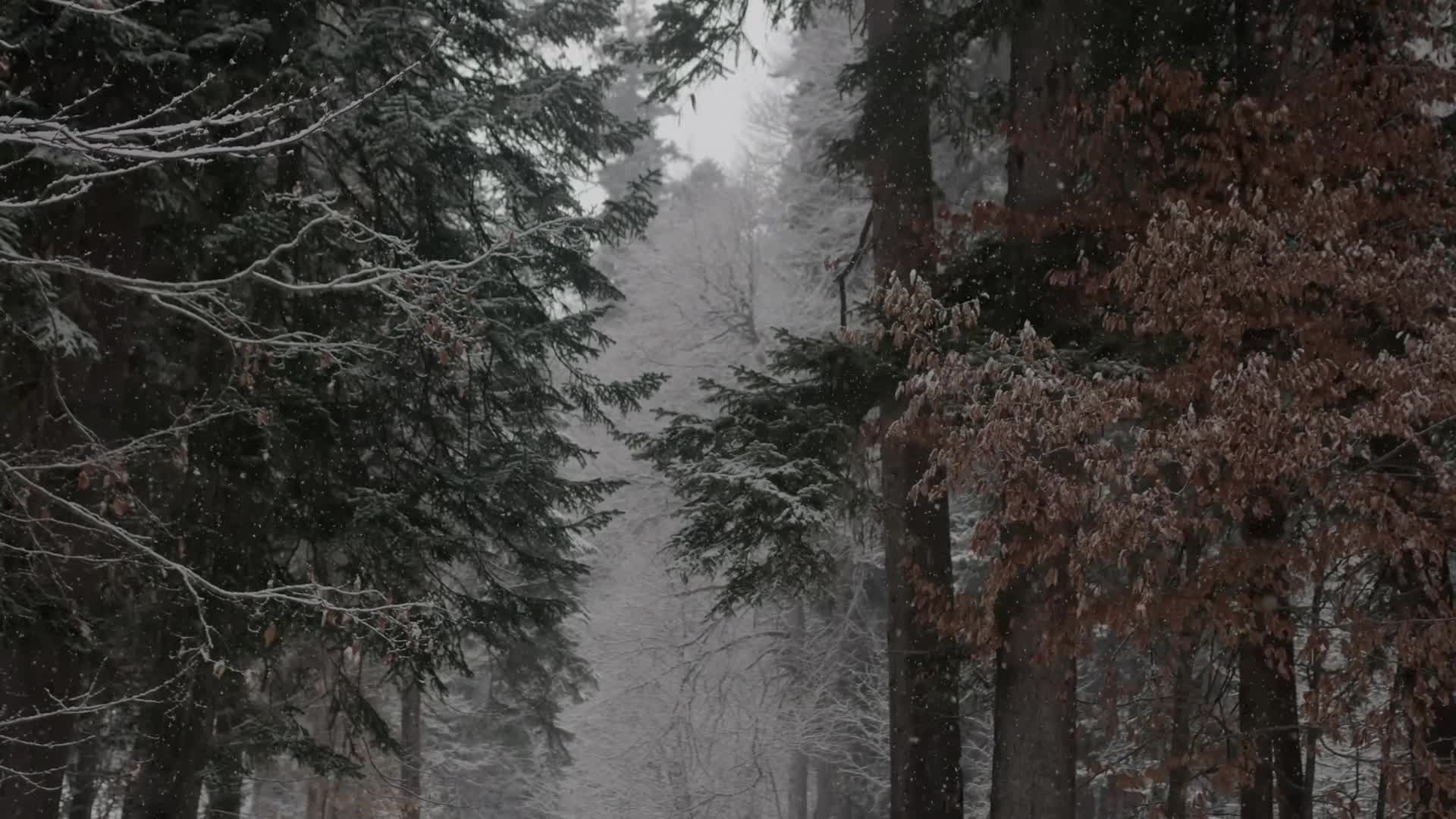
He will not see me stopping here to watch his woods fill up with snow.
My little horse must think it queer to stop without a farmhouse near between the woods and frozen lake the darkest evening of the year.
He gives his harness bells a shake to ask if there is some mistake.
The only other sounds the sweep of easy wind and downy flake.
The woods are lovely, dark and deep.
But I have promises to keep and miles to go before I sleep and miles to go before I sleep.
That's Stopping by Woods on a Snowy Evening by Robert Frost, read by the man himself.
It's probably his second most famous poem, after The Road Not Taken, but it's my favorite and it's the perfect poem for these frigid, snowy days of late January.
Frost wrote these 16 lines in about 20 minutes.
They flowed through him and onto the page at astonishing speed.
But those 20 minutes came after decades of work on his craft, decades of stitching and unstitching, as Yeats said, to finally arrive at this gemstone of a poem.
What draws me in is the crystalline clarity of the imagery.
You instantly picture this quiet wintry evening scene that Frost conjures.
A wagon driver passing by a woodland stops for a moment to watch those woods fill up with snow, until his horse snaps him out of his reverie and he prepares to ride on to his destination.
Now what that destination is, we don't know.
Where he came from, we don't know.
How long he stopped, a second or an hour, we don't know.
The poem takes place in a liminal space outside of time.
We've all found ourselves in spaces like that, usually alone, often in nature, where time and space are not divided and structured in human ways.
What's interesting is that Frost evokes this feeling precisely by structuring time and space in a human way.
That's what a poem is stanza verse line meter, rhyme.
These are structures, often quite rigid ones, placed on language.
This poem, for example, has four quatrains, four stanzas of four lines.
The first three quatrains have an A-A-B-A rhyme scheme, and in the last, all four lines rhyme.
Notice, by the way, that the single off-rhyme in each stanza becomes the dominant rhyme in the next, carrying you forward through the poem.
Another thing carrying you forward is the meter, which is a perfect iambic tetrameter, never deviating, not for a syllable, and so on.
Frost uses this metronomic rhythm, a rigorous structuring of language in time to hypnotize the reader, to cast a spell that removes them from time, like the narrator is in his quiet contemplation of the woods.
But the seeming simplicity of the imagery, phrasing and structure of this poem conceals a lot of subtlety, and that's on purpose.
As Professor Langdon Hammer puts it, Frost masks himself in obviousness, unlike his modernist contemporaries like TS.
Eliot, whose poetry is often difficult to parse on first or tenth reading, alluding to all kinds of obscure sources.
Frost's poetry is accessible.
It uses conversational phrasing, what he called the sound of sense.
For Frost, the sound of sense is the rhythm and tone that carry our words in everyday speech.
The best way to understand what he means, according to him, is to listen to people talking behind a door, so that the words are so muffled that you can't make them out.
That's how you can hear the live sentences, the ups and downs, the melodies, the talking.
We're all singing all the time.
Too often poets disregard the sound of sense and, according to Frost, this can make their poetry dull.
Often, the sound of sense in Frost's poetry exists in tension with the meter.
We don't read this poem in the metronomic way that I did just a second ago.
We read it according to the sounds of sense.
You can hear Frost himself reading it that way.
My little horse must think it queer to stop without a farmhouse mare, between the woods and frozen lake.
The darkest evening of the year gives his harness belt a shake to ask if there is some mistake.
The tension here is subtle but important.
It echoes the central tension of the poem the perfect solitude of the dark, lovely woods which, like the perfect meter, entices the wagon driver into a mystical place outside space and time, versus the real world of deadlines and promises and people who speak in irregular forms.
The more you look at this poem, the more you see the real world intruding on the narrator's meditative moment.
It starts at the beginning with this first clause whose woods?
These are instantly bringing another person into the poem and calling out his ownership of the woods.
Nature, this magical, timeless realm beguiling the narrator, has been carved up and made the legal property of some guy.
How's that for tension?
What's more, this guy lives in the village, a man-made settlement full of other people.
Here he is again in the third line and in the fourth line another reminder of his ownership of the woods.
In the second stanza, we get the mention of a farmhouse.
Even though there isn't one in sight, Frost is putting the image of a human habitation like the village into the reader's mind.
And then we have the darkest evening of the year, which situates the poem In the final stanza.
Promises evokes the everyday commitments we all make and the people that we make them to.
And miles are an arbitrary human way of dividing space.
Everywhere you look, the real world invades the narrator's contemplation.
Even the horse won't give him a break.
The horse who has learned the man's routine knows that this isn't a place for stopping.
And yet, despite this, the other world, the world of the snowy woods, pulls at the narrator and the reader.
Reading this poem, it's almost like sinking into a dream.
Frost encourages this transition with soft consonant sounds like W's H's, S's and L's, and in each stanza the chain rhymes gently but inexorably, carry you forward until you find yourself in the final stanza, in which all the lines rhyme and the last two repeat like a hypnotist putting you under, directing you to sleep.
I said before that the poem ends with the wagon driver preparing to move on.
The words may suggest that, but a poem is more than just words, and Frost uses other tools with great subtlety to imply the opposite, that the narrator in fact succumbs to the snowy woods.
Really, the ending preserves the tension between the two worlds, a tension that exists in all of us.
Because it's winter, because it's the darkest night of the year.
Some critics have interpreted the woods as a symbol for death, reading a suicidal urge in this poem.
I don't really see that.
To me, the woods are an image of deathlessness, an eternal realm, a transcendent state in which the patterns we place on the world to order and control it are meaningless.
That place, of course, doesn't exist, and I'm not entirely sure we'd even want to go there if it did.
But I think the idea of it offers a necessary contrast to the real world, where our cares seem so big and important, where our perspective can be so myopic.
It's important, even healthy, to tap into that other world every once in a while.
You can find it in nature, in quiet, snow-filled woodland on the darkest night of the year, and you can find it in poetry, the approachable but sneakily subtle poetry of Robert Frost.
Hey everybody, thank you so much for watching.
I hope you enjoyed that.
I love making poetry videos and just generally following my enthusiasms wherever they go, without having to worry too much about what's going to perform and what the algorithm wants.
If I was worrying about the algorithm, I definitely would not have put seven seconds of snow falling at the beginning of this video.
I just think that when we follow our creative instincts instead of the needs of this or that platform, we make the most interesting work for you.
So if you want to help me continue to do that, consider supporting my Patreon at patreoncom.
Slash nerdwriter.
Even as little as a dollar per video helps a ton.
Thank you so much and I will see you guys next time.
This episode was brought to you by Squarespace, the all in one website platform for entrepreneurs to stand out and succeed online.
Whether you're just starting out or managing a growing brand, Squarespace makes it easy to create a beautiful website.
And now you can make a completely personalized website with design intelligence combining two decades of industry leading design expertise with cutting edge technology to unlock your strongest creative potential.
And if you're selling something, Squarespace Payments makes that easy too.
It's compatible with popular payment methods like Klarna ACH, Direct Debit, Apple Pay, Afterpay and Clearpay.
Basically, a Squarespace site looks and feels professional, something that will impress all your customers and fans.
Head over to squarespacecom for a free trial and when you're ready to launch, go to squarespacecom.
Slash nerdwriter for 10 off your first purchase.