NPR. This is The Indicator from Planet Money.
I'm Darrin Woods and today we're joined by former Indicator intern Sean Saldana.
I'm glad to be back Darrin.
It is very good to have you.
You're now at MEMBA station KUT in Austin.
That's exactly right.
I work for a radio show called The Texas Standard, and today's story has to do with one of the ways we raise money, car donations.
Car donations, yes!
This is something that Make -A -Wish America does, also Habitat for Humanity.
These are just a couple of nonprofits that help pay their bills this way.
Yes, and here at the member station level, we do a lot of begging for old and beaten up vehicles because it can be very lucrative.
Here at KUT in Austin, we receive anywhere from 400 to 500 donations a year.
And so that is why on today's show, we're going to follow one of these donations to see exactly how old cars turn into hard cash for nonprofits.
After the break, a driveway moment.
This message comes from ServiceNow.
People should do the creative work they actually want to do, not boring busy work.
Now with AI agents built into the ServiceNow platform, you can automate millions of repetitive tasks in every corner of your business IT, HR, and more.
So your people can focus on the work that they want to do.
That's putting AI agents to work for people.
It's your turn. Get started at servicenow .com slash AI dash agents.
All right, Sean. So today's story starts out in Austin, Texas where you met up with a longtime public radio fan for the first stop on our journey.
My name is Noel Preece.
And you are a public radio donor?
Yeah, we've been donors off and on for most of the time that we've been in Austin.
Noel's family has lived here since 2008, and together he and I inspected a 2013 Ford Explorer that his mother -in -law used to drive.
It's silver, has a lot of dings and dints.
And when I asked him how he'd describe it, this is what he told me.
I think the brakes probably need to get replaced, and the roof leaks.
OK, so is this actually useful for the public radio station, or is it just offloaded junk?
It's both useful and offloaded junk and that is exactly why Noel gave it away.
It needs work. And so, I thought, well if I donate it, then that work can go to somebody else and all of the profits can go to, you know, services that I have relied on for a really long time.
Okay, well I've never met Noel but he sounds like an ideal public radio fan to me.
Anybody who gives me money is a good person, and Noel's especially a good person because he allowed us to track his Ford Explorer through a long and complicated process Yeah that's because behind every car donation there is a system of non -profit and for -profit companies that come together to extract as much value as possible If there is value to be extracted you'll find it in an automobile That is the voice of Howard Perl, the CEO of Charitable Adult Rides and Services, a non -profit whose acronym spells out the word CARS.
CARS helps administer vehicle donations for around 10 ,000 non -profits across the country.
We can process as many as 150 ,000 vehicles in a year.
And those vehicles can be anything from heavy construction equipment to collectible vehicles.
So the nonprofit that gets the vehicle donated, they end up with around 70 % or more of the proceeds, and the rest goes to administrative costs and the nonprofit cars.
Some of those donations are sold for parts and scrap metal, but the majority are auctioned off and sent back out into the world.
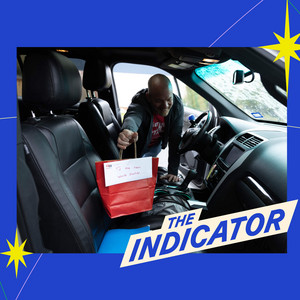
Noel's donation is one of these, which is why right before we sent it off, he and I plastered the back bumper in NPR stickers and then dropped a care package into the passenger seat.
To the new vehicle owner dot dot dot.
That's the node I prepared for the potential new owner kut socks with song notes and what I did this to let the future owner know that we are following this Ford Explorer and Just a few minutes after this the first group of people who profited off of nulls vehicle arrived Right now the Ford Explorer is being loaded up onto the bed of a tow truck while a woman named Sonya grabs the keys That is it.
That's all that entitles to you donating the vehicle.
They will call you.
Sanja works at Leo's Towing, a local company with two trucks and for this particular job, they earned $175.
So as Knoll's Ford Explorer gets repurposed, we know that many people are going to benefit financially from this, clipping the ticket, but generally not the donors themselves.
You know, it can be claimed as a tax deduction, but most people don't as, you know, in the returns, they just claimed a standard deduction." Our donor Noel will, however, get some public radio merchandise in the mail.
Very nice. And now Noel's car is off to the next step in its journey.
Exactly. To the auction lot.
That's a Nissan Altima.
That's a little Mini Cooper.
Town cars, Toyota Priuses.
I mean, it is an array of everything.
That's Andrew Kinn's father, the general manager of public auto auctions in Kyle, Texas.
It's about half an hour South of Austin.
On any given day, there are up to 200 vehicles on the lot.
As I found out, they don't just take in cars and SUVs. Now this is a food truck that we have out here.
Haha, this is not even a car.
No, it's not a car.
It is a full fledged, kitchen on wheels.
I mean it has fryers, a flat grill, regular grill, and a - After Andrew and I got settled in his office, he showed me this pricing tool they use.
The exterior color was silver.
This allows him to compare similar makes and models that have sold in the past year.
And because our public radio car has dings and dents, and that leaky roof, it gets a 2 out of 5 rating.
And that gives us an adjusted MR value of $6 ,800.
Public Auto Auctions takes fees based on the sale price of each vehicle.
and they need to try and empty the lot as quickly as possible.
I heard that these days a lot of car auctions take place on line.
You heard correctly, which is why right now a robot voice is doing the calls.
Next item, 2013 Ford Explorer.
New bid 4 ,000 dollars.
I need 4 ,200 dollars.
Wait, I recognize that voice.
Is that the person who's always on the end of my phone calls to corporate?
Yes, it's the most personal voice that they could find.
OK. uh, Knoll's car was one of the most sought after items because it only had 72 000 miles which means that within just seconds of it opening its price shot up going once for five thousand dollars going twice for five thousand dollars.
Come on this is a nice one guys this is a nice one guys it will keep you cool when the roof leaks sold for $7 ,025 alright so doing the math from that final sale price public auto auctions received 632 dollars the non -profit cars received a little over a thousand and kut the members station that you work for Sean that got just over $5 ,700 and we were thrilled to receive every single penny Darien yep and after all those checks cleared our public radio car has exited the sphere of nonprofits in all truism and re -entered the free market bumper has been repaired.
All of our public radio stickers have been removed.
About a month after it sold, I tracked our SUV down at the last stop in our journey.
A used car dealership in north Austin.
Its owner, Sam Safa, put around $1200 into fixing it up, which is why right now it has new tires, new brakes, and a sunroof that does not leak.
Well, Darian, if you were in the market for a new car, this one costs $12 ,499.
And at this point, our public radio car has completed a transformation.
It's had a bit of a makeover.
Yeah, it's gone from a run -down donation to a bright and shiny piece of inventory for a small business.
That's right, so seems to be good for both the station and for the car.
Well, Sean, thanks for all the car talk.
Who knew you could squeeze so much money out of altruism?
If you liked this episode and want to help, you can donate your car to your local member station or, something a bit easier is just to tell a friend about this podcast. This episode was produced by Angel Craros with engineering by Maggie Luther and Jimmy Keeley, it was fact -checked by Sierra Juarez.
Kaken Kennan edits the show and The Indicator is a production of NPR.
Hi this is Steve Inskeep.
Our team is in China inside a historic Chinese trading city where people come from all over the world to buy wholesale goods to import to their countries and we're here to find out among other things how people are responding to tariffs on goods that go to the United States.
Listen for that report on UpFirst from NPR News.
I'm Ira Glass on this American life we tell real life stories, really good ones.
My mother said I'm sorry you weren't here because Father Sager was here visiting and and he found a very nice orphanage for you.
And I said, but I'm not an orphan.
Surprising stories in your podcast feed, This American Life.
This message comes from Wondery.
When Luigi Mangione was arrested for allegedly shooting the CEO of United Healthcare, he didn't just spark outrage, he ignited a cultural firestorm.
Listen to Law & Crimes Luigi, exclusively on Wondery Plus.