A cancer diagnosis changes everything.
At Kansas City Proton Institute, we combine expert physicians with advanced proton therapy technology.
Our cutting edge imaging and high intensity proton beams target cancer precisely while minimizing damage to healthy tissue.
That means better outcomes, fewer side effects, and faster recovery.
If you have prostate breast, head and neck or brain cancer, proton therapy may be a better option than traditional radiation therapy.
Get a second opinion today.
Visit kcpi.com and take the next step toward healing with precision.
This episode is brought to you by State Farm.
Listening to this podcast, smart move.
Being financially savvy, smart move.
Another smart move having State Farm help you create a competitive price when you choose to bundle home and auto.
Bundling, just another way to save with a personal price plan.
Like a good neighbor, State Farm is there.
Prices are based on rating plans that vary by state.
Coverage options are selected by the customer.
Availability, amount of discounts and savings and eligibility vary by state.
The History Channel original podcast.
History this week, October 1955.
I'm Ben Dickstein.
So for our regular listeners, I want to note up top that I'm normally behind the scenes producing the show.
But recently I got the opportunity to go to Denmark, specifically Billund Denmark, to visit the world headquarters of Lego.
This is the Lego factory.
Sorry, I don't have to yell.
This is the Lego factory where 20 billion Lego bricks and parts are produced every year.
The factory floor has dozens of these plastic injection molding machines, basically shooting hot plastic into the shape of various Lego elements, letting them cool off and then dropping them onto conveyor belts which feed into these huge bins full of Lego.
Just a short drive away from the factory.
In this small Danish town there's a Lego museum featuring some of the company's earliest plastic bricks.
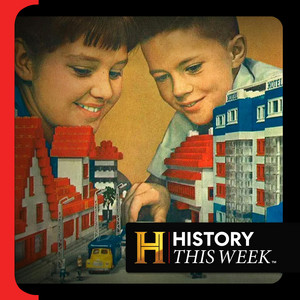
And featured in this exhibit, a 1950s miniature Lego model of a little town.
The models here will be a mix of some that were introduced all the way back in 55 and some that are introduced a little bit later.
Christian Reimer Haug, Lego Company historian, took me through this museum.
Glass cases displaying dozens and dozens of models from the company's history.
But this little Lego town from the 1950s, it might be the most important thing here.
The houses, the trees, the little bicycles and cars, everything fits in scale.
A 1 to 87 scale, to be exact.
And this Lego set which is called the Town Plan.
It really captures kids' imaginations back in the 1950s.
You know, children learn about their surroundings by mirror themselves in their surroundings.
So, having you know a car that looks like the car that your parents have, then you can play that you are driving to work just as your parents are, and so on.
Or maybe you want to create the town that you wish you lived in.
But having that mirror to the outside society is something we have seen in the entire course of our history.
At first, Lego made wooden toys, not the plastic bricks they'd be famous for.
But this little 1950s town marks a big shift.
Right next to where this Lego town is displayed in the museum, there's a typed-up document framed on the wall.
It's a company announcement from 1955.
To our customers saying, we have something important to share with you.
We have this fantastic new idea, the Lego system in play.
The Lego system in play.
This is the innovation.
The idea of a toy city itself, that's not really a big deal.
Other companies have done something like that before.
The change here is that this isn't a toy that you buy and play with and then throw away.
Instead, each time you buy this toy, it adds to what you've already got.
The bricks you bought yesterday.
They fit with the ones you buy today and they will also fit with the ones you buy tomorrow.
You can always build bricks together, no matter if they're 50 years apart.
The idea that you never have to throw the toy away.
It's nice and all, but it's not obvious that this would be profitable.
But in reality, this decision transformed a small Danish company into an international powerhouse.
Today, the story of Lego.
How did a small town Danish carpenter end up starting a plastic toy empire?
And how did Lego re-envision what a toy can be?
The LEGO Museum is actually part of one of the first buildings the company ever constructed here.
Off to the side, there's an office, preserved as it was decades ago.
It belonged to LEGO's founder, Ole Kirk Christiansen.
And we're actually right now surrounded by some of his old office furniture.
LEGO historian Christian Reimer Haug sat down with me in Ole Christiansen's old office and told me the story of how this curious carpenter started a toy empire.
Ole was born in 1891 in the Danish countryside, not far from the town of Billund.
He's from a very large family.
He has 12 brothers and sisters.
And he is apprenticed as a carpenter, actually by one of his older brothers who had a carpentry shop in a neighboring town.
He has a knack for woodworking.
He plies his craft in Germany and Norway for a while.
Then he marries, starts a family.
And then he sees that the woodwork shop here in Billund is for sale.
And he buys it.
But the town of Billund isn't exactly thriving.
One writer describes it as a godforsaken railway stopping point where nothing could possibly thrive.
But Ole Kirk Christiansen builds up his small carpentry shop over the next decade or so until 1929.
The Great Depression.
It hits Denmark just as hard as anywhere else.
He loses his customers.
They cannot afford to buy his carpentry services.
The business is in freefall.
And just sort of to top all of that off, he also loses his wife.
So he's suddenly alone with, at that point in time, four boys aged 6 to 15.
So we have a carpenter here who is looking to see how can I put food on the table for my boys.
Money is scarce, not just for the Christiansens, but for the whole town of Ville.
So Ole starts trading his products rather than selling them with other people in town.
A wooden stool for a bag of vegetables.
He's also making little wooden animals and race cars to trade.
And he starts to notice parents sometimes want these toys over the items that might seem more practical.
Something we have seen over and over again in the course of our history that When times are tough, parents tend to want to protect their children a little bit.
They want to get them some new toys once in a while so that they can play and maybe forget about the realities a little bit.
This growing interest in toys also drives home another important business practice maintaining quality.
In the 30s when he was starting this business of kind of going door to door and trying to sell these wares.
Daniel Kostanski is historian for Blocks magazine.
You know, there was nothing there.
I mean, you've been there.
It's small now.
Back then it was.
I mean, this poor man was walking miles upon miles to a very small subset of potential customers.
Like, you know, one mistake, one lack of quality product, and they would remember.
Apparently, Christensen is able to maintain these standards because the toys are a hit.
So he decides to lean into this side of the business.
And now his company needs a new name.
If I am now a toy manufacturer, then Bilon Wood Workshop might not be the most catchy name.
Let's see if we can come up with a better name.
Ole tells his small team of employees whoever comes up with the best name for this toy company gets a bottle of my homemade wine.
He does not like any of the suggestions.
No one wins the contest.
But in 1934 he invents a name on his own combining the two Danish words leig and got, meaning play well.
Leigat lego.
Unbeknownst to Ole, Lego is also a Latin word.
Its translation?
I assemble.
Making mistakes, learning from them, will lead you to the best end result.
Over in the Lego exhibit.
Down the hall from Ole's office, Christian shows me some of the wooden toys Lego starts to produce in these early years.
Doll carriages, yo-yos, but mostly animals.
Elephants, squirrels, rabbits, and ducks.
Lots of ducks.
Most of these ducks look like mallards, I think.
I don't know, I'm not a duck expert.
But I can say that they definitely don't have feet.
They're mainly on wheels.
When you pull them along, they will open and close the mouth, the beacon.
And some of them could also actually make like a quack sound.
My favorite product in this entire exhibition is right here.
It's some sort of ladybug, I guess, with very big feet and pants and thin wobbly arms.
And I love it. so much because I've been looking at this product for 15 years.
I've been working here for 15 years.
I still have no clue what's going on.
Over the next few years, heading into the 1940s, LEGO does pretty well.
It's a solid family business.
Ole is getting his sons involved, too.
But then they have to adapt again.
World War II comes to Denmark.
It's occupied by the Nazis for nearly the entire war and they cut off most imports, which actually leads to increased demand for the Lego company.
Remember, the depression showed that when times are tough, toys are still important.
And the company is meeting this new demand until... It's some sort of electricity malfunction.
And the whole workshop was destroyed by fire.
On March 10th, 1942, The LEGO workshop burns to the ground.
Insurance doesn't cover the loss.
It is a devastating setback.
But in hindsight, it presents an opportunity, a fresh start.
A brand new red brick factory is built over the next year.
And it's still standing.
You could see it from the window of Ole's office.
This new factory lets the company churn out wooden toys by the hundreds.
And it becomes clear that LEGO is ready to evolve.
Take the next step.
We do see Ola being curious when it comes to introducing a new material.
A new material.
Plastic.
Hey everyone, this is Ben from the History This Week team.
All through history, people have searched for ways to understand the mind.
From ancient philosophers debating the soul, to Freud sketching theories in Vienna.
Today we know a lot more about how our brains work, but getting help can still feel like it's stuck in another century.
That's why I like Rula.
Taking care of your mental health shouldn't be harder than taking care of your body.
Pull a muscle, you see a doctor.
Feeling anxious, burnt out, or stuck?
That's where Rula comes in.
Rula makes therapy simple, affordable, and fast.
They work with most major insurance plans and the average session copay is just 15 bucks about the price of lunch.
You answer a few quick questions and Rula matches you with a licensed, vetted therapist who actually fits your needs.
You could be talking to someone as soon as tomorrow.
Rula isn't just a directory.
They stick with you, help you schedule, and make sure you're making progress.
With over 15,000 therapists and psychiatrists nationwide, you're not rolling the dice.
For me, therapy's been a huge help, especially in the middle of tight deadlines or under creative pressure.
It's where I can slow down, clear my head, and actually make sense of things.
I've had moments where I've thought, I'll deal with this later, and later turned into months.
Having an easy way to talk about stress, like with Rula, would have made a big difference.
Thousands of guys have already used Rula to finally get the care they needed.
Don't keep putting it off.
Go to Rula.com slash HTW and get started today.
That's R-U-L-A dot com slash HTW.
Take the first step, get connected, and take control of your mental health.
What's up, guys?
It's Candice Dillard Bassett, former Real Housewife of Potomac.
And I'm Michael Arsenault, author of the New York Times bestseller, I Can't Date Jesus.
And this is Undomesticated, the podcast where we aren't just saying the quiet parts out loud.
We're putting it all on the kitchen table and inviting you to the function.
If you're ready for some bold takes and a little bit of chaos, welcome to Undomesticated.
Follow and listen to Undomesticated, available wherever you get your podcasts.
Tito's Handmade Vodka is America's favorite vodka for a reason.
From the first legal distillery in Texas.
Tito's is six times distilled till it's just right and naturally gluten-free, making it a high-quality spirit that mixes with just about anything from the smoothest martinis to the best Bloody Marys.
Tito's is known for giving back, teaming up with nonprofits to serve its communities and do good for dogs.
Make your next cocktail with Tito's.
Distilled and bottled by Fifth Generation, Inc., Austin, Texas.
40% alcohol by volume.
Savor responsibly.
As World War II rages, raw materials start to run thin in Denmark.
We are actually struggling finding enough high-quality wood.
Wood.
Which, if you're a wooden toy company, is pretty important.
But a new technology has emerged with the war.
Plastic.
It's used in combat to make things like telephones and radios.
And on the home front, plastic is used in buttons, handles, cups, and plates.
So Ole decides he's going to check it out for himself.
He attends some demonstrations of these plastic injection molding machines.
And he is really, really intrigued.
And he can see that this material has reached a quality that is very suitable for toy production.
Daniel Konstansky says...
After the war, Ole orders what will be one of the first plastic injection molding machines in all of Denmark.
You know, to pull handle, get toy, pull handle, get toy, pull handle, get toy.
There's got to be some part of him that saw that and was like, wow.
The machine comes from the United Kingdom, and along with it, some samples to show what it can do.
One of them was designed by a man named Hilary Fisher Page for his toy company, KittyCraft.
It's called the self-locking building brick.
It's one of many construction toys on the market.
There is a history of block-based toys, whether they are wood and even some in early plastic.
We have examples of them popping up, you know, in different places.
There's KittyCraft in the U.K., Build-O-Brick in the U.S., among others.
So you might be asking yourself, did Ole Kirk Christensen steal the idea for the Lego brick?
Daniel Konstansky says, absolutely not.
If I had 5 for every time I've seen an article claiming like oh, I go stole the idea for the brick, I'd go out for a very nice dinner every night this week.
And I don't see it that way at all, right?
We always put those types of stories through our modern context.
You know, this was rural Denmark.
All these types of things were kind of popping up.
And there were ideas that people built off of each other in this toy industry all over the place.
It may not have been the type of thing where, you know, Ole Kirk popped up in bed at night and was like oh, I have this brilliant idea that no one else has ever thought of and that I have not seen any examples of ever.
But in terms of the iteration and all that, those types of ideas always evolve.
Ole Kirk Christensen, seeing these plastic bricks out in the marketplace, thinks he can make one too.
Maybe one that's even better.
So in 1949...
He introduces LEGO's first plastic brick.
Automatic binding brick is the name of our first plastic brick.
But they only bind in the loosest sense of the word.
So really what those early bricks were was kind of guided stacking where you could put those.
You know you could put them on, they wouldn't slide off of each other.
These stacking binding bricks come in small packages of red white, yellow and green that let you build something like a house with some windows and doors.
But if you flipped this creation upside down, it would fall apart.
You can build these simple square houses and so on with bricks like that.
But yes, they will tend to fall apart easily because of that lack of the ability to stick together.
At first, this brick is just one of many products.
LEGO is still making wooden toys and other plastic toys.
That is one product out of 260 plus products in our portfolio.
But the humble brick starts climbing up the sales charts.
By 1952 the automatic binding bricks that don't exactly bind account for half of the company's profits.
But there's competition, especially in the construction toy space.
We have things like the erector set, which was steel girders.
At the same time, Meccano was being made in France, which was virtually the same toy.
That's Chris Byrne, an author and historian professionally known as the Toy Guy.
Tinker Toy, which was rods and spools invented by Charles Pajot.
The other one, Lincoln Logs, which was created by Frank Lloyd Wright's son.
The competition is stiff.
Lego bricks don't really have a unique place in the global toy market.
They'd have to find a way to stand out.
It's January of 1954, and Ole's son, Godfred Kirk Christensen, is on a ferry in the North Sea.
He helps run the family business, and he's on his way to England for a toy fair.
Godfrey strikes up conversation with people from the Danish toy industry.
And one particular conversation with a guy called Troels Pedersen.
Troels Pedersen is a buyer for Magasin du Nord, Copenhagen's largest department store.
And like colleagues do, Troels is complaining.
He's fed up with the toy market.
It's so fragmented.
And he struggles making beautiful window displays because nothing fits in scale.
It's a little bit of this, a little bit of that.
And he says, there's just no system in toys.
And that really triggers Gottfried.
Things that fit together.
The tendency that Toast was talking about is that you buy something, you play with it, you throw it out.
You buy something new, you play with that, throw it out.
Don't really combine what you have.
And that just keeps on repeating in his head.
He said that in interviews later on that, you know, I couldn't get it out of my head.
You know, there's no system.
Can I create a system of toys?
When he returns to Billund, Gottfried gets to work on this question.
Which of LEGO's toys is the best candidate to make a system?
What does a system even look like?
He lines up all of these 260 plus products and goes through everything.
And the one product he feels has the possibility of becoming a system are the hollow plastic bricks.
And that...
In 1955, become the Lego system in play.
There are two sides to the system in play, according to Daniel Konstansky.
The first is more philosophical.
You need to bring a system to how you think about toys as a product.
Godfred literally sits down and writes what he calls his principles of play that the toys are limited in size but allow for a huge amount of imagination.
That they're affordable durable, for both boys and girls.
That it is always applicable, which is an incredible insight to have had that long ago.
Right.
And that absolutely played out because, you know, Lego bricks keep finding new application and new popularity in each subsequent generation.
So he laid down these kind of principles.
It's really more a way to think about how we generate ideas for toys, how we approach the products.
That it was kind of a system of thought.
Then there's the other side of the system, the toy itself, that all Lego components will work together.
And that's best demonstrated by the first Lego system product launched in October 1955 That Town Plan.
You've got the mats and you've got the buildings that go on it and you've got the little figures that are scaled to it.
And every subsequent product is designed that same way.
It's all designed to work together as a system.
The town plan has houses and trees and stores.
It's all laid out on a plastic grid of roads.
There are cars, too.
They're made of metal, though.
The bricks still don't bind tightly enough for something moving around on wheels.
But for a toy, you could say this town is pretty accurate.
There are street signs so that you could also learn about traffic rules.
You know, learning through play.
And there's just one thing lacking still.
What is that?
Stability.
The bricks still don't really stick together.
And no one at LEGO seems to know how to make it happen.
Upgrade your laundry routine with a durable and reliable Maytag laundry pair at Lowe's.
Like the new Maytag washer and dryer with performance-enhanced stain-fighting power designed to cut through serious dirt and grime.
And what's great is this laundry pair is in stock and ready for delivery when you need it the most.
Don't miss out.
Shop Maytag in-store or online today at Lowe's.
My marathon isn't about time.
It's about my 26 friends with intellectual disabilities I'm dedicating each mile to.
I'm Joseph.
I'm running my first Bank of America Chicago marathon for Special Olympics Illinois to help give my friends a place to shine.
Join Bank of America in supporting Joseph's cause.
Give if you can at bfa.com slash supportjoseph.
What would you let the power to do?
Bank of America.
References to charitable organizations is not an endorsement by Bank of America Corporation.
The Lego system is out in the world, and it takes the Danish toy market by storm.
Trolls Peterson, that buyer who talked about the system on that ferry boat 13 months earlier.
He gives the town plan a lavish ground floor display at his department store in Copenhagen.
The company's brick sales double by 1956.
Then they double again the year after, and again the year after that.
It looks like this system is working.
And for the industry, it's groundbreaking.
I think they were one of the first to think of it in that way.
Chris Bernigan.
To look at what is this nucleus of our product?
What is the core of our product?
And then we're going to, pun intended, build on that, developing the new products.
You don't buy a toy from Lego and then throw it out and buy a new one.
You keep adding to your collections. which at first might seem counterintuitive.
Wouldn't a company looking to make a profit want you to throw out your old toys so you wanna buy their new ones?
It's actually kind of the opposite.
Imagine a standard action figure playset, right?
I'll use Star Wars, a Millennium Falcon, right?
So when you go to manufacture that, every single piece of it has to have its own new mold and you're gonna have to assemble it as part of the packaging.
It's true.
The Millennium Falcon's cockpit, the little gun on top Han Solo.
They all need separate plastic molds to be manufactured.
So there's all of these steps and processes where a Lego set now there's always new elements right to introduce novelty and stuff, but the bulk of it 60 70, maybe 80 of it is elements that they have been making in, you know, by the literal bucket load, you know, for years in some cases.
It's classic economies of scale.
By LEGO making all of its products out of different combinations of the same bricks.
They not only have a system that lets each product interact with the other products, but also a system that lets them manufacture much more efficiently than traditional toy companies.
But the product still has that major design flaw.
The bricks don't stick.
There is limitation because of the lack of clutch power, as we say.
Christian Reimerhaug demonstrates the issue with some bricks from that era.
So if I let go of this top one, it will just fall off, right?
So that's the big difference between After the LEGO system debuts, Gottfried goes back to the drawing board.
Literally.
At this point, the LEGO bricks have studs on top, like they do now.
But inside, they're hollow.
There's nothing to grab onto the studs that are below.
Godfred and designer Axel Thompson sketch up a number of solutions to address this issue of clutch power.
They draw up a few options to add underneath the bricks.
X-shaped prongs, indented squares.
But then Godfred comes up with the solution with the tubes inside the brick.
Tubes.
If you look at a Lego brick now, they're still there.
Tubes that allow the brick to grab onto the studs from the brick below, creating that elusive clutch power.
When we get that, the tubes inside, they will stick.
That's just a very, very lovely sound that you know putting bricks together and taking them apart again.
LEGO files the patent for its new and improved toy building brick on January 28th, 1958.
And with that we get the stability that we need to really bring the LEGO system in play.
Come to life.
Sadly, just two months later, Ole Kirk Christiansen dies at the age of 66.
He never gets to see his company reach its full potential, but he did achieve a lot, guiding his carpentry shop through disaster, depression and war and turning it into something completely new.
Ole's son, Godfred, takes over LEGO and finally phases wooden toys out of the lineup in 1960.
The next year, 1961... We get wheels, right?
We get the LEGO wheel.
Yeah well, we won't take credit for inventing the wheel, but we will take credit for the LEGO wheel.
Excellent.
And what that means.
After the system debuts, LEGO expands its product line.
A motorized train, the first LEGO rocket, bigger LEGO bricks just for preschoolers.
And LEGO expands its operations too.
By 1966, it's sold in 42 countries.
LEGO Land opens in Billund in 1968.
The first minifigure, those little LEGO people, those come out in 1978.
And over the following decades, there have been countless new Lego sets and video games and movies.
It's one of the biggest toys in the world.
But all of that success it certainly wouldn't be possible without the Lego system that came onto the market in 1955.
That system is still very much alive, maybe now more than ever.
The LEGO Group has a almost religious fervor in terms of every part works with every other part.
So the process that they go through to design new elements is unbelievably rigorous, right?
Where they are making sure when a new part is developed, they will not only design that part, they'll design every permutation in the family of elements, the roller coasters that they've been releasing over the last 10 years.
Right at the outset, they designed all of these different things.
They came up with the rules, they came up with the proportions and they basically make these little manuals for these families of elements.
So the first year they didn't have loops.
But those loops had already been thought of conceived, and so they worked perfectly with every other piece of track, because they had thought through all of that from the get-go.
So that's one of many ways that they keep the system alive today, where they are very, very careful about what they add and very intentional about what they do with it.
The LEGO system is so good, you might not even realize it's there.
That is not an accident, right?
They want to make this playground, this walled garden, so perfect that when you grab a piece, it's going to attach.
You don't even think about it.
And that doesn't seem like it's going to change anytime soon.
Since this episode started, the factory in Denmark has produced 900,000 LEGO pieces.
Thanks for listening to History This Week, a Backpocket Studios production in partnership with the History Channel.
To stay updated on all things History This Week, sign up at HistoryThisWeekPodcast.com.
And if you have any thoughts or questions, please send us an email at HistoryThisWeek.
At Historycom.
Special thanks to our guests Christian Reimerhaug, corporate historian at the LEGO Idea House.
Daniel Konstansky, historian for Blocks Magazine and author of The Secret Life of Lego Bricks The Story of a Design Icon.
And Chris Byrne, researcher, historian, and the toy guy.
We also want to thank Dana Goldsmith, Andreas Friess and Roberta Cardazzo at Lego for their help with this episode.
This episode was produced, hosted and sound designed by me, Ben Dickstein, and story edited by Sally Helm.
For Backpacket Studios, our executive producer is me, Ben Dickstein.
From the History Channel, our executive producers are Eli Lehr and Liv Fidler.
Don't forget to follow, rate, and review History This Week wherever you get your podcasts.
And we'll see you next week.