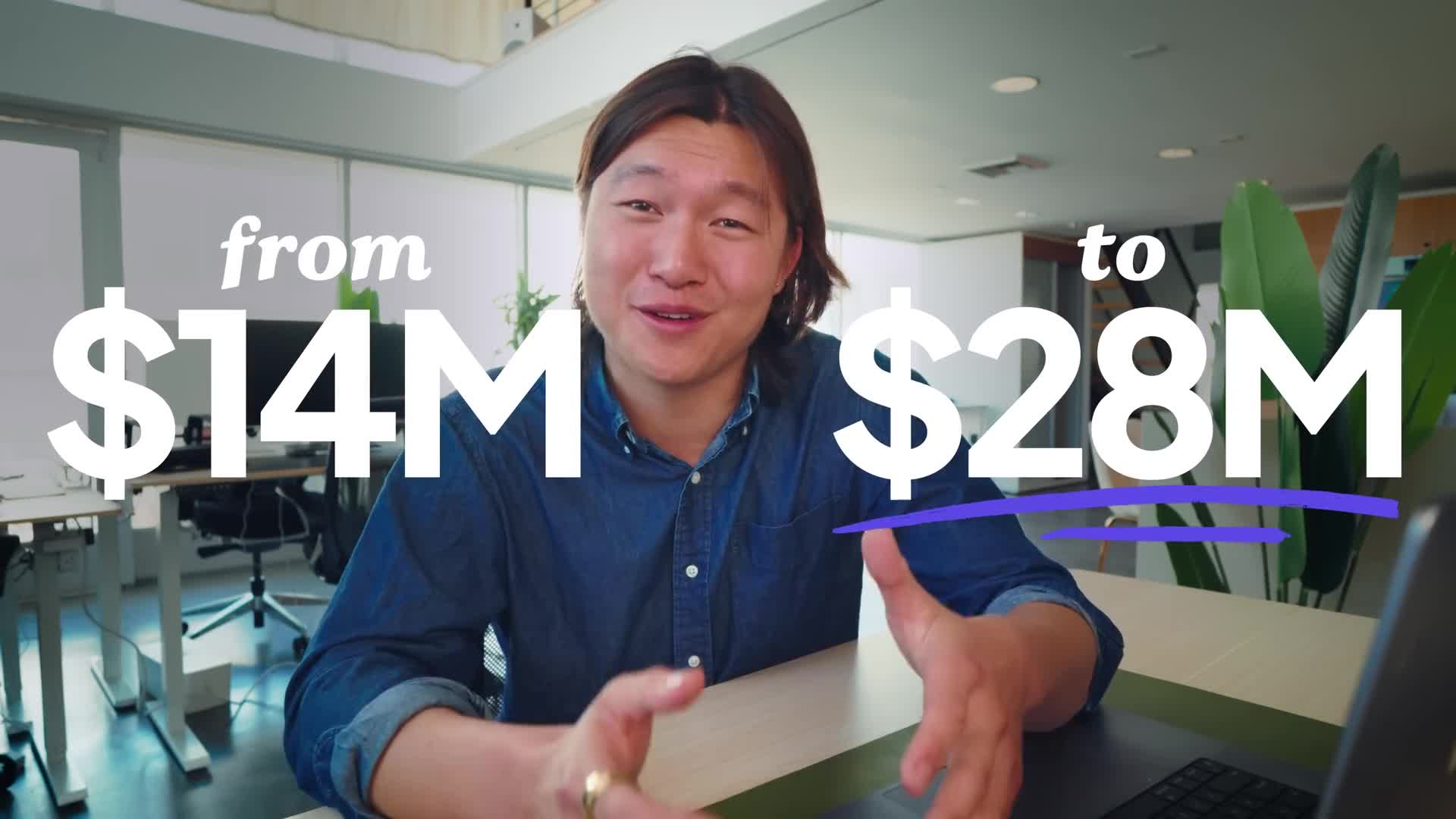
This year, my startup doubled from $14 million to $28 million in recurring revenue.
So I'm going to walk you through the shareholder letter that I just sent to our investors, as well as our exact financials, and then all of the lessons learned that we've had from this year.
Because, despite the numbers looking up and to the right, there have been many ups and downs in that process.
And I think it'll be super helpful for you in your own journey and for you to understand what it's like to try to build a billion-dollar company.
So what I'll do for this video is I'll just throw up different sections of the shareholder letter here and you can pause the screen and read this.
But essentially the highlight on our financials is that we had a really strong year.
We've basically scaled from zero to 30 million in annual recurring revenue in just about three years all while staying profitable as a business right.
So not being a startup that goes out there and raises a bunch of money and burns a ton of cash.
But instead we've really tried as a business to be super hyper-focused on fundamentally strong unit economics.
But the stat actually, that I'm most proud of is actually this last line here, which we call GMV or gross merchandise value, which is basically the income that we've helped our creators make and our entrepreneurs make.
And this year, about halfway into the year, we fully crossed $100 million made for creators.
And then, just a few months later, we easily crossed 200 million, and we're already way past 250 million at the point of me filming this.
Why this stat is so important to us is because that's just our mission manifest, right?
Like.
Our job here at Stan is to help anyone build their own online business in the simplest and easiest way possible.
And so what's really cool is you're seeing that GMV chart actually accelerate over time.
Like we're actually getting higher and higher returns over time as more and more people are starting to be successful and we're able to help more and more people be even more successful than they already were before they joined Stan.
But I think the place where a lot of people get lost when evaluating a business is that they just get stuck in the numbers rather than recognizing that every single one of these numbers here is actually just the output of actually a human input, like people in an organization working together and making decisions.
And so that's what I actually think is the most interesting part about Stan so far is how much, in order to get to these numbers and even think about how do we get to the 100 million plus level, How do we as people have to evolve and think and do things differently.
And I think that's like the real, like valuable goodness that I can share with you guys in this video.
And so there are three key ingredients here that have really gotten us to our success that we've had to date that you should think about for your own business, which is number one achieving really strong product market fit right.
This is the fundamental value of your company.
And then number two is how do you build a really resonant marketing message, right?
How do you cut above the noise of all the stuff that's going on out there and actually get people to care about your company?
And then number three is a concept that I'm still really learning myself, but it's this concept of how do you build repeatability and scalability into your organization over time.
So if we dive in this first section here, it's all about that first major key ingredient that you have to have for your business, which is your business has to offer some sort of value.
And we use this concept of product market fit, aka does the market actually want your product?
Does it eat it up?
Does it fly off the shelves to actually determine whether or not your company has value to people?
And so if you pause here to just read the letter, It's really crazy to think that when I first started Stan like it was not pretty at all right.
I was just hacking together in my dorm room.
It's evolved to become the very best product in the market.
Where, back when I started Stan, in order to start my own online business, I had to get a link in bio and then build a custom clunky website and then pay like 200 for a core software and then If I want to do a community, that I have to pay for something separately and try to hook that up.
And then I have to get a really expensive email marketing service, like all of these things, just to run my business, which just didn't make logical sense to me for two different reasons.
Number one, I was paying hundreds of dollars a month just to get started.
And then number two to send your customer through to seven different landing spots that are all clunky and load really slowly and aren't mobile optimized was just bad e-commerce practice in general.
And so over the last four years, we've worked super hard to make sure that Stan has every single feature that you need to start your business without any of the clunk.
And then also to make the immigrant kid in me really proud, we offer it for basically a 10th of the price that it usually costs to get started with all these other tools.
But even though we built the best value prop in our market, this is not at all a time for us to rest on our laurels, because the market is ever changing.
Where we have to realize as business people that our customer is never satiated.
Like we as consumers are ever demanding.
And so I think this section can be best summarized by a quote that Alfred Lin, one of the top Sequoia partners, actually once told me where I was.
Like Alfred, you've been on the boards and invested in all these incredible multi-billion dollar companies like Airbnb DoorDash, OpenAI.
Like what is the most consistent pattern between all of those companies?
And he just looked at me and said John, no matter how big and how successful these companies were, they were constantly iterating to more and more product market fit.
But of course, building a great product isn't everything, right?
You still have to cut above the noise and actually have people know that you even exist and also care about you.
And so this next key ingredient we've unlocked here is this really nebulous amorphous concept of brand, where I actually wrote here a line that says I used to struggle in understanding the value of brand.
At first, it's quite intangible and woo woo.
But over the last year, I've realized just how powerful brand is as a distribution medium.
So if we try to break down that concept basically what I mean by that is in our heads we often suffer from the gap of context where everything that we know about ourselves like everything that we know we can do for someone and why our product is the best all that stuff no one else actually knows and no one else cares about.
And so if you're to sell to other human beings, you first have to enter their psyche, of first them knowing about you and then them thinking that they want you in their life.
And one of the best ways to do that is just to be your full authentic self.
Basically.
What I mean by that is if you think about who lives in your psyche.
It's the people who walk around in life and fully live themselves and are really, really memorable in some sort of way.
Like maybe they're a super creative artist who dresses in a really funky way.
That's always super memorable.
Or maybe it's someone in your life who does extreme sports, like jumping out of planes and doing crazy tricks on a snowboard hat pipe.
AKA you might have just thought of a Red Bull athlete there which is a real testament to how strong they've built their brand.
And so, for us, what we've realized is this huge unlock on who we are as people like.
Truly, what do we care about and how do we want to express ourselves in this world?
And we're realizing that that mission and that message is really deeply resonating with so many people around just this frustration of like the current institutions and current systems around us, like being trapped in this nine to five that doesn't care about you, that's just not even working to even be able to pay the bills nowadays.
And instead having this energy of like, no like.
I want to take my own life and my own agency into my own hands and build this thing for myself.
And so what we've tapped into are just our own self-made stories, right?
Like even my story as an immigrant kid of a single mom, like building from nothing and actually building this career for myself and getting to work for myself and building this business.
And, like then, looking at all of our most successful customers, like I'm so proud of the fact that every one of our top customers is self-made,
And so, just to give you guys a sense of what you might be able to do and accomplish for yourself, I'll share these lines here of some of our most memorable customers, where I say whether it be Janessa Linne, using the money she made from Stan to escape an abusive relationship and move across the country with her daughter, Selena Camarillo, creating a six-figure business out of her love for making sourdough, or Eddie Abiu, who's made a million dollars in his sixties while teaching others how to stay in shape, we see the reward that comes if you can just persist through the muck and make that first dollar for yourself.
Where Stan isn't really about the software, right?
It's the best product in the market.
But what Stan is really about and what we recognize is how deeply transformative this entrepreneurial journey can be, of helping you really build agency for yourself, not just from a financial perspective, but truly from a sense of meaning and purpose and fulfillment, and giving you that sense of like holy shit, no matter how much shit is going on in this world, I can still make it.
And so in your business, I want you to think about what do you stand for?
Because if you can really start to live in that and step into that power, you'll start to see content performance, right.
So now we're in the rational bit here of like outputs and performance.
You'll see that all of our content resonates so deeply because that message resonates so deeply with people.
It's so, on the vein of the cultural zeitgeist, that our content is getting millions of views all the time.
And so what I lay out here for our shareholders to end the section, is that Stan isn't just a software company.
Stan is about building a movement of people who actually believe in themselves and want to build something for themselves.
And so over this next year you'll start to see us step into that power and really share our story on a world stage.
But that's if we can build an organization that will actually scale to the $100 million plus level.
Where, early in our year, you'll see this growth spike here that we had, that wasn't at all tied to our core fundamentals as a business.
Where yes, our vanity metric here of the number of new customers that were signing up for Santa did spike up in the short term, but so many of those customers would soon drain out the end.
But now the problem with that kind of spike is that kind of flood into your system really disconnects you from your reality.
Where I want you to imagine you're a small scrappy team of just 20 people.
And overnight, basically, your customer base doubles as that.
You have 30000 people come in in just a matter of a few weeks who all need help setting up their product, who all have a ton of questions on hey, how do I get started?
And you're so focused on just supporting and helping all these people that you're not able to actually zoom out and think high level and be like hey, number one, is any of this stuff actually sustainable and the right thing to do for the long-term health of this business?
And then number two at this overinflated rate, have we actually built a controllable go-to-market engine and acquisition engine that at this scale we can actually continue to acquire numbers at that scale?
That actually makes a dent on the business.
Where hint hint, I show in this graph here.
Clearly the answer is not for us, because we only had two go-to-market or sales employees during this whole time.
And so, as this trend started to die down, the resulting plateau that we hit because of the overinflation in our business ended up being quite painful.
But now, looking back, having survived and grown through that period, I can't help but feel really grateful for that period because, despite how painful it was, it forced us to ask some really needed, soul searching questions where basically what we realized was that the model we had used to get this company off the ground was no longer the model we needed to get to the 100 million plus level.
AKA.
The reason why we had scaled so quickly, shot out of the gates from zero to 30 million in ARR so quickly, was because we had a founder-driven sales model right.
It's the way any business gets started, right?
It's the entrepreneur, the founder, like wheeling this business into the world.
But what you realize over time is, after you hit a certain scale, like 30 million in revenue, there's only so much I can do as a single human being.
And if you want to build a business or organization that becomes much greater than you, then you have to figure out how to instead distill those principles down and then create an organization that repeatedly and scaly, does that on your behalf.
And so this is really the key insight of this next section here in the shareholder letter, where we're trying to figure out and transition and evolve from an early stage company to a growth stage company that goes from a founder driven mindset to a repeatability and organization based mindset.
Where I think this graphic and caption here best summarizes what we're going through where the total potential output of the machine we built on the left side was probably around 15 to 20 million.
Now this machine we're building, where we have a bunch of different single-throated owners replicating and scaling out what we're doing over time, will actually get us to a hundred million dollars plus.
And so very tactically speaking, like what does that actually look like in a business?
Basically we removed me as the bottleneck in the organization.
And we started to ask ourselves what were the core essences of what John was doing, that we should actually spread to more people and train them on so that we can actually replicate this and remove John from these things, because John can only do so much as a single person.
And so some good examples of that that you can use in your own business is number one.
On the product side, what my co-founder and I were finding is that our product velocity as an organization was going down because my co-founder and I were so busy doing all these different things in the business that we very rarely had time to be super thoughtful about approving product decisions or helping drive those to completion.
And so now instead we're thinking about how do we actually bring in a single threaded owner and a couple of different product owners who actually drive all that decision-making themselves on our behalf or on the content side.
You and Lo don't have to be the only ones making content.
Like instead, why don't we build a Marvel universe of creators, like the Avengers of creators, to actually establish a brand for Stan on a much larger scale which, when you say out loud, sounds so obvious right?
Like from the outside.
It's like obviously John, you should be scaling horizontally yourself and doing all these things.
But there's something to be said of being so thick in it when you're like in the midst of all these things and things are struggling and things are going well in some ways and things aren't.
And there's just like so much chaos.
It can be so hard to zoom out and make those calculated rational decisions.
But what I've learned about the entrepreneurial journey at this point is that it's just a bunch of ups and downs right,
Like you figure something out, you skyrocket, maybe you can kind of go like this.
And then at some point you hit a plateau.
And you go through this learning period, it's pretty painful.
Maybe you actually take a couple steps back.
And ideally, because of your persistence and grit and your curiosity, you shoot to the next stage where, for us here, just a couple months later, as we started to figure out how to scale this organization and start to repeatedly execute that magic sauce we have and give that to even more people, we've already started to see the fundamentals of this business re-accelerate and then compound over time.
And so the special thing that I end this section here with are these lines here, which is why I'm so excited about our future, which is that Stan started as just me in my dorm room, right.
It was like just me, a kid and a dream.
And now Stan has evolved into something much greater than me.
It's an organization of some of the very best people I've ever gotten to work with, all building a repeatable machine that's ready to capture the massive market opportunity.
And so all of that tea, up of all of these hard ingredients that we've earned over time and like really earned our stripes on, actually sets us up for the very last section, which I think is the most exciting.
So I want you to put yourself in the head of an investor.
And I want you to think through the checklist that an investor goes through to be like is this opportunity a multi-billion dollar opportunity where, first of all, you have to have a great product right?
Is this product a 10X better product than the rest of the market?
And then number two is, is this business repeatable, right?
Do the unit economics make sense?
And can I scale out this organization?
The number three is, what is this specific company's competitive advantage?
And then lastly, what is the quality of this specific team?
Like, is this the right team to execute on this offer?
And so when you look at Sand, you realize that it has all of these assets, right?
Like we have by far the best product in the market.
It's the most affordable.
It's the most valuable.
It's the most helpful.
And most importantly, our customer success rates are the highest in the entire industry.
And then number two, we really clearly repeatable unit economics with a marketing message that we know resonates with our customer and that we can actually blow out and scale with our economics.
And then, on the competitive advantage side, we've got a ton of different stuff cooking which I can't share with you here, because I know all of our competitors are obsessively watching this video.
Before lastly, talking about the quality of the team, which is no matter what strategy we have or what our competitors try to copy from us, they will never be better than this team because they will never live, breathe and bleed this experience of being a creator, entrepreneur like us.
And when you think about the fact that we as an organization have started to unlock repeatability like really understanding how do we scale our organization and help even more people you realize just how large this opportunity for Stan might be, especially given this last final ingredient, which starts with a quote from a ball, which is that eventually, everyone will be in the creator economy.
Because it's become extremely clear to me that the creator economy is no longer about the creator economy.
It's actually just the entire future of entrepreneurship in general.
Where the total addressable market for Stan is much larger than we first thought.
Because what started first as a few niche content creators posting online about their passions has now evolved into every small business owner, every yoga teacher, every personal trainer, every hair stylist, every nail salon owner, realizing that social media isn't just social media anymore.
It's just the new marketing channel.
And so when you see the thousands of different kinds of entrepreneurs who are using Stan to make a living, doing what they love like whether it's using social media and YouTube to drive leads to your dentistry business or your immigration lawyer business, or personal training, or even crocheting and braiding bread baking and building a six figure income stream for yourself,
You're seeing that literally anyone out there with a dream, like you don't need anyone sign off.
You don't need a gatekeeper.
You don't need an institution to give you a stamp of approval.
All you need to start your own business and pursue your dream is your phone and a stand store.
And so I end this shareholder letter here, just reflecting on this journey, right?
Like There's so much left that we still have to do for, actually become a multi-billion dollar outcome that actually fulfills our mission and dream of lifting the success curve of entrepreneurship.
But I think what I've realized is that, no matter how many times this experience has punched me in the face and forced me to get back up, I couldn't be more grateful for the journey where, if you're at all thinking about starting your own thing one day, I hope you can recognize just how transformative of an experience this is, just as a human being right.
Like if you think about our most successful customers, or even think about Stan as a journey itself.
It all just starts with a dream.
It all just starts with this desire.
But the hard part is getting through the emotions and the insecurities of pushing yourself through hard things.
Like it's you versus you.
And I think what makes this mission so personal to us here at Stan is we know how transformative that journey can be of building a life for yourself, of creating financial independence, of feeling this immense sense of fulfillment and self-agency, of like I can do hard things.
And so, as I think about the shareholder letter here and the year of trials and tribulations that it encapsulates, I think I just wanted to say thank you for being along this journey with me, where I hope some portion or some semblance of it can be both inspiring and helpful to you in pursuing and building your own dreams.