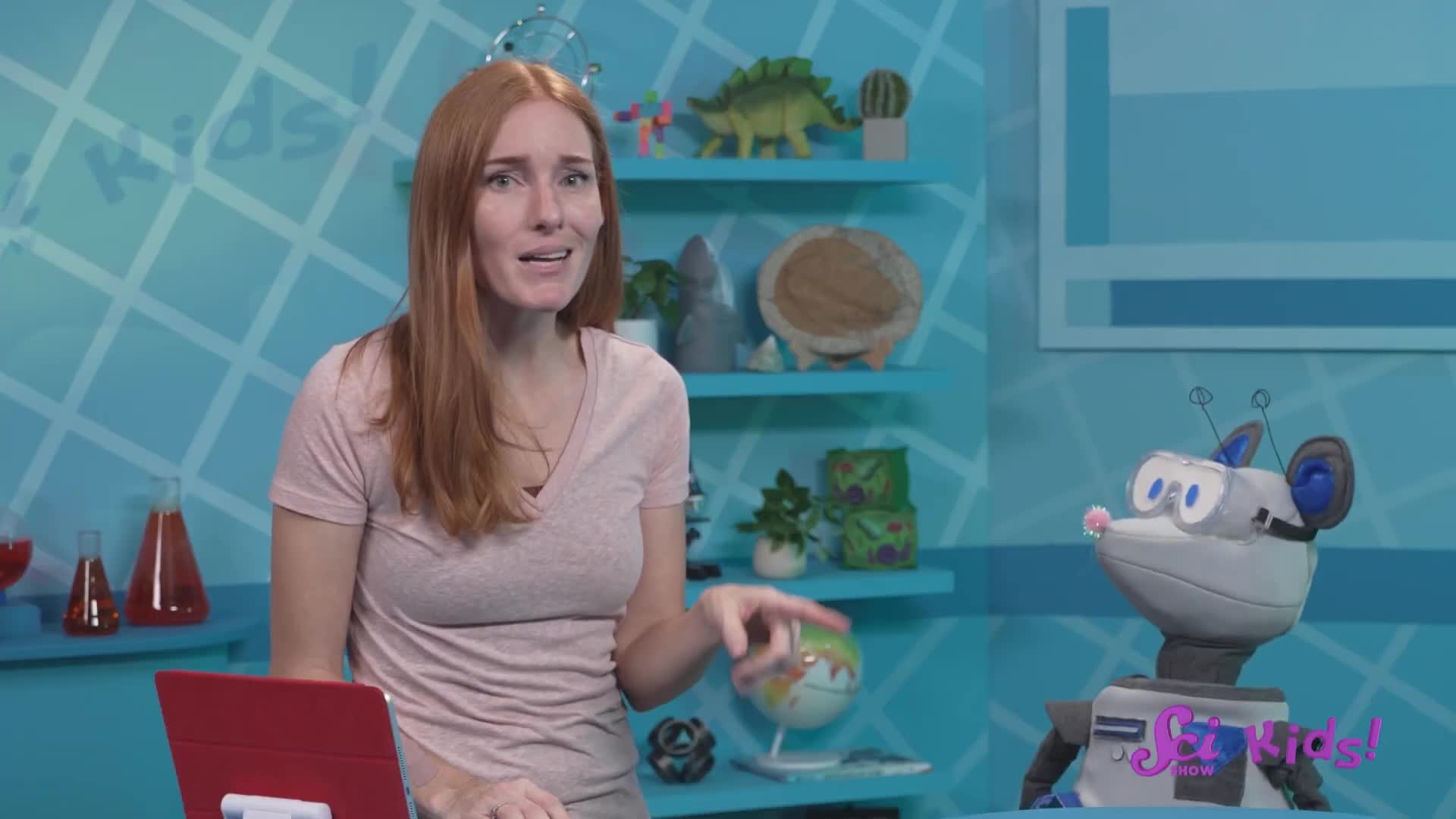
Squeaks, I'm so excited for your big trip.
You're going to see so many new places.
Oh yeah, I wish I could go with you too, but I promised our neighbor that I would take care of her garden while she visits her family.
And I don't want to go back on a promise.
I'll miss you too, buddy.
We'll go on another trip together someday.
I thought of a way that I could still kind of join you this time.
Ta-da!
Tiny Jessie can come with you.
Well, Tiny Jessie can't experience everything exactly like I can.
Humans experience the world through our senses, and Tiny Jessie doesn't have senses.
But maybe she can help remind you of the senses that I use to explore.
For example, you'll be going to see some amazing places.
Exactly, using your eyes.
Eyes are really cool body parts that help animals survive.
And animals' eyes take in information about the world around them, like if there's food or water nearby or something dangerous to avoid.
Animals can do these things using other senses too, but eyes help us by letting our brains understand light.
When I see something like your luggage bag, what's really happening is light is reflecting off of its surface and into my eyes.
The black circle in the middle of my eye is actually a hole called a pupil.
That's where light comes in.
Then the light goes through the lens which focuses all the light into a small point, and then it hits the back of my eye, called the retina.
The retina helps turn the light into special signals that can get carried to my brain through my optic nerves.
And once the signals get there, my brain can make sense of it all, and I see your luggage.
Yeah, senses like sight are complicated.
My eyes have lots of little structures or parts inside, but they're all tools that help my brain to sense light and understand the world.
Squeaks is asking about color, and yes, my eyes help me to understand and sense color, too.
Objects that are different colors reflect slightly different kinds of light, and eyes have to make sense of these differences.
The retinas at the back of my eyes have two different structures for understanding the light that reaches them.
Together, they're called photoreceptors.
Rods are one kind of photoreceptor.
They send my brain signals when there's just a little light to see.
This is important for seeing things when it's dark out, but rods don't tell me anything about color.
It's the other kind of photoreceptor called cones that help me see colors.
Most people have three types of cones, and each is better at picking up a different kind of light.
Like, one is really good at picking up blue light, and another is best at picking up red light.
That way, my brain can take the different messages these cones send together and turn them into any color we can see, from orange to light, yellow to dark, green or pink, like your nose.
It's like my brain is mixing light like you or I might mix paints and coming up with one final color that we're actually seeing.
Oh, good question, Squeaks.
Squeaks wants to know if everyone's eyes work this way.
The answer is actually no.
What do I mean?
Well, even among humans, there's a lot of difference in how our eyes work.
Lots of people's eyes see things as blurry unless objects are really close or if objects are really far away.
This is because their eyeballs are shaped a bit differently.
And it causes the light that goes through the lens to focus either in front of or behind the retina instead of right in the retina, where all of those important rods and cones are.
This is why some people wear glasses.
Glasses help to move the light just a little bit, so the light can focus right at the retina in the back of the eyes.
Meanwhile, for some people, their cones don't respond as well to the colors they're supposed to, or they might have been born without one or more types of cone.
People with eyes like this see colors differently.
Like they might see shades of red and shades of green as pretty much the same, even though other people like me can see red and green as being very different.
We call conditions like this colorblindness, when people's eyes can't see the full rainbow of light that other people can.
And there are actually lots of animals besides humans that are colorblind or at least can't see the same number of colors that we do.
Fish, dogs, cats, they all see fewer colors than humans.
Meanwhile, some animals can see more colors and kinds of light that we can't see at all.
Can you guess what kind of animal that has special vision?
Birds!
I have an idea.
Let's give Bill and Webb a call.
Hi, Bill.
Hi, Webb.
Hi, Jessie and Squeaks.
Bill and I were just arguing about which color is better, blue, like my hat, Or red, like my scarf.
Maybe you could help settle the debate.
Squeaks and I were just talking about colors.
I think blue is a great color for Webb and red is a great color for Bill.
Interesting opinion.
I like it.
Me too.
So what's up?
Squeaks and I are learning about eyes and how they work.
And I once heard that birds can see a special type of light.
Oh, I love my eyes.
Birds like us can see colors, like humans do, but we can also see a type of light called ultraviolet light or UV light.
UV light is basically invisible to humans, but birds have an extra kind of cone in our eyes that lets us see it.
It helps us to find food that reflects ultraviolet light.
Oh, and birds can also see certain patterns on each other's feathers that reflect ultraviolet light.
Our eyes see these ultraviolet patches on each other and whether the patches are lighter or darker, so we can tell each other apart by the ultraviolet light from our feathers.
To a human, two birds might look like identical twins, but to us, they look different.
Hmm, I don't see any ultraviolet spots on you Squeaks, but maybe we could get some UV paint from the craft store and give you some ultraviolet stripes next time we hang out.
That sounds so fun.
Let's get together after Squeaks comes back from his trip.
Bye!
Bye!
So Tiny Jessie might not have eyes that work like mine or yours or Bill and Webb's, but I have another present for you that can help me experience all of the cool things you'll see.
It's a camera!
Now you and Tiny Jessie can take pictures of everything you see on your trip.
And when you get home, I can use my eyes to see all of the special places that you visited.
How do your eyes see the world?
Do you use glasses to help focus the light going inside your eyes?
To keep learning about senses and other fun science topics with Squeaks and me and all of our friends.
Click the subscribe button and we'll see you next time here at the Fort.