NPR.
Former Venezuelan leader Nicolás Maduro appeared in a New York court yesterday.
He pleaded not guilty to drug trafficking and weapons charges.
This is after an explosive abduction by US forces in Caracas and is the culmination of months of American attacks on vessels in the Caribbean and Pacific alleged to be carrying cocaine.
The attacks have killed at least 115 people.
The stated motivation for the Trump administration to depose Venezuela's leader extends far beyond cocaine.
Trump has mentioned oil many times and also the migration of alleged Venezuelan criminals into the US.
But the drug trafficking accusations against Maduro go back many years, under both Republican and Democratic administrations.
So we wanted to learn more about what cocaine trafficking looks like right now.
This is The Indicator from Planet Money.
I'm Darian Woods.
And I'm Stephen Basaha.
Today on the show, the cocaine supply chain.
We trace the drug from leaf to nose and ask how the Venezuelan government might have been involved.
This message comes from Dell Technologies.
Every great idea deserves the power to bring it to life.
Meet the all new Dell XPS laptop, where style, power and performance come together to elevate everything you do.
With its ultra thin design and all day battery life, it's built to keep up from your morning coffee to late night inspiration.
Powered by Series 3 Intel Core Ultra processors.
The XPS is made for editing photos, mixing tracks and more.
Check out the all-new Dell XPS at dell.com slash XPS.
This message comes from NPR sponsor, Capella University.
Learning doesn't have to get in the way of life.
With Capella's game-changing FlexPath learning format, you can set your own deadlines and learn on your own schedule.
That means you don't have to put your life on hold to earn your degree.
Instead, enjoy learning your way and pursue your educational and career goals without missing a beat.
A different future is closer than you think with Capella University.
Learn more at capella.edu.
Hey there, how you doing?
Good, glad you could join.
Jan Grillo is a journalist based in Mexico City and the author of the El Narco trilogy of his journalistic work.
He's been on the drug trafficking beat for 25 years and yet he's got a bit of firsthand experience from a military base in Mexico.
A general once showed him a pile of seized cocaine.
He held the cocaine to me and he said, go on, have a taste.
I didn't know if he was joking.
So I put my finger in the cocaine and licked it like that.
And he said, oh yeah, you can feel your tongue going numb, can't you?
Yeah.
I don't know what I would do in that situation, Stephen.
Like, is he testing me?
Yeah.
You're about to get arrested the second you try.
Anyway, Jan says the cocaine trade starts in the high altitudes of Colombia, Bolivia, and Peru.
That's where the coca plant is grown. quite an ordinary looking plant.
It doesn't look actually anything too exotic when you see it, kind of dark green leaves.
These coca leaves are harvested by the farmers living in those remote mountainous areas, often with pretty limited road access.
These are not really cartel figures, organized crime figures.
They're like small farmers who grow this crop and then they'll sell the leaves or they'll turn it into the paste.
That paste can be chucked in a backpack and taken by motorbike to the next step in processing, purification and crystallization.
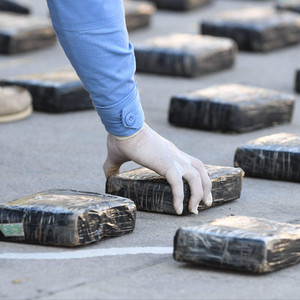
These are quite expensive operations where you have quite a lot of equipment and you turn the paste into a kilo brick of cocaine.
And the kilo brick is really the operating unit of the cocaine trade.
They're standardized, I guess.
Yeah, yeah, they are very, very standardized.
Yeah, very standardized.
Yeah, in fact, these kilo bricks are so standardized that cocaine producers will often put a seal on them to mark whose cocaine this actually is.
And this is important because the cocaine producers are often different from the next stage in the chain, the trafficker
Trafficking these days rarely goes straight from Colombia like it used to.
Several decades ago, intense US law enforcement efforts meant that direct routes were too likely to get caught.
The traffickers then flipped and said OK, we'll move it through Mexico and we'll go Colombia and sometimes bounce it through Central America.
Move it through Mexico.
And then we've got a 2,000 mile border to smuggle cocaine through.
So then Mexico becomes a major transit country.
Mexico already had the illicit smuggling infrastructure because of marijuana and heroin trafficking.
And so the country was ripe for the cocaine trafficking trade, a tidal wave of new business.
You've got all of this cocaine money.
And then you're buying off vast amounts of law enforcement and politicians and starting to build up armies of hitmen and create this real bloodbath in Mexico, pumping billions of dollars into this business in Mexico.
In the 2000s.
At the same time, Mexico's role in the cocaine trade was growing.
The US government was working with Colombian authorities to really crack down on Colombian airspace.
So then it becomes easier for traffickers to flip, to bring it over the border to Venezuela and then fly it from Venezuela on planes there and fly it into.
One route was flight to Honduras, other was flight to Mexico on planes from Venezuela.
So this is when cartels and groups start operating in Venezuela.
Venezuela starts to become a more material player in the cocaine supply chain.
Now we'll return to the question of whether the Venezuelan government is involved or how likely it is that those US military strikes are actually hitting cocaine traffickers.
For now though, the bricks keep moving up the Caribbean, maybe over to Honduras perhaps, and up to the US-Mexico border.
Once that brick gets across the US border, Jan says the price goes way up.
They'll sell that in the US border.
It's a pretty big markup.
I know most of us would love to be in that kind of business where you could invest 1000 and get back 10000.
That's just the price once the brick hits the US.
The supply chain doesn't end there.
Jan says that after the American trafficker has purchased their brick, they'll smuggle it across the US and sell them on to other groups who break down the bricks.
Maybe they add fillers and other substances to make more money.
And then they put it in bags as grams to sell on the street. or they'll turn it into crack cocaine.
Thanks to solid demand for cocaine in the US, the price of a gram could go anywhere between 60 and 200.
In other words that kilogram brick went from a price of about 2000 in South America to 60000 plus in the US.
A massive increase.
But of course, there were a lot of expenses along the way.
Bribing vast amounts of officials and paying for armors of killers and all of these kind of things.
So a lot of money going to corrupt officials, which brings us with the first big question.
Is the Venezuelan government involved in the cocaine trade like the Trump administration claims?
Well, According to an indictment from the United States against Nicolas Maduro and others unsealed this weekend, Maduro's government facilitated the importation of tons of cocaine into the United States.
The indictment builds off a similar one in 2020 that describes Nicolas Maduro as leading what the US government calls the Cartel de los Soles, the Cartel of the Suns.
The sun being the symbol the Venezuelan military wears on their uniform.
I do think there are credible accusations.
The reason Jan thinks this is because of his reporting over the years, like a trafficker who moved cocaine from Venezuela to Mexico.
He described mass complicity of the Venezuelan military.
Also separately from a former drug czar from Honduras.
You know, so they were flying cocaine from Venezuela into Honduras at that time very openly.
And from others Jan's talked to.
I did an interview with a guy who ran airplanes of cocaine.
The Venezuelan government then were totally on board.
They were allowing them to use the airports to move cocaine.
So these are not claims that suddenly came from nowhere a couple of years ago.
And familiarity with the cocaine trade around Latin America, there's immense corruption.
So a lot of examples by plane, but that leads to our second big question.
Were the vessels that were being blown up in the Caribbean and Pacific drug traffickers?
The Trump administration says they were, but hasn't provided proof.
While we can't give answers for any individual case, prior to these strikes, the U.S.
Southern Command was regularly intercepting similar boats in the same routes, hauling thousands of pounds worth of cocaine, often off the coast of Venezuela.
They are involved in cocaine trafficking, but is that a reason to, in itself, to invade the country?
No.
You know, they're doing it for political reasons.
International law experts condemn the U.S.'
's January 3rd strikes on Venezuelan soil as illegal.
And President Trump himself has given shifting explanations for the invasion.
Oil, gang migration and drugs.
Of course, the U.S. and Europe provide the demand for cocaine.
That's what motivates turning a barrel of green leaves in the Andes into cocaine crystals, trafficking them across land, sea and air to get to the Mexican border, smuggled across the US and sold on the street.
This episode was produced by Corey Bridges and engineered by Kwesi Lee and Jimmy Keeley.
It was fact-checked by Cooper Katz-McKim and Sierra Juarez.
Editing by Julia Ritchie.
KK Cannon is the show's editor.
The Indicator is a production of NPR.