But Why is brought to you by Vermont Public.
As a nonprofit public media organization, listener support makes up the lion's share of how we fund this podcast.
There are lots of ways to support future episodes of But Why.
If you're able, you can purchase something from our merch store.
Join the But Why?
Fan club or make a donation in any amount.
And we always love it when you share our show with others.
Learn more at butwhykids.org.
Thanks for your support.
Now on to the episode.
This show is supported by Odoo.
When you buy business software from lots of vendors, the costs add up and it gets complicated and confusing.
Odoo solves this.
It's a single company that sells a suite of enterprise apps that handles everything from accounting to inventory to sales.
Odoo is all connected on a single platform in a simple and affordable way.
You can save money without missing out on the features you need.
Check out Odoo at odoo.com.
That's odoo.com.
This is But Why, a podcast for curious kids.
I'm Jane Lindholm.
On this show.
We take questions from curious kids all over the world and we find cool people who can offer answers.
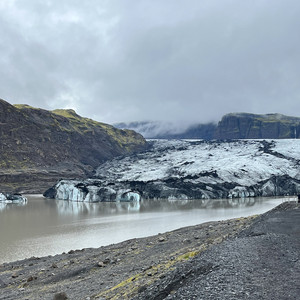
Today, I'm at Solheimjökull.
That's a glacier in southern Iceland.
It's been around for four to six hundred years.
We're visiting it to see what a glacier looks like.
But you have sent us a lot of glacier questions over the years.
So we're going to go now to the University of Iceland to talk with somebody who can actually explain what they are.
As you may have figured out by now, but why went to Iceland?
That's an island country in the North Atlantic Ocean a little closer to Europe than it is to North America.
One of the things we wanted to learn more about while we were visiting was glaciers.
So, after walking around looking at an amazing glacier called Solheimajökull, we went in search of someone who could explain this geological phenomenon to us.
But to do that we had to leave the glacier, go into the capital city of Reykjavik, where we walked to the University of Iceland and into the bright and sunny science building.
That's where we found Gvudfina Adelgerstotter in her office, where she works as a professor when she's not out walking around on glaciers herself.
So I'm a glaciologist, and I became a glaciologist because I'm really interested in skiing.
And I found this way of traveling on ice and snow as a job through my interest.
And because I found this group of people who were researching glaciers.
So I didn't know that this existed when I started, but I learned geophysics.
So I was interested in math and physics.
And what I do now is I measure the glaciers.
I model them.
That might sound like she spends her days sculpting models of glaciers out of air clay or something.
But sadly, no.
Or maybe not sadly, because Gvudfina Adelgerstotter seems to really like her job.
What she means by modeling is that she uses math and physics to create computer models for glaciers which are paired with climate models.
Those models can help researchers figure out what might happen to glaciers under different conditions over the next many years.
And of course, as a professor, she also teaches students.
And she does get to ski.
No, I ski a lot.
So I take every opportunity I have.
For example, this spring we were on Myrtavsjökull.
And then we drive on the glacier.
And then I had a rope and I could be towed behind the car.
So then I didn't have to sit in the car, but I was on the skis behind the car, towed by a rope.
And then we traveled to the measurement location.
And then when we did the measurement, we drilled the thickness of the snow layer to measure how much was snowing during the wintertime.
And then I was towed to the next measuring place on the skis.
And then when everybody went home, I skied down the glacier.
So that was a great ski trip, but a measuring trip at the same time.
I have to just say right now it is not safe for you to be towed behind a car on skis unless this is something you're specifically doing as an adult for your job, in a very controlled way.
Do not try that at home.
Well, that's true, yes.
So we should be very careful and you have to train a lot to be able to do this, yes.
But wait, we're getting out over our skis.
That's an expression people use to mean we're getting ahead of ourselves and might fall over.
We haven't really explained yet what a glacier is, so let's do that now.
My name is Ina.
I'm nine years old.
I live in Victoria, British Columbia, and my favorite season is winter, because it's close to my birthday and I love snow.
And my question is, how are glaciers formed?
My name is Kira.
I live in Barrie, Ontario.
I am six years old.
How do glaciers get there in the first place?
What is a glacier?
That's a good question.
So glacier is ice, and the ice is formed because the precipitation of last winter didn't melt in the following summer.
So that means that there was a positive mass balance that this region gained.
And when there is a sequence of years where there is snow left in the autumn buried, then under next summer winter snow layer, then that accumulated snow is compacted.
And once that has become densified, so that the snow that was like fluffy and flurry in the beginning is compacted into glacier ice, then it can start to flow.
And the flowing happens because the thickness of the ice is high enough or large enough.
So once the thickness is large enough, that the ice can start deforming under its own weight.
And you can think of this as honey.
If you put honey on the table and it may be like a pile, and the pile then kind of floods out because the thickness is too high for the surface tension, if you like.
So a glacier is snow that forms on top of land and gets squished down year after year as more snow falls and not all of it melts.
Over time, that snowpack gets so heavy and compacted that it turns to ice.
And then that ice starts to move under the force of its own weight.
That is a glacier.
And one of the most important things is that glaciers aren't really glaciers until they start to move.
You can have snowpacks that are just sitting there.
And specifically, if the slope underneath, so the bedrock underneath, is maybe steep, then the glacier can start flowing downhill and then it has become a glacier.
So it's ice that flows and then you have a glacier.
And glaciers can only form on land, right?
We're not talking about icebergs.
Well, some icebergs are carved off glaciers.
So they are formed on a glacier and there are many icebergs.
For example, the iceberg that caused the Titanic to sink was breaking off Greenland ice sheet.
That's another thing that I find interesting.
The glacier ice flowing off and breaking off in the fjords, for example.
In Greenland that's the oldest ice because that has been formed somewhere way up and has been transported down to the edges of the glacier and it's breaking off.
So it's almost like a conveyor belt where the new snow gets buried and goes down and down and down and then eventually it comes out at the snout and that's the older ice and that newer snow is pushing down from the top and sort of pushing that older ice continually downwards or outwards.
How old are glaciers?
That's very dependent on the location, like where in the world, but also where on the glacier.
Like we were saying, the conveyor belt.
So the youngest ice is on the top in the accumulation area, and then the oldest is at the snout.
And the glacier ice in Iceland is probably up to 800, 900 years old.
So that's the time that it takes for the ice to be transported with the conveyor belt the ice itself down towards the axis.
There are glaciers that are much older, much, much older.
The Greenland ice sheet and the Antarctic ice sheet, they are much bigger.
They are like whole continents covered with ice.
And the ice in Greenland, it's about 130,000 years old.
And they have found around one million year old ice in Antarctica.
Ice that is a million years old?
Imagine putting that in your glass of water.
Just kidding.
Scientists do collect some of that ice, but they don't just let it melt in a glass.
Professor Athal Gerstotter says that ice is like a time capsule.
It contains a record of the precipitation, the snow and rain, that fell a million years ago.
And the bubbles trapped inside the ice are a time capsule telling us about the air a million years ago.
So we can learn a lot about the past from glaciers.
Hello, my name is Coco.
I'm eight years old.
I'm from St.
George, Utah, and my question is, how does algae get into glaciers and turn them pink?
Yes, this is a very interesting question.
And the surface of the glacier can be variable.
And the question about the algae.
I don't actually know, but I think and that's my wild guess now I think that algae are blown onto the glacier and start growing.
And then they can fall.
Well, you can think.
Well, what can grow on a surface that is freezing, at the freezing point even, and very cold, and there is no soil to grow?
But apparently those algae quite like the cold surface and maybe the solar radiation gives them enough energy to grow.
And that causes kind of like a reddish hue.
We checked on this and the color is coming from algae.
The algae itself is green, but it has a secondary red pigment called a carotenoid.
In the summer, the algae can turn on their red pigments as a protective barrier against UV radiation from the sun.
It's kind of like sunscreen.
But this red color causes the algae to absorb heat instead of reflecting it, and that leads to glaciers that melt faster than white ones.
Pink isn't the only color you can see in a glacier.
Sometimes a glacier looks blue.
The more dense the ice, meaning it has fewer air bubbles and is packed down under its own weight, the more likely it is to look blue.
Those large, dense ice crystals are absorbing some wavelengths of light and scattering the blue light back to your eyes so it looks blue.
Generally speaking, the older the glacier ice, the more likely it is to appear blue.
But glaciers can be other colors, too.
They can be white, blue, pink, brown, black, and more.
In Iceland, the color changes can be because dust is blown.
It's very windy in Iceland.
And in the highlands, it's basically a desert.
And our sand, because it's a volcanic island, our sand is very black.
So the black sand is blown onto the glacier, and that causes like a darkening of the surface.
There can be even sand dust from Sahara on some glaciers in the Alps.
And that sand is kind of yellowish.
And then the algae can change the surface color.
And anything that is blown onto the glacier will have an effect.
The darker the surface of the glacier, the faster it melts.
Speaking of which, when we come back, we'll talk a little bit about how increasing global temperatures are affecting glaciers around the world.
And did you know you can find glaciers in the tropics?
This is But Why, a podcast for curious kids.
I'm Jane Lindholm.
We're learning about glaciers with scientist and professor Gvudfina Adelgerstadur, a professor and glaciologist at the University of Iceland.
Remember at the beginning of this episode when I said I was standing at a glacier?
You can see glaciers from a lot of Iceland.
Even though only about 10 of the country is covered by ice, these glaciers are a very striking feature of the landscape.
And some of the glaciers are pretty easy to walk right up to and touch.
Like the one we visited.
I asked Professor Athelger Stotter to tell us about the glacier we had visited before we went to her office.
It's called Solheimagjokull.
It looks like a big pile of dirty black ice and snow tumbling down in between two valleys and piling up on itself.
It actually starts higher up in the Icelandic highlands as part of a much larger glacier called An ice cap, called Mirdasjökull.
That ice cap is on flatter land and kind of spreads out in all directions.
And Solheimajökull is an outlet glacier where the ice is heading downwards toward the sea.
So Solheimajökull is flowing towards south, towards the coast in Iceland.
And this outlet glacier...
It's like a long tongue and it's bending a little bit down into this valley.
And the end of it is now in a lake.
And the lake formed only maybe 15, 20 years ago.
I'm not exactly the exact date of it.
And that lake is forming because the glacier is getting shorter.
And the glacier is a little bit like a conveyor belt and it's transporting the snow accumulated on the big ice cap Myrtasjökull down into the lower region.
And the glacier is also like your bank account a little bit, that you put something in it in the wintertime.
So the snow comes in the wintertime and that certain amount and we go and measure that in the springtime how much was coming into the glacier.
And then during the summertime, at the lower region, but also high up, is snow.
Ablation.
So ablation is how much is melting.
And the ablation is then also a certain amount.
And then come the bank account, you can say the mass balance of the glacier.
If you take more out than you put in, the glacier is going to get shorter.
And Solheim Major Karole has been shrinking recently?
Yes, since 1995, so now 30 years, it's getting shorter, sometimes 50 up to 100 meters a year.
And we know this because we go and measure every year the position of the snout.
So we call it the snout where the glacier ends.
And the snout is now in the lake.
So it's not only melting on the surface at the snout, but it's also breaking off into the lake.
So then that's called calving, because it's kind of like a calf being broken off the snout of the glacier.
So the ablation possibilities are breaking off into the lake and melting at the surface because of the high temperature.
Given how cold it needs to be for a glacier to form, you might be surprised to learn you can actually find glaciers in a lot of places on Earth.
You can even have a glacier in the tropics or near the equator.
But you need to have more snow that falls than the snow that melts year after year after year.
So for that to happen in really warm parts of the world, you usually need to go up.
If there are very tall mountains where the air is cold, even if it's tropical, down below you might be able to find a glacier.
In Africa there is the mountain Kilimotiaro, and we find a glacier there that is actually shrinking quite fast at the moment.
But in the tropics, if you get high enough, you can find glaciers.
My name is Jack.
I'm five years old, Ontario, Canada.
My question is why glaciers are formed and they shape the land?
Sometimes, where we live in North America, people will talk about the landscape and say oh, that was formed in the last ice age, when the glaciers receded.
And here in Iceland we often hear.
This is a landscape that has been shaped by volcanoes and glaciers.
How do glaciers shape a landscape?
They are really like bulldozers.
So in areas where there is sand underneath the glacier, they're basically just shoveling the sand like bulldozer in front of them.
And they create what we call frontal moraines.
And those moraines are then like marking of a bulldozer that has pushed the material in front of it.
They also carve the valley.
So valley is V-shaped, kind of like a V.
If there is only a river at the bottom, that is carving valley landscape.
But if a glacier then starts to fill that valley then it carves and create kind of more like u-shaped And it kind of grinds the bedrock underneath it and transports it.
Remember, it's a conveyor belt.
So it transports the rocks that they grounded from the sides.
And then we can see that V-shaped valleys haven't seen a glacier, but the U-shaped valleys.
Those are the valleys that the glacier has formed.
And if we think of it as that bulldozer and it's pushing that material forward, then sometimes it also leaves that material there.
And does that form new hills or mountains?
Because again we're thinking of like a bulldozer for a giant, not a bulldozer that any of us could drive.
So you could see a hill or a mountain that was sort of left behind, like pushed over there and then just discarded by the glacier.
Exactly.
And this is how we know how big the Laurentide Ice Sheet was in North America and the scandinavian.
I see it how big they were because we see those landforms, that exactly those bulldozed hills that are then the leftovers of that big bulldozer that is now gone.
I think that's kind of amazing to think about.
Someone like you can go walk outside and see into the past, because you know how this landscape was formed and i wonder if in your head you can almost picture what it might have looked like a thousand years ago or 10000 years ago.
Yes, and even shorter distances, because we see, for example, in Solheim, where you were, we can see now how big the glacier was, because the vegetation hasn't come yet.
So in areas where the glacier has recently been removed or retreated from, There are not vegetation yet, but in areas that have been uncovered or released from the glacier a longer time ago, we see that there is moss and maybe some grass visible.
So the landscape is really telling us how big the glaciers were and how extensive they were.
And that's what we are using to read the landscape.
And, of course, the climate changes tells us that we understand this relationship, that if you get cooler climate, the glacier can grow.
And when it gets warmer, the glacier can shrink.
And shrinking is what many glaciers are doing right now.
Glaciers are always changing, growing and shrinking over time.
But right now they're shrinking all over the world and at a fast rate, because our climate is getting warmer.
Some glaciers are even disappearing.
But if glaciers have gotten bigger and smaller, appeared and disappeared over the whole long history of the Earth, why do researchers like Professor Athel Gerstotter think that what's happening to glaciers now is a problem and not just part of a normal cycle?
They grow and shrink as a response to temperature changes and precipitation changes.
And they are very sensitive, actually.
But what they also are, they have a long memory.
So they are kind of integrating the climate over a long period.
And their response is telling us how the climate has been changing.
And we see records from different regions in the world and more and more information from the ice cores, from the big ice sheets, indicate and sort of confirm this idea of ice ages and and interglacial periods.
So those warmer periods in between, and those are natural and those are kind of because of the, the distance of the earth to the sun is changing and that is causing the, the ice ages to form, also the, the tilt of the earth axis and the wobbling speed is also changing.
And that combination causes the ice ages and the warmer periods.
And those are happening on long timescales like 40,000 years and 100,000 years timescales.
So now, if we think of those timescales, like 100000 years, and compared to the time since we started burning fossil fuels, that's only 150 years ago.
And also building up that amount of fossil fuel that we are burning out.
That takes millions of years.
Like the reservoirs that we are using now for our energy consumptions, have been formed over millions of years.
And in the span of 150 years And I say 150 because often we talk about 1850 as the beginning of the industrial revolution.
And when we started having like fuel engines and started burning coal for heating our houses and fuel and gas.
And of course, there's a lot of technical evolution, really rapid evolution of technology.
And we managed to start flying between the continents. and using a lot of energy.
And in that period, we have emitted, by burning the fossil fuels, the CO2 in the atmosphere.
And that is causing the temperature at the surface to warm up.
And now, what has been natural and maybe variable over the different regions on the surface of Earth?
We are now seeing very clear signals.
All the glaciers in the world are responding.
We have already warmed the planet on average 11 degree and all the glaciers are telling us that they can feel that.
So the clear signal everywhere, from Patagonia to Svalbard, Icelandic glaciers, the Himalayan glaciers and, of course, the big ice sheets in Greenland and Antarctica, they are starting to shrink.
So let's just make that thought experiment and say the temperature rise stopped at 1.1 degree.
The glaciers, and it depends on how big the glaciers are, they will take a few decades to adjust.
So the conveyor belt has to kind of figure out what the new size should be.
And then they would be about 40 smaller, or the volume amount of current glaciers will be about 40.
If we continue to warm, the more of this ice will be lost.
So the message from the glaciers is really stop the warming as fast and as soon as possible, and as much as possible.
There have been agreements made among many countries to limit greenhouse emissions, the gases we put into the atmosphere that are contributing to a warming climate.
Countries have worked to reduce emissions so we can limit that average climate warming to two degrees.
But those agreements don't seem to be making a difference so far.
And countries sometimes change their mind about what they're willing to do, depending on who's the president, or prime minister or political leader at any given time.
Sometimes countries or governments even decide they no longer want to be part of the agreements, like the United States did at the beginning of 2025 with something called the Paris Climate Agreement.
Pretty much every scientist agrees.
Climate change is happening at an alarming rate, and it's going to affect all of us.
But governments disagree about what to do.
Professor Arthur Gerstotter says she thinks all countries are going to have to deal with it one way or another, whether we like it or not.
And the ways we change our policies could wind up happening very quickly, as the climate forces us to think differently.
Many places are using renewable energy.
And they're called renewable energy because they are not using the fossil fuels, the coal and oil and the gas that are burning and emitting CO2 in the atmosphere, and replacing it with solar energy or wind energy.
And I think we could use tidal energy as well.
There are a lot of energy sources, geothermal.
And there are energy sources that we know how to harness and we know that they're not emitting CO2.
But it's kind of like comfortable to still use and all the systems are built on the fossil fuels.
But I think the decision, once we make the decision, to say OK, we really need to swap, I think that will happen fast.
We are on the verge of transition.
And this is why we are talking about the transition.
We really need to move into this renewable energy regime because we understand that that the regime that we have had in the last 150 years is both not good for the climate and it's also not sustainable because we're going to run out of those fossil fuels anyway.
And glaciers are helping us understand the urgency needed to move in a new direction.
That's it for this episode.
Thanks so much to Professor Gvudfina Adelgerstotter at the University of Iceland for talking about glaciers with us.
As always, if you have a question about anything, have an adult record you asking it on a smartphone using an app like Voice Memos.
Then have your adult email the file to questions at butwhykids.org.
But Why is?
Produced by Melody Beaudet, Sarah Baik and me, Jane Lindholm at Vermont Public and distributed by PRX?
Our video producer is Joey Palumbo and our theme music is by Luke Reynolds.
If you like our show, please have your adults help you.
Give us a thumbs up or a review on whatever podcast platform you use.
It helps other kids and families find us.
We'll be back in two weeks with an all new episode.
Until then, stay curious.
From PRX.