This is World Business Report from the BBC World Service.
I'm Andrew Peach.
As firefighters work to put out the flames, the science of fire safety in the tallest buildings.
Also on the way why Venezuela has cancelled the landing rights of six airlines and the risks posed by fake football shirts.
Hong Kong.
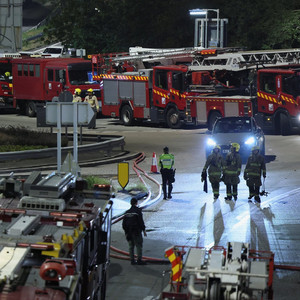
Emergency teams there are still working to extinguish fires at the giant housing complex where
Flames have engulfed several buildings.
At least 83 people known to have died, more than 200 remain missing.
It's unclear what caused all of this, but various residential blocks were undergoing renovations at the time.
The BBC has verified this footage from the start of the fire.
Now what you can hear is a man shouting that the fire has got to the fourth floor and to get out, get out, and then, after a relatively short pause, that the fire had got to the eighth floor in that time.
Jason Kong lives in Tower Block 1 at the Wangfoot Court Complex.
One neighbour said he could still not find his wife.
Some said they are safe.
I know some are still inside the building.
Why is there no one saving them?
Are we waiting for them?
How should we deal with this?
I know someone who has young children and elderly people in their family.
I called him and he said he was still trapped inside the building.
This woman said she and her family had lived in the apartments for more than 20 years.
How do I feel now?
I even feel like dying.
Seeing it like this and being unable to help, what can we do?
What can I do?
Wong Kar-Wing is Deputy Director of the Hong Kong Fire Services.
Actually, our major challenge is the temperature is very high in the fire ground and the inside layout is very compact because there are That folding is collapsed.
And our firefighters need to conference the high temperature to proceed to the fire ground.
One layer by one layer.
It is very difficult for us.
Huang Qingyan is Associate Professor at the Department of Building Environment at Hong Kong Polytechnic University and a specialist in fire safety.
We have these...
Bamboo sky-folding fires are very common in Hong Kong because the bamboo sky-folding is basically used in every building during the renovation, also the construction.
But no one expected the fire spread so fast from the bottom to the top, not just in one building, but also spreading from one building to another, sixth one.
Even for experts like us, we never expected expect anything like that.
It's very similar to the Greenfire Tower in London, but it's seven here at the same time.
Well for more on the safety of these tall and complex buildings.
I spoke to fire engineer Ross Timpson.
Tall buildings are very, if there is a fire and it gets onto the outside of the building, the fire can spread very quickly up the external envelope of the are really bad and that wind is then blowing the burning debris and falling stuff off the building to adjacent buildings which in this case also had shrouding around them etc and you can see the potential for you know, quite rapid fire growth.
So I'm just trying to get around my head around some of the risks.
I mean, one of the risks is obviously, when you've got a tall building, it's difficult to get people out of it because they're very high up and it involves lots of stairs and all that kind of stuff.
So that's one aspect of it.
But also I hadn't really addressed my mind to the idea that if it's a tall building, there's more wind around it.
And that's part of spreading the fire as well as the materials.
Absolutely.
There are several significant differences between tall and complex buildings and other lower buildings, and one of them is the wind.
Now, I believe that it was a particularly hot day in Hong Kong from the reports that I've seen on the media and I'm again speculating, but it may mean that people had lots of windows open and lots of doors open in the buildings to allow air to flow through.
So those are the kind of things that can aggravate these types of fires, but clearly Most tall buildings and this is a residential building that we're talking about here the design is based on compartmentation.
In other words, that means that each of the flat or apartments should be separated by fire-resistant materials from each other, so that the fire should not spread easily throughout the building.
Now, if the fire gets on the outside of the building, then it rather defeats all of the design intentions.
And that's when you get these fires spreading up the outside of the building, going into numerous open windows, et cetera, and spreading the fire quite quickly.
And an example of that is what happened at Grenfell Tower, which was a tall tower block in West London.
I'm interested to hear more about the mitigation measures that you're designing in.
Someone wants to have a tall building for all manner of reasons.
What are you thinking about as someone they might call up and go OK.
How are we going to make it safe?
Clearly, I'm going to advocate the use of sprinklers.
Sprinklers throughout these buildings.
They are, I think, essential for tall buildings to make sure that the fire is controlled.
Even with sprinklers, you need all of the fire safety in the building to be looked after.
So we need to know that a fire is started by having some kind of detection system.
We need compartmentation.
But above all In my experience, having been doing this for a long time now.
The building has to be managed and the people in the building need to understand their role in the fire safety of the building.
So in my experience, these residential blocks sometimes don't have the level of fire safety management that they should have.
And certainly if they're undergoing construction work, which this building appears to have, then that would need to be very significantly higher than normal day-to-day fire safety management.
And the people inside the building will have to realise that they may well have to evacuate.
And are you just taking a risk in the end by living in a tall building or having an office in a tall building or even visiting a tall building?
Is there a level of risk that can't be mitigated whatever you do?
The statistics are very clear that significant, severe tall building fires are very, very rare events.
But I would counter that by saying that when those fires do occur, these significant fires, then we've seen that they can result in significant loss of life.
And we don't know the final fatality number in this particular fire, but it's going to be significant.
So tall buildings are safe, provided that they are managed. and the risks inside them are managed.
And we know that in lots of fires, like in Grenfell Tower, some of the more vulnerable people in our society pay a very heavy price when these buildings fail.
Fire engineer Ross Timpson with me.
Venezuela has cancelled the landing rights of six international airlines after they ignored a warning to resume flights.
They're among a group of carriers that had stopped flying in recent days after the US said the security situation in Venezuela was posing a risk.
This is the latest flashpoint in worsening relations between the US and Venezuela, amid American accusations over the role of Caracas in the illegal drugs trade.
The flight disruptions began over the weekend even as Maricela Luisa, who heads both the country's tourism council and its airline association, was flying home.
It was very empty.
And of course, it's going to be complicated when the flights return because you have to rebook all those passengers.
And it's in the thousands because we're talking about we lost 46 international flights.
And I'm talking one way.
Let's go live to my colleague Guillermo Moreno from BBC Mundo.
Guillermo, what's the latest on this?
Well, the latest on this is that the impacted airlines have been offering a refund and a change of the date or even the route to the passengers affected by these measures.
This is the way they are trying to offer a solution to them.
And also we heard that the International Air Transport Association, apparently acting on the behalf of these affected airlines, has requested the Venezuelan authorities to reconsider this decision.
But so far, there's no indication that the Venezuelan government may be willing to do so.
We just heard from the Venezuelan Interior Minister, Diosdado Cabello, speaking on State TV.
And he said to these airlines keep your planes, we'll keep our dignity, which sounds like an indication that they are not willing to change course at this point.
Also, we learned that the French government has advised its nationals to postpone any travel to Venezuela due to concerns of the security situation in the country.
It feels as though the airlines want to align themselves with the US position, maybe because they agree with it, maybe because they don't want to be on the wrong side of the Trump administration.
Well, we haven't heard from them yet on the specific reason for this decision.
We know the Venezuelan government is blaming them of joining what the Venezuelan government describes.
And now I'm quoting a state terrorism from the United States government against Venezuela.
What these airlines have stressed is that the safety of their passengers are the utmost priority.
And this comes all...
This all comes from a warning issued by the Federal Aviation Administration, that's the American Aviation Authority that warned on last Friday of the deterioration of the security situation in Venezuelan skies.
As you know, there's a... huge American military buildup in the Caribbean, very close to Venezuela.
And the concern was that any unexpected military activity may cause a serious incident.
It seems that these airlines were really wanting to prevent this from happening.
And that's why they are taking this decision.
And is there any suggestion as to what's going to dislodge this in the end, even if it hasn't done it yet?
Well, not really.
It's clear that this all is connected with the current tensions between Nicolás Maduro's government and the United States President Donald Trump.
And as long as these American buildup remains in the Caribbean, it's hard to see any sign of return to normal.
And, well, if you think of the possible outcome of this...
It could be either way.
Mr. Trump has said he may be willing to talk to Maduro.
But at the same time he has hinted that his country may take military action against Venezuelan targets in Venezuelan soil.
So, as long as there's no clarity on what Mr Trump is going to do, and if there's any sort of military confrontation coming up, the rest of actors be the airlines or the Venezuelan travelers will probably hold out before taking any risk.
That's Guillermo Moreno from BBC Mundo.
Thank you very much indeed for that.
This is World Business Report with Andrew Peach here on the BBC World Service.
Let's bring in Bill Blaine now, principal and founder of Windshift Capital.
Bill, it's been a relatively quiet day on the markets.
It's Thanksgiving in the US, obviously.
Still some stories to look at, though.
Let's start with JP Morgan.
This huge bank has decided to build a new headquarters building covering Europe and Africa and the Middle East.
And it's decided to build that building in London.
I'm just wondering why, if you are a huge global corporation of some sort, when you're deciding where to headquarter part of your global operations, how do you choose?
That is a fascinating question.
And the fact that J.P.
Morgan is still, and let's be honest, J.P.
Morgan is the world's leading financial institution.
And they're basing themselves in London.
I think that confirms some hope for the UK financial industry and the financial sector.
The fact that the UK is still seen to be the centre of European finance.
And that's going to be very positive.
We know in the market that if you need to raise money, it's very difficult to raise it in size in small European countries.
And Britain's still where you come for large size doesn't quite match what you can get in America.
The fact that JP Morgan is going to build here is fascinating.
And the fact that they're going to Canary Wharf I just find even more fascinating because many of us did think the wharf was on its knees.
We've seen some of the big banks like HSBC pull up.
There are empty buildings there.
But it shows that financial institutions, they need money.
New buildings, they need space for them, and there just isn't that space available in the city.
Interesting.
Let's talk about Campbell's Soup.
They're in trouble because of an executive who was secretly recorded basically being derogatory about the company's products, about its employees, about its customers.
So the executive, Martin Bally, has departed.
But how does the firm recover from this?
What sort of damage does this kind of thing do?
This is another classic Thanksgiving Day story, isn't it?
I mean, this is the ultimate Ratner's moment.
In the USA.
Ratner, as you'll recall, was run by an executive, Gerald Ratner, who famously described his product as costing less and lasting less time than a Marks and Spencer's sandwich.
And he was so selling gold jewelry.
Now, Campbell's soup, of course, has been something that's, it's been one of the staples of America for 150 years.
But now it's changing.
It's becoming a snack business.
The soup business is almost ancillary to its main businesses, which are selling snacks.
And we all know that snacks is something that tends to be bought by people who are less well off.
So sometimes the truth hurts.
And certainly Campbell's, isn't the kind of thing that Andy Warhol would have painted and everyone would have thought oh, iconic America, up on your wall.
Today, it's something else.
And another story we've been looking at over the last few hours today is this cyber attack.
There have been a few of these, and this is a cyber attack on a huge beer company in Japan.
Asahi, yes, the latest global company to be brought low.
I mean...
Just in this country, here in the UK this year, we've had two spectacular cyber attacks Marks and Spencer's, and then Jaguar Land Rover.
And the damage that a cyber attack does is phenomenal.
The government nearly had to bail out the entire UK auto parts sector, which is one of the UK's biggest manufacturing sectors, because of the damage that was done to one of the premier constructors, Jaguar Land Rover.
And it's put them both back.
If you saw the results that M&S came out with following their cyber attack, they were devastating.
What it demonstrates to firms yet again is that you cannot scrimp and save on your cybersecurity.
And a lot of questions asked to the firms providing cybersecurity to M&S and Jaguar.
And guess what?
They were both Tata.
Tata Cybersecurity, I believe, was the name of the firm.
Interesting.
Thank you, Bill.
Bill Blaine from Winship Capital, live with me on World Business Report.
Now we're going to talk about football shirts.
One is going to cost you £85.
The other is going to cost you £15.
Might be tempting to buy the cheaper one, even if you know it's a counterfeit.
But with figures given to the BBC revealing that more than 11 million items have been seized over the past five years, there is more and more concern that these fake shirts could pose some kind of health risks and that people buying them are handing over their personal details to organised criminals.
Here's Chloe Long, Deputy Director General at the Anti-Counterfeiting Group in the UK.
This is not just an opportunist who's selling the odd shirt on a market stall.
These are really serious organised criminal groups with sophisticated operations who are funding other serious organised crimes through the sale of counterfeits.
So it's not scaremongering.
It's something that people really need to be aware of and mindful of when they're purchasing counterfeit products.
It's just not worth the risk.
Our correspondent Jane Dougal on this story for us.
I asked Jane about the scale of the problem of fake fan shirts for English Premier League fans.
It's becoming more and more popular for fans in the English Premier League to buy fake kits.
And the answer, the reason for that, Andrew, is cost.
At the moment, Premier League shirts...
Prices vary from between £60 to £85.
That's just for the basic adult men's version.
For the child's version, it's around £60 to £70.
That is full price, of course.
There are seasonal reductions throughout the year and, of course, at the end of the season.
But if you want to personalise a basic kit, you could be paying as much as £120.
And if you take the cost of living crisis into consideration well, more and more fans are just finding those prices far too expensive.
And they are openly admitting to buying fakes online, mostly free. from China-based websites.
Now for this investigation.
The BBC found several websites where counterfeit shirts of every Premier League club were being sold for as little as £12.
So if you compare the two, it's really a no-brainer, isn't it?
I went to Liverpool's match against Nottingham Forest a little while ago and outside Anfield almost every fan I approached admitted to buying counterfeit strips.
And especially in the lead up to Christmas.
They said well, when there are three new kits every season, when you've got children asking for a brand new kit, not everybody can afford to buy kits for the full price that they are going for.
So it's understandable that a lot of people do opt for the online counterfeit strips, but not all of them know the risks that they might be putting themselves and their children under.
So it's either a fake kit or no kit.
Tell us a bit more about the risks that have been uncovered.
So trading standards say.
They just don't know what is in these kits and they feel that they could pose a health risk.
And it's because they are made in unregulated factories and they use, they think, substandard materials.
Now, that's what trading standards say.
And, of course, they advise you to go to reputable websites and to buy from known shops or, of course, the official club shops.
But I also spoke to the deputy director general at the anti-counterfeiting group, Chloe Long, who went even further and said that she thought that wearing a product like a counterfeit kit could potentially cause irritation to your skin, could cause a rash or perhaps even more significant problems.
She feels that there are harmful toxins or dyes that may be used to manufacture these products.
Now, I did push her on this.
I did ask Chloe Long if there was any evidence of toxins in these fake strips and if she was perhaps scaremongering.
She said, now, look, it's very difficult to know retrospectively what's been put into the product.
However, we know that these factories are do not follow any regulations.
They are not bound by the same legalities and regulations that the genuine manufacturers are.
And Long says that the counterfeiters have no morals, no standards, and the only thing they're motivated by is price.
So they will do whatever they can to make the fake kit look as close to the real thing as possible.
So you don't know what they're doing.
You don't know what products they're using in order to do that, to achieve that.
And she feels that that is a risk that you should just not be taking.
And apart from putting this information out there, is anyone able to do anything about it?
Because you're not going to be at a curb demand.
The Premier League is such a huge brand around the world.
It's going to be enormously difficult to control supply.
Absolutely.
It is important to say it's not illegal to by fake strips in the UK, but it is against the law to sell them.
And anyone caught could face a prison term of 10 years and an unlimited fine.
Now, as you can imagine, there are regular raids and seizures taking place around the country under the remit of Border Force and the Police Intellectual Property Crime Unit.
And in fact, earlier this year, more than 67000 fake football shirts and kits were seized, with a value of £51 million.
Seven arrests were made Two of them by West Yorkshire Police.
And the Premier League has given figures to the BBC where they revealed that their anti-counterfeiting programme helped to seize 11 million items.
They say worth more than £70 million.
That's across five seasons, though.
And the Home Office say that there's evidence that sales of fake kits spike in the lead up to tournaments.
So that means that they do expect a rise before next summer's World Cup.
Our correspondent, Jane Dougal, with me.
Now, you might be hearing this over the next few weeks.
Theme music for Stranger Things.
And nearly ten years after season one, you can enjoy the final series with sci-fi and 80s nostalgia on tap on Netflix.
Rachel Lloyd, Deputy Culture Editor at The Economist, is live with me on World Business Report.
Now we know there's massive demand for this Rachel, because it actually crashed Netflix for a bit when they first dropped the new episodes.
Yes, it did.
And there were thousands of reports and complaints on social media about that.
And Netflix really should have known that this was coming.
I mean, season four was in the top ten in 91 countries when it came out in 2022.
So the demand was no surprise to Netflix, but yet they still weren't able to cope.
Why is Stranger Things such a big deal?
Well, there are some...
So it touches in on that 80s nostalgia, as you mentioned.
It's set in a fictional town of Hawkins in Indiana and it features a group of youngsters who are battling monsters from another world.
And that's a theme really that resonates across lots of very popular shows.
If you think about Harry Potter, for instance, it shares a lot of its DNA.
But Stranger Things balances the specificities of its story with those kind of overarching themes of how to protect your children, for instance, in an unsafe world.
And it does it very skillfully with very kind of high tech effects.
Just thinking about what this means for Netflix as a business.
First of all, the business model now doesn't drop every episode of a big thing like this at once.
They drop some episodes and make you wait for the others.
Why?
Yeah, so they're dripping out the eight episodes in three batches, actually.
So the first set is out now, then Christmas Day and then New Year's Eve.
I mean, the obvious reason is that it keeps people subscribed.
People will keep waiting to see what happens.
They're in a kind of state of fearful anticipation until the very last minute.
So that's the real reason.
But we've seen a real shift in how Netflix is approaching releasing its biggest shows.
You've seen the same thing with things like Bridgerton, for instance.
And it's also a kind of way of keeping things in fans' hearts.
So with the finale of Stranger Things, for instance, they're actually putting it in cinemas, in 350 cinemas across America and Canada.
And it's interesting because it's a streaming platform.
But clearly they've identified that there's a communal aspect to watching this show that they would quite like to tap into that will deepen fans' experience in some way.
So it's interesting to see how Netflix is playing with the kind of analogue aspect.
It's almost like a step back into the old world, isn't it, of TV and theatre and all of that.
And in terms of Netflix continuing to grow.
Obviously, Stranger Things is soon going to be a thing of the past.
So what else are they up to?
Well, they're hoping to spin off Stranger Things into different directions.
So they're releasing an animated show and they're developing a live action series set in the same universe to hopefully kind of capitalize on fans affection for the show.
But it's been interesting because people will carry on re-watching it.
In the first half of this year people spent half a billion hours re-watching it to get ready for for season five.
So I expect they'll be hoping that the same thing happens again with these new shows, that people will carry on re-watching them and coming back to them um, and you know, stay fond of them for years to come.
Rachel, thank you.
Rachel Lloyd, Deputy Culture Editor at The Economist with me.
If you go online at bbc.com slash news, check out the business pages there.
There's a particularly interesting piece about the big JP Morgan building the £10 billion tower they're planning at Canary Wharf in London.
You can see artists' impressions of that.
Read more about it at bbc.com slash news.
But from me, Andrew Peach and the whole team here on World Business Report, thanks to being with us today on the BBC World Service.