Discussion keeps the world turning.
This is Roundtable.
You're listening to Roundtable.
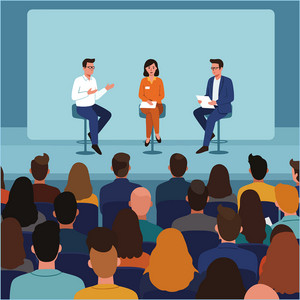
My name is Steve and together today with Lai Ming and Niu Honglin, coming up, more than 300 guests from 95 countries and regions attended the fourth CMG Forum recently in Qifu, Chandong to discuss the roles of cultural exchange and technological empowerment.
We'll find out why this forum is such an important one.
After that, we often talk about stress as a reaction to what's happening around us, But what if it goes deeper than that?
Could feeling stressed be something we inherit?
And if that's true, does it also explain why some of us seem more prone to anxiety?
Our podcast listeners, that's you, can find us at Roundtable China on Apple Podcast. and don't forget we love hearing from you as well.
So send us an email or a voice note our way with your thoughts on any of the issues that we discuss here on the show.
Here's how you do that, roundtablepodcast .qq .com.
That's roundtablepodcast .qq .com.
And now in the historic city of Chiufu, thought leaders from around the world recently came together for an important dialogue.
The fourth CMG forum, A collaboration between China Media Group and Changdong Province brought together hundreds of international participants with one shared goal to bridge cultures, spark innovation, and reshape how we communicate across borders.
What new ideas emerged from this global exchange?
Let's have a look at some of the key takeaways Niu Honglin.
More than 300 guests from 95 countries and regions attended the 4th CMG Forum.
It was opened on Friday in Qifu, the birthplace of great Chinese philosopher Confucius.
So it's a perfect place to have cultural exchanges and in today's world, technological empowerment in specifically the media industry.
And we have guests include political figures, mostly local political figures like local civil servants and officials from Shandong province, to show their support of the forum.
We also have leaders from international organizations, from UN, from Ypol, and they attend in person or some of them send a congratulation videos to the forum.
And there are heads of mainstream media organizations, including AP, Euronews, CNBC in Kenya, Broadcasting Cooperation, Kazakhstan's Presidential Broadcasting Service, Brazil's Media Group and Reuters and different media.
Yeah, all of them. This is a giant international media gathering.
Yes, and there are diplomats.
We see some ambassadors to China attending the forum, and experts, scholars, representatives of multifunctional corporations, and they also brought some of their creations, some their products with a lot of high tacky tacky element in it.
It was super fun. Very nice.
CMG China Media Group is our parent company so we work for them essentially and new holy and I we were sort of in road to the mission.
Lucky enough. We're interpreting for some of the guests there as such it was we had a chance to look at the the amazing products and system tech firms, tech software being displayed there.
There was a robotic arm that does Chinese characters, very, very interesting.
And there were people dressing in Hanfu, walking around, showcasing the local culture and the Chinese costume culture.
And what else? There were definitely some kites, which was a specialty of the Shantung province that's for sure.
And what we've learned on the forum, let's talk about the important ones a bit later.
Let me talk about a tiny little detail that I learned there.
That is one of my favorite shows crossing cultures.
It was a documentary.
It is a documentary, a very fun show about Chinese intangible heritage and also European culture elements.
I liked the show quite a lot enjoyed it and it was just on this forum, I realized that it's actually a co -production by China and Europe.
Oh, wow! Yes, it is designed to explore hidden art gems in both regions, and supporting cultural exchanges.
And currently, the show is airing on European TV networks, with a combined viewership of 500 million people.
Goodness gracious! Yes.
And on that forum, there are also launch of several activities such as the China Through its Intangible Heritage global tour, China Up Close Shandong tour, which is a media campaign allowing numerous media professionals to travel in Shandong, interview interesting local people and local enterprises, dig up the stories behind the prosperous market and learn about the art and the culture and being able to find the really good stories to write about in their work.
Laming, you talked about the importance of university programs, the humanities being represented in study, right?
This is why, right?
A gathering of this nature, an international media gathering, where important people from different media groups around the world have an opportunity to meet and share cultural experiences, and the possibility of working together on programs where you can learn about each other's place in the world and people the people from there and the foods and the music and all and all of those related things in the art.
I mean, this is, to me, this is kind of what the world media should be like, should be about all the time, And it's about changing the monopoly or media reports not just on China, but about countries around the world in fact.
For many decades if I may, the narratives in international media have been somewhat dominated by Western media.
They are very successful and they come up with very good content, very impressive documentaries and stuff.
But that narrative is limited, is rather narrow, is pretty based on the predilection of a few and perhaps a set value.
But in comparison, we are in an age of globalization, despite some headwinds we are still in the globalization, and we are becoming more and more open between countries.
And at such, there should be more opportunities for us to know each other in a more direct fashion.
And media co -production and content exchange programs, like those being showcased at the CMG forum, is one way that we could break that monopoly and I just dismantle the echo chamber effect that we may or may not be aware of.
I mean, we as the media professional, media professionals certainly are aware of this, but I'm not sure it's the case for the average consumer of media content all around the world.
So, this is something that we personally witnessed at Intrifu last Friday.
And again, another thing that I would like to highlight is still the tech point, I mentioned the robotic arm, and in fact over the past few years...
You were very impressed.
Yeah, the other thing I was impressed with was the CMG GPT.
GPT is I think it's the same as ChatGPT.
It's a model, but not just a language model.
Yeah, it's a model that you can use to generate content.
Whereas, in the past CMG Foreign, we've seen the showcase of that CMG GPT.
The first generation.
At a very raw state, the videos they generated, the software they were able to generate was not ideal, I would say, comparatively speaking.
Now at least per the display and the demonstration, I've seen dramatic improvement in the ability to translate from language to language, from Chinese to Arabic for instance.
So the same kind of content originally made in Chinese or in English can almost seamlessly be translated into a different language and even video format.
You see the anchor and the reporter, the shape of their lips, they change.
According to the change of the language.
So it's almost instinctive.
Almost to the extent that can take our jobs.
And, as a matter of fact, there was an innovation technology discipline area.
In that area, not only can you see the application of the CMG GPT, media GPT.
You can also interact with it a little bit, saying that you want to write a stage play based on this one idea.
You type in your idea and the GPT would help you in different stage of your creation.
It'll help you have the outline of your story.
It helps you to generate paragraph by paragraph of the certain plot you want to write, the style you can choose, the name of the characters.
It can help you to create someones in different styles and at the end it can also help you generate the pictures of the play you're thinking about.
There's that. There's also the kind of interaction you can have with the technology that is by standing there, giving them authorization of your face, of the portrait of yours.
You can generate pictures So you can become a character in your own performance?
You can! You can become your version of Mulan if you want!
It's crazy fun! And I don't think it's wise or professional to rely solely on AI to help us produce content, but I think it's very good source of inspiration.
That is the fun part I was about to mention, the topics featured during the forum.
We have the very traditional ones.
we talk about the authenticity, the fairness of news writing, we talk about being not biased, we talk about write the real news stories.
The ethical aspects.
Hence the importance of interdisciplinary studies at the university level.
Sure. And also we talk about the very up -to -date technologies.
Not only AI, we talk about how to make the picture you look at super ultra high definition to the point of 8, 4k and 8k during the production of it, how to make sure of that.
And also we talk about how to use AI properly in media production, making sure that by using AI, we do not compromise the important things we talk about like the authenticity and the factual of new stories.
So there were many fun discussions and listening to those talks make me appreciate my job and my occupation a bit more.
Appreciate it. And also a really great insight into the direction that the industry is going because pardon me, that wasn't only a China forum, it wasn't only a European or a North American forum, this was an international media forum.
So you really got a good look at how tools will be used appropriately, effectively, ethically in future media productions.
And also, I bet you got to meet some really cool people as well.
Not to mention robotic arms that can do calligraphy.
Why was that the first thing that you mentioned about this incredible gathering?
Because I'm really poor at calligraphy and I would love to have a robot that does all the writing for me.
Very cool. What a wonderful gathering and that was the fourth one, correct?
Yes. So hopefully there will be more.
...in the future, yeah.
Coming up, why and how does stress affect our bodies?
Where does it come from?
We often look to an outside source, but the answer may be in our genes.
Stay with us. You're listening to Roundtable.
I'm Steve, today with Lai Ming and N MON LING.
Ever wonder why stress feels so intense, right, real at times?
Well the bad news is stress is just a part of life, everyone has to live with it.
The good news, I guess, is that stress doesn't always have to be bad, there are certain benefits in certain situations.
The weird news though is that stress may actually run in the family.
Today we'll see if we can unlock the scientific mysteries of stress, where it comes from and the impact that it has on us.
So let's start with the with the family aspect of this.
Let's not bury the lead.
Can we look to our parents for answers about how we handle stress?
In real life I look to my parents to explain the stress that I feel, I mean that's for sure, but in theory, scientists have located the reason to some extent.
Some studies reveal that stress can be inherited through DNA.
Liu Xing 'en, who is a researcher from Shenzhen Institute of Advanced Technology, Chinese Academy of Sciences once voiced this conclusion via a 2023 science open class at a high school in Shanghai that anxiety or stress can be passed down from parents to their children.
Liu's team actually set up an experiment to prove that in the experiment they created a stressful living environment for the mother mice and calculated the outcomes.
According to the study, anxious mother mice tended to have sons who also exhibited anxious behaviors while their daughters demonstrated signs of hyperactivity, meaning they have repetitive motions.
And there's also research in this area showing that stress during pregnancy or even before pregnancy can affect whether or not a child develops anxiety later.
Scientists believe this happens because some genes can be programmed to turn on or off even before they're passed down from parent to child.
This is scary to a mother.
Well, it just shows how important it is to have a relaxed pregnancy, right?
If possible, if possible.
I don't know if it's… I'm looking to you for help right now, Laiming.
I don't know if it works that way really.
Even if the mother feels rather relaxed during… In fact, I think when women are pregnant, Their body creates a kind of hormone to make them feel relaxed and happy, in fact.
So I wonder what kind of experience might inspire them to overcome the hormone that their body is already excreting to feel extra stress and pass it on to their children.
I'm just gonna skip on to the next part of our chat here.
Here's something else they found.
Anxiety can be influenced by your genetics." They noticed a family connection for anxiety, even before the scientists understood how DNA or genes worked out.
This is from GoodRx.
So that means that if you have a close relative with anxiety issues, your chance of developing anxiety issues is about two to six times higher than if you don't have a close relative with anxiety issues.
That's a bit anxiety inducing on its own, isn't it?
Well, they make you feel better.
And anxiety and the ability to feel stressed actually has a survival advantage.
I think it adds aspects on matchmaking software or apps, talking about whether or not you have someone in your relatives who have anxiety problems. If so, maybe that's not a plus.
Well, it's a survival advantage.
I mean, in ancient times human beings, they are often subject to a situation where they have to decide whether I'm going to fight the sparrow or am I supposed to run?
Yes. So stress, when it's triggered, really inspires human beings to think fast and act fast. That's the good side, right?
That's what the scientist is saying.
Liu said that when our ancestors lived in the forest, First they often face wild beasts, like you said, and when a beast appeared, they would experience anxiety triggered by a threat to their survival.
And this instinctive reaction helped them quickly judge whether they could defeat the animal or run.
And that happens in our daily life as well.
So the dumb people who don't feel stressed, they've been eaten by crocodiles or bears, whereas human beings who have that gene to trigger stress.
But the thing is in ancient times, your anxiety source are relatively instant, at that moment you flee or fight.
Yet in today's world, the anxiety comes in a form of a long term type.
The stress comes because of a test that you're about to take in three years.
It's not going to take your life, which is not going to eat you alive.
But it triggers, it lingers.
It looms, doesn't it?
Like a dark rain cloud following you around.
This is from reorigin .com.
That's a website dedicated to the power of Neuroplasticity.
I love this topic. Neuroplasticity is your brain's ability to form new connections.
This is what it says.
In order to adapt to our changing environment, the human brain has evolved to constantly reorganize its synaptic connections in accordance with new incoming information.
Some of this information may come from the outside, as is the case, for example, like a hot stove.
We learn not to touch a hot stove and that stays with us, doesn't it?
The other information bits come from within though.
So for example, anticipating a negative event, for instance, has been shown to change your brain's function to resemble how your brain might look if those negative events were actually taking place.
Let me say that one more time, even just thinking about the possibility of something, Not being eaten by a crocodile.
Not even that. Maybe a presentation going horribly wrong, right?
Even just thinking about that possibility, your brain reacts as if it's actually happening at that time.
That's a pretty powerful thing.
It is a pretty powerful thing.
is really making the idiom a lot of sense.
The idiom goes like a coward dies a thousand deaths before he actually dies whereas a hero only dies once.
So in your head if you imagine your death a thousand times then that imagination has been real in your head.
But your brain, your brain, the neuroplasticity, the brain's ability to form these new connections or make other connections stronger, even just thinking about something that didn't even happen yet can impact the structure of your brain.
I'm not really sure about the numbers, but my feeling is that the majority of Chinese people, at least in our generation, have had the nightmare of waking up all of a sudden and you are in the classroom, in the middle of a GaoGao exam and you do not have everything with you, do not have the knowledge, you do not know how to answer.
I do not believe I had that dream.
I had that dream and also for people working here or working in news industry, I used to work the morning shift, meaning that I have to come here around four o 'clock preparing for the show, which will be aired, it's seven o 'clock.
I've had several dreams of - The show going on, going live without your contribution.
No, of waking up too late and miss the show.
I've had those nightmares as well.
Or I've also had the radio nightmares where I'm hosting and all of a sudden I lose my ability to speak that's a panic moment in your dream that's kind of the anxiety we're talking about.
Back to that point from reorigin .com.
So as powerful as our brain can be to think in a negative way and how that can change the structure of our brains, and by the way that's according to them our brains are constantly thinking negative thoughts about the future and our brains have a negative bias and the reason is because of what just talked about.
Our ancestors had to be careful of a bear walking around the corner.
So we're always looking for something negative.
We prepare for the worst. Sorry, I'll just finish this very quickly.
So we can do that. We prepare for the worst naturally, but with certain types of self -therapy, if you want to call it that, you have the power to change those negative anticipations, those stresses those anxieties into a more positive fashion and if you actively try to change the neuroplasticity of your brain as crazy as that sounds according to the researchers and you could you can do it by introducing more positive thoughts into your life it sounds so silly and far -fetched but it really works I don't think it's a really good news and another thing I really want to know is that will I pass my
anxiety down to my that's very important to me because I feel like I was not the most calm mom or mom -to -be when I was pregnant.
Is that a legitimate concern for you?
I think that's likely and if it makes you feel any better, even if you didn't pass that anxiety gene to your child, and there's a likelihood that he might turn that on all by himself given the circumstances that he has to deal with.
How about this piece of news then?
Each person's environment plays a role in whether or not they have anxiety.
So facing a stressful situation can trigger anxiety and it's possible to develop anxiety even if you don't inherit the genes for it.
So your son has two opportunities.
Number one, to download it if you will directly from you and the other is if he happens to grow up in a stressful environment.
But the good news for you is I guess you can control that environment at least to a certain degree.
Anyone has the ability to improve his or her environment and his or her situation.
For instance, I think in modern times it's important to realize that we are now exposed more to the social environment rather than the natural environment.
So as such, focusing our feeling of love and well -wishing toward others, which helps ground individuals in the present moment and reduce anxiety and helps cultivate a healthy social environment might make you feel secure enough not to trigger that stress response.
And one little tip I want to give to people who have anxiety problems, the fact that you can perform, you can function under stress even pretty well, it does not mean that the anxiety does not hurt your mind or body, you still need to channel out all the stress a bit later after your big thing and make sure to treat yourself well.
You know, there goes my stress buddy.
Um, I, I, we, I believe Christine and I, we perform rather well under stress.
I mean, we, we, we deal with a lot of stress, but we don't necessarily, uh, are able to, we aren't necessarily able to handle the emotional response that we get from the stress and as such. We're helping each other sort it out.
And that's the key isn't it?
I always say this, you can't control the chaos around you.
you can only control your reaction to the chaos in the office, if you will.
And that will do it for today's round table.
I'm Steve, thank you to Niu Honglin and Lai Ming.
And of course, thank you for sharing your time with us as well.
Have a delightful day, however, you're spending it and please do come join us again next time.