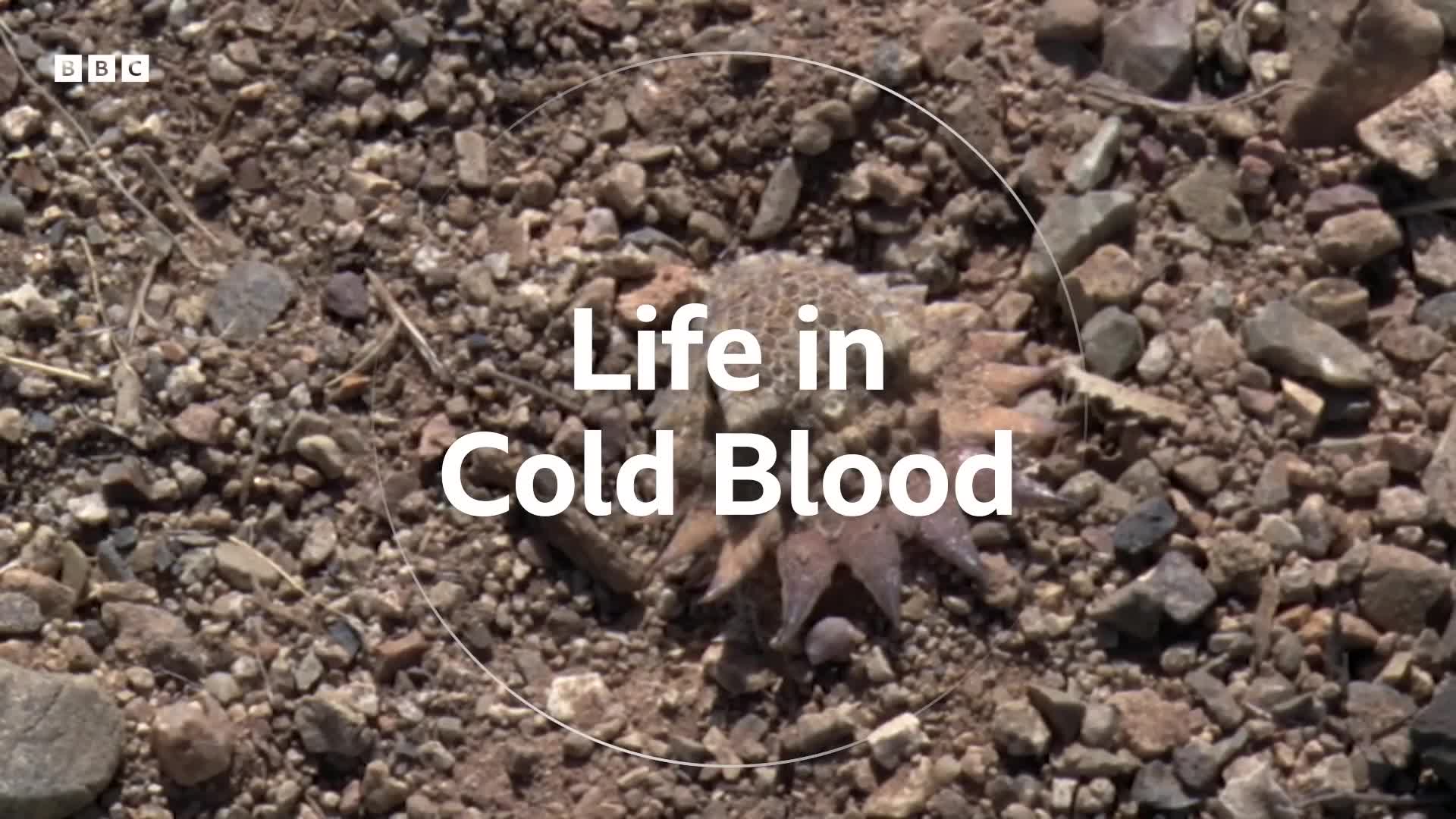
I'm in Arizona, and that at my feet is a lizard buried in the sand up to its neck.
Even while it's buried, it can use the sunshine to warm its whole body.
It can control the supply of blood to its head so that it pools in a cavity behind the eye.
Soon the blood there is as much as five degrees above the temperature of the rest of its body.
Then the animal opens the major blood vessels in its neck and the hot blood circulates so that its whole body is thoroughly warmed, even though it's still mostly below ground.
This is a horned lizard.
This particular species is called the regal horned lizard because it has this splendid crown of spikes at the back of his neck.
When he's hidden, they break up the outline of his head and so you hardly see him at all.
And now, in the warmth of my hand and in the sunshine, I guess he's warmed up quite a lot.
And if I put him down, he now, at last, may be able to run for it.
And indeed he does.
South African armadillo lizards which live on these rocky outcrops have a different solution to the problem of safe sunbathing.
They've turned it into a social activity.
Whole families of them live together in the crevices among the rocks, and in the morning they all emerge to warm up in the sun.
Of course, there is safety in numbers.
There are lots of eyes to spot danger, if it appears.
And when one sunbather takes fright, they all dive for safety.
If a predator is quick, it is possible to grab one.
But even then, an armadillo lizard is not going to be an easy meal.
Ow!
They have an additional form of defense.
They bite their tails.
The reason they do that is that it covers up their vulnerable underside and exposes only these very sharp spiny scales, which is very good protection against predators like snakes or mongooses.
And they stay like this for quite a long time before they're confident enough to uncurl.
I'll put him down and see how he does.
Leopard gecko it, like most geckos, is nocturnal and it manages to get all the heat it needs from the rocks, which retains something of their warmth for several hours after the Sun has set.
This male is in search of a mate.
She is less brightly colored.
They inspect one, He collects her scent with his tongue and discovers that not only is she female, but she's sexually available.
He's interested.
He nibbles her neck and strokes her flanks, all part of his elaborate courtship routine.
Population begins.
This is the time in mammals and birds when the sex of the young is determined, but not in a number of reptiles, including geckos.
Once again, it's temperature that profoundly influences their lives.
The female goes away to lay her eggs.
She has chosen a place where the temperature is about 31 degrees.
As her body is the same temperature as her environment, she can't heat her eggs by sitting on them, as warm-blooded birds do.
So they're exactly the same temperature as the rocks beneath.
After a couple of months, both eggs begin to hatch.
The first to emerge is a male.
And the second will be two.
It's the temperature which has determined that.
If it had been a few degrees lower, both eggs would have developed into females.
A baby North American painted turtle.
It and the rest of its clutch have only just hatched.
But it's late in the year and the chill of winter has already begun.
If the hatchlings clambered out of their hole now, they would find nothing to eat.
So they stay where they are.
MUSIC
The temperature will fall to minus 10 degrees.
Ice crystals grow around the babies and even inside their bodies.
But their tissues are protected by a kind of antifreeze.
This would kill any mammal or bird.
They remain in this deep freeze for up to six months.
But spring comes at last.
The ice melts around them and eventually within.
Slowly, they begin to come to life.
It takes quite a time for them to become fully functional, but eventually they're ready to face the outside world.
So by allowing their bodies to cool, they have avoided the hard times.
With the arrival of spring, their parents are now preparing to breed again.
The male courts the female by gently strumming her cheeks with his long claws.
And she responds.
Cold blood is clearly no barrier to affection.
In fact, reptiles can conduct as complex and as sensitive a courtship as many a mammal.
The rare and wonderful golden frog.
It does have a voice, but it's not loud.
Individual males set up their territories beside the river and then wait for females to turn up.
And since good positions for the territory are not common, they may have to hold them against intruders.
And here one comes.
Just in case his call is inaudible, he makes his message clear with a wave.
And his rival waves back.
He repeats his message so there's no misunderstanding.
But rival is not deterred.
Well, that makes things perfectly clear.
Another arrives.
Perhaps at last this is a female.
No, it's another male.
So there will have to be a wrestling match.
That should teach him.
And his rival signals submission by keeping his head down.
Where are those females?
And here she is.
She is pure, unblemished gold and much bigger than he is.
This is a South American red-eyed tree frog.
A close match for the leaves on which it habitually sits.
The eggs are not very conspicuous either, just little blobs in transparent jelly.
And they're always laid over water.
They develop very rapidly.
In less than a week, they've become recognizable tadpoles, almost ready for freedom.
Then the jelly liquefies and they simply drop into the water beneath.
But some don't survive long enough to do so.
Wasps raid the cluster and carry off the unhatched tadpoles to feed their young.
But the tadpoles are not entirely helpless.
By the time they're five days old, they know when they're under attack.
And what's more, they can do something about it.
There.
Quick wriggle, and the tadpole drops to safety.
The alarm spreads quickly through the whole cluster, and they all take a dive.
Their tails are not yet fully developed, but they can swim well enough to take refuge beneath the leaves of the water plants.
So if there's a choice between being carried off by a wasp and taking an early bath, there's no competition.
This tiny poison arrow frog is carrying his tadpole piggerback.
It hatched on a leaf and now he's taking it to a pool in a bromeliad high up in the branches.
The tadpole wiggles off.
He may have half a dozen babies, each of which he puts into its own tiny pool.
He makes regular tours of all his nurseries, checking on his tadpoles' welfare.
This youngster is hungry and tells him so by nibbling his legs and vibrating against his body.
But the male can't feed the tadpole himself.
He needs help.
He has to find a female.
There she is.
He calls.
And she follows.
He has to lead, for only he knows exactly where he deposited each tadpole.
This one is now very hungry indeed.
He calls to the female encouragingly.
She jumps in, perhaps to assess the situation.
Out she comes without having done what's required, so he keeps calling.
In she goes a second time.
This time she produces food for the hungry tadpole.
An infertile egg.
There.
Out she comes, and mother and father embrace.
Baby has its dinner.
This is the South African dwarf chameleon, a male in full courtship costume.
This, somewhat less colorful, is a female.
She is not welcoming his advances.
As her mood darkens, so does her skin.
She's driven him away, but why?
There is a reason.
She's pregnant.
Her home, the South African Cape, can get quite cold.
So, instead of laying her eggs on the ground, as most chameleons do, she retains them within her body and warms them by seeking out the sunniest places and sunbathing.
Now they're ready to emerge, alive.
Producing babies in the branches might seem to be a risky business, but the membrane enclosing each one will stick to a twig if it hits one.
And when at last the babies disentangle themselves, they immediately deploy their formidable chameleon grip.
By the time they're properly dried out, the babies are as much at home in the branches as their mother.
Lizards, for the most part, are not known for being caring parents, but there are exceptions.
It's spring in the woodlands of North America.
An American robin is nesting, warming her eggs with the heat generated by her own body.
And below on the forest floor, a five-lined skink is warming her cold-blooded body by basking in the sunshine, so that she can do the same thing.
She has a nest below the log.
It can get quite chilly in these woodlands, and she warms her eggs by transferring to them the heat that she's collected from the sun.
She takes just as much care of her eggs as the robin does.
A month later, and her eggs are hatching.
The robin's eggs have hatched too.
Her nestlings are helpless and need constant feeding.
The young skinks, however, are already capable of finding food for themselves.
Within a day or so, they've left their mother and are independently exploring the woodland floor for themselves.
A female catches the eye of a male. he starts to follow her wherever she goes.
Couples stay side by side for up to two months.
He courts her by gently nudging and licking her.
Six months pass, and then, eventually, the results of this prolonged courtship begin to arrive.
It's a long and strenuous business for a mother shingle pack.
She produces not a small egg like the five lion skink, but a live baby.
It's a whopper.
And there's another one to come.
Together the two weigh as much as a third of her body weight, the equivalent in human beings of carrying a three-year-old child.
There's a mouse just along that log.
That obviously came to nothing, but the cameras have started recording again and the snake is moving.
He's checking out the trail with his tongue.
See, that's exactly where that mouse was running.
It's pitch dark and the mouse clearly has no idea that the snake is there.
But the snake is well aware of the mouse, thanks no doubt to those heat detecting pits.
A snake strikes by suddenly straightening the curve in its neck.
But at the moment, the mouse is not within range.
He's getting himself properly adjusted so he can strike when he next gets a chance.
Now once again, waiting.
Oh my goodness.
That's a dead mouse, all right.
Slow down that shot, and you can see that the snake stabs the mouse just once.
After three convulsive kicks, the mouse is dead.
Snake is moving again.
He's going back now to look for the one that he knows is dead back there.
Where is it?
Ah, now it looks as though he's really got it.
That's his tail.
And that can last him for three weeks, four weeks, if necessary.
To see just how important scent can be to a snake.
I've come here to Karnak Island, just off the coast of Western Australia.
It's home to a large population of highly venomous tiger snakes.
Snakes have been established here for many years, but there's something odd about this particular population.
Many of them have damaged heads, and some of them are actually blind, like this one.
And yet, puzzlingly, in spite of the fact that they're blind, they all appear to be very well fed.
So how do their heads get damaged?
And how, in that condition, when they can't see anything, can they catch all the prey they need?
The snakes, of course, are not the only inhabitants of the island.
It's also home for a large colony of silver gulls.
The gulls breed throughout the year, so their chicks are a source of food for the snakes.
That never ends.
In fact, the snakes eat pretty well nothing else.
But the snakes don't get it all their own way.
The gulls are valiant defenders of their nests and their chicks.
Their stabbing beaks are powerful, sharp, and strong.
And the gulls always go for the snake's head.
One in 10 of the snakes are totally blinded.
Tiger snakes don't have those heat sensitive pits that rattlesnakes have, so these blinded hunters must be guided entirely by their forked tongue.
It's a superb direction finding device.
The snake can measure the strength of the smell separately on each of the two forks of its tongue.
And if it wishes to follow up a smell, then it simply detects the one which has the strongest smell and goes in that direction.
Gull chicks are an ideal prey for a blinded snake because they're programmed to stay on their nests.
Once a snake has located it, a chick is doomed.
And in the eastern United States, many rivers contain crayfish.
Like crabs, they have a hard protective shell and they have particularly powerful pincers as well.
The queen snake, however, eats crayfish and nothing else.
But not just any crayfish.
It's very selective.
Crayfish, as they grow, shed their armour.
Every three to four weeks, a split appears across the back of its shell.
The old shell hinges away and the crayfish hauls itself out and expands its body, which is soft now that the snake has its chance.
A newly-molted crayfish looks much the same, but it gives off different chemicals that the snake can detect in the water with its tongue and from some distance away.
It can swallow this crayfish because, since it's newly molted, it's as soft as a boiled egg.
This is a giant Galapagos tortoise and it's climbed all the way up the flank of this great volcano and is here wandering around the rim of the crater.
But why should it come to such a bleak and inhospitable place?
Tortoises, being reptiles, can't generate their own body heat internally, as we do.
Instead, they must get it from their surroundings.
And these particular ones have come up here to warm themselves on the hot volcanic rocks, among the jets of steam and sulfurous gas.
They live longer than any other animal on Earth, well over 150 years.
They weigh up to a quarter of a ton and have shells over a meter across.
They really are giants.
Having a body encased in shell obviously brings problems, and one of them is how do you mate?
Making love in a suit of armor is not easy.
But the males have a very ingenious solution.
The underside of their shell is concave, so it fits neatly over the domed top of the shell of the female, who is somewhat smaller.
That doesn't make clambering on top of her any easier initially, but once the male is up there it will reduce his chance of slipping off.
The two shells fit together as neatly as two spoons.
So mating can begin.
And once started, it can go on for a long time.
The most aquatic of all freshwater turtles is found in New Guinea and a few rivers like this one in northern Australia, the pig-nosed turtle.
Its feet have become completely transformed into flippers and are of little use on land.
And indeed, the pig-nosed turtle rarely comes ashore.
But turtles are descended from land-living ancestors, and so they still need to breathe air.
Females also have to return to land in order to lay their eggs.
Pig noses nest during the dry season, high up on the riverbank.
If turtle eggs get wet, the babies inside them will drown.
At least, that is the case with most turtles.
An egg for a turtle. represents a huge investment, as it does for any reptile.
So turtles go through a great deal of trouble to make sure that they lay their eggs in safe, dry places.
So you would think that dropping one into water would be a disaster.
But watch. fully developed baby turtle.
And it's come from an egg which, as far as we know, is unique in the reptile world.
It can not only survive being flooded, it actually requires to be submerged in water in order to hatch.
The water that has kept them safe until now is beginning to dry up.
Each year, in the space of a few short months, the llanos is transformed from a flooded paradise to a baking oven.
For some babies, the unrelenting heat and the lack of water has already been too much.
Any babies that are left alive will certainly die if they stay here.
So the mother decides to leave.
Calling to her creche, she sets off across the parched land.
In one long cavalcade, they march onwards in search of permanent water.
For the mother, this is certainly exhausting.
For her babies with their tiny legs, it must be a real marathon.
Some start to fall behind.
But she stops.
The babies call constantly.
She knows exactly where they all are and waits until every single one of them has caught up.
Only when all are with her will she set off again.
At last, safety.
The babies are close to exhaustion.
Without such devotion from the female, few, if any, of these baby caiman would have survived.
And remarkably, most of them aren't even her own.
When parental care was first described in crocodiles, the reports were dismissed as too extraordinary to be true.
We may call reptiles cold-blooded, but they can show great tenderness.