On the ThruLine podcast from NPR, the story of the undersea cables that run the internet.
Other historians have compared it to the Apollo missions of going to the moon.
Listen to ThruLine in the NPR app or wherever you get your podcasts.
You might already be familiar with Hedda Gobbler, the classic Henrik Ibsen play.
It's about a woman bored with her dull husband and who devilishly manipulates the affections of everyone in her orbit.
Well, the intoxicating new film Hedda, starring Tessa Thompson, is not your grandmother's Hedda.
It's sexy, chaotic, and above all, messy as hell.
I'm Aisha Harris, and today we're talking about Hedda on Pop Culture Happy Hour from NPR.
This message comes from Paramount+.
Streaming November 16th on Paramount.
It's The Return of Landman from Taylor Sheridan, co-creator of Yellowstone.
Academy Award winner Billy Bob Thornton is back, featuring an all-star cast including Academy Award nominees Demi Moore, Andy Garcia and Sam Elliott.
Tensions come to a head as Thornton's Tommy and Moore's Cammy Miller struggle to maintain control of EmTech's oil.
Landman, new season streaming November 16th, only on Paramount+.
Hey, I'm Daoud Tyler-Amin.
And I'm Anne Powers.
We are an editor and a critic at NPR Music.
And we're also friends who love digging into music histories and thinking about how songs can change over time.
And we're doing that on a new show.
We're totally nerding out about the songs that just stick with us and why.
Find our first episode in the All Songs Considered feed on October 23rd.
Families around the world aren't having as many kids as they used to.
Researchers say the average woman is having half as many children now than they did in the 1970s.
I love having only one child.
On the Sunday Story from Up First, why are so many families making this choice?
And what exactly does it mean for our future?
Listen now to the Sunday Story on the Up First podcast from NPR.
Hey, it's Ray from Car Talk.
Are you tired of all the depth and thoughtful care that goes into NPR shows?
Want some good old-fashioned goofing around and stumbling to figure out what's going on?
Well, I've been taking occasional car questions again.
You can hear them by signing up for NPR Plus, along with lots of other bonus content.
Just go to plus.npr.org.
Joining me today is culture commentator and co-host of the iHeartRadio podcast High Key, Ryan Mitchell.
Welcome back, Ryan.
Hi, so happy to be back.
Lovely to have you here.
Also with us is Soraya Nadia McDonald.
She's a cultural critic, journalist, and the senior criticism editor for The Rumpus.
Hello, Soraya.
Hello, hello.
Lovely to have you both here.
This is going to be a fun conversation because this movie is fun.
Dark, but fun.
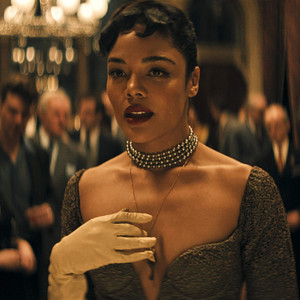
So Hedda's set in 1950s England and stars Tessa Thompson as Hedda, a general's daughter.
She's recently wed George Tesman, an academic played by Tom Bateman, and convinced him to buy a sprawling estate they cannot afford.
Filmmaker Nia DaCosta makes some bold changes in this adaptation and sets almost all of the action during a lavish party gone awry.
And a guest list is an assortment of characters from George's stuffy professional world and Hedda's bohemian social circle.
You want to meet my friends?
I'll meet your colleagues.
I have friends too, Hedda, don't be rude.
It's your friends, your friends.
Trust me, George, they're well-behaved and well-bred, and Greenwood will love them in you, by extension.
Yes, well, you'd better hide.
One guest is Eileen Loveborg, played by Nina Haas.
Eileen and Hedda once had a rocky romance, and they obviously still have some unfinished business.
And it so happens that Eileen is up for the same university position as George, which gives Hedda all the ammunition she needs to maniacally orchestrate the evening for her own selfish benefit.
It's streaming now on Prime Video, which means we should mention that Amazon supports NPR and pays to distribute some of our content.
Ryan, I'm going to start with you.
Did you enjoy your time at this fabulous soiree that we have here?
I have two words and it's queer icon.
Hedda, this film is just so, so good.
You know, as someone that didn't know, this film was reimagined from a play.
I thoroughly enjoyed what was done here.
You know that moment where you can just tell when a director loves working with an actor?
Yeah.
You know, Nia DaCosta and Tessa Thompson really just speak the same language.
And I think it's really, really noticeable.
And I love seeing what they create together, right?
I think that's, for me, starting there.
But Hedda is just a fun, pure chaos, queer icon.
Y'all thought y'all liked Megan.
Nah, this is the girl that we should be celebrating.
I need Hedda all over the billboard.
Hedda for pride, 2026.
It's too late for the costumes to happen for Halloween this year, but maybe for next year.
Absolutely.
Yes, yes.
Soraya, how are we feeling?
I mostly enjoyed this.
As Ryan pointed out, I love seeing Nia and Tessa work together.
Nia really seems to have an eye and an ear on for places that Tessa can stretch, because it's a period drama tragedy comedy, all of the above.
It is, I think, impossible to watch this film and not think of the partnership between Emma Stone and Yorgos Lanthimos, particularly because so much I think the production design and stylistically kind of evokes that vibe that people love so much about the favorite.
Yeah.
And also the way Tessa and of course Hedda as a character really embodies the this sort of enfant terrible characterization, that exploration of what happens to a woman who is infantilized by her circumstances, by patriarchy, by everything, and the way folks lash out when they're sort of confined by that.
Yeah.
It's interesting that you mentioned Yorgos Lanthimos and Emma Stone, because when I think of that partnership, I think of just all the suffering that that director has inflicted upon that actress, whereas Absolutely
I mean Hedda inflicts a lot of suffering on other people but, like I mean, she's suffering in the ways that, like you, would expect a Black woman in the 1950s to suffer, but not to the extent of like begonia or something.
No, not begonia.
I also understand that sort of dynamic and, to speak to both of your points of how, This is a movie where, like you, can tell that the director really has locked in and that the star has locked in and they have this sort of symbiotic relationship.
Their first partnership together was Little Woods, which is like a radically different movie from this.
And that was Da Costa's first feature film as a director.
That's a very small film.
It's very insular, indie.
And now we have both of them going big with this film.
I mean, don't forget the Marvels, please.
I know everyone hated it, but I loved it.
It was a good time.
All right, all right.
Okay.
It was a fun also stretch to the other side.
Yeah.
That's true.
That's what I find so fascinating about Nia DaCosta as a filmmaker, because every movie she's made so far and she's made four, plus she has the 28 years later franchise.
That's her next one after this.
But every movie has been radically different in terms of vibe and genre.
And to me, this is her most successful thus far.
I love how she stretches what this story can do and how she makes it so that this is set in the mid-century England.
You have Tessa Thompson, who I think is just fantastic in period pieces, period.
Like Sylvie's love passing.
Gave it all to me.
All of them.
And I love sort of like the fact that Tessa understands that Hedda herself is a performance.
Like she is someone who is an outsider.
And one of my little quibbles, and this could have been speaking to me like where I was when I saw this the first time.
I've watched it twice now.
And the first time a lot of little details about Hedda kind of rushed by me and I didn't quite understand Hedda.
Yes.
Yes.
Let's talk about that.
I'm so happy you brought that up because for me, it also took twice to watch this.
One, I want to start with the accent work.
I think what Hedda's overall doing is fine, but it was a little rough to understand some of the dialogue, except for the second time when I was really able to like oh, tie in these really important plot pieces together to what was actually happening in the story.
And I think really succeed is how she portrays the nuances of this character, right?
Especially being that this character is no longer in its original state, being a white woman, but is actually a mixed race woman.
And a bastard.
Yeah, an illegitimate daughter of a highly respected general born into society.
Yeah.
Right?
And what I did feel like was lacking.
What I wish was painted more in the dialogue was how this 1950 world, that they were set in a loud that to happen, because it's not like she's passing.
You know, this is a black woman, like she knows that, and I think the world felt a little raceless at times and you had to really pay attention to those specific moments that recognize those intersectionalities.
I feel like they were centering the fact that she was a woman and a queer woman, but really nothing else, like I feel like oftentimes I felt like her blackness were in the fine print instead of like out loud, and I don't know if that was a choice by Tessa in the way that she acted it out, or if it was a choice for Nia in the dialogue to like.
You have to actually like work to understand what this film is doing.
Like you can't just be a passive viewer.
No, I do think some of that is very subtle, but in a way that I appreciate, particularly going back to what you were saying about the fact that Hedda herself is a performer,
So when you think about that accent, I mean, it's so posh.
It's posh in that way that there's that hint of I don't want to say overcompensating, because it's not quite that.
But you hear the way that she is kind of like arguing that she belongs in this setting, in the way that she's enunciating.
It sounded to me more like a transatlantic accent that you would hear an american hollywood star from that era do like.
It's very katherine hatburn best time to leave parties after something terrible's happened, but before the police come, And I don't know if that was a deliberate choice or not.
For me, it worked.
And to me because this is a performance and she's so on the outside.
That's how I kind of justify it in my head.
But I can also understand how someone might be like, this doesn't, it's hard.
There's a lot about this film that is so, I mean, I hate to use this buzzword, but it's so camp.
And I think that takes notes in the performance, right?
Like, there's moments where it's deeply unserious, but then it strikes you back in.
And like I think Tessa does a really great thing with Hedda in this overarching question that I feel like the film is asking.
Like, what do you do...
With freedom, what does freedom actually look like?
We caught glimpses of her in those moments of freedom and then she was able to reel it back in and realize, like I don't want anyone else to catch me in this moment or ever catch me slipping as, like you know, we would say, at the kitchen table.
In a lot of ways,
And so it's so interesting.
There's so many nuances of this performance that are just really thought were great and some that was like, oh yeah yeah, there's that tension of being to the man or born, but the wrong way.
Yeah, it's interesting to me because, like i kind of liked how subtle some of the details around her race were, like it didn't quite clock for me.
I was a little confused as to like, was her father a white man or not?
Like the first time around i was like i'm not sure, like you would expect it to be, but I also didn't want to presume because there's, we know how history goes.
Like we say, these things never happened.
But then we learned Oh, actually a black person invented that.
Or like an Asian person did this for like, we learned these things.
And so I didn't want to assume, but I feel like where it really comes out.
One moment is where she's talking with Eileen and And Eileen is saying like I'm disappointed in you.
You could have, like, been more than just someone's wife.
You could do anything.
Like what?
Become a professor?
Tell me, how many women are at the university teaching?
Two.
And they're both white, I presume.
Whatever.
It's like, of course, like, her options are limited.
And then there's also her dynamic with Judge Brack, who is played by Nicholas Pinnock.
And he is the other black person in this movie who has the most time on screen with Peta.
I refer to this dynamic like oh, this is like Addison DeWitt to her, Marco Channing and all about him.
He is the acerbic, like, I know everything.
I know your game.
No one else may be willing to admit it, or maybe they're too in love with you to understand, but I know you.
I've helped you buy this house.
There's all these little things that come up and the way that dynamic plays out.
He knows her the best, in part because he's the other Black person with some sort of power in that room.
To me, that subtlety is what I liked about it.
I loved that relationship.
It's so twisted.
Oh, yes.
You made the safe choice.
The only choice, really, for someone like you.
Nothing you can do now.
Just play the part and stay out of trouble.
There was something very sort of like Chuck Bassian about him.
Yes, yes, yes.
I mean, what do we think of Nina Haas as Eileen?
Because Nia DaCosta had switched the gender from Eilert in the original text, who is a man, to Eileen.
And so you have that.
You have this love triangle, romantic triangle sort of, with Imogen Poots playing Thea, who is like Eileen's sort of academic partner but also a romantic partner.
And you know Ryan, you mentioned sort of like this idea of this movie as a queer, like queer icons all over the place.
And I'm curious how that dynamic played out for you here.
I thought it really worked.
One thing that I really loved about this film is the fact that, regardless of the time period, it's just yet another way of saying that queer people are always here and we simply existed throughout history and time.
And I think that's really important now more than ever to like really pinpoint that.
And I think this film does this really well, right?
It shows the complicated nature.
And I know I keep using this word, but it really does continue to ask like what does it mean to be fully free or courageous?
And I think we even get to see that relationship to that, where Eileen ultimately held a lot of complicated feelings around who she was and the life that she was living, ultimately right.
For her being sober now and getting away from Hedda because it clearly was a toxic mess.
And honestly, who can't relate to a toxic relationship?
Tessa was so good in that dance scene where she first sees Eileen.
Oh my goodness.
And then that dolly, the Spike Lee dolly shot.
With that floating dolly, honey.
Oh, the floating dolly.
There's something there about being like, a closeted queer person.
And I keep just resonating with the fact that we see these moments and pieces and glimpses of Tessa, being able to like show, this release of emotion at times, but then reeling it in.
Because often, as a queer person, if you're closeted, you're looking around you trying to make sure that no one is clocking you.
And I think...
With that nuance and then like the unbearable hold that Eileen also has over Hedda, right?
I mean, Hedda almost shot this woman.
She almost shot this woman.
Chaos, chaos.
Why didn't you shoot me back then?
When you left.
When I left.
Because I knew you really wanted me to.
I really appreciated a lot more of the nuances that I think this film was able to have because of that gender flip, because of the queerness that was completely a part of the DNA of this movie.
And I think it works because of Nina Haas.
Absolutely.
The presence that you just cannot get away from every time she is on screen.
I mean, your eyes just go straight to her.
And that magnificent cleavage, you know, certainly helped.
The way that cleavage plays a role in this critical point in the plot.
Hedda, ultimate mean girl.
My goodness.
Oh, yeah.
I was like I literally screamed and said Hedda, you are dead wrong for sending her into that room like that.
Like, Hedda is, she's quite selfish.
She's devious.
She's always choosing chaos.
But I do feel like she's ultimately making the choices that she's making out of survival.
And at some point, I think, she got addicted to the chaos and quickly became bored and resentful of the life that she actually wants.
This is all happening because you wanted it.
The house, the party, a lot of money and effort was expended for you.
I hope you're happy.
There's a lot of things that she's chosen, that she's dealing with the consequences of those choices.
Unfortunately,
Absolutely.
I mean, I think she knows deep down inside that she will never be one of them.
Yeah.
Truly.
Like they will never accept her fully.
No matter, she says, like the only thing my father left me were these guns.
Guns.
The guns.
And it's like both.
I mean good for you girl, because guns are powerful, but also like presumably, his other children or whoever like.
They still have their place in society.
And here she is with this like lowly, boring, but hot, but boring husband who is an academic.
And one step away from a panic attack.
Oh my goodness.
And clueless.
Lord have mercy, that poor man.
So anxious.
You know.
The other thing, I think, is how much this film's existence I feel like I can sort of track.
It's meant to be in the world because of all the things that it's pulling from that you can sort of see.
Get us here both in terms of like historical works, right.
Because it's an Ibsen adaptation.
Yeah.
And the fact that the themes, that it's dealing with these deeply unsatisfied women who feel trapped, because that's also right.
That's a big part of A Doll's House, but also Mrs Dalloway.
But also, you know, you've got sort of like the chaotic elements of Who's Afraid of Virginia Woolf.
Yeah.
It's also sort of standing on a foundation of, I think...
I was thinking about Belle.
Oh.
I was thinking about Mr. Malcolm's List.
It feels very stylized and contemporary, even though the setting is 1950s Britain.
That feels like shades of salt burn.
Yes, that house.
Absolutely.
What speaks to me and what I love about this is knowing that I grew up as a Black girl in a small town in North Carolina.
And I watched a lot of PBS dramas, like so many.
And so there's this way that Tessa gets to be in her career that I find so alluring.
And I'm so happy actually exists.
Do a Bronte adaptation, right?
Do George Eliot.
She makes the argument for more of these things and the fact that they need to exist, right?
When we think about period dramas, and British period dramas in particular, there's a way that we either think that Black folks are just supposed to be absent from those canonical stories, or that you have to notch it up to such a degree that it's Bridgerton.
And I think this is a little more mature now.
Yeah, it splits the difference.
This is a play that's been done so many times, countless times.
It's such a as part of the canon, like so important for so many previous actresses, right as establishing sort of their bona fides.
I mean it's so reductive to be like oh, it's female Hamlet, even though I understand what they mean.
No, I think that's pretty accurate, though.
What is her Hedda Gobbler?
What did she do with it?
I just want to see more work from Tessa.
Just throw it at her.
Give her everything, because she can just do so many things.
Tessa deserves all the things.
She's got the range, and I don't think we talk about it enough.
But we've talked about it plenty here, and Hedda is absolutely something you should definitely check out.
And the production design is divine.
Oh, and so was the costume design.
Everything.
The costume design, production design, the score.
Everyone was just working together symbiotically.
And I love it here.
Absolutely.
Well, tell us what you think about Hedda.
Find us on Facebook at facebook.com slash pchh.
And on Letterboxd at letterboxd.com slash nprpopculture.
We'll have a link to that in our episode description.
That brings us to the end of our show.
Ryan Mitchell, Soraya Nadia McDonald, this was so much fun.
Thank you for being here.
Thank you so much.
This was such a pleasure.
Thank you.
This episode was produced by Liz Metzger and Mike Katzeff and edited by our showrunner, Jessica Reedy.
Kahlil Kamin provides our theme music.
Thanks for listening to Pop Culture Happy Hour from NPR.
I'm Aisha Harris.
We'll see you all next time.
I invite influential thinkers to open up about the big topics we all think about but rarely talk about.
Tune in this fall to hear Mel Robbins, Malala Yousafzai and Brene Brown talk about everything from grief and God to ambition and forgiveness.
Watch or listen on the NPR app, YouTube, or wherever you get your podcasts.
Hi, it's Terry Gross, host of Fresh Air.
Hey, take a break from the 24 hour news cycle with us and listen to long form interviews with your favorite authors actors filmmakers, comedians and musicians the people making the art that nourishes us and speaks to our times.
So listen to the Fresh Air podcast from NPR and WHYY.
On this week's Books We've Loved.
We're headed to the open range with Morning Edition's Michelle Martin.
To break down, Charles Portis' classic true grit.
Find Books We've Loved in NPR's Book of the Day.
Podcast feed on the NPR app or wherever you get your podcasts.