Discussion keeps the world turning.
This is Roundtable.
When looking for stuff to buy these days, most of us turn to online shopping platforms like Taobao or Amazon on our phones and tablets.
But do you know that there is a tropical island in China where you can browse hundreds of thousands of consumer products from more than 4 ,000 brands?
That will also inspire an endless shopping list. I'm talking about the Fifth China International Consumer Products Expo to which we sent our reporter, so we will bring more to you on today's show.
Hello, I'm Lai Ming and you're listening to Roundtable Today with Steve Hadley and Yu Shan.
We talk about extraordinary things to see at the Fifth China International Consumer Products Expo.
We begin with Yu Shan and how about you give us a very brief intro of what this is all about.
Oh, wow, I'm so excited to hear more about this whole exhibition.
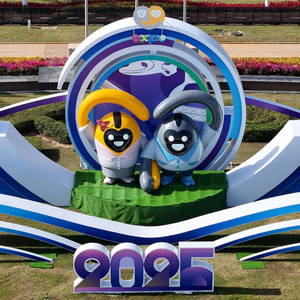
This is the fifth China International Consumer Products Expo that is held in South China's island province of Hainan, as you mentioned, Laming.
As China's only national -level exhibition that's focusing on consumer goods, this year's edition of the expo emphasizes innovation and global collaboration, and it aims to become Asia Pacific's largest consumer goods expo and that's to bridge global brands with China's market and also highlighting Hainan's role as a key free trade hub that welcomes just participants and companies and brands from all over the world as it's being demonstrated right now in Hainan.
This is the introduction that I found from one media outlet.
A seamless integration of cutting edge technologies into daily life is taking center stage, painting a vivid picture of a smarter more interconnected future.
That sounds pretty good.
Yeah, sounds fascinating.
There are more than a couple of expos going on throughout the year in China.
The China International Import Expo, the latest also a new expo on supply chains, and there is the in Beijing, there is the annual Expo for Trading Services, But, the thing I would like to highlight about the consumers' products in expo is that, as the name suggests, it's focused on consumer products.
Therefore, unlike, for instance, the International Import Expo, where you can see a lot of commodities and very huge gadgets and equipment, very fascinating robots, even cars and helicopters, this is more like consumer products, you and I, that can come into contact and as such, there's a lot more to see.
And we've sent our reporter Song Ruixing to the island province of Hainan and this is what she has to say upon her first impression.
Well, I'm not sure if the healthcare sector at this year's Consumer Expo is the biggest in terms of floor space, but it's definitely made a strong impression.
I mean, compared to sectors like electronics or lifestyle health care had a more focused presence, I mean, the quality of exhibitors and the level of interest from visitors were both high.
I think what really caught my attention is the international presence.
I saw health care brands and organizations from places like Switzerland, Ireland, and there's Australia, yeah Ireland, Australia and all showcasing different strength from From medical devices and supplements to biotech and digital health solutions, it was really clear that they weren't just there to display products but also looking for partnerships and opportunities to localize for the Chinese market.
There were also quite a few traditional Chinese medicine companies, some of which are clearly aiming to modernize their image and go global, like Pianzai Huang.
on. The setups were not very massive, but they were well -designed and interactive, which really, I think, helped with engagement.
That was Songrui Xun with an overview of the CI CPU.
There's a lot to see.
I think she had managed to highlight the healthcare sector at this year's Consumer Expo.
That seems to be the biggest in terms, well, not the biggest in terms of floor space, but it's definitely attracting a lot of attention as international companies and brands come and join on the Hainan Island.
A little bit more details on this?
Yeah, I mean, the total domestic consumption market for health products is definitely on the rise and no wonder it's attracting a lot of attention because, well, it is indeed expected to reach 10 trillion yuan and that is 1 .37 trillion U .S. dollars in 2025.
It's a growing and booming market and it may reach 16 trillion yuan.
That's 2 .2 trillion U .S. dollars by 2030 with more young people entering this consumption of health and beauty products.
The data I just said, that's from a recent report from China National Radio, but we also hear what Ruixin mentioned just now, many brands.
I heard Pian Zai Huang is a I think it's a Hong Kong SAR brand that I used to shop a lot when me and my family traveled in Shanghai.
What does it do? I think it helps reduce your throat and it helps clearing up the throat and breathing system's health.
So it's something that's very popular in say the southern area and now it's also popular in the Chinese mainland and now it's being promoted as a consumption product being introduced to the whole world, too.
That's very interesting.
And also consumers' demand for healthcare is becoming increasingly strong nowadays, as well as various elements such as the increase of income, the changes in consumer attitudes, the influence of social media, of course, technological advancements as well as policy supports all have collectively promoted this upgrading of beauty and health consumption among young people?
Yeah, we've talked about it on Roundtable before, I think, when we were talking about the beverages industry, and that was just one example of how healthcare products were seeking their way into drinks for people to enjoy, and they became really, really popular.
So, these numbers that you shared are not really surprising.
and I think that the products showcased at the expo, the health care products showcased at the expo, are also evidence that these are necessary in the market and they're popular in the market.
One example would be a continuous glucose monitor, another example would be light therapy glasses.
Lai Ming, have you ever worn light therapy glasses before?
I never wore glasses, I'm not near -sighted so I only wear glasses when I drive too but these are more like...
These are more like goggles I believe, I don't think you'd wear that when you were operating a motor vehicle.
I hope not. But these examples spotlight the combination or the fusion of tech and well -being.
Brain -computer interfaces that's something that pops up in the news a lot these days.
They've and accessibility.
Then you've got other companies presenting smart health ecosystems at the event.
There are massage, AI massage robots.
That sounds. I can use some of that.
It sounds okay. Can we get, can we get one in the office as a matter of fact.
Oh yeah please. We could, we could all pitch in and perhaps we buy one.
There's another company from Canada.
That's, it's a company that proposes non -medicinal sleep solutions.
they introduced a product called DeepSleep Cabin, that's where they use charged particle waves to create immersive rest environments, I'm not sure how that science works, but as you mentioned before, Leiming, we're talking about products that apply to every day consumers, whereas the other expos that happen in the country during other parts of the year may not be so focused on the direct consumer, but these products definitely are.
So now, people's awareness and attention to healthcare has improved.
No longer are we in the age of goji berries and green tea as the only means of health care.
So what are people really looking for on top of these high -end products that Steve just mentioned being displayed at the Consumer Products Expo?
As a young people, as a young person Yuxian, what stuff that you generally look for when you browse the online and shopping platforms, what will catch your attention?
Yeah. I, as a young person, thanks for referring to me as young even though I don't define myself like that.
I'm not sure why I got left out of that description.
Exactly. Christine held grudge for not calling her, for me not calling her young members of the team.
Thanks. Just to answer your question, actually when I look into the healthy trend regarding the consumption preferences in general, I see that a lot of say, younger generation here in China, they focus on healthy food products.
And that's not just me saying that's, well, also according to a recent China daily report, that on the first day of the expo, the CP group and two other entities signed a strategic cooperation agreement marking the first contract signing of the expo with a project scale of 4 .38 billion yuan.
That's 600 million US dollars.
So this very project aims to provide strong support for elderly health and chronic disease recovery through scientific diets and precise nutritional intervention.
That's something that's, well I mentioned elderly care, but it's also something that young people are looking into as well.
How to recover from chronic symptoms, not necessarily diseases, but how to just maintain a long -term health for themselves.
One very interesting example is a brand called Na Ngo food, I'm not sure if you've heard of that, lime -ing, it just raises so much childhood memory.
I think that's a brand that's older than I am.
I remember eating the candy from their brand and also they I think they make coconut -flavored candies.
Yeah, that's a popular hai na local brand that's known for innovative snacks made from local ingredients, coconut, durian, fruit, and they make just very sweet and very popular snacks among children.
So I'm mentioning this brand because their chairman mentioned upon the interview that Their company even that old name brand will also develop healthy food in the future Well this guy the chairman said that the company has always tried to use local raw materials like coconut coffee Chili and pepper to develop healthy food with the their local say style and flavor But at this year's Expo they also aim to put in some dietary nutrient products.
I hope that's not too much artificial and they remain their good old style of using the traditional or rather the real flavor of the local food.
And don't make it too scientific as as we talked about but it's good that even brands as such as snacks and candy brands they're trying to just go towards that direction as well to modify their products to become healthy or say more healthier in a way.
Yeah some food and beverage companies they're adding traditional Chinese medicinal herbs into snacks and drinks too.
That's from the food side of things how about a little bit from the fitness side of things Impulse Fitness they have brought a full range of indoor commercial fitness equipment and they provide smart fitness solutions.
There's an intelligent body measurement machine.
That sounds like something I would use once, be disappointed with the results, and put it in my closet for years to follow.
You should have faith in technology, they advance!
I'm worried how honest it would be, probably 100%.
That's your concern, I understand.
They have body indicators that include physical fitness and even posture, which is a pretty cool measurement.
They have tailored fitness prescriptions.
They call them fitness prescriptions, which is quite clever I think.
Those are generated according to the user's physical condition.
And when someone starts to exercise smart devices will analyze personal data.
They will recommend suitable exercise courses on the screen interface.
And the product manager Li Zhanjing said that more intelligent fitness equipment can help achieve more scientific weight management.
I've seen these types of products before and I think there are a few different benefits one of them is just the cool tech factor right the compared to your traditional gym where you go in and it's kind of boring for many people right and you get bullied by the coach yeah you can't yeah depending on who your trainer is I suppose but the other thing is that they they make these machines either inspirational in a sense or they distract you in another sense.
I've seen cycling machines that will put the user almost as if they're on a real course, and that just makes it more interactive and competitive.
But that's good for your own motivation, right?
So those types of advances in exercise equipment technology can really help out with people achieving their fitness goals.
That's just my opinion.
So there's plenty of potential to be tapped in the consumer products market in terms of health care.
According to an earlier article by Chinese financial news outlet Yicai, the health industry consumption trend development report released by the China Consumers Association in August 2024 revealed that the total revenue of China's health industry in 2024 has approached 9 trillion yuan, and according to the Healthy China 2030 initiative, China's health service industry is suspected to reach 16 trillion yuan by 2030.
So things to look out for at this year's fifth China International Consumers Products Expo.
There are also other consumer trends that our reporter Sung Ruixin has spotted as she's currently in Hainan and let's see what she has to say.
So it's not just about cheap or basic stuff anymore.
People want things that are natural, organic -safe, and actually good for them.
So they are reading labels, asking where things come from and really caring about how products are made.
So now they've got more money to spend and they want to spend it on stuff that helps them live better.
It's like clean food, trusted supplements, and all that wellness lifestyle stuff.
For the future, it looks like this trend is only going to grow, so brands that are honest, sustainable, and can really show their quality are going to stand out.
So if you are a company offering high quality health -related products, especially from abroad, you've got a good shot but just gotta localize a bit and make sure people really get what makes you different?
Well, we just mentioned a lot of stuff that the average consumer might want to be interested in at the Consumer Products Expo.
I think that's rightfully so, but I also think the expo can be attractive to international brands and countries and traders as well because, well, China is an open market and is becoming more open as we speak and is not threatening to slap 10 percent over or tariff for any country that's dealing with.
And the Chinese citizens, they generally have more savings as compared to some Western countries who may have problems. And also the borrowings of the country, the bonds, a lot of the borrowings and treasury bonds or stuff, they are somewhat invested and they are funded.
They're used to fund infrastructure investment and that such. So you can expect some return, actual return based on investment.
I think there's a lot of potentials in the economy of China.
As such, I think at the Expo, we're now seeing a lot of international traders and companies trying to really graph the size and the significance of the Chinese market.
An estimated 71 countries and regions are participating in the expo showcasing over 4 ,100 brands, including 65 Fortune Global 500 companies and industry leaders.
And so, I'd just like to expand our discussion more on the impact of it on international trading.
Yeah. Britain is actually this year's guest country of honour and they are occupying over 1 ,300 square meters to display 53 different brands, and those brands cover a lot of different things.
There's fashion items, beauty items, home goods, there's luxury brands recommended as well on display.
There's even a company that has their cycling gear.
So yeah, the UK is well represented this year.
And here's a quote from Douglas Alexander, he's the Minister of State of the UK's Department for Business and Trade.
He said I've seen the tremendous innovation and growth taking place within China's economy in recent years not least in digital technologies life sciences and Green energies and these areas present significant opportunities for both economies He said he emphasized as well the UK's commitment to deepening economic ties with China And that's just obvious, isn't it when we have a quote like that from the?
from the minister of state from the Department for Business and Trade how important the relationship is and how important the relationship will be in the future right and the UK is not the only country that's being attracted to the expo we also have representatives from Switzerland and our reporter we seeing found had a chance to speak to a counselor of Embassy of Switzerland in China head of Swiss business job hub on the strengths of Swiss companies in China and and the person being interviewed is Joe Serena.
Well we see that as as global supply chain evolve Switzerland sees a new demand for quality traceability and innovation and this is basically the core strengths of Swiss companies and Swiss goods.
And of course sector like precision manufacturing, medical technology and nutritional science also, and sustainable consumer goods are growing very fast in Charlotte.
Here at the booth we have 11 Swiss brands who are representing companies from the various sectors of the economy.
We have companies who are in the in the healthy living industry, we have food and beverage, we have home appliances, we have really life science, also products which are coming here and cosmetics.
So this is a place where we actually bring those products.
So the companies and businesses in China and in Switzerland and other countries they can be complementary but we are also pretty much aware that the landscape and the dynamics of international trade is somehow shifting not only because of the tariffs being threatened but also because well the economies and the market's entities they are evolving and China is becoming more competitive in certain industries and there's a lot of highlight being thrown on the automobile electric automobile industry that's for sure but also it's the same case for many other industries in China because of the size of the market
and also the investment and the competition being held.
So, I think the expo can also be a window for international businesses to get a chance or get a glimpse of what's really going on, and to see the rhythm of the competition.
And here's more from Anjou or Serena.
Well, I would say that the CICPE is basically a platform that allows Swiss company to engage directly with Chinese consumers.
But it is also a platform that enables those Swiss firms to have the possibility to see what is the competition doing.
And coming to places like Hainan where you foster exchanges between companies and between people from different countries, it enables also those companies to see what is happening on the China's market.
And the Chinese companies are now extremely innovative.
There are also four Swiss brands very often becoming direct competitors.
So seeing what is happening in China enables Swiss companies to continue their research and development and to make sure that we continue striving together to bring more added value and more and more adapted product to the consumers of China, but also to the consumers of Switzerland and global consumers.
Every time we talk about an expo like this we always seem to come back to the point that it's a great opportunity.
It's like a temperature check for foreign companies.
They come, they put their goods on display for whatever type of expo it is, and they can talk with potential customers here in the country.
But they can also use it as an opportunity as he said to see what other people are doing, what other companies are doing.
And that's what I meant when I said temperature check.
Where do we stand in this market?
How are we doing? What opportunities do we have, and what can we learn from what's going on here too?
It's kind of a reciprocal opportunity.
And it's a temperature test for bilateral relations as well.
And trade really is a very important glue in terms of two countries developing and deepening their relationship.
And if there are enough chances, opportunities for businesses, people and businesses to communicate and find common ground to push for more win -win situations, then perhaps the talk of politicians about decoupling or de -risking can be somehow mitigated or made to look a little ridiculous.
Switzerland and China have shared a few free -trade agreements since 2014 and that free -trade agreement has somehow shaped bilateral trade and a lot of benefits have arisen from that relationship and here's more from Joel Serena.
Well thank you for this question, I think first would like to say that Switzerland is very proud to be the first continental European country to to have a free trade agreement in place with China.
And that was about 10 years ago.
Which means that last year we celebrated our tenth anniversary and we are hoping to celebrate many more anniversaries of this free trade agreement.
I think the free trade agreements are very important.
This one has helped to tremendously boost the bilateral trade between Switzerland and China.
I know that China entered the WTO in 2001 as far as I remember.
The free trade agreement was signed 13 years later.
And since the free trade agreement was signed, the trade between China and Switzerland has increased by 70%, which is a very interesting number for Swiss but also for Chinese companies.
The way we leverage it is we see that this free -trade agreement has a very interesting and very good utilization rate.
From the Swiss art, we've seen that in the last five years it has grown 5 percent to reach, as far as I remember, 71 percent utilization rates.
And this is one of the free -trade agreements we have in which the utilization rate is the What can I say, the Heilann Free Trade Court and Heilann Expo are the places where we can basically leverage this kind of free trade agreement.
This Heilann Expo is a consumer expo that really enables Swiss companies and Swiss brands to come to the attention of Chinese consumers, and this is where the Chinese consumer can experience the high quality sustainability and innovation that we find in sewer spreads.
The 5th China International Consumer Products Expo runs from April the 13th to 18th, in the southern Chinese island of Hainan.