Literally, there are two or more concurrent timelines that we're living in.
I've got to be very careful with this.
They were handing this cube around from country to country to the elitists in the countries to look into their own futures so that they could pick the best paths for themselves.
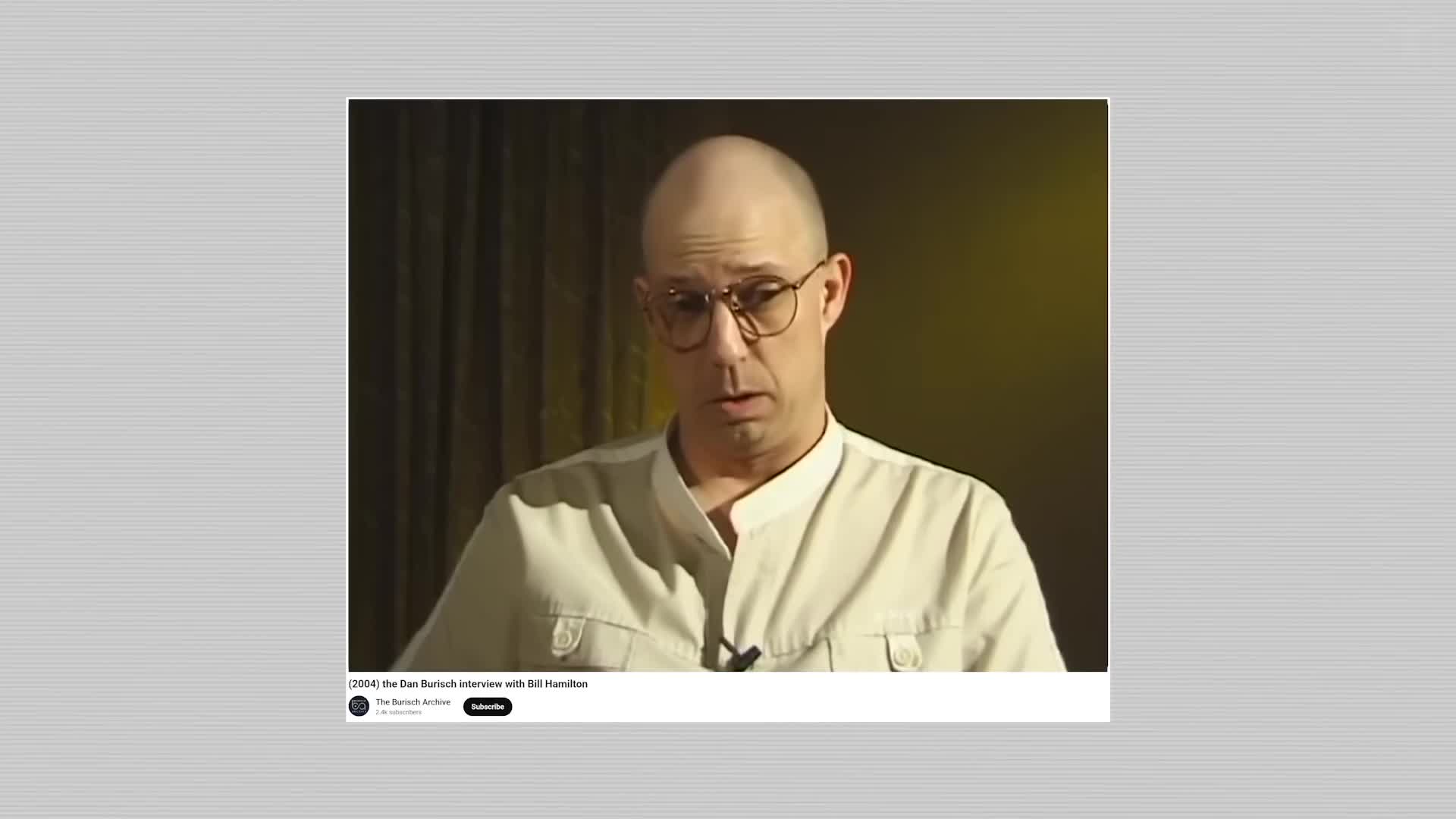
It feels like he revealed more than he should have, and I wondered if something happened to him after all those public statements.
So I started looking him up.
On Reddit, people were asking about Dan Burish, where he is now, and if he's okay.
And then I found this.
A disturbing image.
A user saying he was warned shortly after speaking publicly.
And that definitely makes you pay attention to what he's saying next.
Those two time streams could occur simultaneously.
Reality could be mixed, which is why there are so many confusing data sets.
Yeah.
All this information comes from inside Majestic 12, a top secret US government group he says he was a part of.
But here's the thing, he's not the only one talking about this.
The American writer Philip K. Dick described the same idea.
We were reliving the present deja vu perhaps in precisely the same way hearing the same words, saying the same words.
I submit that these impressions are valid and significant.
This too might account for the sensation people get of having lived past lives.
They may well have, but not in the past.
Previous lives rather in the present.
Physicist David Deutsch talks about it from a scientific angle.
There are other copies of you and of me in other universes.
Some of them, some of these copies, are completely identical to us.
There are other universes which are very like this one, but differ only in the position of one atom somewhere.
Now those universities are interfering with ours and they are producing interference effects which we could detect in the laboratory if we wanted to.
And this is where it gets uncomfortable.
Something doesn't seem right with reality.
Because to this day, no one can clearly explain why a large segment of the global population shares the same false memories.
Memories of events, logos, movie lines.
Things they remember the same way, but that don't match reality anymore.
That alone should make you take this seriously.
They were still reticent about informing me as to what the real nature of the situation was.
The actual potential for both timeline number one and timeline number two outcomes.
In the case that we're in right now, we seem to be in a variant of timeline one.
It's not happening exactly the way that they figured that it would.
But then again it couldn't because we've made changes along the way which diverted us away from timeline number two.
When you really stop and think about the idea that things like this could be real, it gives you chills.
At least it did for me.
It reminded me of a real experiment done by psychologist Darrell Bem, known as Feeling the Future, and the computer randomly selects a set of photographs to show you, and most of them are calm, neutral pictures, and every once in a while there's an arousing picture.
So the results is that the physiology of the participant shows higher arousal, not just when the picture appears, which you would expect, but a few seconds before the computer shows the arousing pictures.
Even before the computer decides which picture to show.
In BEM's experiment, nothing was predicted in advance.
The choices were random.
And yet the body reacted as if it already had access to what was about to happen.
What comes next brings us back to something mentioned at the very beginning of this video.
That cube elites use to alter their future.
Before we play the next clip where Dan talks about that, I want to mention that today's video is sponsored by CyberGhost VPN, one of the most trusted VPN providers out there.
With over 38 million users worldwide and more than 20000 people rating it excellent on Trustpilot, that level of trust is honestly pretty rare.
A lot of people assume that using incognito mode means they're private online, but that's not really how it works.
Your internet provider, your workplace or school, public Wi-Fi networks and even the websites you visit can still see and track what you're doing.
That's where CyberGhost VPN comes in.
It encrypts your internet traffic and routes it through secure servers in over 100 countries, hiding your real IP address and keeping your data protected.
And because CyberGhost has a strict no-logs policy, not even they can see what you're doing online.
CyberGhost also lets you unlock content from over 40 streaming platforms, including Netflix, Amazon Prime and Disney.
So if you're travelling or you just want to access shows and libraries from other regions, it's all just a click away.
It works across all major devices and allows you to protect up to seven devices at the same time, which makes it easy to secure your entire digital life or share it with your family.
Right now, you can get CyberGhost for just $2.03 a month, plus four extra months for free.
It also comes with a 45-day money-back guarantee and 24-7 customer support.
Use the link in the description to grab the deal and start protecting your online privacy today.
Did you have exposure to that black box?
It was something that we called the cube or the yellow disc or yellow cube, yes.
Okay, but then that was not a looking glass.
Was that a looking glass?
That is a variant of the technology.
However, whilst the looking glass shows probabilities, or has shown probabilities, the cube would react with the people present.
So there was an alteration, if you will, over what you were seeing from it.
It would actually spin out as a yellow disc out of the top of it, where the word yellow originally came from.
And depending upon what predisposition, it's kind of like a little Yoda telling young Luke you bring in there what you have with you.
You know, whatever is in there is what you bring.
You could then change the perspective, the tilt, if you will, the orientation or angle of the information being presented back to you.
So, unless you are well prepared to deal with such a thing, human interaction and human emotions bring instability of the provenance of the information.
At this point, I think it's important to step back and look at this from the outside.
The idea of something like looking glass didn't appear out of nowhere.
For decades, governments and research institutions have been obsessed with one question.
Can complex systems be modelled far enough ahead to understand where they're heading?
We already do this in limited ways.
Weather models, economic forecasts, military simulations.
None of them predict the future with certainty.
They map ranges of probability based on inputs and assumptions.
What makes this different is the claim that those probabilities could be explored more directly, not just as numbers on a screen, but as something you could interact with, compare and adjust.
That's where things stop sounding theoretical and start sounding uncomfortable.
Because once you move beyond observation and into interaction, you're no longer just asking what might happen.
You're asking whether the act of observing and adjusting could influence which outcome becomes real.
The looking glass has an ability to show one the future.
Let's say that one has the looking glass and you're saying it shows probabilities.
And one of the things we were wondering is how does it do that?
The rings and the amount of information via energy, which is passed into it.
And I've got to be very careful with this.
The position of the rings, their orientation, the energy running through them, position of the barrel, et cetera because you can raise the barrel up on an armature inside the center of it all come into play, as if you have an onion with the various layers of the onion.
As you move through the different energy levels, you also move through the different layers, so you get different bits of information.
Now imagine an almost infinite number of layers overlaying, in comparison to the positions of the rings, an amount, an almost infinite amount of energy that you can add or subtract, tuning it up, tuning it down.
Instead of going up by one hertz or by two hertz, maybe by a thousandth of a hertz up and down.
But it sounds like you're working with almost like a kaleidoscope effect.
You know, like a kaleidoscope, a real kaleidoscope the way you would turn and twist and focus and each time you get a different design right.
Right, except you get a different design and the colors change.
But it's like working with multiple kaleidoscopes where, when you find two different probabilities that you would run into, you have two kaleidoscopes and you make a change on one kaleidoscope that may factor or function to a different angular change on another kaleidoscope, so you get two separate pictures that you then have that are flashing back and forth.
Okay, let me simplify what he's actually describing here.
He's saying that what they were seeing wasn't one clear outcome, but multiple possible outcomes appearing at the same time, almost like different versions of the same event, overlapping.
So instead of guessing which one is real, they tried to separate them visually, frame by frame.
They would break the image apart, look at each version individually and then measure how often each one appeared.
The idea was simple.
The version that showed up more often was treated as more likely to happen.
Then, over time, they would compare what they saw with what actually happened later.
And by doing that repeatedly, they believed they could refine the system.
Not to predict the future perfectly, but to estimate which outcome had a higher chance of becoming real.
And this is where another name comes into the conversation.
Some of you may have heard it before.
Stargate.
Over the years, several people have spoken publicly about a project associated with that name, each from their own perspective, each describing different aspects of it.
A Stargate or equipment that accesses a Stargate or wormhole is for time travel, right?
We're talking about two different things.
Yes.
Are they using the same technology?
Essentially, yes.
The original device was the Stargate device.
That was then increased in power, if you will, with the use of these field posts.
The Looking Glass device was a back-engineered Stargate.
So it was actually back-engineered from the original cylinder seal data, which allowed us to produce the Stargate access devices, if you will, what we call the Stargates.
When people talk about Stargate as a device, they're usually talking about something very different from what we see in movies.
The idea is that some places on Earth are already unusual, places where the environment feels different, where energy, space or even time doesn't behave the same way it does everywhere else.
According to several people who spoke about this over the years, these places already existed in nature.
The device wasn't meant to create anything new, but to work with what was already there.
Think of it like this.
If there's a river underground, the device doesn't create the river.
It just helps you access it.
In these accounts, the Stargate device worked like a tool.
It helped focus energy or conditions in a specific place so that access became possible.
That's why location was so important.
The same setup wouldn't work everywhere.
It had to be used in the right place.
People describe this technology as allowing movement through space and time.
Not in a simple or casual way.
It wasn't like stepping through a door and going anywhere you want.
It was more like following certain paths that already existed.
That's why the idea of Stargate is often linked to specific sites, not random locations.
The environment itself was part of the system.
And this isn't a new idea.
Throughout history, different cultures talked about specific places on Earth as being different.
Locations where something felt off, where navigation, perception or even time itself didn't behave the same way.
For a long time, those stories were dismissed as myths or symbolism.
But modern science does acknowledge that certain regions of the planet have unusual electromagnetic properties, areas where signals behave differently, where instruments act strangely.
So when I hear claims about devices needing specific locations or being more effective in certain places, I don't immediately think of science fiction.
I think about geography, physics, and how little we understand about the environment around us.
There are a number of nodes on the planet, from what I'm understanding, that naturally are sensitive electromagnetically.
I don't know.
They're naturally sensitive to the space through which we pass.
These nodes activate spontaneously when we pass through them or can be struck with electromagnetism and be temporarily opened.
Now, haven't you been investigating a site where there is a natural... Indeed, Frenchman Mountain.
Frenchman Mountain, and your work...
When you step outside these interviews and look at the broader picture.
This idea doesn't exist in isolation.
For decades, governments and research institutions have quietly mapped unusual locations on the planet.
Places where signals weaken, where navigation behaves oddly, where instruments don't always respond as expected.
Not because of portals or theories like these, but because those areas matter strategically.
Pilots have reported regions where compasses drift.
Military engineers have documented zones where communication systems lose accuracy.
Geophysicists study areas where the Earth's magnetic field behaves differently than the surrounding regions.
Most of the time, these places are explained in practical terms.
Geology, minerals, underground structures. electromagnetic interference.
But what's interesting is that these locations tend to appear in clusters, not randomly scattered.
That's where the scale starts to change the conversation.
Because once you move from the idea of a single site to patterns across different regions.
The question stops being, does this place exist, and becomes something else entirely.
How many places like this are there?
How many have been identified, mapped, or quietly monitored over time?
At that point, the topic stops being about one mountain or one location.
It becomes about a broader network spread across different countries, different environments, different conditions.
And that's where this discussion leads next.
Are we able to know how many man-made stargates there were on the planet?
No.
I'm not going to comment as to the total.
I will say that there was over 50.
Really?
Yeah.
Wow.
In different countries of the world?
Yes.
Okay.
And these are man-made?
Yes.
Okay, so, and natural stargates.
Well, see, it's not a stargate.
It's a device which accesses.
Okay, right.
Which accesses a portal, a wormhole.
Does it access a natural, in other words, the man-made device accesses a natural stargate?
It draws off from a natural ERB, an Einstein-Rosen bridge.
Okay.
It, accesses it and somehow works, from what I understand, not in parallel, but almost like piggybacks on the energy of the natural stargate.
You're saying you don't want to use the looking glass for advantage over country to country.
But what about country to
No, no, no, no, no, no, no, no, no, no, no, no.
It shouldn't be used at all.
Understand, but all right, but is there something there I mean in?
In other words, is this technology something that they are using now to look at our relationships with?
Because the technology is not being used at all right now?
Okay, and but the reason it's not used now is because of where we're going into the galactic the plane of the.
As of about 2017, I would expect probably, that all of these little pieces of equipment will probably all get reassembled.
Yeah,
Turned back on.
Oh, sure.
2017, that's quite a long time.
2016, 2017.
Oh, not until then.
Probably not.
I'm figuring that they're probably going to act conservatively on this.
That's what all of the people of wisdom have suggested to them. is to act conservatively.
He says that what they were looking at wasn't a single event, but part of a much larger cycle.
The idea is that history doesn't move in a straight line.
It moves in long cycles that repeat over very long periods of time.
Not years or decades, but tens of thousands of years.
Inside those long cycles, there are shorter phases, when major changes tend to happen.
The time window he mentions, roughly from the 1990s to around 2012 and possibly extending to 2016, wasn't described as a fixed deadline.
It was more like a rough zone inside that larger cycle where things begin to shift.
He also makes an important point about scale.
When you're dealing with timelines that stretch 45000 or even 50000 years, being off by a few years doesn't really matter.
From that distance, time looks blurred.
A decade can disappear inside the margin of error.
That's why he compares it to our own history.
We still argue about what really happened just 2000 years ago, even with written records, so trying to interpret information that comes from tens of thousands of years away becomes extremely difficult.
It's very wise for them to wait.
Okay, and you mean the looking glasses are now decommissioned, but also the Stargate technology?
Yeah, they're decommissioned, and the Stargates and the looking glasses, I'm sure they're all in their little mothballed containers and all of that and they have been separated.
The three components of each have been separated and moved to different power structures, diplomatic and military authorities in the world.
And we're talking about the EU specifically, the UN and NATO.
Those are in specific control of one of the three components each.
And I cannot comment as to which component is contained by whom.
After hearing all of this, I think the most important thing isn't deciding what's true or what isn't, it's noticing the pattern.
Different people, different times, different angles, all circulating around the same ideas.
Probabilities, cycles, locations, access.
Not as answers, but as questions that keep coming back.
And maybe that's the point.
Because, whether these systems exist exactly as described or not, the fact that so much attention has been given to them says something about how humans think about the future.
Not as something fixed, but as something shaped by choices, conditions, and timing.
I'm not here to tell you what to believe.
I just wanted to put all these pieces on the table and let you look at them together.
So that's it for today's video.
Don't forget to check out the link in the description below to check the special CyberGhost VPN deal.
It helps protect your data while you browse and lets you access blocked content online.
All for just $2.03 a month.