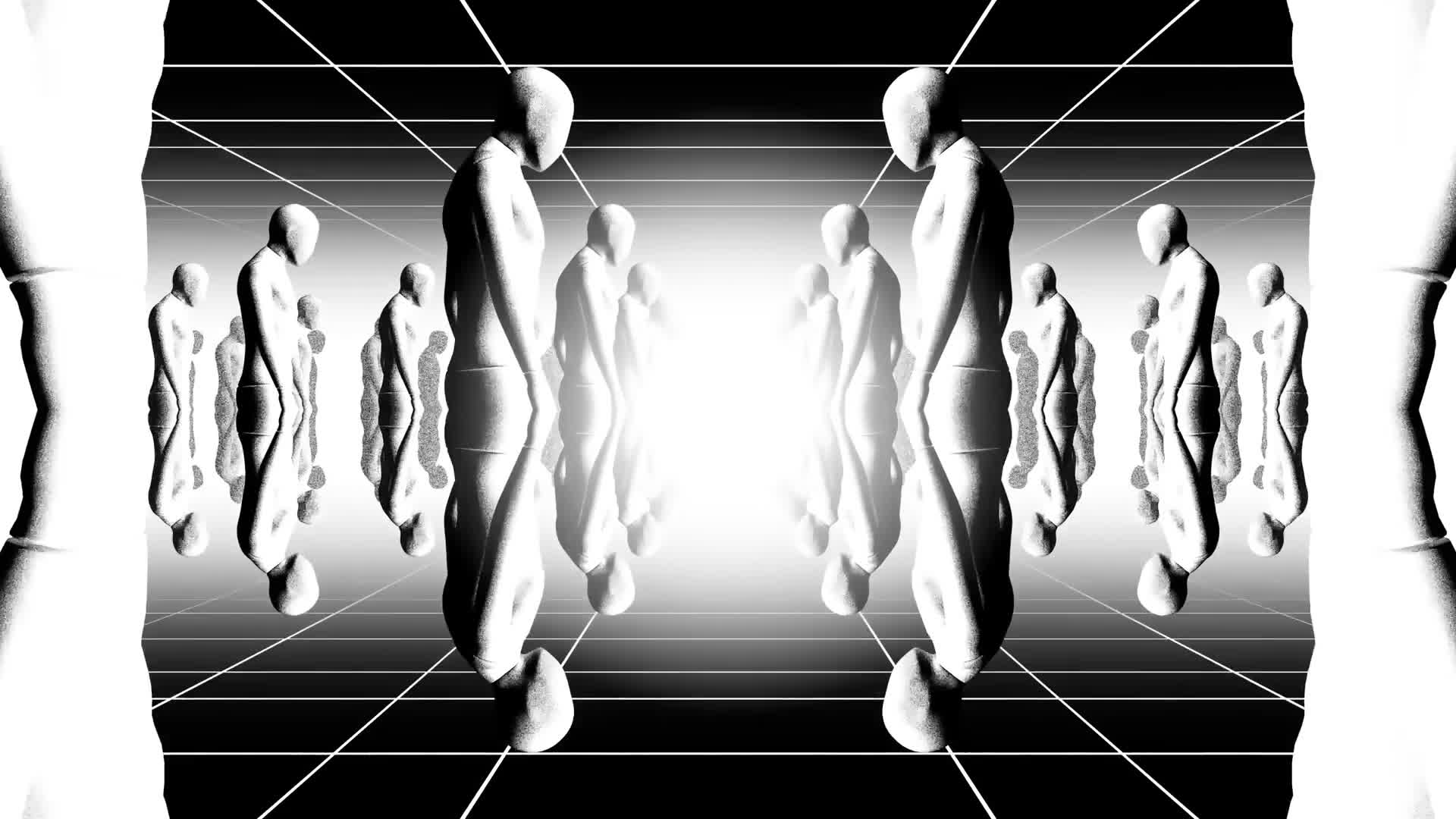
You already exist in multiple copies.
Initially they are all identical.
And then, when a moment of choice happens, both a microscopic one and one made by you consciously, these identical copies become different from one another.
So suppose you're walking in Oxford and you have to choose to go left or right.
In that case, in half the universes I go left and in half I go right.
This man showed a parallel reality on television.
Please pay attention.
This is just a piece of cardboard with little pinprick holes in it.
And there's one of them, just a single hole.
This is a laser pointer that we use in giving lectures.
I shine the laser through the hole and we can see a little spot on the screen over there.
And what would you expect to see?
You'd expect to see just if there's one hole.
You'd expect to see one spot, but that's already not true.
Quite a complicated pattern.
It's called an interference pattern.
I'll tell you why.
What would happen if we made a second hole?
Well, here's another place on the screen where there are two holes we get a completely different pattern, and through three holes there's a different pattern again.
That's the pattern we get from four holes.
We can see the behavior of things like photons, being affected by things we can't see.
Even when one photon is going through, there's a different pattern for six holes, for seven holes, for a hundred holes, for a thousand holes.
And that means that there must be something traveling through every one of those thousand holes and making a difference to the photon that we see, making thousands of parallel universes.
And that means there must be at least thousands of parallel universes.
In fact, the theory tells us there are a lot more than that.
The real surprise wasn't the experiment, but the words that came after words no one was ready for.
Is it physically possible to build a time machine, that is, a path from the present time into the past?
And the answer there is.
It's still an open question, but as far as we know, there are physical processes which would allow the tearing of the fabric of space-time.
In such a way, there would be a pathway into the past.
This is David Deutsch, an Oxford physicist who dared to say things on live television that most scientists only whispered about.
Let's break down the strange laser experiment he used to prove the existence of parallel realities.
The experiment you saw him perform is not new.
It was first carried out in 1801 by the English scientist Thomas Young.
He used candlelight and two narrow slits.
That simple setup proved that light could behave like a wave.
More than two centuries later, physicists still see it as one of the most important demonstrations in science.
Albert Einstein himself said it had some of the deepest implications in physics.
And yet, despite its simplicity, it remains one of the hardest experiments to truly understand.
But here's the more interesting part.
The same experiment he showed in the interview has also been performed under much stricter conditions, using a dark filter so strong that only a single photon, one particle of light could pass through each second.
This setup changes everything.
Instead of a beam of light, the detector now clicks once for each particle.
A tiny dot appears on the screen, then another. then another.
At first it looks random, just scattered points with no pattern at all.
But the strange part is that as time goes on, those single dots start performing the same interference pattern, as if a full beam was shining through.
Even though the photons travel one by one, separated in time, together they create the exact same wave-like design.
This should be impossible if light were only particles.
Each photon should pick one hole or the other, leaving two simple clusters.
Instead, each particle acts as if it passes through every hole at once and as if it knows whether other holes are open.
And yet, this isn't the strangest part.
The next step is even harder to explain.
Before going further, I want to tell you something that may help you.
A few months ago, Magic Mind reached out to me.
They told me about their products and said they'd like to sponsor a couple of the videos, but first they wanted me to try their shot.
I decided to give them a real test for a few weeks and honestly, I felt a huge difference.
Now I'm glad to say I still use them and I'm thankful they're sponsoring this video.
What I really like is that it's all natural, with no tropics, adaptogens and matcha that help me stay focused and clear without the coffee crash.
I've been using it for almost three months and the difference is clear.
I used to struggle with brain fog, but now I feel sharp, calm and productive every day.
Shots come in three versions free, which is completely caffeine free, for calm focus.
Original, with a small dose of green tea caffeine for steady energy.
And max, the strongest option, built for those high demand days when you need maximum concentration.
I tested all three, but the one i use every day is free, no caffeine.
It gives me a clear focus that lasts longer than coffee.
And here's the best part they're giving us their biggest offer yet.
The link is in the description or the QR code on screen gets you 60 off your subscription and they back it with a full money back guarantee.
If you don't like it, they refund you 100 no questions asked, which basically means you're trying it for free and can cancel anytime.
This offer won't be around for long, so grab it while it lasts.
Now let's get back.
There's more you need to see.
Well, the question is How do we explain the fact that we see the same pattern, that we detect the same pattern on the screen when there is only one photon at a time going through here, as we did when the bright laser light was shining on it?
You see, this one photon, the one we detect, must have gone through one of those two holes.
The experiment becomes even stranger when more holes are added.
With one hole, the result is just a simple spot.
Add a second and suddenly a new pattern appears.
Add a third or a fourth and the picture changes again.
Even if the photons are sent one by one, the final image still depends on all the holes together.
It's as if each tiny particle somehow knows about every possible opening, even the ones it never passed through.
Something that should be acting alone behaves as if it's connected to all paths at once.
Something is coming through those other holes and shoving our photon aside.
And that process is interference.
What is this something?
Well, we can do further experiments to find out what that something is.
The conclusion that we draw is that this thing behaves like light in every way we can detect experimentally, except one, and that is we can't detect it.
So it's not there.
It is there because it pushes aside the light that we can see and it behaves like light and the Only reasonable conclusion is that it is light of an invisible kind.
It's as if invisible possibilities are interfering with the visible outcome.
Something else must be travelling through those paths, pushing the photon we can see.
It behaves like light in every measurable way, yet cannot be detected directly.
The unavoidable conclusion our reality is not solid and isolated, but shaped by layers of existence we normally cannot see.
Quantum theory reveals something extraordinary.
In its equations, invisible elements of reality are treated in the same way as the visible ones.
This suggests they are not illusions, but real features of the universe.
Light itself behaves as if hidden versions of it exist, interfering and pushing against what we can see.
And this strange behavior is not limited to photons.
Every particle, including the atoms in solid matter and the molecules in our bodies, appears to be influenced by unseen counterparts.
The implication is staggering.
Entire parallel worlds of matter, energy and light must exist alongside ours.
At the moment of the Big Bang, these universes all came into being together.
In the very beginning, they were almost identical.
Over time, through interference and interaction, they began to diverge.
Imagine countless books printed with the same first chapter, each gradually telling a different story.
Our universe is simply one of those variations and, as deutsch emphasizes, the other universes are not imaginary.
They are just as real as the world we inhabit today.
Suppose you're right.
Suppose we have a lot of different and a lot of the same universes all existing together.
What would it mean for me?
I mean, am i a part of many universes?
You have to start thinking of yourself as not as an entity existing in one universe, but an entity existing in the multiverse as a whole.
And so there are other copies of you and of me in other universes.
Some of them, some of these copies, are completely identical to us.
Now, in those cases, it's really just a matter of words to say whether they are other universes or whether they're the same universe.
If they're completely identical, There are other universes which are very like this one, but differ only in the position of one atom somewhere.
Now those universities are interfering with ours and they are producing interference effects which we could detect in the laboratory if we wanted to.
This idea becomes even more personal when applied to human experience.
You already exist in multiple copies.
At first, those copies are identical, but each time a choice occurs, whether at the level of a random atomic event or a conscious decision, they begin to separate.
Picture walking down a street in Oxford.
In half the universes you turn left.
In the other half you turn right.
Both outcomes are real because both are taken.
David says it is misleading to imagine the universe splitting in that moment.
Instead, it is better to think that all those universes already exist and our choices reveal which one we're currently living through.
In this view, the multiverse does not grow out of us.
It has always been there.
What changes is our path within it and the recognition that countless other versions of us are walking their own roads, shaped by decisions, both great and small.
A natural question follows.
If there are multiple versions of us, how do we know which one we are?
David Deutsch compares this puzzle to identical twins.
Imagine two brothers who are indistinguishable at birth.
Over time, life's events and experiences cause them to grow apart.
Each twin remains equally real, and each has their own story.
In the same way, there are versions of you spread across the multiverse.
At first, they're completely identical, so it makes little sense to distinguish them.
But as choices are made and events unfold, they slowly begin to diverge.
Some of these variations are so slight that they're almost invisible.
Maybe just a single atom out of place.
Others farther away in the multiverse become so different that they might no longer resemble you at all.
This view reshapes the idea of identity.
Not a single fixed entity, but as one branch within a wider landscape of possibilities.
It sounds pretty bizarre, actually.
We have to get used to the fact that new advances in science get further and further away from common sense.
If you want science merely to predict the outcomes of experiments, without telling you why, then you don't need to believe in multiple universes.
In fact, you don't need to believe in multiple planets.
You don't need to believe that anything outside this room exists if you only want to predict.
But if you want to explain, then you must adopt the explanation which meets the facts.
And in quantum mechanics, there is only one explanation that meets the facts, and that is the multiple universe explanation.
We can see the behavior of things like photons being affected by things we can't see.
Our only choice is to say it behaves as if it were affected by those, or to say it really is affected by those.
And it only makes sense to say it's really affected, because something that doesn't exist surely can't affect things that do exist.
Skeptics often respond with doubt.
If these other universes exist, why can't we see or feel them?
Deutsch points out that our senses have limits.
We cannot feel the earth moving beneath our feet either.
If we relied only on our bodies, we might believe the ground is still.
But with instruments such as Foucault's pendulum, we can indirectly detect the Earth's rotation.
The same principle applies here.
The fact that we cannot directly sense parallel universes does not prove they're absent.
It only shows that human perception is not tuned to them.
David says that science is not only about predicting experimental results.
It is about finding the explanation that actually fits the facts.
And when it comes to quantum mechanics, the only explanation that truly works is the existence of multiple universes.
This means that, even though we cannot touch or see them, their effects are present all around us, revealed through interference patterns and strange behaviors of particles.
If, by chance, our senses had contained an instrument equivalent to this pendulum, we would be able to feel the rotation of the Earth.
In a similar way, if our senses happen to work through quantum interference, then we would be able to feel directly the influence of parallel universes.
So saying that you don't feel other universes is like the Inquisition saying to Galileo that they don't feel the Earth moving beneath their feet.
Well, the reason why they don't feel the Earth moving beneath their feet is because Galileo's theory explains why they won't feel it moving.
But if they do a different experiment with a Foucault's pendulum or with telescopes, they will indirectly be able to tell that the Earth is moving.
The idea of parallel universes naturally raises another question.
If reality branches in so many directions, what about time itself?
Could we, in principle, move through it, not only forward, but backward?
Few topics ignite as much fascination and debate as time travel.
Is it physically possible to build a time machine that is, a path from the present time into the past?
And the answer there is.
It's still an open question, but as far as we know, there are physical processes which would allow the tearing of the fabric of space-time in such a way that there would be a pathway into the past.
This would involve something like a rotating black hole, some very violent event in space-time.
The other half of the question is if we had such a path, would it be possible actually to travel on it?
And what would then happen in regard to the paradoxes?
For instance, what if we try to change the past?
Would the past be as it is recorded or would it get changed?
If, for instance, I go into the past and prevent myself from ever entering the time machine or from even building the time machine, what would happen?
Would I prevent myself?
If so, who was it that went back into the past to stop me?
And if I couldn't, what would stop me?
Physics tell us that time travel is not entirely impossible.
Under extreme conditions, such as near rotating black holes, space-time itself could twist into loops.
In theory, these distortions might create tunnels into the past.
But immediately we face the classic paradoxes.
If you travelled back and stopped yourself from building the time machine, who was it that made the journey?
To erase the cause, how could the effect exist?
These contradictions are why time travel has long been seen as impossible.
Yet the multiverse gives us a way out.
David Deutsch argues that the paradox disappears when we understand time travel not as altering our own past, but as entering the past of a different universe.
In the multiverse, all possible histories exist side by side.
If you go back and change something, that change takes effect in a parallel reality, not in the one you came from.
This means the original timeline continues untouched.
You still built the time machine and made the journey, but in the new universe events unfold differently.
The act of stopping yourself or changing history belongs to that branch alone.
Both versions are real but in separate worlds.
This interpretation preserves consistency while making sense of the paradoxes.
Instead of asking how can I erase my own past, the question becomes which universe am I stepping into?
Suppose we would have a time machine.
Would you go with it?
I don't think I would, because when you travel in time, one thing we do know is that you can't get back to your original universe.
So, at the very least, what would happen is that I would end up in a universe where there was another copy of me, the copy who hadn't set out in a time machine.
And in that universe, there'd be two copies of me.
And in my original universe, there'd be no copies of me.
Now that would mean that all my friends, the people I know in this universe, they would see me entering the time machine and not come out.
And from their point of view, I would be lost forever.
There would be another group of the same people in another universe.
They would have a copy of me and they would see a second copy arising coming out of the time machine.
And from then on they would be in the company of two copies of.
They might not consider that to be an improvement on one.
Seen this way, time travel would never allow us to rewrite history.
It would not give us the power to undo mistakes or erase what has happened.
Instead, it would mean leaving one universe behind and entering another where a different version of events begins.
From the perspective of those left behind, the traveler simply disappears.
In the new universe, two versions of the traveler exist side by side the one who is always there and the newcomer who has just arrived.
As Deutsch explains, the journey is one way.
Once you leave, you cannot return to your original timeline.
The implication is sobering.
Time travel might be possible, but it is not about fixing the past.
It is about stepping sideways into another branch of reality, where history takes a new shape while the old one continues, without you.
That's it for today's video.
Thank you for watching and don't forget to check out Magic Mind.
It genuinely made a difference for me.
You'll find the link and the QR code below.