You're listening to Roundtable.
I'm Nian Honglin, joined by Steve and Yang Yang.
Coming up soon.
No frills, no promos, no nonsense.
Just rice, oil and drinking water.
Cheaper than you ever thought possible.
Hard discount supermarkets are rewriting China's retail playbook.
But how come shop owners get to keep the lights on while keeping prices low?
That is the question today.
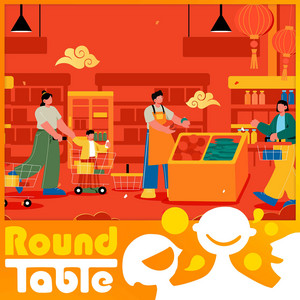
But now, Step inside a hard discount supermarket and you notice what's missing.
No music, no product posters, no sales chatter, just shelves lined with daily staples rice milk, tissues and stacked in their shipping boxes, as if the warehouse simply slid into the street.
Now we're talking about these hard discount supermarkets, but can these players sustain this low margin, high volume mold, and how?
So tell us more about this hard discount supermarket.
Exactly what is it and what is hard to discount?
Yeah, so it's a retail model for supermarkets, and they define it by offering their goods at prices that are continuously and genuinely and significantly below the market average.
And, speaking simply, it's a cheaper supermarket than your typical one that you might find in your average neighborhood.
Now, the core strategy behind it is low pricing, and they achieve this low pricing through extreme cost control.
They're also big on efficiency optimization.
They're looking at supply chains from start to finish and how to save money there so that they can pass it on to the customer.
And this is kind of the opposite idea of what they'll call a soft discount in a store.
A soft discount in a store would be reliant on getting rid of items in the store that they need to to make room for new merchandise, or new clothing or new whatever or, in this case, supermarkets.
New food that would come in like near expired vegetables or something like that.
A temporary sale.
These are permanent and the stores focus on selling high frequency items, your daily items, like you said, like rice or oil or water, or dairy products, or paper goods or things like that.
And the idea is keep the costs as low as they possibly can so they can pass those savings on to the customer and drum up a lot of business that way.
This is very interesting because we're familiar with the soft discount that Steve has already mentioned.
We see it all the time.
All the time.
And there are so many different new ways to give you discounts.
You can get one and get another one for free.
You can buy the almost expired food so that you get usually it's even for the almost expired ones.
You get a huge volume of the food.
Well, usually food with the similar price that you get for just one or two.
So that's the idea.
But for this one, who's so smart that thought of this idea and made it possible?
What's the origin of it?
Well, actually, this concept came abroad.
It started in 1948 in Dortmund in Germany, and it was established by a Germany company called LD.
Oh, that company is still around today, as a matter of fact.
Yeah, it's really popular.
And it's not that new, the concept.
No, it's been around for decades.
1948 you said yes and since then the model, i think it keeps growing and now it's ran on what is called three new principles no elaborate decoration, no service and no advertising to minimize the cost.
That makes a lot of sense if you're stepping into a place that is almost the as simple as a warehouse not a lot of decoration and a lot of cost.
But that is not that easy, or at least no longer the simple mode here in China, isn't it?
We're minimizing the decoration itself simply cannot lower the price to the level we're looking at today.
Yeah, this kind of model in China is still relatively new.
Yang Yang said it goes back to 1948 in Germany.
But in China, it's still kind of still kind of trying to find its feet in the market, if you will.
So this rapid growth of these types of stores, yeah, we can see that there, but there's only a market penetration rate of about 8%, and that's significantly lower.
If you compare it to the international examples for example, Germany Aldi and perhaps other stores have a 42 market penetration rate.
In Japan as well 31, indicating significantly, though I think we can say that there is a lot of growth potential here in China.
Yes.
That being said, the hard discount market in China has already surpassed 200 billion yuan in scale in 2024.
So remember, China has a huge market.
And with this as a start point, and also the 8% as the status quo, we are looking at huge potential.
So what are some key strategies here?
So what are supermarkets doing these days, on top of making the decoration in the supermarket super easy?
Well, I think the first thing, they just keep things super lean.
I think most stores only sell around 1,000 to 1,500 products.
I mean, that's a lot less than a typical supermarket.
Yes.
And for example, some stores like Walmart control the total item count to within 1,300.
Yeah.
So you're not finding a whole lot of items.
You remember, if you walk into your average supermarket, you can see thousands and thousands and thousands of items in there for sale.
That's not the case with these hard discount markets, and the reason that they do that is it simplifies the supply chain process and it also lowers their inventory costs and it also really increases inventory turnover very very, very efficiently.
So if you're a manager of one of these hard discount stores, it's very easy to, or easier to, get rid of the products that you have know when you need to order new products to bring them into the store.
So everything runs more efficiently.
So what that means is there's not as much waste.
At the same time, it's easy to say or it's easy to understand as a concept, but there must be a lot of calculation, a lot of analysis to do.
You need to find the sweet spot because people love choices.
Well, do they?
See, this is an interesting thing.
So I'll use Korea's restaurants as an example.
My friend was a restaurant owner there, and he has places in other spots in Southeast Asia as well.
But what he told me about the food market, the restaurant industry, is that sometimes Korean customers don't want a lot of choice, meaning they don't want a menu with 55 different items on it like your typical American family restaurant, because it's just like uh.
I don't know what I want to eat.
You go to a Korean barbecue restaurant because you know what you know you want Korean barbecue, right.
I use that comparison because if there are a limited number of choices on the shelves for customers, you don't need to choose between 10 different types of peanut butter right.
The store might have just one or two and the customers might be okay.
And they are okay with this because, number one, they know why they're there.
They know what it is when they get there.
And it also simplifies the shopping experience for the customer.
It makes it faster, it makes it more convenient and it also saves them money.
And that's the only reason, those are the only reasons that I would disagree with you when it comes to making choices while you're shopping.
Yeah, but we're talking about the loyal clients of this hard discount supermarket already.
But I do not have to only shop in this hard discount supermarket.
So for me, I still have countless choices.
So for the supermarket, they are looking at a certain number of items they want to put in their supermarket from almost numerous choices in the market.
So they need to make the smart choices and find out the kind of product they want to put in their supermarket that can draw enough clients.
I see what you're saying.
Yeah.
Customers can be picky about the type of rice that they like.
Yes.
So therefore, from the business point of view, you'd have to make sure you make your selections wisely.
Yes.
Smart choices.
And at the same time, you want to make sure the products can be lowered, or the price of the product can be lowered to a point that it fits the standards in your supermarket, cheap supermarket.
Well, from my perspective well, you don't need a lot of different items under one same category, but i think the key strategy is to make those products different enough to be representative, so that different categories Under one category but each different product is representative.
For example, one peanut butter is sugar free and one is not.
Something like that.
Yes.
So you can have the choices, but also be clear about what you want to buy.
Yes.
I don't know why I chose peanut butter. but it seems to have developed a theme.
Yeah.
And that is the key strategy those hard discount stores are doing.
They only sell essentials, stuff you buy all the time.
And within each category they offer maybe one or two popular options, instead of 10 different rice brands that traditional supermarket might offer.
Yeah.
And also they can connect directly with um source factories or farms or major suppliers right, and that means that they can secure the lowest prices possible and they often will sign large um, sometimes long-term contracts to lock in those costs as well and to lock in the supply too.
So from a business point of view that's very comforting, i think, and from a customer's point of view it's very comforting as well, because If the retailer has that type of contract with their supplier, you don't have to worry about price fluctuations.
The business can offer those lower prices at a long period of time and not have to worry about price changes.
And we know, with groceries and the price of groceries around the world these days, price fluctuations are annoying yes.
At the same time, if i have grown into a law you consumer of this supermarket, i do not mind trying the product that they develop by themselves, because i have faith in them.
I am happy about their product, so i'm pretty sure many of the brands are doing that too.
Yep, they are, and that's a major source of profitability for these types of companies.
And it offers an opportunity for growth in the future as well.
And why they like to create their own brands or use these private labels is because they can bypass the cost of the brand name right.
Often those labels will be what you're paying for most of the time.
So you'll cut that out.
You'll cut out your traditional marketing costs.
You'll cut out your intermediate channel costs too.
So yeah, developing their own brands or working with private brands is something that these types of retailers really like to do.
How about logistics?
Anything they're doing smart so that they slim up the process and lower the cost?
Well, when it comes to logistic efficiency, it is also maximized.
Some products may be displayed directly in their shipping containers or logistic boxes.
And the store's premises typically do not include inventory storage rooms.
Yeah, so products are often displayed directly in the shipping boxes.
No extra unpacking or decoration.
Even the shelves are designed for minimal restocking effort.
I kind of like that.
Especially when I'm shopping in the vegetable section.
If you go into that room, sometimes it's a different room.
And the little misty spray things will be around.
And the lettuce is still in the brown cardboard box.
Or the tomatoes are still in bulk in their original packaging.
I kind of feel like I'm walking in the middle of a garden at that kind of time.
Well, what I like is that I do not have to talk to the overly welcoming sales assistant in these kind of places.
The overly welcoming.
I don't know.
I mean, I like to talk to people, but sometimes I talk to people too much.
So in these occasions, I just like to very quietly make my decisions.
And we see that in these kind of places they definitely would say make sure they have the smallest staff size they can and having all the staff to do multiple things.
So they do not have time to talk to consumers.
I mean, you can, you can look at that in a, in a positive or negative light, right?
If, if you're saying well, if they don't need that many staff um at the venue, then they can save money there, and that gets passed on to the customers.
But also, you know, you're reducing the number of people, the number of jobs, um of the people that work there too.
Well, they can open more of these supermarkets.
I know.
I'm just saying for this particular point.
You can look at, you can look at this through a couple of different lenses but yeah, that's one of the ways that they can save money and pass that on to us as well, as because um, their labor efficiency is on point.
They only have the number of employees there that they need.
They absolutely need to have on location.
Do you think this model is sustainable?
Are we looking at any challenges that prevent this super huge hard discount supermarkets for dominating our market, so I can enjoy these cheap products?
Well, I think whenever we talk about discounts or low price, sustainability is always an issue.
So I think this kind of like model not only gives us low prices, but also it has low margins as well.
So yes, the stats shows that gross margins for those hard discount stores are thin, typically ranging from 10 to 15.
That's significantly lower than the 20% to 25% seen in traditional supermarkets.
So yeah, I think that means every tiny increase in cost, whether it's labor, delivery or packaging, hits profits hard.
Yeah.
Yeah.
Um, your profit margins are really small.
So yeah, like you said, any increase in labor costs or shipping costs or anything, anything really at energy costs that's going to cut into your profit margins and that might make the sustainability of this particular model over the longterm uh kind of a challenge.
Um, The more it becomes competitive, too, I think would make it a challenge.
Because if this model becomes popular with more and more supermarket chains, then you have a lot more players in the game.
And when they enter into the market with those similarly priced goods.
Well then, the customers have more options in terms of where to do their shopping.
Now, if you start to lose customers, then you might think I better lower my prices even further to draw those customers back.
And that would essentially reduce your profit margins even further.
So this particular type of model, where the profit margins are already slim, increased competition could be a death knell for some particular businesses.
And we're only talking about the legit strategies when it comes to starting a supermarket business in the Chinese market.
We cannot say that everybody has a Samaritan's heart and will always do things according to law.
So if, like what Steve said, in a certain supermarket, they want to lower the price a bit even more, it is also possible they might jeopardize the quality of the product and sometimes even go as extreme as break the law and change, for example, the expired date on the product, and though these would in turn hurt the uh consumers rights.
So we cannot have that from happening.
So, When it comes to prices, especially lowering prices yes, as a consumer, we love that, especially when people are now doing it in a smart way, in a scientific way, in a way that they're lowering the cost because of better technology, of better supply chain, that they can do so.
But, at the same time, a super low price is also an alert that we need to look out for and make sure it's not going to be the slippery slope starting point for something bad.
But, that being said, i think there's always demand, the demand.
Demand will always be there, and i'm reminded of the discount supermarket chain that we have in nova scotia, where i'm from.
It's called no brand.
Oh really, that's the name.
That's the name of it.
That's the name of it, and you can buy no brand potato chips, no bear.
To continue with our peanut butter theme no brand peanut butter, no brand everything and it's just the perfectly delicious product.
It's just the label doesn't have a big company's name on it.
It just says no brand.
And that can be another great choice for a brand name for your business here in China as well.
And that brings us to the end of today's Roundtable.
We'd love to hear your thoughts on today's topics.
Leave us a comment wherever you listen to your podcast, or send us an email to roundtablepodcast at qqcom.
Until next time, keep the conversations going and the ideas flowing.
I'm Niu Honglin with Steve and Yang Yang.
Thanks for listening.
Bye.