I have a special treat for you.
If you're curious about ancient wisdom, legendary tales and the fascinating stories behind this zodiac, you will definitely want to check out the Chinese Folk Tales podcast.
Join us for a thrilling ride into the Chinese New Year as we embrace the spirit of the horse.
Rediscover timeless wisdom in stories like Bo Le discerns a noble steed.
Bo Le jumped off his cart and overwhelmed with emotions, he rapped at the saddle and cried.
Tian Ji's horse racing.
Race straight up.
TNG would lose every single race.
Game over.
And reconnect with the famous silent white dragon horse from the epic classic Journey to the West.
One day, a monk from the Tang Dynasty will arrive.
How dare you eat my horse!
A fierce battle followed.
So much more than old folk tales.
These stories teach us lessons of vision, resilience and strategy in an uncertain world.
So settle up and gallop with us into the Year of the Horse.
If you like what you've just heard, check out the new series on Chinese Folk Tales podcast.
Now let's get back to today's topic, the expressions and customs of Chinese New Year.
你好,欢迎收听随行汉语。 Welcome to Takeaway Chinese.
I'm Nian Honglin with Steve Hatherly in the studio.
Hello, Steve.
Hey, how's it going today?
It's going very well and happy Chinese New Year.
To you too.
Yes, yes.
This is, would you say, this is the most exciting time of the year?
Well, depending on how you see exciting, I find it the most relaxing and happy time.
Period of the year with a little bit mixed feelings, especially when you spend long days with your family.
You love them, but you get frustrated easily with them as well.
That's a universal thing, isn't it?
Yeah.
Especially here in China, with Spring Festival, 春节 or the Chinese New Year, we have longer holidays and we spend more days with the family.
And this year, you know, there's this long holiday with nine days.
A nine day holiday very nice.
Do you know what i realized the other day?
I was chatting with a friend from canada who lives in canada and uh, you know, they said, do you have any holidays coming up?
And i said yeah, the spring festival's right around the corner.
And they said what's the spring festival?
They don't know.
And I said, it's like the New Year celebration.
And they said, oh, Chinese New Year.
Yes.
And I said, yeah.
And they said, oh, it's also called Spring Festival.
Yes.
And I said, yeah, yeah, it's the same thing.
It's just a different name.
Yeah, people don't... And I realized, oh, yeah, right.
People don't know that.
And I didn't know that before I moved here either.
Yeah because, while China has a long history, we say this all the time, which means that initially, this is the official start of a new year because,
Instead of the Gregorial calendar, we have the Chinese traditional calendar, which is a combination of the solar calendar and lunar calendar, which is a relatively more scientific way to help farmers know about the year.
When should they start?
So when should they start?
Yeah. doing, you know, other agricultural activities.
And with all that and the fact that we embraced the Gregorian calendar a bit later so that we can, you know, talk to the world in the same time, we started to use different ways and different terms to refer to different festivals or different periods of the time.
For example, initially, 元旦.
We talked about 元旦 one or two months ago because 元旦 is the new year.
New Year would be 新年 or 元旦.
Initially, 元旦 was referring to our start of the New Year, which would be the Chinese New Year.
But now it's been used for the New Year, New Year.
And we reserved the word 春节 for the Chinese New Year.
春 is spring.
And 节 is festival.
节. Yes, so 春节 together would be the spring festival.
春节.
Yes, and we put the character 年 in the middle area because 年, if you say 过年, spend the new year, or celebrate the year, or just, you know, get past the year.
Most people would still think about the traditional Chinese new year.
But 新年, new year well, it's kind of also the new year.
So the character 年 or the word 年 can be used in both scenarios.
To your point about it being stressful to hang out with your family members, I think if people compared the stress to the value of seeing your family, then obviously the value outweighs the stress.
Definitely, yes, yes.
And that is why most occasions people would choose to go back home.
But we'll talk a little bit about some new trends here a bit later.
But today is the Spring Festival Eve, Chuxi Day.
And this is the time that you have to spend with your family members, which means the Spring Festival travel rush would have to happen a bit earlier and you're already at home, maybe listening to Takeaway Chinese with your friends and family.
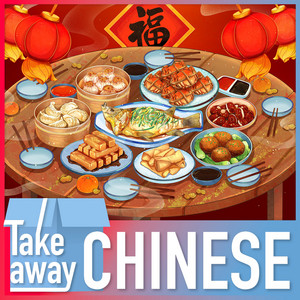
This is the most important meal of the year.
Yes, yes, yes, yes.
The evening meal of Spring Festival Eve.
Yes, we call it 年夜饭.
Nian is the year, and ye is eve or night or evening, and fan is meal.
Very, very important.
People eat a lot.
More than they should on this day.
But that's what it's all about, right?
Being with your family and having a meal.
I mean, this meal is almost like the main activity of the spring festival with your family.
Yes, yes.
The preparing of the meal.
Nowadays, it gets much better.
It's getting more delicious and more ready because of the development of technology.
Bear with me.
Here is a story.
I remember 10, 20 years ago when we talk about Nian Ye Fan.
Yes, it is very enjoyable because at that time I think the society was not as developed as today, for sure, which means at that time, when I was a little girl, maybe 30 years ago, I guess, we only get to have those very, very precious and expensive and delicious ingredient for the major events, which also means that you would love the kind of food you eat at that time.
But in order to prepare a entire table of delicious dishes takes days of preparation, which also means would be a bit cold.
Oh, yeah, right.
Because you prepare for 20 dishes and you have to start somewhere.
And the dish would be cold and also the meatballs, which is a must-have for 年夜饭, and also the fish.
Oh, 鱼 is interesting.
I don't know if you know this, but I think if Those of you who are listening are loyal, loyal listeners of Takeaway Chinese,
You must have already known about this.
That is 鱼, because it's fish, and it carries the same pronunciation with another character 鱼, which means surplus.
It's a must-have for 年夜饭 for some families because they believe in 年年有鱼.
Every year you got some surplus.
You save up a little bit, so you do not spend money the entirety of your income, which is a good sign.
So you must have fish on the table.
And think about it.
You have fish.
You have 鸡鸭鱼肉.
So 鸡 would be chicken.
鸭 duck.
鱼 would be fish.
And it represents all kinds of seafood.
And 肉 is meat.
Oh, yeah.
And with all those kind of dish.
And it takes almost half a day or even longer to prepare.
Cold food.
So at that time, it was cold food.
But now I... don't see that as common as 20, 30 years ago.
Well, we have microwaves and ovens.
Yes, and also we have those kind of pads that you can put on your dining table to keep the plate warm.
Yes, yes, yes, right.
It's very nice.
Put the candles underneath.
I like today's day and age.
Yeah, it makes things a lot more convenient.
I wonder if people are cheating a little bit when compared to the past.
For example... I know what you're going to say.
Tell me, what am I going to say?
Pre-cooked food.
Yes, especially the side dishes.
Yeah, just go to the store.
Wait, what did I just say?
Go to the store?
No, just open up your app and have it delivered to your door in 30 minutes.
Yes, that's one I love.
预制菜 预制菜 Perfect.
So 预制菜 is pre-cooked food.
预 carries the meaning of pre.
And 制 is to manufacture or to make or in this case to cook.
菜 is a dish.
I mean, I think it's because sometimes We are not as good a cook as we thought.
Well, I think it's maybe partly that, but I think it's partly convenience too.
Of course, of course.
Because traditionally to prepare all of those dishes, like we said, would take days and days.
So if you could just, you know, make some stuff and order some other things.
Oh, do you know what?
I just remembered.
I went to a Christmas party.
This was years ago.
And my friend invited me over to his house and his wife had air quotes cooked.
And one of the I think she did cook many things.
But one of the things she brought out and oh, that's really nice.
She said, yeah, I just kind of made this.
My brain said you made this because I saw this at Costco last week and I didn't say anything.
And i didn't even say anything to my friend, of course, and nor did i say anything to anyone else.
You know, i'm not a gossiper, but i, in my brain, i was like but also no blame either, because everybody does it these days as they should.
You should do that.
Give yourself a break yes, and as long as it's tasty, it's healthy and it's hot, it's good.
I was like Girl, you did not make this.
Don't try to tell us.
And the thing is that here in China, we have a lot of very, very hard to make kind of dish.
Yeah, very complicated with a ton of ingredients.
I watched a lot of TV during last year's Spring Festival because a lot of the news coverage was cultural.
And they were showing different regions around China and the foods that they ate to celebrate the new year.
And the place that blew me away, I can't remember which region.
I hope you know what I'm talking about here.
Yes, please continue.
Let's see if I know.
The whole half table looks like a peacock.
And they arranged...
Do you know what I'm talking about?
They arrange the foods towards a certain angle.
No.
Well, I don't.
Maybe.
But they arrange it in a shape so that it looks like the bird.
OK, I know what you mean.
I don't know exactly which part of the country you're talking about because again, China is a bit too vast.
And, at the same time, different places, even different county in the same provinces, might have different costumes when it comes to specific arranging of their 年夜饭, of their New Year's or Chinese New Year Eve dinner.
Well, the reason I mentioned that it was their example of the amount of preparation that goes into the dinner.
Definitely.
So 年夜饭 would be one thing that people would do for, you know, today.
And oh, by the way, some people would consider the food on the actual Chinese New Year's Day as their most important meal.
It depends a little bit, meaning it's not happening for Chinese New Year Eve.
Wait, is that a whole different meal or is that leftovers? a whole different meal.
Oh my goodness.
It depends.
It depends on different parts of the country and maybe sometimes even different traditions of the family.
For example, my family, because I usually would have this most important meal in my grandparents' house.
Okay.
And it's usually my little family, my parents and I and my grandparents, who are my dad's dad and my dad's mom.
And I would visit my mom's dad and mom's home on the second day of the new year.
And for the first day, it's usually a larger family.
You know, it's like you have to gather the entire family.
But when you form new families, there's different things you need to think about.
And when there is a tradition that, For both families to think about, they would choose different days for the enlarged family meal.
Yes, I know exactly what you're talking about.
They do that in Korea, too.
Yeah, it's called kunjib, which translates to English as big house.
And it's funny because big house in English is slang for jail, and so there was some confusion when i first moved.
It's unfortunate to that country uh, but yeah, everyone will gather on that day and then on the second day people will kind of go to the uncle's house and then the other cousins houses and things like that.
So similar tradition here.
Similar tradition.
It's more about the in-laws, though we do visit the cousins and the aunts and uncles a bit later during the entire period for the New Year celebration, because traditional Chinese New Year go all the way to the 15th day of the first month.
But now we get relatively shorter holidays because we spread our holiday days throughout the year.
In comparison to in ancient days, you only have this major holiday day.
But that being said, we would visit families.
We call it 走亲戚. is relative, and 走 is to walk into, and you walk into their houses, and you 拜年 means to give them good New Year wishes.
Is there like a money exchange?
It's not money exchange.
It's red envelope giving.
That's what I mean by money exchange.
Yes, because there's usually money inside those red envelopes.
So the older members of the family will give the red envelopes to the kids.
Mostly to the kids.
It's a good wish.
And it's kind of like 压岁钱.
压岁钱 is important for tonight as well.
That is, you put the red envelope under the pillow of the younger, of the youngsters.
And it's a way to give them good blessings and help them spend or get crossed.
The new year.
So when they wake up in the morning the following day, they get excited.
Yes.
Yeah, sure.
Also, do the maybe married or mid-30s aged kids in the family?
Do they give money to the grandparents?
Sometimes.
In different families, there are different traditions, for sure.
But I don't think those kind of money would be considered as 押税钱.
Because 押 carries the meaning of press.
And 岁 is year and 钱 is money.
So 压岁钱 has the connotation of the elders blessing the youngsters.
But when you 拜年, definitely you can give red envelope to the elders.
Because there's a time in a person's life where they go from the receiving of the red envelope to the giving of the red envelope.
I don't know which role I like better.
I've done both already.
Well, they say this is what experts say.
It's better to give than to receive.
That's why I said that.
I've never believed that.
But being able to be the one who's putting a smile on the kids in your family's faces, and you love them.
And it's also very nice.
Yeah, sure.
Yeah.
Like we mentioned earlier nowadays, on top of 走新期 or 拜年 or, of course 买年货, but 买年货 purchase for yearly goods.
It's not goods for the entire year or your yearly change them, it's just to spend the year, to celebrate the year.
The kind of commodities
And besides those, there are more and more other new trends here, especially in the younger generation, or when the younger generation started to become the Decision makers in the family.
Like the things that they're buying, you mean?
Not only that, but how the family, the extended family even, would spend, would celebrate the Chinese New Year.
Because, we mentioned, most people would choose to go home, spend time with their family, visit the elderlies.
Yes, that's true.
But for some families, they would also decide to 返向春运.
So 春运 we know is the spring festival travel rush.
That's when you go home and you you know, because we get the holiday days or get off work the same days, which means we would have to fight over the tickets and stuff.
Everybody in the country has the same holiday.
Yes.
Imagine that, everyone.
Yeah.
1.4 billion people on vacation at the same time.
Yes.
And the funny thing is, mostly it is the major cities, the mega cities, that young people are flocked into when they decided to find a job, start a career which means when it comes to spring festival period of time, they go back home to the little towns and counties and cities they live in, their parents live in.
And 返向春运, 返向 means reverse.
So 返向春运 is a way to celebrate the Chinese New Year together, yet not in their parents' home, but in their home.
So they would invite their parents to their homes in the megacity so that they can both spend time together and also enjoy a little bit of time.
The museums, the destinations, the kind of pop market that are very popular in mega cities, and they can bring their parents.
Yeah, and it takes the pressure off the parents, I think, right?
Because when you invite your family members, all of your family members into your home, that creates a tremendous amount of work to prepare and then to clean up after and sure.
So yeah, it's just a nice little reversal of the trend.
It's kind of like sharing the responsibility a little bit and having a different kind of fun.
Avoiding the responsibility a little bit, because your parents, friends and relatives would not be able to find them.
Sure.
I mean, that's, yeah, right.
It's kind of a sign of modern times a little bit.
Yeah.
Yeah.
People are just kind of being a little bit more flexible with their scheduling and their events than they were in the past.
Yes.
And now, because we talked about the heating pad, keep your food from getting cold on 年夜饭 period of time.
That's interesting.
Yeah.
Those you can see everywhere in restaurants.
By the way, if someone doesn't know, these are like metal trays, but they have space underneath where they'll put like things, usually three candles, and it'll just keep that plate warm so the food sits on top.
That's one type, and another type would be a.
I think it's kind of like a mattress, but it's much thinner and it's the pad that you can keep on your table and it's hooked up with electricity so that it heats up Very nice.
So people use those heating pads that you would normally put that in your bed, would you not?
It's much, much, much thinner.
And I think the material is a little different.
So it's meant for your table.
It's meant for the table.
See, I never heard of that before.
That's very convenient.
There are larger ones and smaller ones.
Smaller ones for maybe just a couple of tea.
Bigger ones for your entire table.
That too, that's... quite enjoyable and much safer, especially for the families with younger kids.
You could put it on your chair if your bum's cold.
A little too warm, maybe?
Yeah, consider yourself cooked food.
Anyways, I'm mentioning that because you see how technology changes the way we live and it changes the way young people celebrate their 春节 as well.
They would have The kind of preparation or the kind of customs.
And those customs are digital, so we call it 数字年俗 sometimes.
数字年俗.
Yeah, so 年 is, you know, the Chinese year, and 俗 is custom.
So 习俗, 风俗.
数字年俗, I don't think they're quite that common to qualify as a custom just yet, but many young people are doing it.
Like what?
For example... they would hire an AI assistant to write their spring festival couplets. chun lian chun lian chun lian is the couplets you would stick up on both sides of the door with a heng pi a little note you put on the top of the door and shu zi chun lian or ai xie chun lian is like using artificial intelligence to generate the couplets customed for your need your family But the messages are often quite short, right?
There's not that many characters there.
No, I think it's more about the great wishes it carries for the entire year.
It does not have to be very specific.
It's usually something along the line of longevity and a happy and wealthy family and healthy and...
All the standard ones.
Yes, a lot of kids, something like that.
Yeah, yeah, yeah.
So young people are using AI to come up with their messages now.
Yes, because previously many people would choose to buy a pair of couplets from a market, which means you're sharing similar kind of wishes with anybody else.
And for the relatively more the kind of family who would carry more weight in customs, they choose to write their own couplets, especially those who has got good calligraphy skills.
They write couplet for themselves.
But even for them, unless you're super talented, you cannot come up with your own couplets.
You have to steal, you know, find some or copy some from others.
But now with AI, you can create your own.
Yeah, I remember last year in our building on the first floor there were people who were writing the couplets for people, I guess.
There was a table set up, and I guess these were very talented calligraphy writers.
Yes.
And they were just creating these beautiful characters for people, and they were there all day.
It was kind of a really cool thing to see.
I had never seen that before.
Yes, it is a kind of you know welfare.
Yeah well yeah, it's just kind of like a feel good and yeah, and the vibe is very energetic.
Yeah, it's very festive.
It feels like christmas in canada with the mood, with the mood that people are in.
People are really excited and really happy.
And, besides that, Because I think traditionally people when celebrating something as important as the spring festival, would light up fireworks
I think initially it's for scaring away the Nian monster.
Nian shou is the Nian monster that you scare away and you use crackers and fireworks, the light and the sound to scare away this monster during the spring festival period of time.
This is new information for me.
Okay.
Who's the spring monster?
Okay.
The idea is that, to start with the Chinese character nian, not the current character, but the very original one, the very initial one.
The top part of it is a he, which represents grains, so harvest.
And the lower part of it is 人, it's a person.
So this is the period of time when people started to harvest and put all of their harvesting or finish harvesting the ending point of winter and the starting point of spring festival.
They are starting a new cycle of their life.
I'm still waiting for the monster.
And that is...
And that is the period when the nian shou, the nian monster, would come over and rob the harvesting from the people, because it's the most abundant period of time.
Okay, yep.
And then the monster would also scare the kids.
Maybe grab one or two kids as their food, getting a little bit bloody.
Oh.
And that is why people would lit fireworks and would put up red decorations, including couplets and also the Chinese character fu for blessing, on the door, on the wall, just to scare away the Nian Monster.
And that also has something to do with the Ya Sui Qian we talked about.
Some people believe the Ya Sui Qian would be able to help the kids peacefully spend the New Year period of time.
It's kind of cool.
Has the Spring Festival Monster ever been like, Turned into a character, I wonder, in films or TV dramas?
What do they make it look like?
Do they make it like super scary, like creepy, or just more like kind of like, like a cartoonish type of thing?
Cartoonish for sure.
And also what's fun about this is that you know, what people nowadays do is to give new characters and new traits, and to the traditional characters, the nian monster as well, i think.
In one of the cartoons i watched, the nian monster was not meant to scare people in that village.
He was trying to go and celebrate the period with the villagers together, but they didn't understand him.
It was misunderstood.
It was misunderstood and, and you know, happy ever after ending, they got happy time together and they understood each other.
It's very nice.
That's cute.
Yeah, that's very cute.
So yes, we mentioned the writing of couplets and we mentioned firework, and the reason i'm talking about that is because, for the sake of protecting the environment, a lot of families adopted a lot of different types of electronic gadgets and almost toys and decorations that can mimic the function and the effect of a firework.
And they put those kind of equipment at home to, you know, sometimes it's the electronic lantern.
Sometimes it's just some kind of installing kind of almost art.
I know what you mean.
Yeah, and the point is you don't have to go out and try to find real fireworks or real firecrackers or things like that.
Yes, and use those to protect the love of tradition in your heart, as well as the environment at the same time.
There's plenty of reasons then to be excited and happy during this time of year.
You've got great food, obviously.
You've got your gatherings with your friends and your family.
You've got perhaps a little bit of the stress from the traveling getting to your hometown.
But everybody knows that that's part of the deal and it's expected.
So it really is a special time of year.
And then you put your couplets up on your door and wish away the spring monster and hope for great things for the following year.
Yes.
And thank you so much for taking this precious half an hour from your one of the most important days of the year to be with us.
Or if you're annoyed with your family, we are the perfect excuse.
To get away for half an hour.
Look, I've got to go listen to this show.
I'll be back.
Yes.
And for those of you who are not part of this culture and history, now you know how come.
This day is very important to us.
One of the most special times of the year.
Yes, and hopefully you can celebrate the New Year's Eve with us as well, and also the coming of the year of horse Ma Nian.
So we wish all of you Ma Nian Kuai Le.
Ma Nian Kuai Le.
Thank you so much, and we'll see you next year.
Bye-bye.