This BBC podcast is supported by ads outside the UK.
Have you ever wiped with a piece of dry, single -ply toilet paper and wondered, is this as good as it gets?
Well, it's not. It gets a lot better thanks to the wet, extra -large cleaning power of Dude Wipes.
They comfortably clean up whatever TP leaves behind on your behind.
It's time to stop being an a -hole to your b -hole and start experiencing the confident clean of Dude Wipes.
available at amazon and major retailers nationwide dude wipes best clean pants down sonesta travel pass is the most rewarding way to travel sign up at sonesta .com for instant savings bonus points and perks like early check -in and late checkout room upgrades and free stays choose from 1100 hotels across 13 brands and unlock their best rates when you book with With Sonesta Travel Pass.
Here today, Rome tomorrow.
Join now at Sonesta .com.
That's Sonesta .com.
Terms and conditions apply.
This is The Happy Pod from the BBC World Service.
I'm Nick Miles and in this edition, an unusual version of a message in a bottle.
Even when things are really tough then, you know that you're going to find something to be happy about in it.
When you get to the other side of it, you are going to be smiling at some point.
Why one woman decided to send her mum's ashes on a journey around the world.
How breeding deer helped a remarkable recovery for endangered tigers in Thailand, and...
My favourite part about the hospital model is that they can go to their room and jump on the bed, right?
Gain a little more agency back.
How computer games can help make hospitals more fun for children.
We start with a story about trying to find happiness whilst grieving for a loved one.
Cara Melia's mother, Wendy Chadwick, passed away at the age of 51 from an undiagnosed heart condition.
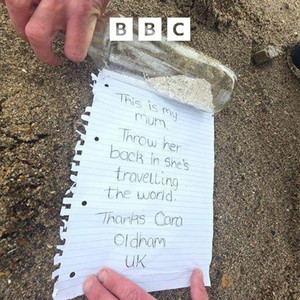
Determined to keep her dream of travelling the world alive, Cara put some of Wendy's ashes in a bottle and launched it out to sea with a note that says, this is my mum, throw her back in, she's travelling the world.
Well, the bottle entered the water in the English seaside town of Skegness and when someone posted on social media that they'd found it on a nearby beach, the story went viral.
Cara spoke to The Happy Pod's Holly Gibbs and started by telling her what Wendy was like.
She was amazing. She was just like the heart of the family.
She was quirky, she was different, she never wanted to fit in.
she never got the chance to really travel since she was a kid because obviously she had five kids of her own to look after um a mom a brother so she just she never got the chance but like she was talking at like the start of like the year in the end of last year that she wanted to start traveling again anywhere that had a really nice beach and really good sun so that's originally where the idea has come from and what has the response been like it's gone viral on social media so it's been like really positive from what i've seen mostly everyone's absolutely loved the idea and they want to do it
themselves from what i've read it's made people cry oh it's just i weren't expecting any of it and i weren't like i weren't expecting it to be viral either how does it feel to you when when you have someone say to you that their story has made them cry I'm like well I wasn't expecting that but I'm happy that it has like touched people the way it has and I'm happy it has traveled as far as it has would you inspire other people who are struggling with grief and the loss of a loved one to do something similar to this to keep their legacy going yeah I think it I think it helps a lot just like with the whole
grief part just to know that But, like, I did get to fulfil what she wanted to do.
Obviously, it weren't in the way that we wanted, but...
Where do you hope the bottle will wash up next?
Possibly, like, Barbados or even Spain, just somewhere that's really, like, nice and sunny for us.
Anywhere with a beach. What should people do if they find your mum in a bottle washed up on a beach?
Well, I've had so many different comments about it, of, like, people putting some paper in it or writing on the back of the note, but if they do find her throw her back in.
If you want to share it on Facebook or anything like tag the place that you found her and then hopefully it gets back to me so I can see.
Talk to me about the day that you put the message in the bottle in the sea for the first time.
I felt really sad actually but it's something that I wanted to do.
It was just like saying bye to her in my own little way so it was a good experience it was especially for like my grief it's made me happy to know that you know she's out there like she may not be in body form but she is still out there she is traveling I don't have a clue where she is now but she is traveling somewhere like I think it made me feel a bit better knowing that she weren't just a sign of oxen what legacy do do you hope she will leave by travelling around the world in a bottle?
I hope it'll inspire people, just anyone who's lost someone, that there is a way to kind of make it a happy thing, to hopefully inspire other people to do something of the sort, just to manage their own emotions throughout it.
What do you think your mum would say in response to all of this immediate attention and also to travelling the world in a bottle?
Oh, one, she'd be calling me crazy, because why, why not?
Two, she'd be absolutely laughing, because she doesn't want to ever want the attention or anything, so for it to all just come so suddenly.
but she also knows that this is like the type of person i am i will make a good thing out of a bad situation hopefully she'd be laughing and seeing a good side to it like i would have drowned in the if i couldn't find something to try and make it happy because even when things are really tough then, you know that you're going to find something to be happy about in it, even though it's obviously it's a horrible situation.
But you know, when you get to the other side of it, you are going to be smiling at some point.
Cara Melia. And if you found an unusual way to celebrate the life of a loved one that you think could help others, we would love to hear from you.
Just send us an email mail or a voice note to globalpodcast at bbc .co .uk.
Now to some good news for one of the world's endangered big cats.
Figures released this week show there are now five times more Indo -Chinese tigers in Thailand than there were 15 years ago, from about 40 to around 200.
It follows a joint project between the government and the conservation group WWF, which included breeding deer, for them to hunt.
Indo -Chinese tigers, which are smaller than many other species with darker fur and narrower stripes, are only found in Thailand and Myanmar now.
Tara Pirri is a lecturer in ecology and conservation at the University of Surrey here in the UK.
Tigers have been in trouble for a very long time, unfortunately, because they are this majestic creature.
They've got got this beautiful coat and unfortunately there's a lot of myth mythical properties surrounding it as well and unfortunately it's really come under poaching a lot but also the loss of habitat has really impacted the tiger because they do need a large space they need a lot of prey they're kind of getting hit from both sides and so they have plummeted in numbers so now we're looking at about four and a half thousand tigers worldwide.
They are in a fragment of what they used to roam across.
Now this population of tigers, the Indo -Chinese tiger in Thailand in particular, seems to have been boosted by the reintroduction of deer in that particular area to boost the numbers of prey.
Absolutely. So it's not just the boosting of prey.
There's been a lot of logging in the area and again a lot of poaching and it's not just of the tigers it's of the food source as well so by regenerating those areas have been logged and actually adding in grasslands which is really what the deer need and then being able to improve the deer populations there's enough food source there for the tigers to survive so we're seeing this this amazing increase in numbers that's That's absolutely brilliant.
And it just shows, you know, having a really good strategy for regenerating the forest really does reap the rewards.
And hopefully we can keep going with that.
I mean, that is a huge effort, a massive increase in the population of this particular tiger there.
Is it something that's being replicated for other tiger species?
Yes, I believe so. You know, again, looking at the numbers, it's really encouraging to see.
but you know it needs to happen on a big scale and it can't happen without money so that's why i think you know having wwf behind the governments and providing funds from the general public i mean this is this is the big thing you know people across the globe have actually been able to get involved in this so just by donating money it provides the funds that are sorely needed to help locals get involved and locals need to be involved because at the end of the day if they're they're not involved, that they don't know to conserve these animals, they will still go on and poach and log and that sort of thing.
So getting them involved, making sure that they have what they need to help protect these species is absolutely vital.
So it can be rolled out and it has been seen in other species.
And I think we need a few wins.
We need to hear about these wins.
So this is why it's so important.
Tara Pirrie. And staying with good news for endangered animals, scientists have made a breakthrough that could help restore part of the Pacific Ocean and tackle climate change.
The kelp forests off the coast of California provide food and shelter for a vast array of marine life, as well as absorbing carbon dioxide, the main gas that causes global warming.
Well, in recent years, they've been devastated by a surge in purple sea urchins.
But now researchers have found a way to breed a critically endangered starfish that can restore balance to this vital ecosystem.
Harry Bly reports. It's easy to see where the name sunflower star comes from.
These animals have 24 arms, like petals, and measure up to a metre wide from tip to tip.
While some are a soft yellow or orange in colour, like the flower, they can also be purple or brown.
These creatures once thrived along the Pacific coast of North America, but in the past decade the population has decreased by 90%.
Jessica Withley is a senior biologist at the California Academy of Sciences.
The sunflower starfish is actually incredibly important.
They were recently listed as critically endangered along the California coast by the ICUN list. That means that there's barely any that you would find in the California coast where you used to find them all over the place.
Sunflower starfish are also voracious predators, feasting on crabs, sea cucumbers, urchins and even other sea stars.
That might not sound like good news, but it's actually part of what makes them crucial to the local ecosystem.
California has beautiful kelp forests that is habitat to thousands of different animals and that habitat is being destroyed right now by over a population of purple urchins.
Those purple urchins normally would get eaten by pycnopodia or sunflower starfish, but because of their decline after the sea star wasting disease multiple years ago, the purple urchin's population has mass produced and is decimating our kelp forest, which is destroying habitat for many different species and affecting animals all up and down the California coast. But now Jessica and her team have learned how to breed them and are building up captive populations.
We have a ton of larvae.
So we are growing these up from flea floating larvae to tiny settled starfish to much larger juvenile starfish.
The laboratory is aiming to cooperate with other aquariums across California to raise and eventually release hundreds of sunflower stars back into the wild.
Already three other aquariums in the state are now caring for these creatures.
The goal here is to get good and kind of break the code about how to mass produce and breed and care for these animals in our care so that then we can reintroduce them back into the wild to see surges of their numbers along the West Coast. It's hoped that by reviving the population of sunflower sea stars, the tide could turn on reinvigorating California's kelp forests and biodiversity.
diversity. This year, four of the starfish were spotted off the Northern California coast, which scientists say is a hopeful sign of natural return.
Harry Bly. Coming up in this podcast. I see these women, they have free time and they are improving their lives economically, socially, they feel empowered.
How an invention that makes it easier to carry water is transforming lives in Pakistan.
Have you ever wiped with a piece of dry, single -ply toilet paper and wondered, is this as good as it gets?
Well, it's not. It gets a lot better thanks to the wet, extra -large cleaning power of Dude Wipes.
They comfortably clean up whatever TP leaves behind on your behind.
It's time to stop being an a -hole to your b -hole And start experiencing the confident clean of Dude Wipes.
Available at Amazon and at major retailers nationwide.
Dude Wipes. Best clean.
Pants down. From coast to coast, unlock adventure at Red Lion Hotels by Sunesta.
Where restful sleep, friendly service, and local knowledge await.
Whether for business or pleasure, spend less and make more of every trip.
When you sign up for the Sunesta Travel Pass, you'll get their best rates instantly.
Go to Senesta .com to book your stay and unlock their best rates with Senesta Travel Pass.
Here today, Rome tomorrow.
Join now at Senesta .com.
Terms and conditions apply.
Hi, I'm Cindy Crawford, and I'm the founder of Meaningful Beauty.
Well, I don't know about you, but I never liked being told, oh, wow, you look so good for your age.
Like, why even bother saying that?
Why don't you just say you look great at any age, every age?
that's what meaningful beauty is all about we create products that make you feel confident in your skin at the age you are now meaningful beauty beautiful skin at every age learn more at meaningfulbeauty .com drivers who switch and save with progressive could save hundreds with that kind of money you could go big time on a fancy water bottle with ultra titanium alloy metal you're not sure why you need all that.
I mean, it just holds water.
But you're getting it anyway, because if you're hiking near an active volcano and you accidentally drop the bottle into molten lava, your water will still be icy cold.
Switch to Progressive and you could save big time for water bottles.
Progressive Casualty Insurance Company and affiliates not available in all states.
Potential savings will vary.
Now, being in a hospital can be frightening and lonely at any age, and especially so for children.
But in the United States, immersive video games are helping young patients come to terms with illness and long stays.
The project at Seattle Children's Hospital is entirely funded by donors, including the charity Child's Play and some computer games companies.
Scott Miles went to meet some of those involved.
My name is Maximilian Williams and I am one of the therapeutic gaming specialists here at Seattle Children's Hospital.
The idea is simple.
Use what children already love to help them cope with being in hospital.
Max explains one way this works.
It's very hard to feel achievement in the hospital because a lot of these treatments, you know, you're doing better.
Everybody's telling you you're doing better, but you're feeling worse and feeling more side effects.
And so feeling that journey is very difficult.
But, you know, if you were able to get from level four to level seven, and then tomorrow you get from level 7 to level 10.
It's just that little tiny engine of achievement and helps you hold on to hope in medical settings.
14 -year -old Aiden, who has spent most of his life in hospital, knows this firsthand.
Aiden is using a ventilator while I speak to him.
Well, I like having the video games here because all of my procedures, surgeries, they get really stressful for me.
So it just really helps me out.
For Aiden's mom, Elsa, the gaming program has been a lifeline.
I think it's absolutely amazing.
It has definitely helped Aiden through some really hard times.
It's a great distraction, personally, even for myself.
And there's one ambitious part of this gaming program, which was started by one of the hospital's senior surgeons in his spare time.
time. Dr. Henry Oh spent hundreds of hours building a complete virtual replica of the entire hospital inside the video game Minecraft. I wanted to make something that would make the hospital more familiar to kids and make it less scary.
So I figured, okay, you know, if they can actually go to where they are in the hospital and see it, or before they come to the hospital, ideally say, okay, I'm having surgery.
Where is that going to be?
What is that going to look like?
For those unfamiliar, Minecraft is a video game where players build structures and worlds using virtual blocks, a bit like digital Lego.
Multiple players can connect and interact together.
Dr. O and I are joined by Max as the surgeon gives me a tour of the virtual hospital.
Dr. O built everything from the patients' rooms to the operating theaters to help children explore the virtual hospital.
— Dr. O has added a few playful touches he hopes will turn the Minecraft world into something familiar and fun to navigate.
— I put little animals and have a scavenger hunt that is like, oh, find Kelly, the cow who is in this, so that kids can navigate the hospital and learn the hospital.
— If this is the first impression that most, maybe many, patients have, then they have a positive association when they get here.
— I hope so. Yeah, that's what I hope.
And importantly, other patients can appear in the virtual world alongside each other.
So children who can't leave their rooms can still meet other kids and even become friends.
There you go. That's a patient in their room right now having fun in the server.
My favorite part about the hospital model is that they can go to their room and jump on the bed, right?
Gain a little more agency back.
Which they're not allowed to do otherwise.
You're not allowed to do, but you are allowed to do that in the Minecraft servers.
purpose. Those kids who are able to move around the hospital get together once a month on game night.
Max takes me downstairs.
All around the Aerie space are carts and tables with video games, board games, and art supplies.
It's a great way for patients and staff alike to connect.
It's a great opportunity for peer -to -peer connections, so patients that are on disparate units tend not to have the opportunity to meet, and we've created lasting friendships and also So, like, knock -down barriers with new staff groups, you know, a staff member who may be just passing by and they see two of their patients and they're like, oh, you know, I love Mario Kart, and they're like, what, you love Mario Kart?
And so now then those daily visits are so much easier, right?
That was Max Williams ending the report by Scott Miles, and you can hear more ideas on making hospital life easier for children on People Fixing the World, wherever you get your BBC podcasts.
costs. In Pakistan, 22 million people lack access to clean water.
And in rural areas, women and girls often have to trek for hours to collect and carry what their families need every day.
But one young woman has invented a device which makes the process quicker, easier and safer called the H2O wheel.
And Neda Sheikh's organisation, Tayuba, has also installed equipment that dramatically improves the water quality.
Ned has been speaking to our reporter Jacob Evans and began by telling him more about the challenges people face in rural areas.
They carry these multiple clay pots on their heads, like 50 kgs of weight every day.
And when they reach these water sources, they don't even know if the water is safe to drain.
And sometimes the sources are wells, which are 400 feet deep.
And it's like a tug of war, we call it a tug of four or four to five women just to get water out that takes about 10 minutes just to get a pint of water men do not contribute to the water collection responsibility it's only on the shoulders literally physically and mentally on the women because it's considered to be a woman only chore so talk me through what you've made and how it works we developed this simple tech enabled solution called the h2o wheel that's how we started with uh that aimed to reduce the physical burden of these women who collected water on a daily basis.
It's a water roller that carries water equivalent to eight clay pots aimed to solve the transportation problem.
But what it did was it transformed their lives holistically.
You know, as they say, Jacob, water is life.
And it saved them so much time that not only did it improve their physical health, like, you know, all the back issues, chronic joint issues that they were facing.
It also contributed positively to their mental health.
Income prospects increased by 100%.
Children who accompanied their mothers on these arduous journeys could now go back to schools.
So this was a ripple effect just created through the provision of safe water.
And guess what? It's very rare men started to contribute to the water collection duties because the H2O wheel, as opposed to a clay pot, was not considered a woman -only thing.
And you've also improved the quality of the water.
Through those rollers, they were still collecting water from unsafe water sources.
So then we decided to solve the water source problem as well.
And we installed solar -powered water facilities that are generating safe drinking waters in these off -grid communities in these rural areas.
And now we've also launched this new revolutionary device called an H2O air device that produces safe drinking water produced from the humidity that's found in the air.
So in less than three years, we've provided over half a billion litres of safe water.
What's the impact been of this?
If you've seen women and girls, what do they think about it?
How has it been for them?
I see these women, they have free time and they are improving their lives economically, economically, socially, they feel empowered.
They just needed a push.
And they are truly very happy.
And we've scaled this up across Pakistan, we went in very slow, we wanted to test it, we wanted to learn.
So I think in less than three years, we have reached almost 1 million people because of the ripple impact.
You've received global recognition for this work now.
How does that make you feel?
Again, it's incredible.
It's reassuring. It does alleviate those feelings Feelings of isolation, frustration and sometimes anger that you feel because you do feel the burden.
You know that the solutions exist. And so these kind of recognitions are definitely important to get more people to mobilise, you know, root for you, support you.
And because of the support, so many doors have been opened, which would have been closed to me.
Nedesheik. Now, time for a celebration you might not have heard of that's becoming increasingly popular amongst men in South Africa.
It's called a nappy braai and is seen as the male equivalent of a baby shower, usually involving a big braai, the South African version of a barbecue, and gifts of nappies to prepare the father -to -be for his new chapter as a parent.
Azola Muzukandabo founded Black Dads Unplugged, a network of men supporting each other through fatherhood.
He told my colleague Namulanta Kombo about his own nappy braai and why this celebration represents a new kind of parenting.
I walked into what I thought was a chilled Saturday braai.
It was just a bunch of guys, not a lot of us, under 10.
When I arrived, everyone burst out laughing and handed me a massive adult -sized nappy.
nappy. Before I could protest, the adult -sized diaper was strapped onto me like it was like some sort of sacred rite.
My friends brought quite a number of nappies, but like for me, the gift of their time, the gift of their care, to know that they're thinking that my daughter is coming, is the greatest gift, like to be in solidarity as brothers.
How did you feel about the advice you received at your nappy bride?
right the thing is with men the advice usually comes with humor and sometimes you need to read between the lines but they were like the first step is just being there you know um which I think for me is very important because my first recollection first memory of my father was seven years old you know so for me the advice was just be there you know um you'll figure it out as as you go.
And you talked about your own dad.
How has becoming a parent after you had your first child, your son, how did that make you feel about your childhood?
I want to parent differently.
I'm 35 right now. My father has never asked me how I am, you know, and I love my father.
I feel like I was brought up in a house filled with love, primarily my mom being the conduit of that love.
All I ever wanted was to be seen by my father.
And so I want to affirm my children, you know, I want them to know that they are unconditionally loved.
Apartheid, for people who don't know, was essentially institutionalizing racial segregation and discrimination.
You know, There's an element of taking out manhood and masculinity from the Black man, which I think informed how the dads also showed up in their families.
I came up with a project called Black Dads Unplugged, which is here to inspire a new narrative.
It's a space where Black fathers from all walks of life come together to share, to reflect and support one another.
other i think we are living in a time where only the negative is being spoken about and i know a lot of young fathers who are showing up so beautifully so honestly and willing to learn and willing to grow and that's the story that i want to tell you can hear more from azola and many other interviews about parenthood relationships and families on dear daughter wherever you get your BBC podcasts.
One last thing before we go we've had a voice note from one of our listeners at the end of every episode of the happy pod and our global news podcast which goes out twice a day on weekdays you'll hear this.
The editor is Karen Martin.
The editor is Karen Martin.
Our editor is Karen Martin.
The editor is Karen Martin.
The editor is Karen Martin.
The editor is Karen Martin.
And Ed got in touch with some concerns.
This is Ed Porter from Auckland in New Zealand.
In listening to the closing credits for each episode, I have become concerned that Karen Martin does not appear to have had a day off for several years.
So I am now making a welfare inquiry as to her well -being.
If you are not being forcibly held against your will, I would appreciate any sign you can provide to confirm all is well.
Well, Ed, we put your message to Karen herself, and this was her response.
Ed, I really appreciate you getting in touch and the concern that you shared.
I'll be sending it on to the higher -ups and requesting more time off.
But seriously, though, I'm lucky enough to lead a team of amazing journalists who all work really hard behind the scenes and not all of them get a name check.
So luckily for me, yes, I am the editor of the overall podcast and that is a massive privilege.
privilege but do I have the odd day off yes I do thanks Ed be more red everyone and that is all from the happy pod for now if you have a story you think would bring happiness or inspiration to other listeners we would love to hear from you as ever the address is global podcast at bbc .co .uk and you can now watch some of our interviews on youtube just search for The Happy Pot.
This edition was mixed by Sidney Dundon and the producers were Holly Gibbs and Rachel Bulkeley.
The editor, as we heard, is Karen Martin.
I'm Nick Miles and until next time, goodbye.