This is the Happy Pod from the BBC World Service.
Hi, I'm Anca Desai and in this edition I knew that there is no way that I would have two children and Georgia wouldn't have any.
I just feel so lucky.
And every time I look at her, I just, yeah, I'm so grateful.
If you can do an act of kindness that you know really changes someone's life, then you should do it if you can.
How an extraordinary teenage promise resulted in a woman having a baby for her best friend.
The world-renowned pianist Lang Lang on spreading the healing power of music.
We've been very lucky to work with many kids around the world and somehow music is really the best medicine.
A new statue designed to celebrate the realities of pregnancy and childbirth.
The small owl that had a lucky escape after getting stuck in a cement mixer.
Plus the young feminists putting their own spin on an ancient Alpine tradition.
You're listening to the Happy Pod on the BBC World Service.
We start with a story of love, friendship and an extraordinary teenage promise.
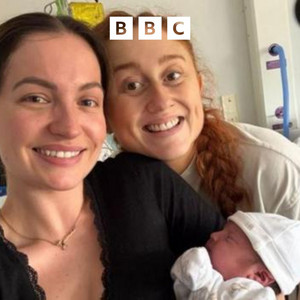
Georgia Barrington was just 15 when she learned she'd been born with ovaries but no womb a rare condition called Meyer-Rokitansky-Kuster-Hauser syndrome or MRKH.
So her best friend, Daisy Hope, promised that she would carry her baby for her when they were older.
Despite her heartbreak, Georgia continued with her dream of becoming a midwife.
And after delivering Daisy's baby, her friend became her surrogate and gave birth a few weeks ago.
They've been speaking to Emma Barnett, starting with the day the GP broke the news to Georgia.
At the time, she may as well have just said to me, you will never have children.
I remember that's all what I felt like I heard.
It was devastating.
It felt like my whole world fell apart in that room, to be honest.
God.
I'm sorry.
I always knew that being a mum was something I wanted, and it just felt like everything that I'd ever dreamed of was gone.
And I think I kind of shut down a bit.
So I think Daisy reached out to me, having heard it through our dads, really.
I think me being the person I was just wanted Georgia to feel OK.
And the best way for me to do that was to give her some hope that...
It wasn't the end of the world because I knew that that was probably how she was feeling.
What did you actually offer?
What did you say?
So I would have said, don't worry, I can carry for you.
I'll have a baby for you.
It was always in my mind something that I knew I would do for Georgia.
It didn't really go any bigger than that in my brain because it was never mentioned again.
And Georgia, what's your memory of when this was said when you were much younger?
I think it was such a big thing for me to take in.
I don't think I was really taking in anything that anyone was saying to me.
I wouldn't have suddenly been like, right, that's it.
Let's get things planned.
Do you know what I mean?
I think I just... I think at this age, you would understand how genuine that is.
But I think at 15, although I knew it was a promise, George wouldn't have seen it like that.
It would have been my friends trying to make me feel better.
You know I'll be honest.
No offense to any of my wonderful friends listening.
I don't think I would say that.
You know, it is an extraordinary thing.
Yeah.
And...
You do have a baby now.
Congratulations on being a mummy.
Thank you.
How did that process begin that you would make good on that promise?
What happened after having your daughter?
So I went through, obviously, becoming a mum with Amelia.
George delivered her, so we were in that beautiful moment together.
She was God mum.
And I knew the love I felt for Amelia in that moment.
And then the weeks that came after, I only felt happiness and love looking at Amelia and was like I just knew that I wanted to be able to do that for George.
And I said to George, you know, the offer still stands.
I will carry for you if that's something you want to look into.
And what was your response to that?
I think it felt a bit more real then.
And because of being a midwife, I know all of the things that could go wrong.
I remember saying to you no, I want you to finish your family before you think about doing anything like that for me, because if something was to happen during the delivery or the pregnancy and you couldn't have any more children, if that's what you wanted, that was something that weighed really heavy on me.
But Daisy kind of said no, I'd rather us both have one than me have two and you have none, which is extraordinary.
Yeah, I just it's really hard to explain, but I was so lucky and I am so lucky to have Amelia and she was the one thing in my life, other than Ollie, that came and like completely just opened up this whole new world for me of how amazing life can be.
And I knew Georgia deserved that and I knew Georgia would be the most incredible mum and I knew that there is no way in this timeline of my life that I would have two children and Georgia wouldn't have any.
The birth.
Talk to me about the birth.
You've got a midwife, but you're not at work.
No.
But did you deliver your own baby?
To be honest, she didn't actually need delivering because she's shut out onto the bed.
It was such a rollercoaster.
It was the most magical, intense, scary, wonderful moment.
And then that moment of you telling us it was a girl was just... I said, it's a girl, George.
It was just magical, yeah.
And we were both like... Yeah, everyone.
I mean, as soon as I saw her head, like when Daisy was pushing, I absolutely lost it, which meant Claire, who was our midwife, lost it.
So she probably couldn't see really what she was doing.
I said, stop crying.
If I start crying, there's no chance I'm getting this baby out.
And my partner kind of just sat scared but excited.
We were all there, though.
My partner was there.
Yeah, to have all of us there, it was just amazing.
You are very newly a mum because of your best friend.
I just feel so lucky.
I wish I could picture this and give it to that 15-year-old me sat in that GP surgery.
Because now, even though I see and I think oh, it would be lovely to be pregnant, I would not change this.
No one else will ever have what we have had.
I just feel so lucky.
And every time I look at her, I just, yeah, I'm so grateful.
Doing this, having fulfilled the mission, I mean, is that how it feels a bit?
Is there sort of a sense of purpose about it?
Yeah, I feel like my purpose is complete.
Like, that's genuinely like, because I've done this wonderful thing and it's the first time in my entire life, other than having Amelia, that I feel so proud of myself.
And I'm so pleased that I am a strong person and I could get through it and I did it for my friend.
And that's like the best thing I will ever achieve, I think.
I feel really lucky to have gone home to my beautiful family myself.
And I feel so lucky to get to look at my best friend's beautiful family.
And I think that's just the wonderful thing.
If you can do that for someone, or if you can do an act of kindness that you know really changes someone's life, then you should do it if you can.
Such a lovely, heartwarming story.
Daisy Hope and Georgia Barrington.
Now, the Alpine tradition of yodelling has long been dominated by men, whether as a centuries-old form of communication between herders or, more recently, a social activity, with men gathering to belt out vocals from the hilltops with their friends.
Lyrics, when there were any, often portrayed an idyllic life in the mountains, surrounded by nature, with the men in charge, and the women presented as naive girls, self-sacrificing mothers or nagging wives –.
Fast forward to now and Gen Z feminists are taking on that tradition, forming choirs across Switzerland and yodelling their own way.
Anna Kölberner is 26 and part of the Jütz Youth Choir.
She told Stephanie Prentice how and why she yodels in the modern way.
It's a special technique of singing.
It's not like classical or pop singing.
You sing a bit different.
Could you tell me a little bit about how that works?
How do you do it?
So you have like your breast voice that sounds like, And you have like your head voice that is like a bit higher.
And if you switch between these two voices, you get this really, really fine crack.
You get like... And that's the thing that we call yodeling.
So, Anna, you're part of a youth choir with lots of women in it.
Why is yodelling so important to you, both as a performer but also as a feminist?
So there are some regions where there are more and more female voices who yodel.
But here in the east of Switzerland, until today, it's more a man tradition.
But yodelling is just like a natural singing that really comes directly from the heart.
And it can connect so many people together, because you can sing together if you don't really know what you're singing and you don't have to read notes.
You can like go with your ear and hear what the others do and you can just connect.
So I think yodeling is a really good thing to bring people together.
I think it should be living from all the people who live here and not only old men or whatever.
Some traditional songs that you would sing when you were yodelling.
Some of the lyrics perhaps have been regarded as maybe a bit sexist, about nagging wives mistresses, things like that.
Can you tell me a bit about how you changed the lyrics to make it more modern and to make it more applicable for women?
Yeah, so sometimes they're a bit, you can see them critical, the lyrics.
We really try to pick lyrics and songs that we agree with the text.
So I don't like to change things that are composed like this, but if it's important to do so, sometimes we change lyrics.
But I think as long as we really respect the tradition, also the other people will respect what we do.
When you have young women that come and join your choir and they get into yodeling and they join in with the group.
What kind of things do they say to you about how they feel?
Everyone who came into our choir was so.
I couldn't imagine before what it could be in this choir.
But now they were so happy because they found out that there is a new style of singing and such a style that brings people together, because they didn't know that it's so nice to be in a yodel choir before.
I just want as many people as possible to go into this yodeling and that they also feel what it can do with them when we just can connect through singing.
Now our next story is an unusual rescue tale.
It's about an owl who fell into a concrete mixer in Utah in the United States and still survived.
The Happy Pods' Vanessa Heaney can tell us more.
A great horned owl lies unconscious on the operating table at the Best Friends Animal Sanctuary in Kanab as three vets work to save its life.
Oxygen is pumped into a clear mask covering the beak.
No one knows how the bird, believed to be a young male, got into trouble.
The owl came to us through a phone call from the Department of Wildlife Resources, who picked up the owl from someone who found it in a concrete mixer at a construction site.
Bart Wyszwolski is a supervisor at the sanctuary.
When we got the owl back to our rehab centre, we found that he was quite covered in dried concrete.
And it was primarily on his right side, but for the most part his entire body had some concrete within it.
It's the first time they've seen something like this.
The team quickly came up with a plan to help the owl in the least invasive way possible.
Under anaesthesia, they gave him short daily baths.
We initially started by taking hemostats and forceps and crushing the bigger pieces of concrete very gently and then using our fingertips to crumble away the smaller pieces.
And then after each session, which lasts about 20 minutes, we would bathe him in Dawn dish soap and water and rinse him and dry him thoroughly.
The painstaking treatment worked.
Two weeks later, the owl was able to fly.
Because the concrete affected the feathers, he makes a whooshing sound when he flies.
That means he'd have trouble getting food in the wild if he was released now, as he wouldn't be able to sneak up on his prey.
So he still has a way to go, but Bart says they're hoping to release him back into his natural habitat in a few months.
So the long-term prognosis for this guy looks really good.
We do need to wait until he molts and gets in healthier feathers so he can fly silently.
But we expect that to happen late next spring, early summer.
Bart Ryszwalski from the Best Friends Animal Sanctuary in Utah, ending that report from Vanessa Heaney.
Coming up in this podcast, the man bringing the stress-busting power of nature to tens of thousands of people online.
A lot of my followers are older.
One of the biggest things I find joy in is taking these videos and those people being able to see them and enjoy them.
And they're always saying how grateful they are.
Even if you've never heard of London's Lindo Wing, you might well have seen a photo of it.
It's the maternity ward where Kate Middleton, and before her, Princess Diana and Princess Anne, have given birth to royal babies.
And hours later, tradition is they pose with their newborn on the steps.
But that image of an immaculately presented mother and child is a world away from many women's experience of childbirth.
Our reporter, Will Chalk, has been finding out about a piece of public art designed to address that imbalance.
She's called Mother Verite.
She's a seven foot tall sculpture made of bronze depicting a woman wearing only a pair of disposable postpartum underwear over a still swollen belly, cradling a newborn child to her breast.
The bodies of more than 40 real new mothers were scanned to create the figure, and the very first place she was put on display was here at the Lindo Wing.
Her message isn't lost on the mothers I speak to.
I love to see a real woman, because we're not all skinny flashing back to our own body as soon as we pop the baby out.
So that gives that reality as a comfort blanket that I'm allowed to take my time.
It's a good thing because it gives people more understanding of what women go through.
And having to get up and walk, especially after a C-section.
You're expected to get up and feed your baby when you have gone through a huge abdominal surgery.
Finally, we understood.
So this will be a game changer.
After being unveiled here, the sculpture is touring art fairs before finding a permanent home back in London.
Her creator, Raven Shalia de Clark, told me she wanted to show the beauty in what can sometimes be portrayed as the ugly side of pregnancy, and made a conscious effort to include things such as cellulite.
Recognising how much women's bodies change throughout the postpartum period and throughout pregnancy as well, I think it was important to reframe a lot of the kind of the visible nature of cellulite within this context.
You know, we see it in terms of when we're thinking about how we shame women for their bodies and what that means in terms of, you know, snapback culture.
But for us, it was really about inverting that.
And it's nothing to be ashamed of, and particularly within this context.
You know, it is a moment of beauty.
It's a moment of transformation.
Research in 2021 found only 4% of London's statues are of women.
That's fewer than are of animals.
The vast majority, too, show white people.
Raven told me she designed Mother Verite to be racially ambiguous so as many women could relate to her as possible.
Still, the women of colour I've spoken to here, like Blandine, say they can see themselves in the statue.
And it means a lot.
I like it because it's a black lady giving birth.
We have to have more because women are doing a lot, and we are the ones giving birth.
We are the ones working hard.
Even if you work eight hours in the office and come back home, you need to work again.
So I think we need to give value more.
Next, in Bangladesh, around six million people live on river islands known as chars, which are formed from sediment and provide fertile land for growing crops.
But they're often prone to erosion and flooding, so their inhabitants have to keep moving and can struggle to access services.
One organisation called Friendship is trying to change that, providing healthcare, education and help adapting to climate change.
Last month, it was among the winners of a 13 million Earthshot prize, set up by Prince William to recognise innovative solutions to environmental and climate issues.
Claire Bates has been finding out about one of their projects bringing education to women on these fragile river islands.
Groups of around 20 women are taught by a teacher at a learning centre.
This is usually a spare tin roof building in the area.
It's difficult to find qualified teachers in this remote region, so Friendship accepts women who've attended school up to the age of 13 and then provides them with extra training.
I spoke to teacher Shabna just after she took her lesson.
We don't have a permanent structure to take our classes in, so we rent a room in a house in the village for a year.
The room has to be big enough to fit 20 students.
We start with the basics, introducing them to the alphabet.
We have a flip chart with lots of pictures on it from daily life to help them learn.
From there we teach them words and then sentences.
They learn to read first and then to write.
You have no value in society without education.
There are lots of social issues like child marriage and domestic violence, and education therefore, is important to give you knowledge about your rights.
Floods are pretty common in the area, so if there is one, Shabna splits her students into small groups and then visits them separately in turn.
One of her current students is Rashida, who has been attending classes for two months.
My parents never sent me to school and I've suffered from not being able to read and write.
My children were embarrassed that I was illiterate.
I couldn't even do basic accounting.
Until now, I've had to use my fingerprint as a signature as I was illiterate.
But now I can sign my name because I can read and write the alphabet, and I'll also be able to keep an account of my expenses.
No one can cheat me anymore.
Jahura recently graduated from the class.
When I go and buy something on the market, I can read whatever is on the packet.
Or if there's a slip or a receipt, I can read that as well.
Students like Jahura, who complete the course, are then offered more training.
I learned how to buy livestock, rear livestock, how to keep livestock, how to take care of them.
That has helped me tremendously.
I now have three cows and two goats and generate my own income.
For a lot of us, a mountain of stress.
So if you need a break from it all, the soothing sights and sounds of nature could help.
And if you can't get out and about for yourself.
One man in Oregon in the US is bringing the wilderness online to help others explore, unwind and find inspiration.
As Riley Farrell reports.
Imagine you're scrolling on social media.
Like and subscribe.
And suddenly the chaos of your feed disappears.
You're transported to a world of rushing waterfalls. babbling brooks, and grand evergreens.
Filmmaker Matt Swack has provided that escape for over 200,000 followers.
His viral videos of the Pacific Northwest's natural beauty have become a digital sanctuary, according to his viewers.
So I spoke to Matt about why he believes that nature belongs in our timelines.
You can shoot real life beautiful things and still grow.
You don't have to shoot just, you know, horrible news and things that cause drama.
When I go on my feed, all I see is nature stuff.
So I hear a lot about all this horrible stuff on social media, but luckily I don't really see much of it.
I'm very glad that I'm helping shift the scale a little bit, because these are crazy times and there are a lot of people that just doom scroll.
How'd you get started with posting nature videos?
The first one I ever shot.
I went out to a river about 15 or 20 minutes from here, right after a fresh snowfall.
I hiked through three feet of snow, like powder, to this river bend.
And I was there and I didn't really plan on taking any videos or photos, but I was like man.
This is one of the most beautiful things I've ever seen.
Like the river was blue and you have the white snow and the blue sky and it was just incredible.
And so I just took this kind of simple pan or just kind of pan from the snow over to the river.
And so I posted it on Instagram like later that day.
That one little video kind of sparked my interest in doing it more.
I was like, well, I love shooting this stuff.
And if people enjoy it, then that's kind of great to be able to, you know, show it to people and have them appreciate it.
How has spending so much time outdoors impacted your own mental health?
And what do you hear from your audience about theirs?
It's kind of crazy.
Every single time i arrive at a place and you get out and you're in the fresh air, and especially when you arrive like say, at a waterfall or something, there's this natural energy that happens.
I mean i just completely am awake, i don't need any energy drinks.
I don't know what it is.
I mean, they say scientifically, you know, there's like these ions that are created from the water crashing.
That gives you energy and kind of like a good, healthy energy.
It's kind of this amazing feeling.
A lot of my followers are older.
They're at the point where they can't hike anymore.
One of the biggest things I find joy in is taking these videos and those people being able to see them and enjoy them.
And they're always saying how grateful they are to be able to sit at home and see these videos of places.
Maybe they even have been, but they don't get to go there anymore.
And with that, let's close out with the soothing sounds of the Pacific Northwest.
Wherever you are, take a breath.
The very chilled out Riley Farrell there.
Now from the power of nature to the power of music.
The Chinese musician Lang Lang is widely regarded as one of the world's greatest living pianists.
And he's sharing the joy and healing benefits he finds in music, with concerts and creative workshops for children struggling with physical or mental health issues or grief.
They're part of a project called Music Heals, run by the Lang Lang Foundation, which aims to bring light to children and families when they need it most.
He's been speaking to and playing for my colleague Amal Rajan.
MUSIC PLAYS
We've been very lucky to work with many kids around the world who's having some sort of problems.
And somehow music is really the best medicine in a way. especially for kids who's having autism.
For example, I had many students, six or seven students.
They weren't talking to anybody.
They were just locking themselves into some place.
And then when they start playing piano, everything changes.
And now I have one of my students who's completely beautiful.
I mean, and he's like talking to everyone.
He's now teaching piano.
What do you think makes a good piano teacher?
A good piano teacher has to really listen to what the students need and to really open their heart and try to inspire them to play with the genuine heart and also to play with joy.
And very often you practice so much, then you become a machine.
And then we always need to put the human side first.
Have you found that music heals you as well?
Absolutely.
When I travel particularly, I get sometimes real problems.
I don't have a patient.
I get really angry.
But then when I start playing some beautiful music by Bach or Chopin, I just come back to a wonderful mood.
The brilliant Lang Lang playing O Holy Night.
And that's all from The Happy Pod for now.
If you have a story you think we should cover or would like to tell us what you think about anything in this episode, we'd love to hear from you.
As ever, the address is globalpodcast at bbc.co.uk.
And you can now watch some of our interviews on YouTube.
Just search for The Happy Pod.
This edition was mixed by Rosanne Winder-Elm and the producers were Holly Gibbs and Rachel Bulkley.
The editor is Karen Martin and I'm Ankur Desai.
Until next time, goodbye.