Discussion keeps the world turning.
This is Roundtable.
Game -changing AI, dancing robots, epic video games, and more.
Hangzhou's startup scene is on fire.
So why is this city in eastern China suddenly the epicenter of China's startup revolution?
And we often think that workplace burnout is all about the workload.
But what if I told you that it might be your boss who's really pulling the emotional weight from micromanaging to lack of support?
Today, we break down how leadership styles can leave us feeling more tired than the job itself.
Coming to you live from Beijing, this is Ram Table.
I'm Ha Young. For today's program, I'm joined by Steve Hatherley and Fei Fei in the studio.
First on today's show.
Back in the day for nearly 1 ,500 years, Hangzhou was known as the place where nature and history came together in a breathtaking way, with Westlake shining as its crown jewel.
This UNESCO World Heritage Site has drawn millions of visitors each year, all mesmerized by its beauty.
Skip ahead to June 28, 1999.
Hangzhou, home to Alibaba Group, the tech giant, has put this city on the map as a hub for innovation and e -commerce.
But wait, there's more.
Today, Hangzhou is buzzing with super cool startups such as DeepSeek, GameScience, and Unitree.
Or Unitree, in fact.
The city is already a major domestic tech center.
With the right ingredients, could emulate Silicon Valley's success.
And with one major perk, some of the finest tea in China, right from the cradle of tea.
So whether you're here for the stunning views, the cutting -edge tech, or the perfect mix of ancient and modern, Hangzhou has it all.
Are you ready to explore?
So let's start with the basics.
Where exactly is Hangzhou and what makes this city so special?
Well, Hangzhou is the capital city of Zhejiang province in eastern China.
It's basically the political, economic, culture and scientific and technological center of the region as well.
And it's very close to Shanghai, to the north, and has a population of just over 12 million, which is not really a large city by China's standard but apparently if we put it on international standard 12 million people can be constituted as a very big city.
Yeah you know those moments when you are living overseas and then you suddenly realize that you're getting used to where you are when I moved to China and I was seeing the population number Shanghai, 25 million.
Beijing, 21 and a half million.
Oh my gosh. And I couldn't wrap my mind around it.
Then yesterday as I was getting ready for the show and learning about Hangzhou, I saw 12 million people and I thought, oh, that's small.
Welcome to China. Yeah, exactly.
So I knew I'm starting to get used to things here.
Anyway, sorry to interrupt.
Yeah, so as He Yang mentioned, Hangzhou is the perfect mix for ancient and modern China.
For the ancient part, we have the famous Westlake, as she mentioned, it's a UNESCO World Heritage Site.
And then we also have the Lingyin Temple, which is also one of China's oldest Buddhist temple that was founded in AD 326.
And then Hangzhou is also famous for his green tea, the Longjing tea in particular.
So for most of the tourists, visiting one of the Longjing tea farms is kind of also a staple item of your tours, of your visit to Hangzhou.
You can taste the tea there and then visit the park.
Some of them you can experience tea picking.
And then on the modern side of Hangzhou, it's the hub, I would say, for digital economy and also a lot of the technology surrounding artificial intelligence and algorithm.
For example, Alibaba's headquarter is based in Hangzhou and which is also open to visitors.
You just have to make a reservation beforehand.
And then Hangzhou is also known for the Yunti Town and also the Hangzhou City Brain Company, which is basically to showcasing how the city of Hangzhou utilizing AI technology to manage the city in terms of transportation, medical resources and also safety.
So it's also open for visitors as well.
So you can see that Hangzhou is not only, I would say, beautiful and also abundant in its historical and cultural side, but also very famous when it comes to artificial intelligence, the use of algorithm and big data technology.
I was looking at images.
It looks stunning, and I was looking at some of the things that you can do.
You know, you have those travel websites and, gosh, the pagodas for the lake views and taking the boat cruise.
I was reading there are boat cruises that you can take there as well.
It looks like there's about a million reasons to visit the city, and I'm really looking forward to getting there someday.
And of course, as you mentioned, to try the tea as well.
Oh, yes. And some really delicious food.
And there's one dish I really like.
It has something to do with the tea.
It's the stir fry shrimp with longjing tea.
But you have to have it there because you have to have the local water, the local tea, and the local freshwater shrimp.
Oh, okay. So it's super healthy and, you know, with the slight but fragrant taste of tea in the shrimp.
It's just so delicious.
I've never even heard of that combination before.
Yeah, right. And it's one of those signature dishes from Xihu or more like from Hangzhou.
Let's put it that way.
And recently, all over Chinese media, we've seen reports about the Six Little Dragons, which are six very popular and quickly shooting to fame tech startups.
So let's maybe if you guys could quickly explain in a thumbnail what these six relatively young but highly successful startups are and the fields they specialize in.
Sure. Well, the six companies you said they're called the Six Little Dragons of Hangzhou and they aren't old at all.
They were established in a relatively short period of time.
The oldest one is only 13 years old and the youngest is just a year and a half.
Sounds like you're describing a family of children, doesn't it?
They average seven years in age, and they're all small and medium -sized enterprises.
But by the end of 2024, these six companies had obtained 226 valid invention patents.
And thanks to the city's active efforts to optimize trademark registration and also acceptance processes, The six companies have focused on cultivating and protecting their brand trademarks from the very beginning.
And as of now, they have collectively filed 2 ,227 trademark applications in China with 1 ,114 of those trademarks successfully registered and 16 trademarks registered overseas across 24 different countries and regions.
Now, remember, we're talking about young companies and a small group of companies as well.
These numbers are very impressive.
And on top of that, through their vigorous or rigorous actions against malicious trademark registrations and also promoting exclusive rights protection for those trademarks, the city has created a favorable intellectual property protection environment for those businesses.
So if a company is looking to do that kind of business there, they can feel comfortable doing so.
And also these six little dragons are, I bet some of the listeners have known the name of a few, for example, game science, which is quite famous.
I think last year when they launched their game Black Myth of Wacom and won the Game Awards 2024 with Best Action Game of the Year and Player's Voice, which is, I think, the first Chinese games to have won such an international prestigious award.
And then Deep Seek, of course, not in the end of last year, but in the beginning of this year, Deep Seek definitely made debut with a significant breakthrough in the field of artificial intelligence, and that sparked the global discussions on the development of AI technology.
And then there are other less well known, but also are making tremendous progress in various respective fields, for example, UniTray Robotics.
That's not unknown to me.
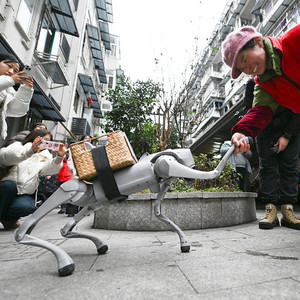
That's the company that had the dancing robots from the gala yeah oh my gosh i was blown away by that but they are quite famous in in this b2w robotic dog which is which was released by the end of last year which is capable of tackling challenging terrains like climbing the hills wading through water
jumping most importantly carrying lows so this robotic dog has already been commercialized industrial inspections and emergency rescue scenarios so it's been already putting into the market and then there are companies like Yunsheng Chu technology which is core product is Jieying X30 robot which is also a kind
of robot that can be deployed for power tunnel inspections which is used in Singapore and then we have BrainCo, which is the second largest brain computer interface enterprise globally in terms of funding, which means the technology that they develop is, for example, they have this robotic hands which can capture
and response to the sort of signal sending out from your brain and replica, for example, the movements of your hand.
And then we have the last one is Qinhe technology, which has also made innovative breakthroughs in cloud computing infrastructure, which can be, for example, they can build 3D space design platform, which for example, can help say real estate companies to sort of rebuild their 3D virtual reality demonstration platform.
Well, in what ways are these six companies leading the charge in their respective industries?
Well, I think we can safely say that they've had a profound impact on the country's new quality development.
They've shattered international technological barriers.
If you saw the news internationally when DeepSeek came out, it was groundbreaking And it shook the AI world to its core.
Their approach to AI model training reduces the reliance on high -end chips, BrainCo's mass production capabilities, and the brain -computer interface field.
They show China's self -reliance on cutting -edge technologies related to that field.
Just every company that we've talked about, they've had a big impact so far.
Yunshan Chu and Unitree's entry into the international robot market, that signals a shift from a follower, if we can put it that way, from a follower to a competitor in high -end manufacturing.
Really impressive achievements so far.
And they've spurred urban and industrial upgrades, too.
In 2024, Hangzhou's GDP, that exceeded 2 trillion yuan.
The tech companies contributed over 30 % to that.
These six small dragon companies, they've become – I guess we could call them the calling card of Hangzhou as the number one digital economy city.
They are kind of the face, the representation of the city and what it's capable of now.
It's interesting we're having this discussion now, and I suppose it has to be in 2025, because last year when Black Myth Wukong was all over every media platform here in China, people were talking about it.
And earlier this year, deep seek all over the place.
Yeah, we're focusing on the individual companies until you dig deeper and you realize, wow, all these companies that we've been that have been catching our attention all come from Hangzhou.
Hangzhou becomes sort of like an incubator of these leading tech startups.
So why Hangzhou? What do you think?
Is there something special about this city that can create these startups this way?
Well, they have a lot of private sector freedom.
Some observers argue that the lack of government stringent or stringent government oversight has enabled startups like Deep Seek and Game Science and Unitry to innovate without the constraints that often come or can come with governmental red tape.
And this has allowed the private sector to drive much of the city's growth.
And, yeah, the Hangzhou government, they have a relatively hands -off approach, and that's been key in allowing the private sector to operate in such a way.
So rather than imposing really heavy regulations, for example, the government, they offer supportive infrastructure and they offer funding and they allow businesses to flourish without being a micromanager, if you will.
Ooh, interesting. Foreshadowing.
Foreshadowing to our next topic.
Yeah, it's really interesting to assess the government's role here because they're obviously not completely absent.
We'll talk a little bit more about policy support in a second.
But they're also not sort of butting their nose in the business when they don't need to.
It's the service philosophy of no interference unless necessary and also responding to every request.
That sounds like a wonderful parent.
That's what apparently what the service sort of slogan is coming from the local government that's quoted on social media these days.
And also one thing I find to be really kind of an example that the local government has set for other local level, regional level governments, that is to turn the government's role in innovation from a manager to ecosystem builder.
So instead of managing, overseeing and saying, you did this not right.
Do it again. Don't do that.
Instead of that, but being a facilitator in helping to build this ecosystem that is highly conducive for business.
According to People's Daily, an investor expressed on social media that the government services in the city are very straightforward and they're efficient as well.
So when businesses settle in, they get things done transparently, they get things done simply.
But more importantly, once the government departments finish their work, they kind of disappear, if you will.
There's no interference, there's no added chaos, and there's no finger pointing at the businesses either.
And I would say it's not only about the city of Hangzhou, but in the province of Zhejiang, they are also service -oriented when it comes to the government side of business.
For example, they have this Zhe Liban application on their phone, which you can basically done everything that you need to go through a governmental agency on that app, which is a very good example, which is very easy to use and very user -friendly.
which also I think kind of reflects how not only Hangzhou but the people of the culture of Zhejiang really when it comes to getting things done.
They're very pragmatic.
Oh, are they? And they are very, has a sort of service -oriented attitude when it comes to getting any business done.
Zhejiang is also very famous for his business culture entrepreneurship.
I think we can date back to almost 600 years ago, the first batch of very successful business people are from this part of China.
And now I think it sort of makes sense, translate to modern times, that not only they have this government support, not only support, but also disappearance, necessary attitude.
But they are also, I think, the entrepreneurship part of the link is also very important.
So that part of China is like a breeding ground for business people.
Yes. For example, at Branco, they have about, it's not a very big company.
They have only 200 people.
And over half the staff are technicians, engineers, you know, people are getting the job done instead of, you know, other sector, other parts of a company, if you know what I mean.
So they cover from, they have neuroscientists, they have IT technicians, they have engineers, and a lot of the, a big part of their cars are pouring into research and development, which I think at the same time, at the other company, Qinghe Technology, Also, over 50 % of their costs are spending go to
research and development, which is far higher than, I think, the average for other such companies, about 20%.
So you can see that they are investing hard in developing real, original, and cutting -edge technology, even though it means you may suffer loss for this year.
And at the same time, it also means this market, this ecosystem, as He Young put it, can tolerate that they are suffering loss for a couple of years before they really launch a cutting edge technology out onto the market.
Which I think is also important from the investor's point of view.
They do very well, does Hongjio, with talent acquisition as well.
They're ranked first in the country, and they have been for several years, as a matter of fact, in terms of net talent inflow.
They've been recognized as, quote, the most attractive Chinese city in the eyes of foreign talents, making it a kind of global talent reservoir.
But not only internationally, a lot of their talent is homegrown as well.
Universities like Zhejiang University, they provide a lot of talent support for Hangzhou's technological innovation.
the founders of three of those six companies are all graduates from zejiang university so just down the road you could say yeah and also a lot of the engineers the high -tech skilled professionals that are employed by these companies they come straight from zejiang university so chinese universities
produce top -notch engineers programmers in droves and it's got to be tough to get into that school, I would think.
Well, it's competitive.
Yeah. Yeah. Yeah. But it's kind of like, you know, in let's say Silicon Valley, you've got, you know, all these world class universities such as Stanford, MIT, and then, you know, graduates, especially the really good ones, you know, they get picked early on and go straight to these very famous tech
companies that we all know internationally.
And I think here in Zhejiang, you're seeing something like that happen as well.
Yeah, in recent years, Hangzhou has introduced over 300 ,000 university graduates under the age of 35 every year.
No shortage of talent there.
And also, I think the CEO of Game Science, Feng Ji, mentioned in one of his interviews that he actually was stationed in Shenzhen in the early days of his career.
And then he decided to move to Hangzhou.
And the reason for that is he thinks Hangzhou has a relatively slower pace of life compared to, for example, cities like Shenzhen, which is very fast paced.
And also the costs of living is also kind of relatively low compared to other major cities like Shanghai and Shenzhen.
And that's the reason that he decided to move to Hangzhou and sort of work really carefully, work really in detail, in depth about the Black Myth Hong Kong Games.
Yeah, it's a wonderful transition of mindset.
Or maybe some people argue that you either have it or you don't.
That is, you know, whether you're working for someone or starting your own business.
And for these six very well -known little dragon startups now, you can see that they have some pretty young and smart and brave trailblazers in these respective fields and starting their own businesses.
While Hangzhou is thriving as a hub of technological innovation and business growth, its appeal doesn't stop there.
The city is also rich with cultural and tourism resources.
And here I'd like to sort of just bring your attention to one of the very iconic myths associated with Hangzhou, and that is the white snake legend, which has captivated audience for centuries.
But how has it brought to life in films, TV dramas and other media mediums and helped to attract more people, visitors to Hangzhou?
Yeah, the white snake legend, which is also very in theme, considering this year is the year of snake.
It's basically a romance story between Bai Su Zheng, which is supposedly a white snake, and Xu Xian, a human.
They sort of set against the stunning backdrop of Westlake and then they fell in love, form a family, and then had to depart because of some reasons.
And then there are different adaptations of these ancient legends.
We have the 1992 TV drama and then we also have a 2024 animated movie and also we have Cantonese opera movie and also ballet And also at this year's Spring Festival Gala, I think they have over 10 or 20 minute long of short play, I would say, also surrounding this white snake legend.
And the landmarks involved, of course, the West Lake and also the Laifeng Pagoda, which and also that bridge, which is also a very important part of the story.
If you're interested, you can check it out about the original story.
Yes. And that just adds to one more reason to visit Hangzhou.
So whether you're drawn by Hangzhou's thriving startup scene or its breathtaking scenery, this city is a living, breathing testament to China's innovation prowess as well.
It's a destination that promises both inspiration and relaxation.
Come here for the tech, stay here for the tea.
There's just so much more waiting for you to see in Hangzhou.