Handshakes and trade deals.
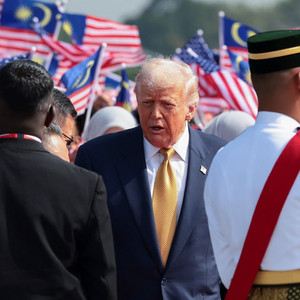
Donald Trump arrives in Asia.
Overall, the agreement is good news for housewares companies in the United States.
This promise of potential stability in the form of a trade deal is encouraging.
Welcome to World Business Report from the BBC World Service.
I'm Sam Fenwick.
The US President has kicked off his tour of Asia with a string of new trade deals and a peace accord.
The White House says it's historic, but businesses say they're looking for more detail.
And markets are cheering as Javier Millet tightens his grip on power in Argentina.
Will his party's midterm victory pave the way for more economic reforms?
So you're going to hear a lot about Donald Trump's trip to Asia this week.
It's already off to a fast start.
The White House is calling it historic, saying that the president has brokered peace deals, slash tariffs and signed what it calls game-changing agreements on critical minerals.
Here's Donald Trump speaking on Air Force One.
You look at what we just did.
It was pretty amazing.
We got a lot of good credit.
And I really have to thank Malaysia for that, because they're really the prime minister and everybody really helped get the two countries together.
But it was quite a great peace treaty.
And it makes me feel good.
I mean, I saved the lives of millions of people.
That's what's important.
In Malaysia, he oversaw the signing of the Kuala Lumpur Peace Accords between Thailand and Cambodia and announced new trade frameworks with Vietnam and Thailand, plus deals with Malaysia and Cambodia to open markets for US exports.
So what might all that mean for US companies doing business in these countries?
Let's talk to Blake Garfield.
He imports products for his bed-making business in Seattle from Malaysia.
He's been watching the deal very closely.
And from Chicago, we've got...
Steve Greenspon, he does business in Vietnam.
He recently sold his company, Honey Can Do International.
It was a home goods brand importing items like drying racks and plastic bins and storage units from Vietnam.
He now advises U.S. companies doing the same and how they can navigate these trade tariffs.
Blake, let's start with you.
First of all, how important then is Malaysia to your supply chain?
Well, we import bedroom furniture there.
It's probably 15% of our overall business and stability is important to us.
And so does this give you stability now?
It's been quite a few months of instability.
What do you think of what's been said?
You know, it's encouraging in that it implies that things are not going to get worse and that there's an idea that stability could exist.
I'm still very curious to know what some containers that I have incoming are actually going to cost when they get here, which is kind of scary, trying to order products and not really having any clue what it's really going to cost when you finally have to pay for it.
So you're still waiting to hear.
Steve, you do business in Vietnam.
Vietnam have signed a new trade framework.
Both sides say that it will give exporters unprecedented access to each other's markets.
What does that mean, do you think?
So Vietnam is a much smaller market than the U.S. market, of course.
But any time that we can establish free trade is good.
We do not sell into Vietnam.
So speaking for my specific company.
It doesn't have a lot of impact that we can – that he's opening up the market.
I think for very large companies, it might be positively impactful for us.
You know, to think seven, eight months ago that one day we'd be celebrating a 20 tariff from Vietnam seems a little bit ludicrous, but as compared to –.
You know, the the announcement from Liberation Day of, you know, 45 plus percent tariffs.
This certainly seems like good news.
At any time that there's an announcement of a reduction in tariffs, it's certainly good news.
But, as Blake referenced, it's the instability and the not knowing what's going to happen that's really impacting the business, because you don't know how to react.
And all of these decisions are huge financial investments requiring time and resources when you needed to change countries.
And the last thing you want to do is make investments and then have something change in the future.
There is some suggestion that some products will fall under a zero tariff category.
Do you know or do you have any idea what products they might be, and might they be the ones that fall within your business area?
I wish that I knew and I've been combing the information and there is just not information out there that I could find related to that and the freight forwarders with whom I'm in touch with.
Also don't know what the tariff is going to be on which products.
So that goes to the earlier point of just not knowing.
So it's hard to make decisions of what to import and then what your costs are going to be and how it's going to impact your pricing and your customer partners.
I mean Donald Trump has often talked about this kind of putting America first and that maybe you should make your drying racks or your plastic bins in the United States.
Is that an option for some of the businesses that you're talking to?
No, not at all.
The products that we're talking about making.
That ship has literally sailed years ago in terms of being able to make these products in the US.
The infrastructure just doesn't exist.
And the jobs that they would create aren't jobs that folks in the United States would want at this point either.
And plus the facilities that need to be built in order to make these products would be so dirty that no towns would want to have them in their towns anymore.
So it's a difficult situation.
The production process is dirty.
Yeah, it's not clean processes to make a lot of these products.
Blake.
The White House says that this agreement with Malaysia is about securing critical minerals, strengthening supply chains.
Do you see that that broader push sort of filtering down to manufacturers like yours?
No, I mean, it'd be great.
I feel like I'm kind of caught in the crossfire and, you know, much like my fellow speaker is Steve.
Steve, that's right.
We bring in nine containers a year from Vietnam and I've got my fingers crossed that raw rubber is going to be considered one of those zero-tariff things because we had to raise the prices on all of our things with the 19 tariff from Malaysia, the 20-whatever 26, I think, on the rubber from Vietnam right now.
Like he was saying, I was celebrating a 26% tariff that I was paying on a bill instead of 45%.
But it's awful.
And small businesses like mine don't have any agency in this process.
It feels like the world is happening to us.
What do you think, what would you say to Donald Trump about that?
I mean, he's a businessman ultimately, isn't he?
And you're saying that you feel like you've been forgotten by him.
I don't think I'm big enough to matter in this scenario.
And I wish there was a degree of empathy for what businesses like ours experience.
That predictability and consistency matters is really, really important for someone like us who's operating on different kinds of margins than you are if you're a multinational or a billion-dollar corporation where they can move mountains to make things work for themselves, where you know.
I'm splitting hairs trying to make sure I can make the math out.
Okay.
So there's still a lot of uncertainty, I think there from Blake Garfield there, who told us that he's importing products.
He's bed-making business.
He's based in Seattle.
He's importing from Malaysia and Vietnam.
And Steve Greenspon, you're importing things from Vietnam.
Well, thank you both very much for joining us today on World Business Report.
Thank you.
Thank you.
Thank you.
Well, while those deals could make life easier for some American importers.
Not everyone in Asia is benefiting from Washington's shifting trade policies.
In India, exporters are really feeling the squeeze from US tariffs in the north.
More than 100000 carpet weavers have lost their jobs and in the southeast coast of Andhra Pradesh, shrimp orders have dried up, putting nearly a million jobs at risk.
Here's the BBC's Archana Shukla.
I'm on the banks of an aquaculture pond on India's southern coast.
What you hear behind me are shrimps being harvested.
There's a flurry of activity here.
A couple of men pulling out nets full of shrimp, loading them in blue bins and taking to a truck waiting by.
This will then be transported to export factories.
Nearly 70% of shrimp from this region is exported to the United States.
And now all of this is getting hit with Donald Trump's tariffs.
This harvest has brought more worry than hope.
At 50% tariffs, American buyers have halted orders.
Shipments are stuck, prices have crashed, and farmers are counting their losses.
Venkata Raju, a second-generation shrimp farmer, says he's already lost more than a quarter of a million dollars.
He's now farming on just a fraction of his ponds.
It is becoming unviable.
Buyers aren't certain so I've stopped shrimp farming.
I'm taking up odd jobs and trying other fish farming.
Aerators still churn on some of the ponds here, spread across miles of coastline on India's Andhra Pradesh state.
This one state produces nearly 80% of India's farmed shrimp, sustaining more than a million people.
But this season, most of the ponds lie still.
Nearly 300,000 farmers here depend on these waters for their livelihoods.
It takes about three to four months of labour to farm and harvest these shrimp.
For these farmers, trade talks taking place millions of miles from here could really decide the fate of their next harvest.
The strain is felt across the chain, from hatcheries to export factories.
That's the sound of tons of ice being poured into bins with shrimp.
I'm at a processing factory, one of the largest in this town, in this large room, which is quite noisy.
Hundreds of men and women workers are cleaning, de-veining and sorting shrimp in ice-loaded bins.
But production work has clearly come down.
Export factories like these are facing the first brunt of Trump's tariffs.
They've had to cut production.
Nearly 30 to 40 percent of workstations here, I can see, are lying idle.
In fact, in the other room where I can see, one of the three grading machines is not being used.
For workers in this factory, paid by the kilo they process, fewer shipments mean fewer shifts.
A lot of stocks are getting held up in our coal storages.
Jagdish Thotta, owner of this marine exports unit, says he cannot afford to lose more money.
He's looking to sell in other markets, but they won't pay as much.
The second largest market is China.
The problem is that they don't pay the prices what US is paying because of the valuation what we do.
If this gets continued, there will be a huge drop in the raw material prices, which will really affect the farmer community.
It's evening and workers are heading home.
As India and the US bargain over tariffs and leverage, farmers and workers in this town wait anxiously.
For them, it's a fight to stay afloat.
That was Archana Shukla reporting for us there.
This is World Business Report from the BBC World Service with me, Sam Fenwick.
Now we're going to head to Argentina, where President Javier Millet has pulled off a surprise midterm victory, strengthening his grip on Congress and boosting his chances of pushing through sweeping free market reforms.
Argentines showed that they do not want to return to the failed model the model of inflation, the model of monetary issuance, the model of a useless state, the model of insecurity.
Argentines said enough is enough to populism.
No more populism.
Well, markets have reacted positively.
Argentine bonds and US-listed stocks are surging.
But those reforms come with political risks and plenty of economic pain for ordinary Argentinians.
Let's talk to Isabel Debray.
She is a reporter for Associated Press and is in Buenos Aires.
So these results, Isabel, took a lot of people by surprise, didn't they?
Just how big a win is this?
This is a pretty big win.
And that's really for a couple of reasons.
One is that Javier Millay started out with such a small congressional base.
He just had this upstart libertarian party that was started a couple of years ago.
And the fact that he is now able to really get almost, or at least a third of both houses of Congress after picking up these seats in the election that we saw yesterday really is a huge difference from where he was before this right.
Which was just less than like 15% of the entire Congress.
So that's one thing.
And the second thing is that The stakes were really high.
And I mean just to take a moment to say we're literally talking about a limited legislative election in Argentina.
You know, never has anyone in London or Washington or Wall Street cared so much about this.
And it's because there was so much riding on it.
Trump had threatened to pull assistance.
If the left-leaning opposition movement known as Peronism won at the expense of Millais.
And so Millais really needed this victory in order to secure that.
And he really exceeded all expectations.
He actually said in a TV interview today that he himself was surprised.
So he's talked about sweeping reforms, cutting taxes, shrinking the state.
What's the reaction then to ordinary Argentines?
So it's really interesting because there was this sense actually over the past few weeks that was really building that Argentines were losing patience with his reforms.
The austerity is hitting hard.
People really cannot make ends meet in a lot of ways.
They've seen the purchasing power decrease over the past couple of years.
And at the same time, they haven't seen the economic revival that Malay has promised.
They haven't seen that other side that they've been really trying to get to.
And so people were losing patience.
That was what was reflected in this idea that he was not going to be doing well.
And so we saw investors were taking out their money from Argentina.
There was this run on the peso, and that's what prompted the U.S.
Treasury to step in.
So basically, there was this climate that was saying he was not going to be doing well.
But I think what it seems that was completely underestimated was just how much Argentines were not ready to go back to populism right.
Just because they weren't necessarily enthused about austerity didn't mean that they were going to vote for the party that has long dominated Argentine politics and was really the party that is blamed for bequeathing the economic shambles that Malay inherited in the first place in 2023.
Isabel, stay there because I want to bring Patricia Orters into the conversation.
She runs a wine business in Mendoza in the west of Argentina.
And Isabel, they're talking about an economic revival.
Do you feel that we're kind of heading towards that with tax cuts and, you know, kind of shrinking the state?
We've seen this in the United States where Doge has come in and made cuts to government.
How are you feeling?
Are you feeling positive about it all?
Yes, we really are very happy about you know, he's getting stronger, more than expected with his election.
And we really need to be competitive.
Many changes that were impossible to make for him.
If he has not majority or at least now He has not the majority, full majority but he's close to that.
So he can now, with the other parties, start to build a chain in order to make things happen which was impossible before this election.
You export wine around the world.
Have the ups and downs of the currency affected your sales and pricing?
Yes, it's always a problem.
You know when the currency goes up and down, because you cannot change your price.
It's like we have to keep the losses for us.
Because it's not, I mean, you cannot go to a market and say today we have to go up.
No, now we are OK.
We can bring down prices.
So we have to put the price and stay on that and pray that the dollar will not cut down.
It's the only way we have.
But we also see that we have lost a lot of competitors in many of the businesses in Argentina.
Because of taxes, because of labor laws.
And so we are looking to have changes so that we can start building more strategies to grow in the future.
So when you say that, do you mean your competitors have closed?
They've shut up the business, they couldn't carry on?
Yes, there are many, many closures today, many job losses.
And that's why people were not happy, like, let's say, weeks ago before elections.
Now we see like a light and we say, OK, we are in the middle of the river.
We have to still swim a little bit to go to the other place.
But at least we see... that there is a hope.
Inflation's coming down, isn't it, as well?
And that must be making a difference to your production costs.
Things like bottles and corks, but also transport.
Yes.
I mean having inflation under control is big when you do business, because you never know the cost of your production.
You have to increase salary. all the time.
And again, if you export, you cannot translate inflation to your product because it's not serious for the markets.
They are not used to that.
So it was a strong time for us when we have to keep losses in order not to lose markets.
Well, as Isabel was saying, support from Washington has been crucial to getting President Milley this far.
The US Treasury pledged up to US$40 billion in support.
Earlier this year, as the peso came under pressure, that was seen as a lifeline for the president.
Let's bring in Peter Jankowskis.
Vice president of research and analysis at Arbor Financial Services is in Chicago for us today.
That was a significant role by Washington in sort of shoring up the economy of Argentina.
Indeed, it certainly stopped the capital flight that was occurring.
And I think adding on kind of that conditional that President Millay had to win for that to continue also provided some support.
Do you think it was purely economical, or do you think it's maybe also Washington shoring up an ally in a region where China is expanding influence?
I think that certainly was an important component as to why the Trump administration moved forward with that.
They very much want to have someone that will be in the U.S. camp in that region.
But I also think there's some ideological similarities as well with the – the emphasis on cost-cutting and free markets.
Let's go back to Isabel de Bray, a reporter for Associated Press in Buenos Aires for us today.
He is still short of a majority in Congress.
So how hard will it be for him to turn this into momentum, this momentum into real reform?
That is the key question that everybody is asking, because as you said, he does not have a majority.
Yes, this is a huge win.
But really the very minimum that this does is allows him to prevent opposition lawmakers from overriding his presidential vetoes, which we've actually seen that happen, which was very frustrating for him, potentially was going to jeopardize his fiscal balance in the past few weeks.
So it allows him to prevent that, to uphold his vetoes.
It allows him to really operate more freely, in that he doesn't have to worry about opposition lawmakers also impeaching him or maybe blocking his emergency decrees, things like that.
But it doesn't necessarily guarantee at all that he's going to be able to really see through the more radical parts of his agenda.
And for that analysts are saying we really expect him to have to make more effort in building coalitions in Congress, making allies.
And this is something that he really did in his first year in order to get some laws passed, but has not been doing as much over the past year.
We actually have not seen the government pass a law since March.
Isabel Debray, thank you so much.
Let's just go back to Patricia Ortes, a winemaker.
There still sounds a lot of uncertainty with the economy.
How confident are you feeling?
Well, it's like expecting.
We are all expecting what's going to be.
The last week was very rough before, even with the promise of the Trump administration. help.
It was a rough week with dollar getting up and up and up.
So we hope that now things will be calm.
But we also know, when he starts to do the reforms, mainly in the labor, We're going to have a lot of riots and a lot of I mean because already the unions are against any reform.
So we know it's going to be a tough year.
But we are all expecting, because to grow, we really need some of those reforms.
Patricia Ortiz, winemaker there in Argentina, thank you very much for coming on the programme.
And before that, you heard from Isabel de Bray, Associated Press reporter in Buenos Aires.
We'll go back to talking about Donald Trump's tour of Asia now.
Investors are watching closely and feeling cautiously optimistic about what the outcome of the talks might be.
Now they're especially looking forward to President Trump Trump's meeting with China's Xi Jinping coming later in the week.
Peter Jankowskis is with us, Vice President of Research and Analysis at Arbor Financial Services.
Peter then, it seems that the markets are pricing in a lot of optimism.
How much of this rally is really about hopes for a US-China deal?
I think a good portion of it is.
Certainly, we've had a lot of uncertainty there that has contributed to volatility in the past, so any progress would be very welcome.
Though we also have a lot of other important news coming out in the U.S. this week as well.
So it's hard to separate out.
You know what specifically is related to Trump's activities versus Biden's earnings reports coming out for a lot of our big technology stocks and, of course, the Federal Reserve meeting later this week as well.
You and I have talked a lot, haven't we, over the past few weeks about the price of gold.
It's been reaching record highs, but it has fallen a little bit by about 2% today on Monday.
What does that tell us?
Well, I think it does say that certainly relief of uncertainty is very much happening here with this talk of an agreement.
People go to gold as a safe harbor when they don't know where the world is headed.
The fact that it's dropping back does suggest that people think there's a way forward here.
I mean, it's still high, though, isn't it?
It's only dropped back 2%.
So it's still higher than it has been for a long time.
We must remember that.
Reports today, coming from Reuters, that Amazon could be cutting as many as 30000 staff across its corporate workforce around the world.
Is that coming as a surprise?
Well, it is a very substantial cut.
Their corporate workforce is about 350,000 overall.
So you're looking at a cut there of about 8%.
There is some talk that they had built up too much bureaucracy as they built out their workforce during COVID, and they're just trimming back.
But I think another side of it is AI, that many of these corporate functions they may believe can be replaced by AI programming.
That's interesting.
We will see how that develops.
Thank you as ever.
Peter Jankowskis from Arbor Research and Analysis in Chicago.
That's all for today's programme.
Thank you very much for listening.
Don't forget you can always subscribe to our podcast.
Search for World Business Report. wherever you get your BBC podcasts.