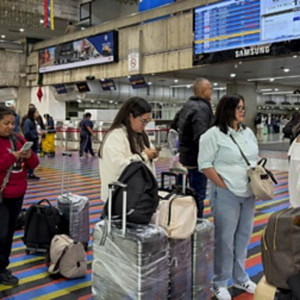
Venezuela fears it's being cut off as more flights are cancelled to and from the country.
We lost 50% of our weekly flight.
The airport here is very empty right now.
That's World Business Report on the BBC World Service.
I'm Will Bain, and in just a moment we'll hear from Venezuela's Airline Association on what impact those cancellations are already having.
And also today how a lost passkey caused red faces.
One of the world's leading internet security organizations.
The Airline Association of Venezuela has told World Business Report that around 50 of all the flights in and out the country have been lost already, with more international airlines cancelling flights for the coming days.
You're right.
Remember that all of this started on Friday, when the United States aviation regulator warned of heightened military activity in the area amid a build-up of American forces in the region.
Many airlines from Europe, North America and the rest of South America promptly cancelled flights to and from Caracas, which led, on Tuesday, to Venezuela's National Civil Aviation Institute apparently threatening to pull air traffic rights from several Spanish airlines if they did not resume operations in the next two days.
Maricela Loaiza is the president of both Venezuela's Tourism Council and the Airline Association of Venezuela, the body that represents commercial airlines.
The latest situation is very complicated.
There are a lot of passengers stranded because the flights, first, all the flights...
From the Americas, most of them were canceled, like Brazil canceled, Bogotá, some of them canceled.
Then the European carriers started canceling, the TAP, then Turkish.
So basically, we already were cut off from Europe totally.
We have no flights to Europe.
We only have international connections right now with Panama Curacao, some airlines to Bogotá, the others have canceled, and Venezuelan Airlines.
Basically, we lost contact.
50% of our weekly flight.
So there's no flights to and from Europe at all at the moment?
At all, at all right now.
And how many would there normally be?
There would be Madrid, 18 flights, one to Canary Islands, 19 to Portugal, 20, 21 flights a week.
That would be one way.
So that's 42 fly with stranded passengers on both sides.
And presumably that has an impact on people working in the airport and for you know, sort of things like baggage control and people who move the steps to and from airlines, things like that as well.
Yes, the airport here is fantastic. very empty right now.
I arrived on Sunday with one of the last flights that came in and it was very empty.
And, of course, it's going to be complicated when the flights return because you have to rebook all those passengers and it's in the thousands.
Because we're talking about, We lost 46 international flights.
And I'm talking one way, leaving Caracas.
So it would be 90-something flights with an average, I mean, 200 passengers per flight.
It's a lot of passengers to rebook and to find alternatives.
Are passengers still turning up to the airport as well at the moment?
Are you having to manage that?
Well, there...
They're very well informed right now.
The airlines set out some bulletins and they're waiving the fees for changes because there's a lot of uncertainty as to when the flights will come back.
The NOTAM that was issued by the Spanish authority is until the 1st of December.
But it's uncertain.
I mean some Spanish airlines only cancelled tomorrow's flight today because they thought they would be able to operate tomorrow.
And when things are uncertain...
They often get expensive, don't they?
That is correct because we went from 100 flights a week to half of them.
So people that really need to travel for working reasons, for medicine, for personal study work, whatever they're looking for all possible ways to move, and there are very little flights.
Is it causing problems? stress for you and the team?
Surely.
It's a very stressful situation.
We had a similar situation about a year and a half ago, but that was political, because Venezuela closed the skies to several countries.
So we lost a lot of And we started recovering it in the beginning of this year and it had become stable, up to about 100 flights a week leaving Venezuela.
But now again, we lost 46 of the 100.
Clearly, a resolution is needed by those who can find one by the sound of things.
And the speed of finding that resolution sounds pretty imperative for you and members at the moment.
Yes, it's complicated because there are a lot of actors involved in the situation.
The decisions are not clear who's taking the decisions.
The airlines also have to take into consideration their unions.
There's a lot of things involved.
That's Maricela Luisa there, the president of both Venezuela's Tourism Council and the Airline Association of Venezuela.
Well, are American consumers starting to feel the pinch?
A clutch of data, delayed because of the us government shutdown, seems to suggest maybe including a closely watched survey from the conference board think tank which found consumer confidence declined in november, of course a key period for retailers in particular which perhaps points to wider warning signs for the world's biggest economy.
In a moment we'll hear from the conference board's chief economist on that data in a bit more detail.
But first, to give you a bit of a sense of what's happening on the ground, perhaps we responded to a post alabama the guitar salesman, izzy miller, had posted about his sales and what he was seeing in terms of his customers appetites to spend.
The bubble burst during after covid and everything you know, the us government of course pumped 5 trillion into the economy, which just made prices on everything go insane.
We saw a lot of prices double, in some cases triple.
And of course, after that money was spent and kind of out, we started to see the market kind of become more stagnant and sales started slowing.
But as prices are coming down, we're starting to see sales pick up again.
It's not necessarily a doom and gloom situation.
I don't think there's a lot of reality in the market right now.
I think you've got Hornkamp that thinks that it's just doom and gloom, and we're going to be trading collectibles and commodities for bread and water in a year.
It's not going to come to that bills.
It's not something you know.
It's not um gas in their car to get to work.
Does it sort of speak to you?
Know anecdotally, what perhaps your friends or yourself feel about your personal finances in the moment, are kind of wondering about where the wider economy is going and should you be kind of saving for a rainy day by rather than buying that nice new muscle car or that nice new uh, that nice new guitar?
Well, i mean, we know from reports that credit card debt is just out of control.
And that's a good example.
And the average car payment in the US is.
I'm not sure of the exact numbers, but it's something like 700 a month now.
So I mean you're seeing people as the economy's slowed, we're seeing layoffs happen, we're unsure about how our jobs are going to go over the next year, two years.
And to be honest, that's a valid fear.
And a lot of people want to call that a recession.
And I'm not an economic guy, so I can't speak to the terms on that.
I see it more of a market correction.
What does that all mean for your business then, right now, and your business for say, the next six months or so?
We prepared for it.
I think the writing has been on the wall for quite some time.
I think at least a year, maybe two.
It got to a point where the market was just unrealistic.
You just start seeing unrealistic growth and you go, we need to pull back a little bit.
You're starting to see people say out loud, we're going to wait to buy these guitars.
You're starting to see people say out loud, the market's slow.
That's a step in the right direction because again, when prices come down, think about it will pick up.
It's not doom and gloom, but it's not you know, roses and unicorns and rainbows either.
There's going to be a market correction and it's actively happening right now.
Izzy Miller speaking and playing for us from his store in Huntsville, Alabama a little bit earlier on on Wednesday.
As I mentioned, Dana Peterson is with us Dana, the Chief Economist at the Conference Board, and George Conboy also with us as well to look through everything moving the markets today.
On World Business Report.
George, Chairman of Brighton Securities, both joining us from New York.
Dana, great to have you back on World Business Report.
First of all, thanks for being with us.
Thank you.
Before we get into the detail, perhaps set the scene for people again then.
How this survey that you guys run works and what you found for November?
Sure, absolutely.
Every month we canvass roughly 3000 Americans and we take a sample out of a big pool of hundreds of thousands of US people.
And we ask them, you know, how are you feeling?
Are you confident?
Are you not?
And we ask those questions regularly. along a number of fronts.
And certainly we saw a really big drop in November.
We think some of that has to do with the fact that we still had the shutdown, the government shutdown, going on.
And there were a lot of concerns about people losing jobs during that period and also losing public losing public funds for food and also healthcare.
So again, I think some of that may have been a little bit exaggerated, but still in all, consumer confidence now is much lower than it was in January.
Yeah.
And on that, those sorts of concerns.
Are you able to drill into those a bit about what it is that people are particularly concerned about spending on?
We heard Izzy Miller talking about it there.
I thought it was quite a good example.
Right, the discretionary items is the economic term, isn't it?
Things that we would like to have that we don't necessarily need to have.
He's saying anecdotally, he's seeing already a kind of pullback on things like that.
Well, when we ask consumers, you know what they're planning to spend.
We are seeing shifts, certainly within goods.
A lot of it's you know things people need, like food or car repair or over you know very expensive goods like a brand-new car.
But I mean before November.
We actually did see some improvement in folks wanting to buy homes and cars, but all that disappeared in November.
When it comes to services, it's actually a more nuanced story.
What we're seeing is that people are definitely shifting to necessary services, but they're also – gravitating towards cheap thrills.
So the number one thing people like to spend on are restaurants and also streaming, as opposed to going to the movie.
So we saw that.
But what was really interesting was that out of the top five restaurants, healthcare jumped from like five or six to number two.
So it's clear that people are also shifting their priorities to services that they need and away from services that are more discretionary.
So I feel for the gentleman.
Indeed, consumers are looking at things that they really need and also cheap thrills.
I'm sure a guitar probably costs hundreds of dollars, but I agree with him.
We're not going to see a recession or anything like that.
Yes, the economy will slow.
A lot of that's a function of the tariff impact and companies just remaining on the sidelines.
While we hear a lot about companies saying they're going to fire people, those are the companies, the sectors like tech and finance, that were already consolidating over the last few years.
And also tech adjacent.
Like you know, these big box stores like that have massive online presences.
But for the most part, we think consumers will continue to slow.
Businesses have threatened to fire people, but they're not.
When you look at the data, they're just not firing people, but they're also not hiring because they're still in stasis.
Yeah.
Just want to bring George Convoy in on all of that, George as well, because George HP is Big tech company, one of those saying exactly what Dana's talking about before the kind of close of trading this afternoon with you in the US.
HP's got up to 10 of its workforce as part of an AI push, not alone in talking in those kind of numbers.
You know 4000 to 5000 employees that could be.
Yeah, we've seen that with a couple of big companies lately.
Verizon talked about 15,000 layoffs.
It's not all AI driven will, but certainly some of it will be.
And that's the kind of productivity push and pull we've seen through our economy over decades.
It's the latest slice of it is AI.
I don't think you've seen the end of it.
You'll see more of that yet.
And George, what did the market more broadly make of not just Dana's team's numbers, but also we had numbers from the University of Michigan as well, didn't we earlier in the week that are always closely watched around sort of similar markets areas, those retail sell numbers as well in Thanksgiving week and in the run-up to Christmas.
What did the market take away from it all?
Well, the market looked at this and you look at the Dow way up today.
NASDAQ did okay, but a little difficult with Nvidia falling.
Dow was way up probably for a couple of reasons.
The economic data seems to suggest a slowing and traders are interpolating that to suggest that maybe rates will go lower.
Slung economy, Try to push rates down a little bit to help it from getting too slow.
Investors like low rates.
That drives the market up.
Compare that also to the big rise in the NASDAQ this year, with the Dow hanging back, meaning there are a lot of bargains to be had in more traditional blue-chip industrial companies, and investors seem to be cycling some of their dollars into that kind of investment, driving the Dow up sharply.
It was more than 1%.
I think it was close to one and a half percent up at the close.
We'll pick up on NVIDIA's numbers with George in just a moment.
But Dana, just in terms of the sort of why now, I suppose the why breaking point's much too strong, isn't it, as you've said, from what's going on?
But perhaps the first kind of cracks, the first real kind of pressure that you've kind of found in your numbers, is it just that the numbers have been delayed because of the government shutdown and no one there to crunch them?
Or is it a sort of lagging effect of things like tariffs that we're finally seeing filter through?
I think some of it is a lagging effect regarding tariffs, because we saw some really interesting behavior in Q1.
Businesses and consumers bought ahead of the tariffs.
And then once the tariffs were announced, they stopped buying.
And so we saw But even within that, you saw like really big changes in inventories and imports.
And that just really caused a lot of confusion with the data.
Third quarter, we're probably going to see growth around two and a quarter percent.
But for the fourth quarter we're probably going to see slower growth and slower growth, certainly in the first half of 2026.
And again, a lot of that's the delay from the tariffs being put in.
And certainly there were changes in those tariffs along the way.
And that picture is still pretty muddy going forward, isn't it as well?
Because we're never quite sure, particularly between the US and China, which bits of those agreements are going to hold.
Dana, always great to have you on the program.
Thanks so much for talking us through those numbers.
Dana Peterson, the chief economist at the conference board there.
George, you took us to those NVIDIA numbers.
Its shares closed down 25 at the close of trading today, and that was all, because it seems to be Google muscling in on its territory.
Right.
NVIDIA has been the whole story of chips for AI.
They're not the only maker, but they're certainly far and away the biggest and the best known.
Google today is really gaining traction in the marketplace.
Their chips are very well integrated.
Google is a player in that space.
And so, as Google shares have been rising NVIDIA, which is way, way up this year I think it was about a month ago They're down about 15 since a month ago.
Still up a lot for the year, but this is a volatile stock and it's not going to stop being volatile anytime soon.
International pressure and now competition pressure.
Really interesting.
George, great as always to get your thoughts on the program too.
George Conboy, Chairman of Brighton Securities, joining us from Rochester, New York.
You're listening to World Business Report on the BBC World Service.
Now, if you've had a bad day at work today, this next story hopefully, will give you some hope that even the surest of hands can sometimes make a mistake.
The International Association for Cryptologic Research is considered one of the leading organisations in internet security, so much so that even its recent leadership elections have used encrypted voting software.
There was a snag with that vote, though.
One of three trustees, entrusted with a section of code that would unlock the digital safe, so to speak, and reveal the results of the election, managed to lose their key.
A bad day at the office, but one that once again illustrates how key we sometimes hapless humans are to even the most sophisticated cyber security.
Bruce Schneimer is a computer security professional and adjunct lecturer in public policy at Harvard Kennedy School, told us more about how cryptography worked, how it became such a key part of global business and what had gone wrong here.
At its simplest, cryptography is secret codes.
I mean, I make a message that's secret that only the person who's supposed to get it can decrypt it.
It's a lot more complicated than that.
What we're talking about here is a lot more complicated, but at its base level is secret codes in the digital world.
And, exactly as you say, as we've come to do more and more of our lives online not just our data, but obviously our spending and things as well more and more important to have more of those protections, because we're getting more and more of those attacks to try and break in and steal, whether it be that data or our money or whatever it might be.
There are a lot of threats on the internet and the internet's all digital, and cryptography is one of the basic security mechanisms we have.
So, if it's protecting your social media accounts and Your bank accounts, your conversations, your files, your photos.
We rely on cryptography.
And so it takes us to this pretty extraordinary story, Bruce.
A very bad day at the office for someone at the International Association for Cryptologic Research.
It is a very strange story.
This organization has been around since the mid 80s.
I've been a member since the early 90s are the mathematicians that invent a lot of these protocols that keep us safe on the internet.
One of the areas of research is voting on the internet, which is unsafe for general elections.
But because this is a group of scientists, they want to do it for their own elections.
And the way the system works is that it breaks up the secret among several parts.
So think of it as a safe with three different locks.
You give a key to three different people and only if they come together can they open the lock.
And that is what protects this election.
Now, it's a great idea until somebody loses one of the keys and then you can't open the safe.
Or, in this case, you can't figure out who won the election because one of the trustees lost their key.
And unfortunately, that's where we are.
And they're going to have to start again with that process.
Obviously, A pretty bad day at the office for that person goes without saying.
It is, and he did resign his position at the IACR.
So interestingly I've been asked like wasn't there some way of getting in without that like a backdoor?
And if you think about it, that would be a terrible safe.
This system is secure enough that, if someone forgets the key, there is no way to know who won the election.
The IACR is going to make a change in their system.
This is something you can do in the virtual world.
You can't do with physical safes, so that any two of the three trustees are enough to open the election results.
People listening around the world as well.
Bruce thinking oh, my goodness, what a kind of bits of best practice in this area.
I mean, this is true.
And we've all experienced it.
We've all lost our passwords.
We lost our keys.
In a lot of cases, there are backup systems available.
A lot of websites, if you forget your password, they'll send you an email.
It kind of defaults your security, the security of your email.
And there are systems with backdoors.
If you have a corporate system, it is likely that your boss or someone in your company has a copy of your key in case you get fired quit, get hit by a bus, something happens.
The company needs your data.
It really speaks to the importance of having good backup systems.
So keep backup copies of your keys.
I tell people to get a password manager.
Those are really good pieces of software that will store the dozens or hundreds of different passwords you have.
That was the American cryptographer Bruce Schneier there with some sage advice.
Now, one of the biggest rock and roll tours of all time finally came to an end in Sao Paulo, Brazil.
Yeah, the British band Oasis, who were back after a 16-year hiatus, embarked on a 41-date, five-month comeback tour that's estimated to have been seen by just shy of three million people around the globe.
These fans in Cardiff Wales, were the first to see them back in July and told us on World Business Report what it was like.
For the first night of the world tour, that tops everything.
It was amazing.
I loved it so much.
Supernova!
I came all along from Estonia and I felt in love, really.
And five months on, was it a feeling echoed by fans in Sao Paulo when it all came to an end on Sunday?
Sounds like it.
Follows, of course, blockbuster tours from the likes of Taylor Swift and Beyonce as well, and seems to be ushering in a new era of the mega tour into music.
So what's the economics behind that?
Jenna Campbell is from Oasis's home newspaper, the Manchester Evening News.
I think there was a lot of apprehension heading into it about whether it could live up to people's expectations, having been away for 16 years.
And I think it really did live up to the hype and it exceeded expectations.
In Manchester especially, it had this really amazing impact on the city.
It came alive in a way that I've not seen.
And it was just really interesting to see how the city embraced it and then see that translated across cities across the globe.
I know previously the Oasis had struggled to crack America for various reasons.
And this time it really felt like they connected with audiences there.
So I think for a Manchester band to translate so long after releasing music and taking to the stage is quite impressive really.
Every single one of the gigs, even when you saw pictures from the international ones as well, Jenna.
You saw that people were travelling from all round the world.
There was fans from Argentina with their flags.
There was people from Paris.
There's people that had managed to bag tickets for every single gig or, you know, several in the UK.
And to feel the sort of warmth and intensity for that band after such a long period away was truly amazing.
I think it's had such a boost for Manchester as well and really proven what Manchester bands can do.
And people from a business programme's perspective like ours have talked about it being kind of part of this sort of wave of nostalgia economics, if you like, you know, sort of comeback video games, comeback fashions, comeback bands, etc.
It's kind of fascinating, exactly as you say, that people, perhaps without a connection to where they're from or even the country they're from, have been kind of as hooked in on that nostalgia trip as anyone else.
Yeah, we've seen so much of this in the last 12 months in terms of nostalgia and music particularly so obviously they're not the only band to do a reunion tour.
You know, we're seeing lots of 20 year, 25 year reunions and next year we've got another Manchester band, take that performing at the Etihad Stadium.
So there's a real appetite for it.
And also that goes hand in hand with people spending, I guess, and Salford University did some research into it and it added like almost 200 million, you know, in terms of that merch being sold across the tour, which is quite staggering really, and that's just for the uk.
So i think there is this real appetite to go back in time and celebrate it.
But i would say, in the same sense, being at one of those gigs, it didn't feel overly indulgent, it didn't feel like we were staying in the past too long and that there was a real sort of atmosphere of how far manchester's come and how far that band has come as well.
So it's not always the case being stuck in the past, but celebrating it.
What next then?
I mean, it's the million dollar question, isn't it?
Whether Oasis will continue the tour.
I mean just today, if you follow Liam Gallagher on Twitter, which I know a lot of us do sort of giving more credence to the idea that they would be doing a European leg, which is what obviously a lot of fans are super excited for.
So there's lots of rumours going around.
We've heard rumours about the Etihad here in Manchester can continue.
It would be 30 years since those iconic Nebworth and Main Road gigs.
So it kind of falls into place, but I can't tell you for a fact whether it is.
But it seems like Liam Gallagher is still very keen to keep performing, whether that's with Oasis or his own band.
So it would be amazing for Manchester to have that again.
Plenty more of those bucket hats that Jenna Campbell from the Manchester Evening News was mentioning, then potentially on sale in 2026 as well.
Jenna Campbell rounding out us there on the Oasis tour coming to an end.
Big money spinning gigs.
Just about it from us, World Business Report.
Just time to say thanks to our team tonight.
It's been BC and Craig, Stephen and Tavi.
And thanks to you for listening.