With the Venmo debit card, you can Venmo everything.
Your favorite band's merch?
You can Venmo this.
Or their next show?
You can Venmo that.
Visit venmo .me slash debit to learn more.
The Venmo MasterCard is issued by the Bancorp Bank and a pursuant to license by MasterCard International Incorporated.
The card may be used everywhere MasterCard is accepted.
Venmo purchase restrictions apply.
For Scientific American Science Quickly, I'm Rachel Felton.
5 .5 trillion tons. That's how much ice has melted out of the Greenland Ice Sheet since just 2002.
It's a number almost too large to wrap your head around.
But if you took that much water and used it to fill Olympic -sized pools which hold 600 ,000 gallons by the way, you'd have a lap pool for every person living in Africa and Europe, all 2 .2 billion of them.
The reason we know this is that for more than 20 years, satellites have been watching and measuring the so -called mass loss from Greenland's ice sheet, one of only two ice sheets in the world.
Antarctica is the other one.
What science doesn't know is how the Greenland ice sheet might come apart.
And that's a really important question to answer because it has a total of 24 feet of sea level rise still locked up in its icy mass.
Today on the show, we're talking to one of our own, Jeff DelVecchio, the head of multimedia at SIAM and executive producer of the podcast. Last year, Jeff ventured out onto the ice sheet for a month.
He went with members of a scientific expedition whose sole goal was to drill through the ice to get to the rock below.
And he's going to tell us why that matters when it comes to Greenland and the future of the ice sheet.
Thanks for coming on to the show, Jeff.
Sure, Rachel. Thanks for having me.
So why did you go to Greenland?
What was this expedition all about?
out? This was a project called Green Drill.
And Green Drill is primarily based out of two institutions where there are two co -PIs, so principal investigators who are working on it, one at Columbia University and one at the University at Buffalo.
And they have pulled this project together that was meant to go into different parts of Greenland and selectively sample the ice sheet to be able to figure out what was going on with it, its state, its health, and how they could push the science forward on what they understand about the Greenland ice sheet, how it's built, and ultimately how it comes apart.
What was life actually like on an ice sheet?
Do you feel like you were prepared, or were there any surprises that came your way?
I was absolutely not prepared.
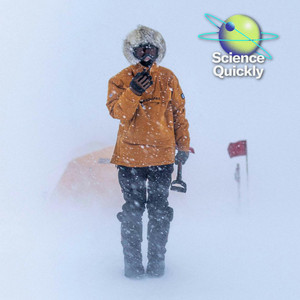
This was my first reporting in a polar zone, and once you get there, you realize that a big part of your safety and well -being really depends on the people who are there with you.
And there was decades worth of experience out there on the ice sheet, and we can talk about this, but it took a long time to actually get to where I was going.
And that was a whole part of the process.
But once I actually arrived on the ice sheet proper, I think the first day I was there, temperatures were right around negative 20 degrees Fahrenheit.
Wow. And the first night I slept on it, I actually was at a place in the middle of the ice sheet at a Danish ice coring camp in transit over to the final location where the Green Jewel team was doing their work.
And they had these these six by six tents called Arctic ovens.
It was not an oven inside, but those were out right on the ice sheet.
And they said, well, campus pretty full.
You should probably go out and sleep in the tent because you need to get used to it.
You're going to be out here for a while.
And so I did that and it was a real experience that first night.
So I guess I kind of asked for this.
I wanted to go here and do the story.
It's fine. it's just maybe um a rough first go but i'm gonna try to go to bed see if i can get some sleep this is what it is right now this is good practice there's actually a station here so if i really get uncomfortable i suppose i could go inside that's not going to be the case if we hit the field camp um yeah glorious reporting work in the polar arctic here we are good night day one uh on the greenland ice sheet it was about negative 20 outside and maybe about 10 degrees 15 degrees better in the in the tent so all night about zero negative five negative ten and it was also at about 8 500 feet
on the top of the ice sheet which you know you're kind of on a mountain already it's like being in the rockies but on the top of a big wide ice sheet in every direction you look there's nothing there's no features there's nothing and you're were just laying on ice all night and, um, it was painful.
I'm not going to lie about it.
It was painful. And you have a sleeping bag that's rated at negative 40 degrees and you have a hot water bottle that you put in to, to try to warm yourself up.
But, um, my face was sort of sticking out of the mummy bag hole and I would breathe and there would just be ice crystals forming on my beard and face as I breathed out.
So a little bit of a rough intro.
Um, but, uh, I did question why I I was there.
I made it through my first night.
I wouldn't say it was pleasant.
Really cold the whole time.
That's tough to get comfortable at any point.
I don't know how people do this for long periods of time.
Brutal. Yeah. But I made it.
But I did get through it, and there was a lot of experience.
Like I said, people who knew what they were doing, which really helped.
Yeah. Yeah. Well, you mentioned that getting out there took a really long time.
How did you get there and where did you end up?
Yeah. So it's a process.
And I had no idea how any of this worked before I got on the expedition.
But typically the U .S. military actually flies a lot of the science flights because there's a bit of history.
And in my feature, you can read a little bit about that, because the U .S. military has been out on the ice for decades for other reasons than ice core research and climatology research. But I went to a base in upstate New York, got on a big cargo plane.
In the event of a loss of pressurization issue, if you're to look over your left or right shoulder, there's a vertical rectangular panel on the wall.
Which flew to Kangaroo Luswak, basically a staging location Where all the science people kind of come in from all different parts of the world You sort of sit there and you wait until the conditions are right So you can get onto another cargo plane So this is it, we're in Kangaroo Luswak Greenland, and today we're shipping out to the ice Which then takes you and your whole crew out to For us, the staging location, the Danish ice squaring site I mentioned out in the middle of the ice because it's too far to go directly to the site okay here we are room and ice sheet this is the east grip danish
site it is cold my camera's not loving this but here we are there's a station behind me and sun just trying to peek through just came in on the air national guard c -130 they're pulling our stuff over here we go Once you get on that smaller plane and you know manage all the weather and get out there in time you sort of sit there and you kind of load up a smaller cargo plane to take you yet another step the final leg to the green drill site which is out in the northeast part of Greenland literally the middle of nowhere.
Hundreds of miles in every direction there's just ice.
So it's a real production.
It took about 20 flights for all of the people and logistics and gear.
There's probably about 20 ,000 pounds worth of gear, including the drilling equipment that we had to take.
So it takes a week just to get there.
And then you're sort of flat out working.
Once you actually do get there, the team knows that there's only so much time and there's a closing window.
So it's kind of a scramble, but it's a long scramble just to get to of there.
And where exactly are all those planes and gear going to?
So they're going to a totally unpopulated part of the northeast Greenland ice sheet, but it was a really important location and it was picked for a reason.
Imagine this sort of large dome of ice.
The way in which it actually moves, and it does move, is that snow falls on the top and sort of compresses then spills out across the ice sheet.
And part of that spillout happens through these things called ice streams. And they're like a stream you would imagine in the water world, but they're just made of fully solid ice.
And they're literally flowing away from the top of the ice sheet at a speed that's a lot faster than the surrounding ice.
So you can actually see them in satellite data.
And so we were positioned right at the edge of something called the Northeast Greenland Ice Stream, which drains about 12 to 16 percent of the ice sheet.
So, like, basically over 10 % of the water that's kind of going out and moving to the sea, getting into glaciers and then going into the ocean, comes through this massive ice stream, which is really just this big tongue of ice moving faster than the surrounding parts of it.
That location is really important to understand how the ice sheet loses its mass.
And if you sample at just the right point, then you can understand in this really critical portion of the ice sheet exactly how that ice stream works in terms of keeping the ice either growing or shrinking.
And right now it's really shrinking.
So they want to understand how these streams can play a part in pulling the ice sheet apart itself.
Yeah. Let's talk more about the science.
What kind of experiments are going on here?
Yeah. So there's all of this ice, right?
Right. And in the past 60 years or so, people have gone to the Greenland Ice Sheet to basically pull these long tubes of ice out of the ice sheet itself and use the ice as a record of climate change because ice is laid down yearly.
And it's basically like a tree ring, but in an ice sheet.
And if you pull out large sections of it from the middle of the ice sheet, you can get up to 125 ,000 years of climate.
The snow falls, it compresses, it captures the air that was above it at the time, little air bubbles.
And so the ice cores are these records of climate going into the past. Everyone was always focused on the ice since the, like, 60s.
What can the ice tell us about climate?
How can we connect it up to other records of climate change and paleo climate in the other parts of the world?
But no one or very few people looked underneath it.
And the important part about being underneath the ice sheet is that the rock itself that's under the ice sheet tells you something about when it's had ice on it and when it hasn't.
When it hasn't is a really important part of that Because if we're wondering about how the ice sheet breaks up, we really have to know how quickly that's happened in the past. And at this point, science has very little idea about how that actually works.
So what they did was we were out there with these small drills packed up in kind of containers.
You take the drill and you drill all the way through the ice.
And you're not happy when you get to the bottom of it.
You stop and then you keep going.
And you pull the rock out from underneath the ice.
The game here is to do measurements on that rock and see what it will tell you about when this place had ice and when it didn't.
There's kind of a great quote from one of the co -principal investigators on the project that really kind of summed up why they started doing this.
Here's what he had to say.
2016 was the first study that was led by us that shows that you have these tools, these geochemical isotopic tools to interview a bedrock and the bedrock actually talks to us.
Since then, it's clear to us, at least, that that's a new branch of science that is absolutely critical.
It's really at the interface of basic geochemical and climate science and societal impact.
It's one of these rare occasions that there is direct contact between basic research and scientific impact and questions like climate and social justice.
So it's a very scientifically and extremely exciting time.
on the same moment, I must say that everything we have found out so far is very scary.
And I kind of have the first time ever in my career have data sets that take my sleep away at night simply because they are so direct and tell me this ice sheet is in so much trouble.
That's Jörg Schaefer from Columbia University.
What was it about those data sets that he found so troubling?
Sure. So I just talked about that long ice square that they pulled from the middle of the ice sheet and using that as a record in the 1990s one of those was pulled at a place called gisp two which is the greenland ice sheet project two site it was an american site and they went further than anybody else had in the past and once they got through the entirety of that ice about 10 ,000 feet worth of ice they pushed the drill farther slammed it down into the rock and pulled some rocks out now the ice core went off to be in thousands of other papers connected to records all over the world.
The rock underneath went to a freezer and got stored.
And people basically forgot about it.
York, Schaefer and Jason Briner of the University of New York at Buffalo in the early 2010s, they realized that that rock could tell you something.
And now they had chemical tools to analyze that rock in a way that hadn't before.
And so they went back and got that rock.
They tested it. And in 2016, they published a paper that showed at that site in the middle of the ice sheet, their chemical test told them that it was ice free within the last million years.
That means the whole ice sheet was gone.
Wow. And that was way quicker than anybody thought was possible.
And so that spurred this whole next step, which was if we got more of these rocks from different parts of the ice sheet, what else will it tell us about how quickly this happens?
The bed of the ice sheet contains a history of the ice that covers it.
Basically the words, the stories of the history of the ice sheet.
It's a book of information down there that we want to read if we can get those samples.
That's Jason Briner of the University of New York at Buffalo.
So that was the seed of this whole thing.
So if you stick the soda straw down into the rock and you pull it back out, you can test multiple locations and it could tell you here there was no ice then, here there was no ice then, here there was no ice then, around the ice sheet as a way to test how it shrinks back to its teeny tiny state.
And how do you get that kind of signal out of a rock.
It's complicated. You know, I wasn't a chemistry major in school.
I was a geology major.
But one of the researchers in the field, Allie Balter -Kennedy, you know, she has a good way of thinking about it.
Why don't I just pull Allie in to talk about how this signal comes into the rock?
So there's cosmic rays that come in from outer space at all times.
And when they interact with rocks, they create these nuclear reactions that create isotopes or nuclides that we don't otherwise find on earth.
And we know the rate at which those nuclides are produced, so if we can measure them, we can figure out how long that rock has been exposed to these cosmic rays, or kind of in our field how long that rock has been ice free.
And so when you do that underneath an ice sheet, you get a sense of when the last time the rock was exposed and also how long it was exposed for.
So it's a pretty powerful method for learning about times when ice was smaller than it is now.
These nuclides are the signal inside the the rock.
If you can tell how much of it is in the rock and how quickly those signals should decay, if you see jumps in that signal, you can tell that ice was over top of it and it stopped the barrage from the universe.
So it turned the signal on and off.
And that's sort of how they look at the signal is like, is it on?
Is it off? Is it on?
Is it off? And that tells you in a way there was ice over top where there wasn't.
There was ice over top where there wasn't.
Wow. Yes, that does That sounds very complicated, but also very cool.
Did the team end up actually getting what they were after?
Yeah. So it was kind of down to the line after all the traveling and all the logistics.
And there was some weather and delays and there was cargo flights that couldn't land.
Basically, everything got compressed into about three weeks on the ice at the site.
That's not a whole lot of time to do what they were trying to do.
It's a spoiler alert, but if you read the feature, you'll hear about exactly how this happened but they did end up getting not just one of these samples but two from two different sites which you can test against each other to make sure you got the right stuff all the way to the last few days before extraction they were drilling trying to get the rock samples but there was this moment out on the ice right towards when we sort of wrapped up where i remember it felt unseasonably warm it was about 25 degrees um which is balmy yeah on the ice sheet and honestly the The drill was just after going through
a couple of rounds where it was tough going, sort of sliced like, you know, a knife through hot bread down to the ice and got the rock out.
And they got this beautiful long core.
There's genuine rock core.
Oh, baby. I just remember Caleb Walcott George was one of the scientists on the expedition.
Just like hoisted it like it was like this prized bass.
Yeah. And there was sort of this shout all around the camp.
I was just baiting you.
And when they closed the hole, they had this liquor called Gommeldansk, which is this Danish liquor, but they call it Driller's Fluid.
They've got to get a picture for Luke, so I've got to see those labels.
There it is. She's the one that taught me to do this.
You've got to lace it right down in the casing, dude.
And they poured one down the hole to close it out as a way to sort of give the hole something back.
Bottoms up. It's all she wrote.
Well done. It was this really clean finish to what had been a pretty stressful couple weeks just trying to get samples back with the window of time closing.
So it was a nice moment out on the ice and, you know, just had music playing and it felt like not the end of the world in the middle of an ice sheet, but a tight -knit science camp where things were going right.
Yeah, that must have been really cool because I feel like there's not a lot of field work where when you get the thing you're looking for, it's like sturdy and hoistable.
So that's fun. For sure.
And I'm sure, you know, there's going to be years of follow -up research on this data, but what are they learning from their time in the field?
They had a site in another part of Greenland from the year before where they did the same kind of work.
And they're just at the point at where they're publishing that.
And what it looks like is that there's this place called Prudhoe Dome, which was in the northwest part of Greenland, where there was this big ice dome.
And what those tests told them was it looked very probable within the Holocene, so in the last 10 ,000 years, that the ice was completely gone there.
And it was a lot of ice to take away that quickly.
Again, it's going from this 2016 paper, which says a million years ago, it was ice free.
A million years is a long time.
But even to sample in a place where there's a whole lot of ice in the northwest of Greenland and having it gone within the last 10 ,000 years with climatic conditions that are close to what we're experiencing now, that puts it on a, our threat kind of level.
Yeah. Because ultimately, you know, if the whole of the ice sheet melted, that's 24 feet of sea level rise.
That means massive migration totally changes the surface of the planet, but you don't need 24 feet to really really mess some stuff up.
So even five inches or 10 inches or a foot and a half is kind of life -changing for coastal communities around the world.
Every amount of exactitude they can get on how this thing changes, breaks up and melts is just a little bit more help for humanity in terms of planning for that kind of scenario, which given the state of our climate seems like we're going to get more melt before we get it growing back.
So it's definitely coming.
The melt is coming.
The Well, thanks so much for coming on to share some of your Greenland story with us, Jeff.
Of course. I was happy to freeze my butt off to get this story for our readers and listeners.
That's all for today's episode.
Science Quickly is produced by me, Rachel Feltman, along with Fonda Mwangi, Kelso Harper, Naima Marci, and Jeff Dalvisio.
This episode was edited and reported by Jeff Dalvisio.
You can check out his July -August cover story, Greenland's Frozen Secret, on the website now.
We'll put a link to it in our show notes, too.
Shaina Posis and Aaron Shattuck fact -check our show.
Our theme music was composed by Dominic Smith.
Special thanks to the whole Green Drill team, including and for all their insights and support in the field.
Jeff's reporting was supported by a grant from the Pulitzer Center and made possible through the assistance of the U .S. National Science Foundation Office of Polar Programs. For Science Quickly, this is Rachel Feltman.