Discussion keeps the world turning.
This is Roundtable.
This November, the 15th National Games are hitting Guangdong, Hong Kong and Macau with a brand new energy.
While top athletes battle for medals, these games are breaking the mold.
Think high-tech competitions, eco-friendly initiatives, and unexpected new events.
It's a fresh, dynamic.
Take on a major sporting tradition and the fields have of play has evolved, and we'll tell you exactly how.
We're live from Beijing.
This is Roundtable.
I'm Steve.
Thank you so much for being with us today.
And for the show, I'm with Yushun and Yushan.
First up.
This November, the sporting landscape of China is being transformed as Guangdong, Hong Kong and Macau unite to host the 15th National Games.
This highly anticipated event will see the nation's most elite athletes compete for glory across a vast array of sports.
Yet this edition promises to be far more than a conventional athletic showcase.
It is poised to set a new benchmark for innovation and inclusivity.
Audiences can expect a dynamic fusion of sport and tech, where cutting edge enhancements provide deeper insights into the competition and we've got some surprises in this year's competition.
As well as non-professionals will be taking part too.
It promises to be an exciting event, and we're going to learn all about it today, so let's get into it.
Yushan and yushan, good afternoon to you both.
What do we need to know about the 15th national games of china?
Yeah if if, this is the first time you ever heard about this event, then here's some a little bit of backgrounder here.
So the national games of china is the country's highest level and largest multi-sport event.
It's held every four years and organized by the general administration of sport of china, and this year, the 15th edition is held between november 9th and 21st, and it also marks the first time that the game is to be joined by multiple segments together.
In southern China, it's hosted by Guangdong province, together with Hong Kong and Macau SARs.
It's like a little regional celebration down the southern part of China.
But is it the first time that Hong Kong and Macau SARs join the national game?
It is absolutely a national celebration, I would say.
The whole venue is held within this area, Guangdong Province, Hong Kong SAR and Macau SAR.
But athletes from all around China can participate in this sports event.
And for the first time, Hong Kong and Macau is serving as host venues for this event.
And it's the first time for this region of the country to coordinate those areas all together for the games.
And also this is according to Chinese online travel agency Tongcheng Travel, where searches related to the national games.
That include hotels flights, train tickets and local attractions.
They surged nearly 400 over the past week.
Searches for Guangzhou and Shenzhen these two cities they rose over 40 while travel interests in Hong Kong and Macau, as They also climbed, quite notably.
And as the host city of the opening ceremony Guangzhou, actually wrote out 50 themed travel routes linking competition venues with cultural and tourism resources that's locally quite popular, via ticket discounts and special offers.
And this is according to China National Radio.
So I believe this is how the local governments they're really sending out signals and gestures to invite more people to also tour around here while you're here, to participate or to just watch the games.
Yeah, this is absolutely one of the, i would say, purposes of these sports events, or huge sports events it can attract people to travel to that area and um boost the tourism industry and everything.
And, of course, aside from that and some of uh, i would say more, the main purpose of these sports events would be uh, first of all, challenges and um competition for all of these elite athletes, right?
And then preparation for maybe future Olympic Games.
That can be a good, I think, testament for a lot of these athletes to at least know about the atmosphere of all of these sports events.
Yeah, not the only events going on either.
In early November, Guangdong launched its winter season consumption campaign.
I know we talk about that each time winter rolls around.
During the 15th National Games, the 12th National Games for Persons with Disabilities and also the 9th National Special Olympics Games are being held in the province.
More than 260 state-owned A-level scenic spots, nearly 40 popular attractions.
They're offering free entry for athletes and staff, and there are more than 100 above 100 for A-level attractions that are providing discounts for spectators too.
And back to the games at hand, they're going to sell a lot of tickets to this.
Yeah, about 5 million to start with.
So 5 million tickets for the national games are scheduled to be issued, many bundled with offers such as free or discounted access to scenic spots accommodations, public transports and even consumption vouchers are all being assigned to just normal citizens and travelers like you and i.
So this is how big of a scale is being covered this this year.
Yeah, it's huge, it's huge, it's huge, and a lot of people are going to be going there to visit the region and hopefully visiting the region for for the first time, for for many people, so that they can experience that and the games, all those events that we mentioned.
I've always wondered what it's winter like in Guangdong province.
I've never been there during wintertime after November.
I'm not sure if either of you have.
I have not, but I can guess warmer than Beijing.
Yeah, for sure.
Yeah.
So let's get to the events then, sporting events.
What are we looking forward to?
Yeah, there are overall 34 sports that's featuring in the main competition.
That includes swimming, track and field basketball, football as in soccer, I believe and table tennis, and gymnastics cycling shooting, and also surfing and skateboarding and sport climbing and wushu that's martial art and more.
So...
Yeah, a lot of varieties.
A lot of varieties.
419 metal events will be taking place.
There are a ton of venues as well.
88 different venues across the three different regions.
And the events are mainly centered in Guangzhou and Shenzhen, but they do extend to 16 cities across Guangdong.
So this is not just a downtown event.
This is taking place over a pretty large area.
Now, as I mentioned in the opening, this is kind of fun.
There are mass participation events too, and this is what kind of separates this event from maybe the Asian Games or the Olympics or something like that.
Yeah.
This kind of a mass participation events means that ordinary citizens can also participate in this huge sports event.
But also, of course, you need to register and go through a lot of process of being selected as an a part of this sports event.
So it's not like I could just get off the high-speed rail and register for a Wushu event or something like that.
You need to be qualified as well.
So, since this addition of mass participation events in 2017, the National Games has become an important platform for promoting nationwide fitness.
And this year's Games features 23 major mass event categories and also 166 sub-events, including four performance-oriented categories such as Dragon and Lion Dance, Tai Chi and something like that.
In addition, Young divisions have been added for football i mean soccer, basketball and volleyball to strengthen the talent pipeline, which means teenagers can also participate in these sports events, and the inclusion of wushu, or martial art, continues to promote china's rich traditional sports culture.
Yeah, that's cool.
So then, how do you i mean so individual?
For the mass participation, you need to be a member of an organization or a group that registers.
It's not individuals that do so?
Yeah, this year this mass participation event.
These are all open for registration by provinces, autonomous regions municipalities, as well as regional organizations such as the Xinjiang Production and Construction Corps and also various industry sports associations.
So if you want to register as an individual, you gotta try to align yourself with one organization or public facility to do so.
It's not like you can, like i said, jump into the arena just like that.
After all, not everybody knows tai chi, not everybody can do lion dance immediately.
So yeah, it's more like um, a wider range of celebration to encourage people of whatever walk of life just to join and have fun and celebrate and exercise in the meantime.
Well, lion dancing, or dragon and lion dancing, is typically held during festival times or celebration times.
Yeah, and I just did a bit of research on that.
There are two types, apparently.
I didn't know this before.
So up in the northern part of China, near Hebei province, there's the northern lion dance.
But the more popular ones are the ones that's known in Guangdong, the city of Guangdong, where they call it Awakening Lion Xing Shi.
So that's like one of the most iconic lion dances.
There's a very famous anime about this.
Yeah, anime and choreography, dance dramas, all featuring that one awakening lion dance that's originated in Guangdong, Guangzhou province in southern China.
So that's the more globally wide-known part of lion dance.
Just one last question.
So for the mass participation Do they win medals or is this just kind of like a side fun thing for people to do?
They do win medals.
It is a side event, I mean sub event that this is holding, but they do win medals and also certificates and showing that they are quite capable athletes.
And of course it is a kind of a trophy for a lot of citizens to letting them getting these kind of prizes.
A national sports event.
Yeah, that's really cool.
One of the big exciting events is an inter-regional event.
It's a road cycling race that will span across all three different regions.
Tell us about that.
Yeah, that sounds really interesting and a long... road to ride as well.
So riders.
They start in Zhuhai in Guangdong province and across into the Macau SAR via the Macau Bridge.
They reach to the Hong Kong SAR through the Hong Kong Zhuhai Macau Bridge and then return to Zhuhai.
So that's overall a 230 kilometers route.
That's symbolizing the physical linkage of the Greater Bay Area in general.
So it's also the first time in history that the Hong Kong Zhuhai Macau Bridge has been used as a venue for this kind of event.
It's a race course for the first time, making it the only event that physically connects all three regions.
You know what?
I actually were on this Hong Kong-Zhuhai-Macao bridge.
We were traveling there in this region specifically.
I've only seen videos about it.
It's like a very huge and wide one.
We were on a bus and the bus go through the bridge.
It takes us for like half an hour, or even more than that.
On the bridge itself.
Yes.
So when people are cycling around this region, I think it is absolutely a challenge for their physical and everything.
But it would be beautiful as well, wouldn't it?
Yeah.
That's cool that this is the first time that that area has been used as a race course.
Then there's a marathon event. too.
And Shenzhen's hosting this?
I think it is even more interesting.
This marathon will use the Shenzhen Bay Bridge to connect Shenzhen and also Hong Kong.
And this is also the first inter-regional marathon in National Games history.
Sounds like a lot of people is going to run quite a bit in that region.
And then what got my interest is the Torch Relay for this year's National Games.
It's the first ever cross boundary torch relay in the history of National Games, with the flame passing simultaneously through the four major cities where the event mainly takes place.
And it also represents the first time the National Games torch has ever been carried in Hong Kong and Macau SARs.
And yeah, and in the meantime, there seems to be a very interesting news.
And I kind of reported a bit about it earlier last week.
Do you know who is the zero torchbearer this year?
Normally, it's someone iconic or someone famous.
You mean like the final person to carry the torch?
I mean the first one.
This year, it's someone named Quafu.
Sorry, it's not a someone, but rather a 5GA humanoid robot that became the very first robot torchbearer in history.
So it was developed by Leiju Robotics in partnership with China Mobile and Chinese Institute for General Artificial Intelligence.
And it did its relay segment completely on its own, without any human operator or technician following it, like running next to it.
So that's pretty cool humanoid robots just just running and carrying uh, i believe it was a 16 um kilograms torch, so it's not really that light.
We knew humanoid robots were going to be included somehow, some way.
That was for sure.
Um this, this region.
I mean it's kind of impressive the, the inter pardon me, the inter-regional events, because the cities that you mentioned hong kong macau uh, Guangzhou and Shenzhen.
They're not very far apart from each other, but yet the geography is not really that convenient either.
We talked about the connection through bridges.
There's the Greater Bay Area.
There's a lot of water down there, too.
Yeah, we've already mentioned several bridges during these sports events.
So no matter it's about the sports event itself or the torch relay or the whole event that is happening.
These events highlight the China's world-class transport infrastructure six major sea-crossing bridges, as well as the expanded Guangzhou Baiming International Airport.
And I would say, hosting a major sports event like this across Guangdong, Hong Kong and Macau is not easy because of the Greater Bay Area, each with its own border controls, currencies and also administrative procedures.
Even though the region is highly connected, as we said, through all of these world-class transport infrastructure, coordinating a multi-city event will still require an aligning policy or like arrangements, medical services logistics broadcasting, scheduling and also venue standards across these separate systems.
So it's a rare and large scale test of all of these cross boundary cooperation, and something that is far more complex than hosting an event within one single region.
I mean the having the infrastructure in place is complicated on its own, never mind holding a national event there.
And that bridge, the one that you mentioned, the Hong Kong Zhuhai Macau Bridge, that's not that old right.
That's only about seven years, eight years old?
Yeah, it was opened for operation since October 2018 and it has already welcomed over 93 million travelers and 194 million vehicles by October this year.
And also, alongside this one single bridge, the Guangzhou Shenzhen Hong Kong Hong Kong high-speed railway, also further strengthen the mobility and economic exchanges within that region.
So I did a little bit of checking.
Previously, I had this relative, a cousin.
She used to do her bachelor degree studies in Hong Kong.
But she told me it's very convenient for her to travel between the city of Shenzhen and Hong Kong SAR.
Quite quick.
Quite quick.
By subway.
Within one to two hours of bus or subway rides.
They often go to Shenzhen to buy groceries because it's cheaper there.
But now, with this new high-speed railway connecting the various regions, it can take less than 20 minutes to travel from the city of Shenzhen to Hong Kong, which is quite an improvement here.
The infrastructure, the coordination is impressive.
But the governments of the three regions, the people in charge, they've worked together closely as well.
Yeah, they work together to optimize routes, ensure smooth information exchange and enabling athletes to pass between regions without manual checks and what not organizers call a no break experience.
And dedicated fast lanes are also set up for sport teams and spectators, allowing quick entry and exit.
All of these things i think they are connected with these uh hard infrastructure and these are can be seen as soft connectivity.
So I guess in the meantime there are also the extended people-to-people bonds here, because jaunt training and youth activities within the Greater Bay Area kind of also relate to a lot of running events, for example in Nanshan District in Guangzhou.
And also in the meantime it involved 500 young participants to train together and have fun together.
And then there is this one Hong Kong athlete, Li Zuwei, who is a record runner. holding runner.
And he said that running on Chinese mainland soil felt like a dialogue between history and modernity, showing respect for the deep sports culture and also competing alongside athletes from across the Greater Bay Area.
So for these individual athletes, it's also one of a kind kind of experience.
Yeah, there's an emotional connection there too.
What about What more about the connectivity should we know?
What about the side little fun things that we like when we hear about an event like this?
Like the themes or the slogans or the mascots or those types of things.
The slogan this year is passionate national games, vibrant greater Bay Area.
And it is even more catchier in Chinese.
I know you wouldn't be understanding any of these words, but I'm going to say it.
Was it...
It just sounds very catchy.
Sounds good to me.
Yeah, but this captures both the energetic spirit of Chinese sports and the unique collaboration among these regions and embodies the values of Olympic movement and Chinese cultural ideals and the spirit of the times and showing unity, vitality and also local character.
I guess that's frustrating sometimes, isn't it?
Because this Chinese is so poetic and pretty and beautiful.
You translate it to English and you look at it and you're like, that doesn't really capture.
The essence of what we're trying to say.
Look at the restaurant menu.
You'll see that.
What about, yeah, the mascots.
I want to know about the mascots.
They're so cute.
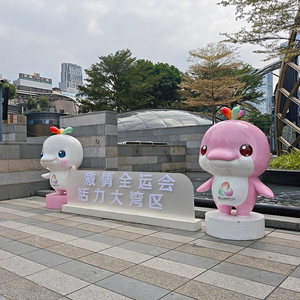
There's a white dolphin named Xi Yang Yang.
And there's a pink dolphin named Liu Rong Rong.
And the both of them, they represent joy, harmony and unity.
And also they are the Chinese white dolphin or Sosa Chinensis.
I believe that's the species name.
So that's a type of nationally protected species that's often seen in the Pearl River Delta, a perfect symbol of the Bay Area.
So, of course, they are the iconic symbols to be selected as the mascots.
Sure.
I was having a look at some of the emerging sports and one of the cool ones that's going to be represented here and this might be a new word for a lot of people a new sport too orienteering.
How do they play this?
Hmm.
Think of it as a mix between running and solving a map-based treasure hunt.
I sound confusing because I am.
So here's how you go.
The athletes.
They get a detailed map marked with checkpoints, usually scattered around the natural area.
So it could be a forest, a park, or a hillside.
And they put you in.
And all you have is a compass and your navigation skills.
And it's not just about getting there the fastest, but also about how you get there, the strategic way of how you plan your trip.
So you've got to read the terrain, plan your route, and make quick decisions on the go.
Sounds like treasure hunting to me.
Well, I mean, the treasure then, in that context, would be the finish line.
So what they do is they tell you where the finish line is, and then there are checkpoints along the way where you have to go and prove that you visited that particular place.
Oh.
But how you get there is completely up to you.
That's why they give you a compass and a map so that you can strategically figure out your route.
And it's up to each team to come up with their own strategies.
And you'll look at the landscape.
You'll try to figure out, oh okay.
Well, actually this way is going to be a shorter distance A to B, but the geography doesn't really cooperate.
So we have to go C to D. It is a longer route. but we're going to get there faster overall.
Like that type of strategy.
It can take me all day.
Yeah.
This is actually the first game of the 15th National Games mass participation program.
Oh, that's in the mass participation?
Yes.
And it is also the official debut in these games.
And I remember this taking place in a local village in Guangdong.
And a lot of athletes from Hong Kong and Macau praised the opportunity to race in this area.
And They get the chance to get a lot of views there and experience local culture, showing the greater areas, growing sports, integration and also the enthusiasm of all the people.
It's really interesting because this kind of orienteering we call it an exercise nowadays.
It originally started in the nordic countries as a nordic military training exercise and then, um yeah, it entered china in the 1980s and 1990s and has now evolved into a growing public sports.
So, on red no, the social media, the ding song or orienting hashtag has reached over eight million views, so it's popular among young people it is, and big brands are getting involved, like Columbia and Nike and ACG, for example.
They're creating these events in urban parks and even campuses sometimes.
So they're really bringing it down to a grassroots level.
I mean, it's fun, right?
You get to use your brain, use a little strategy.
Get lost a little bit.
Get lost a little bit and get some good exercise as well.
Yushin, anything stand out to you in terms of like a fun sport that you're looking forward to?
Yes, and it is quite...
Exciting to get to this part, you know, the new modern pentathlon.
You know that?
Pentathlon?
Pentathlon.
It is an updated version, to be honest, of the classic Olympic multi-sport event.
Now it is consisting of fencing, obstacle racing, swimming and a combined laser shooting and running event.
Yes.
So the old pentathlon.
Pentathlon yep consists of, I think, horseback riding and and, and then the other things that I just mentioned, instead of obstacles.
So this introduced to make the sport more accessible and also exciting, and it replaces, as I said, the traditional horseback riding with an obstacle course and athletes complete all four disciplines because now laser shooting and running are combining to one event.
So Earning points in each event, the athletes, and then the final laser run uses a staggered start based on those points.
So the first athlete to cross the finish line wins.
And because you get to see all these five different sports in one day, in one program, I would say it is absolutely worth watching.
Athletes will be exhausted after completing that for sure.
Yeah.
The venues have gotten cooler, not temperature-wise, but just kind of smart-wise.
At one of the sports centers in Guangzhou, visitors can use a mini program for AR navigation.
That makes it easier for people who are looking around to find seats or find facilities, find things that they're looking for.
There's also online real-time guidance and inquiries and emergency support.
There's a digital assistant for that.
That's in terms of kind of the smart upgrades.
But then the buildings themselves, we said that we wanted it to be green.
And that's something that we hear a lot when we hear about these types of events these days.
And they're doing it.
Over 90% of the competition venues are renovated using existing sites.
And that helped, of course, to reduce the cost and reduce the environmental impact, too.
Yeah.
And also this year.
It also features the human-centered design because Shenzhen Sports Center.
They added electronic restrooms indicators to flexibly adjust male and female ratios and reduce waiting times.
And most importantly, I think, after the closure of this year's national game, after everything is done, all 75 venues in the Guangdong region will stay open to the public, so that it can be reused over and over again.
So that those updates digitally or renovation wise it can still play its biggest value such a good idea electronic indicators for the men's and women's washrooms because then when there's more demand then you create more bathrooms and when there's less demand then you switch them over to the other side yeah that's why have we not thought about this before for major events it just makes so much sense doesn't it Yeah, lots of impressive tech on display at various centers.
Retractable roofs and movable screens and telescopic seats and those types of things allow for quick conversion for a lot of different types of sports, which is really, really cool.
The 15th National Games, of course, it blends, as we heard, the old and the new.
It preserves history.
It also embraces technology and sustainability and accessibility and it turns these really cool stadiums, these legacy stadiums, into smarter, greener and more inclusive community assets.
And, speaking of community, the inclusiveness of people like you and I, if you will, to be able to take part is a really kind of unique aspect of the national games.
And I know that everybody's going to have a good time watching.
I'm going to try and find it on TV if I can.
I'm sure it'll be heavily covered.
You sound like you're flying to Guangdong tomorrow.
I'll be up here in Beijing, but I'll be looking.
I want to know what it looks like to watch on TV the orienteering.
How that's going to work itself out.