Discussion keeps the world turning.
This is Roundtable.
What if we could harness the power of gravity to tackle one of the biggest challenges of renewable energy, storage?
China is doing exactly that with one pioneering gravity energy storage project.
Could gravity be the key to unlocking a cleaner, more reliable energy future?
And Motivational Monday is here to turn meh into magic.
Tune in for stories and songs that will light a fire under your week.
Coming to you live from Beijing, this is Roundtable.
I'm He Young. For today's program, I'm joined by Steve Hatherley and Yu Shun in the studio.
First on today's show.
Imagine using the simple force of gravity to store and release energy.
Sounds like something from the future, huh?
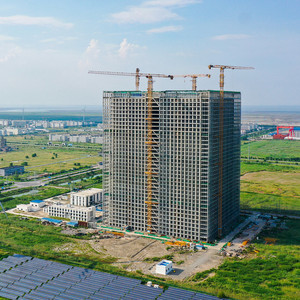
Well, China's making it a reality with its first gravity energy storage project in an eastern coastal county.
This 35 -story facility powered by massive 25 -ton gravity blocks is set to revolutionize how we think about renewable energy storage.
So please explain, what is gravity energy storage?
These are three little words, separately I understand what they mean, but put together, I'm like, huh?
Yeah, so first of all, let's see this exact example.
In this Rudong County in East China's Jiangsu province, this 35 -story high steel structure houses around 1 ,000 gravity blocks, and each of them, as you said, He Yang, weights 25 ton.
And these blocks are lifted to store surplus renewable energy and lowered to produce electricity during peak demand.
After full completion, there will be a total of 12 ,000 gravity blocks capable of generating 100 ,000 kilowatt hours of electricity in just four hours.
Wow. This is equivalent to the annual electricity consumption of approximately 16 to 33 households.
Yeah. That means like in four hours it can it can generate power.
Thirty three households.
It's impressive, isn't it?
Yeah. Gravity battery.
It even sounds cool, doesn't it?
The words kind of rhyme and it sounds like this really futuristic thing.
But it's actually quite simple in the way that it works.
And the way that it works is similar to how reservoirs use water.
So the way reservoirs do it is there's a lower reservoir and an upper reservoir.
And then when the water gets pumped up to the upper reservoir, that energy is stored in the upper water.
And then when it gets released down, it uses gravity to help it.
And then the turbine generates power from there.
It's the same kind of concept here.
When the power from the universe, if you will, from nature is harnessed, that's when these gravity blocks will be lifted up.
Then it turns into potential energy and when that energy is needed, when the reserves are low, then they lower those blocks back down and that releases the energy.
And I think the part that we, it's a little bit hard to understand is that is not the conventional way that we think of, you know, storing the electricity that we generate, right?
Rather, it's an indirect way, I would say, of storing electricity through an energy conversion because we're actually using the electricity that we generated through these solar panels or wind turbines and then to lift these heavy block up.
And that is a kind of a way of storing this electricity, but we're not actually storing.
You're not storing it directly, right?
Right. The issue with energy storage, with natural resources, is that when the sun is shining and when the wind is blowing, that's great.
Right. We can use that.
We can store that. We can use it.
But the problem is the sun doesn't shine 24 hours a day and the wind doesn't blow 24 hours a day.
So what can we do in that sense?
That's one issue. The other issue is when the wind is blowing super strong or the sun is shining super strong, then it creates a lot of possible energy for us.
But we need a place to put it.
And if we don't use it immediately, then it doesn't get used at all.
It gets wasted. So this is just another kind of renewable energy solution that they are looking at, that they are studying and researching right now, so that we can try to harness that energy and use it later.
Great. Great. So now we understand why storage of energy is so vital in this whole chain of events, if we could truly harness renewable and green energy.
And what is the point of building gravity batteries?
Well, you want to build them because you want to use clean energy.
And this is from a CNN report where they talked about one of the biggest hurdles to a power grid dominated by clean energy it's the intermintoncy of some renewable resource and like i said you know the sun doesn't shine all the time there's clouds in the sky and that blocks that or when the wind stops
then what happens then so we need to store this energy it's crucial for balancing generation it's crucial for balancing consumption there's a combination of technologies that can be used from various forms of batteries to other energy storage methods, and these will likely have to increase in capacity
over time. But when we're looking for solutions as these gravity batteries would be, it's about storing energy so that we can use it when it's necessary, when the wind and the sun, when those don't provide enough energy at a particular time when we need it.
And also in recent years using renewable energy like the solar energy and wind energy is kind of the trend and we are building a lot of facilities for these kind of renewable energy but we still need like there is a peak time as you said when the sun is not there or it's always there.
Yeah let's explain it like really simply, right?
In the evening time.
So people go out of their homes, they go to work in the daytime, that's when the sun is up and it's shining, and that's when energy can be stored.
In the evening time when they come home and they want to cook or they want to heat their homes or they want to use their lights in their house, well, that's a peak time for energy consumption, right?
That's what you're talking about.
Yes. And that is the moment that renewable energy is not enough, but actually we generated a lot in the daytime.
So this kind of new type energy storage has been highlighted in many regional industrial plants, and its value target by 2025 exceeded 3 trillion yuan, that's about 410 billion US dollars.
That's according to China Energy Storage Alliance or CNESA.
So in 2024, creating new ways of storing renewable energy was first added into the government report for the first time.
So this is kind of the trend that we need to actually think about and to develop.
Yeah, and we have to do this because this would help offset the carbon footprint of really, really tall buildings.
For example, today, the building and construction sector is responsible for about 40 percent of global greenhouse gas emissions.
So there is work underway to address that.
For example, equipping buildings with better insulation to building with alternative materials that are less carbon intensive, like timber, for example.
So to answer your question, why do we need this?
It's because the building and construction sector right now contributes a lot to global greenhouse gas emissions.
Yes, indeed. And in China, in recent years, we have heard about the dual carbon goals buzzing in this country, talking about peaking in 2030 and reaching carbon neutral goals by 2060.
So, you know, on the way of achieving these very ambitious goals, we've seen so many programs happen in China.
Innovation happen in China, as well as investment to go closer and closer in achieving these goals in the future.
And internationally, what do we see other countries and companies in other countries doing in this area?
This is from CNN as well.
At the end of May, Skidmore Owings and Merrill, they are an architecture and engineering firm.
They're behind some of the world's tallest buildings.
they announced at that time a partnership with the energy storage company called Energy Vault to develop new gravity energy storage solutions.
So their plans included design for a skyscraper that would use a motor powered by electricity from the grid to elevate giant blocks.
We just talked about this, right?
Elevate these giant blocks up when energy demand is low, and then the blocks would store the electricity as what we call potential energy.
And then when the demand is there, when needed, then the blocks would get lowered.
And when the blocks get lowered, that's when they release the energy.
And that's what gets converted into electricity.
So, yeah, companies around the world are looking at this as well.
Yes. And other foreign investment is also eyeing the vast potential of these other new ways of energy storage market in China at the end of 2024.
We're quite familiar with this brand, U .S.
carmaker Tesla's Shanghai Energy Storage Megafactory commenced trial production of its MegaPak batteries.
This new plant, the first of its kind that Tesla has built outside the United States, is expected to start full -scale mass production in the first quarter of 2025.
Megapack, that's an electrochemical energy storage device.
They use lithium batteries.
Lithium batteries are a dominant kind of technical route in the new type energy storage industry.
The VP of Tesla noted that China has a complete industrial chain here in the country.
There's a massive amount of market potential here and also a production and business environment that's pretty critical for enterprise growth.
So China has everything needed to facilitate that type of energy production.
Well, you've probably heard of, read about some neighboring countries competing with China and also due to geopolitical tensions and rising labor costs, et cetera, here in China.
Therefore, companies have been seeking other cheaper options around the world.
Well, you know how capitalism works.
But it's also difficult to move some of these sophisticated and very mature industrial supply chains outside of China simply because of how good it is.
Yeah. And also, could you guys go deep into evaluating the advantages and also disadvantages of the gravity battery storage tech?
Well, one thing that I think we can mention right away, I mentioned hydropower before, pumped storage hydropower.
It's commonly used, but it's just not enough.
Pumped storage hydropower, it can store renewable energy, it can do its job.
But as it entails a turbine pumping water from a reservoir on lower ground to one on higher ground, the water gets released through an electricity generating turbine, but it requires hilly terrain and a lot of space.
So you need to have the exact geographical requirements be met if you want to have a hydropower facility.
And so that's one thing.
You need to have the exact geography.
The other thing is these are huge.
You've seen reservoirs before, right?
They're massive. They take up a ton of space, and they're really expensive to operate.
So when we compare what potentially gravity batteries could accomplish versus hydropower, there's an advantage there.
I have also another comparison.
We talked about lithium before, about these EV batteries.
And compared to these lithium battery, this kind of a new way of storing energy is more, I think, long term and stable kind of a storage because gravity batteries are less prone to degradation compared to these chemical batteries.
And chemical batteries may gradually lose their storage capacity over years of use.
And I think that's also one of the drawbacks or concerns when people are buying EV cars, right?
And while gravity batteries have better system stability and making them suitable for long -term storage and use.
Yeah. Lithium batteries, lithium -ion batteries, they're popular with EVs, right?
But they can't store energy for very long.
So that's one of the downsides to those.
And that's also what Tesla's and I'm sure all the other EV makers are trying to overcome as a major hurdle and, you know, to become something of a selling point for its consumers if it can truly overcome its battery issue.
And what about apparently gravity?
Gravity batteries work really well or only work well with super tall skyscrapers?
I mean, with all these energy options, it seems like there's some restrictions with geographically.
Yeah. Plus, they could be used in, for example, abandoned mine shafts.
I was reading about that as well.
Go deep down? Deep down.
But the concept is still the same, right?
You're elevating the batteries and then lowering them when needed.
But mineshafts can be tricky work.
They can be flooded, for example.
There's safety concerns there.
But yeah, talking about taller buildings making that possible, well, buildings are getting taller.
They are getting more plentiful to, at least partially, to meet demand from rapid urbanization around the world.
And that's driven people into cities.
We've talked about the statistics of where people will live in the future and it's going to be mostly city -based.
And that means that there's going to be limited space.
So when we have limited space, when we look, if we look in front of us, we don't see a lot of space around.
So where do we look?
We look up. And that's why they've thought about this as a solution.
Yes, that's also what I was thinking.
On the one hand, you know, the way is more environmental friendly because traditional batteries may cause environmental pollution, as we said, during maybe production, also disposal.
but gravity batteries do not involve harmful chemicals and it's supposed to be a kind of a full physical process and making their operation and materials more eco -friendly.
But on the other hand, high initial investment cost is the thing that we need to consider.
Gravity energy storage systems like this require a significant initial investment for, as Steve said, construction and equipment installation and also technical technological challenges i would say these are still you know we need that kind of technical breakthroughs to improve energy conversion efficiency
right and also reduce equipment wear and enhance system stability and all of these are kind of disadvantages that we could think of yeah also gravity batteries they They have a lower energy density, generally speaking, compared to other forms of energy storage like, for example, lithium -ion batteries.
What that means is they need more space to store the same amount of energy, and that can be a disadvantage in terms of scalability and efficiency.
You talked about the weight of those blocks, right?
How many tons was it?
Thousands. 25 tons for each.
Right. Those are huge.
Those are absolutely huge.
So they need to be bigger so that the energy potential is larger, and that has to be considered a disadvantage too.
And I've seen some of the analysis to be conflicting with each other.
Some analysis say, oh, this is low cost.
Others say, well, this is actually high cost.
I think it also depends on what you're comparing with because a lot of the new technologies out there or the emerging new technologies are so expensive.
And this morning I actually read this article coming out of the U .S.
also talking about how come, you know, with the sun not always shining, the wind not always blowing, and the holy grail of green energy is to look for a force that's always available.
And they went even on to looking at ocean waves, how that can generate energy.
But also, if you look at the amount of money that it costs, of course, you know, new technology, especially during the development phase, could all be expensive.
But just with the simple math, it doesn't seem to be something that could be scalable.
And at least with this particular gravity battery story, you see that there's at least a couple of construction sites out there already using it and trying to see if it can benefit more people.
But just by looking at the numbers you guys mentioned just now of the megawatts that it generates, it doesn't sound like it's going to be enough to power a whole high skyscraper of tenants, for example.
But scalability is one of the challenges.
You're right. What did you say, Yushin, before that amount of energy could power 30 homes?
30 households for one year, actually.
Yeah, which is great.
Which is good, but not enough.
Yeah, exactly. If it's a high squipper, sorry.
Yeah, yeah. So scaling up gravity battery systems to meet large -scale energy storage, that can be challenging.
And it's the physical and logistical constraints of building larger systems that can limit their applicability, I guess, for grid scale storage.
The technology is great, but how do we make it great enough so that we can use it on a larger scale?
And what are some of the other technologies used to generate or store clean energy here in China we've already seen?
Actually, Chinese engineers are finding ways to store these clean energy abundant output and besides this gravity energy storage, which stores electricity at elevated levels, they explore a multitude of ingenious energy storage solutions and construction in many large projects.
One is called compressed air in eastern Chinese city of Chengzhou.
Air compressed to over 120 atmospheres is salt caverns.
1000 meters underground is used for energy storage and the heat generated is transferred to thermal oil and then the electricity is regenerated on command.
This storage factory, starting operation in May 2022, has saved 40 ,000 tons of standard coal and reduces carbon dioxide emissions by over 150 ,000 tons annually.
That's a significant number, 150 ,000 tons annually.
Also, this is pretty cool, the magnetic suspension flywheel.
That sounds like a ride that you get on it.
Sounds futuristic. Doesn't it, though, at a theme park?
On January 2nd, the world's largest single unit magnetic levitation flywheel energy storage project was connected to the grid and began continuous operation in the city of Peng Lai.
And during energy storage, external electrical energy propels the flywheel rotor to spin faster, thereby storing energy as kinetic energy.
This one I was looking at, you know, I'm not an energy expert, so I was doing some research about the gravity batteries.
Okay, I understand this.
I understand how that works.
Then I looked up the magnetic suspension flywheel.
I need some more time on that one.
But still, that's another thing that's happening here in China.
Also, hydrogen, too.
In this month, China's largest offshore photovoltaic hydrogen storage project in Rudeng began generating electricity.
And in this project, solar power is used for seawater electrolysis to produce hydrogen, which is utilized for electricity generation during peak demand there.
That's just another example of something happening here in China.
Yes. And about the materials, we talked about this gravity energy storage.
They may use like steel or concrete and the batteries may use lithium ion, that kind of materials.
And also, we have sodium ion.
In June last year, a 100 -megawatt -hour sodium ion energy storage project began operation.
And that is representing the first large -scale commercial use of sodium ion energy storage globally.
And this technology has advantages over lithium ion batteries, such as lower raw material costs, higher safety, better low temperature performance, and longer cycle life.
One of the aspects that we can think of when we're trying to buy an EV car is that the efficiency of this lithium -ion battery can be degraded hugely when it's in winter, especially in very, very low temperature.
And this may be the progress that we're going to see.
This is all connected, I think, to the rapid expansion of clean energy capacity in China.
And the green energy goals are wonderful.
But when you have those goals, then you need solutions to those goals.
And it's presented challenges for green energy storage.
But that's what's prompted this surge.
All the examples we're talking about, these are the solutions.
These are the innovative solutions that are happening here in the country right now.
And are we seeing that maybe internationally other countries could find it useful with some of these clean energy solutions that are being tested and tried here in China?
Actually, last year, there is a Hefei -based firm signed agreements with Philippine company Citicorp and UK's Fedra Energy.
Citicorp's 1 .5 GWH order is the largest one in Southeast Asia, while Fedra Energy's 4 .4 gigawatt hours order breaks the European record.
And this company, as the domestic market increasingly competitive and Chinese energy storage firms are like quickening their pace of overseas expansion.